AI Architecture #124
Synthetic data
original term: synthetic data (Eng.) · dane syntetyczne, dane generowane, dane sztuczne
Central European lineage: 1 thread (anticipation) · 1949–2022 · jump to documentation ↓
Working Definition
Synthetic data is data generated by a purpose-built mathematical model or algorithm—rather than directly measured or observed in the empirical world—used in place of, or alongside, real records to solve a specific analytical or machine-learning task. The generating model can range from differential equations and agent-based simulations, through multiple-imputation models in official statistics, to deep generative networks and large language models. Whereas everyday usage equates the term with “data made up by AI,” technical practice distinguishes between fully synthetic data (where no released record corresponds to a real individual) and partially synthetic data (where only sensitive attributes are replaced), evaluating every dataset along two competing axes at once: how much analytical utility it preserves and how much private information about the original sample it leaks.
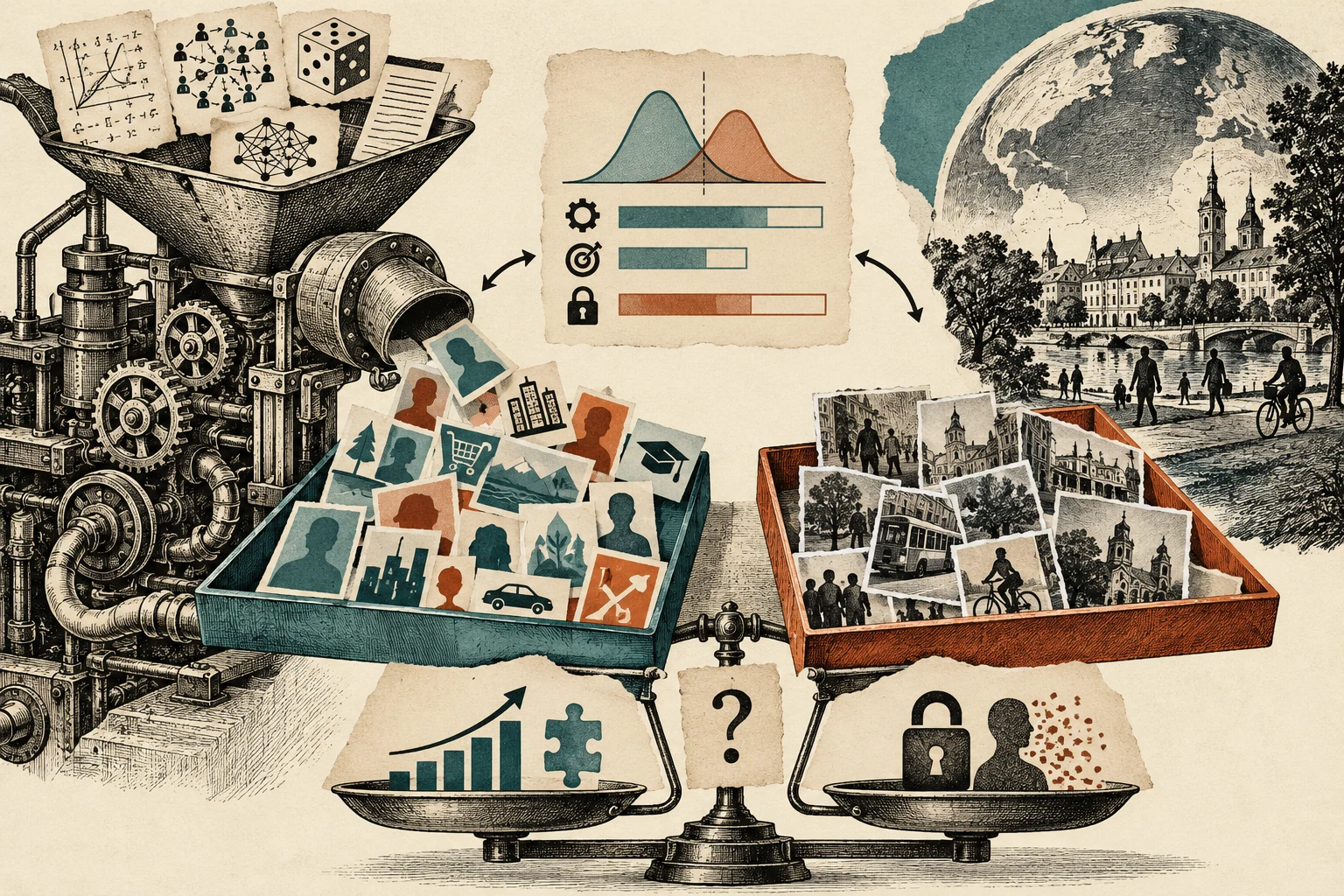
A simulator generates training examples whose quality and coverage are checked against real observations; synthetic origin guarantees neither representativeness nor privacy.
AI-assisted illustration · conceptual metaphor View in visual quiz →Genesis and Global Lineage
The concept grew out of two parallel traditions that merged only after 2015. The first is official statistics and census disclosure control: in a landmark 1993 issue of the Journal of Official Statistics, Donald B. Rubin proposed that instead of releasing stripped-down census microdata that could still be re-identified, statistical agencies should treat non-sampled citizens as missing data and release fully synthetic microdata generated via multiple imputation; in the same issue, Roderick J. A. Little formulated the partially synthetic variant. Developed further by Trivellore Raghunathan, Jerome Reiter, and Jörg Drechsler, this lineage gave rise to synthetic public-use census files and clinical registries, always motivated by disclosure limitation rather than data scarcity. The second source is machine learning and computer vision: data augmentation, 3D physics simulators for robotics and autonomous driving, and—after 2014—Generative Adversarial Networks (GANs), variational autoencoders, diffusion models, and LLMs, which made sampling realistic high-dimensional records routine. The 2022 Royal Society report by James Jordon, Łukasz Szpruch, and coauthors (Synthetic Data – what, why and how?), which serves as our canonical source, unifies both traditions under a single definition while issuing a sharp warning against commercial hype: vendor slogans selling synthetic data as instant “privacy by design” conflate the absence of real row identifiers with genuine mathematical privacy.
Central European Lineage
An important mathematical anticipation of this principle leads back to interwar Central Europe through Stanisław Ulam (and alongside him, Budapest-born John von Neumann). In defining synthetic data, the canonical Royal Society report by Jordon, Szpruch (himself a Polish mathematician working in Edinburgh and at the Alan Turing Institute), and coauthors explicitly traces the idea of computer-generated data “at least” back to Ulam and von Neumann’s invention of the Monte Carlo method in the late 1940s—the insight that a physical or statistical system too complex for closed-form calculation can be studied by drawing artificial random samples from a formal model on a computer. Ulam received his entire mathematical formation in interwar Lwów (then Poland, now Lviv, Ukraine): he studied at Lwów Polytechnic (Politechnika Lwowska), defended his doctorate there in 1933 under Kazimierz Kuratowski, and was a central figure in the Lwów School of Mathematics gathered around Stefan Banach and the Scottish Café (Kawiarnia Szkocka) before leaving Poland in August 1939. While the Monte Carlo method itself was formulated at Los Alamos (conceived in 1946 and published by Nicholas Metropolis and Ulam in 1949) to model neutron diffusion rather than to protect personal data, the canonical literature on synthetic data explicitly recognizes it as the conceptual ancestor of replacing costly empirical observation with controlled simulation.
Documented regional lineage · Link: 1. Compiled: October 2026.
-
anticipation 73 years
Central European Source: Stanisław Ulam, “Metoda Monte Carlo (Los Alamos 1946; publikacja z Nicholasem Metropolisem w „Journal of the American Statistical Association” 1949) — wcześniej doktorat na Politechnice Lwowskiej (1933) pod kierunkiem Kazimierza Kuratowskiego”; Lwów, Poland (now Lviv, Ukraine); Los Alamos, New Mexico, USA, 1949
Global Circulation: synthetic data as data generated by a mathematical model to solve a data-science task — James Jordon, Łukasz Szpruch i in. (raport dla Royal Society), 2022
anticipation
73 yearsStanisław Ulam, “Metoda Monte Carlo (Los Alamos 1946; publikacja z Nicholasem Metropolisem w „Journal of the American Statistical Association” 1949) — wcześniej doktorat na Politechnice Lwowskiej (1933) pod kierunkiem Kazimierza Kuratowskiego”
1949 · Lwów, Poland (now Lviv, Ukraine); Los Alamos, New Mexico, USA
synthetic data as data generated by a mathematical model to solve a data-science task
2022 · James Jordon, Łukasz Szpruch i in. (raport dla Royal Society)
- Claim & Connection
- The Royal Society report by Jordon, Szpruch, and coauthors—the canonical source for this entry—explicitly traces the idea of computer-generated data “at least” back to Stanisław Ulam and John von Neumann’s work on the Monte Carlo method in the 1940s. Ulam received his mathematical formation in interwar Lwów (earning his doctorate at Lwów Polytechnic in 1933 under Kazimierz Kuratowski within the Lwów School of Mathematics) before developing the Monte Carlo method at Los Alamos. This represents an early formulation of a kindred principle—sampling artificial observations from a formal model rather than collecting direct empirical measurements—rather than a direct technical influence on modern privacy-oriented synthetic datasets.
- Source Documentation
-
- reception / translation James Jordon, Lukasz Szpruch, Florimond Houssiau, Mirko Bottarelli, Giovanni Cherubin, Carsten Maple, Samuel N. Cohen, Adrian Weller, „Synthetic Data – what, why and how?”, raport dla Royal Society, arXiv:2205.03257, 6 maja 2022; p. 5, section “What is Synthetic Data?”: Definition 1 and the historical note on Ulam and von Neumann. arxiv.org ↗
- biographical record J. J. O’Connor, E. F. Robertson, „Stanisław Marcin Ulam”, MacTutor History of Mathematics Archive, University of St Andrews; paragraphs on studies at Lwów Polytechnic (doctorate 1933 under Kuratowski), departure in August 1939, and the Monte Carlo method (conceived 1946, published with Metropolis 1949). mathshistory.st-andrews.ac.uk ↗
- Historical Context
- The Monte Carlo method itself was formulated at Los Alamos; what belongs to Central Europe is Ulam’s mathematical formation in Lwów (and John von Neumann’s in Budapest). The link is an anticipation explicitly acknowledged by the canonical text rather than a direct methodological derivation.
Why Now
Three developments between 2018 and 2026 propelled synthetic data from a specialist statistical technique into the center of technology policy and AI engineering. First, data-protection regulation: the EU’s General Data Protection Regulation (GDPR, in force since May 2018) raised the legal cost of sharing personal data across hospital, banking, and telecom silos, creating a booming market for platforms promising synthetic datasets outside GDPR scope. That commercial wave triggered a decisive scientific pushback led by Theresa Stadler, Bristena Oprisanu, and Carmela Troncoso (Synthetic Data – Anonymisation Groundhog Day, USENIX Security 2022), who proved quantitatively that standard generative models either leak membership and attribute information about outlier records or destroy the statistical correlations analysts need. Second, the exhaustion of high-quality human text for frontier AI: as public web corpora reached saturation, AI labs turned heavily to training models on synthetic text, code, and reasoning traces generated by other models (distillation, self-play, synthetic instruction tuning)—a shift whose failure mode Ilia Shumailov and colleagues diagnosed in 2023–2024 as model collapse. Third, institutional adoption by the UK Office for National Statistics (ONS), the U.S. Census Bureau, and national health-data authorities brought the issue into administrative law, forcing regulators to decide when a synthetic registry can safely guide public policy.
Explanatory Power
The concept forces analysts to separate three questions that organizational practice routinely blurs: where a record came from, what valid inferences it supports, and whether an adversary can link it to a real person. First, it explains why “artificial” never automatically means “anonymous”: an overparameterized generative model fitted to a small clinical dataset can memorize rare patient profiles nearly verbatim, making the corporate assumption that synthetic data automatically escapes GDPR obligations an untested hypothesis. Second, it clarifies why systems trained on synthetic data perform well on typical cases while failing at the margins: a statistical generator reproduces the dense center of a distribution while smoothing away its heavy tails, where rare diseases, demographic minorities, and black-swan failures reside. Third, it exposes a feedback loop in the digital commons: model-generated text and images flood the open web, crawlers ingest them into the next training corpus, and subsequent models learn the stylistic priors of earlier generators rather than empirical reality.
Axes of Debate
Does synthetic data solve the privacy–utility trade-off?
Commercial vendors and some official-statistics practitioners argue that because a fully synthetic table has no one-to-one mapping to real individuals, it bypasses traditional re-identification attacks while preserving workflows. Security researchers (Stadler, Troncoso, Giovanni Cherubin) counter with membership-inference and shadow-model attacks showing that high-dimensional generators leak information about influential training records. Strongest counterargument: Privacy is a mathematical property of the generation algorithm, not of the output format; unless the generator is trained with a formal bound such as differential privacy, rare outlier records can be memorized, and once differential privacy is enforced, utility on fine-grained subgroup queries drops sharply. Nature of the dispute: substantive — both camps agree on formal metrics of leakage and utility, but clash over whether uncertified empirical generators provide acceptable protection in practice.
Can frontier models sustainably train on their own synthetic outputs?
Frontier AI labs increasingly rely on synthetic data—model-generated math solutions, code, and reasoning chains—as fuel for post-training and scaling once human web text runs dry. Researchers following Shumailov, Yarin Gal, and Ross Anderson warn that recursive training on generated outputs erases variance and collapses distribution tails (model collapse). Strongest counterargument: Catastrophic collapse occurs when models blindly replace real data with unfiltered synthetic samples; when outputs are strictly filtered by an external ground-truth verifier (a compiler, formal theorem prover, or physics simulator) and combined with real human data, synthetic generation acts as search amplification rather than recursive degradation. Nature of the dispute: mixed — the mathematical conditions for collapse versus verified self-improvement are a substantive research question, though corporate narratives are shaped by the need to reassure investors that the “data wall” can be breached.
Marginal distributional fidelity versus valid statistical inference
Machine-learning engineers benchmark synthetic datasets by checking whether low-dimensional marginals, pairwise correlations, or downstream classifier accuracy match the real dataset. Statisticians in the Rubin–Reiter school object that matching summary tables is insufficient: science requires that point estimates and confidence intervals computed on synthetic data cover true population parameters, which demands releasing multiple synthetic draws and applying explicit variance-combination rules. Strongest counterargument: A synthetic dataset can score near-perfectly on pre-selected fidelity metrics and still produce a spurious correlation on a novel hypothesis formulated tomorrow; utility is always relative to the class of queries the generator was designed to preserve. Nature of the dispute: substantive — reflecting a methodological divide between predictive engineering and inferential statistics.
Underappreciated Angle
Public and technical debates rarely confront the epistemic status of synthetic data as historical and scientific evidence. An empirical dataset—however noisy—is a causal trace of events in the world independent of the investigator’s theory; a synthetic dataset is the deductive output of a model dressed in the tabular or visual format of an observation. When synthetic records enter a clinical archive, economic benchmark, or administrative proceeding without indelible provenance metadata, the evidentiary chain silently flips: an artifact in the data is no longer a measurement error correctable by inspecting the instrument, but a theoretical assumption baked into the generator masquerading as empirical confirmation of itself. Just as a facsimile reconstructed from a model of a lost manuscript is not a primary source, the most important institutional norm for the synthetic era may be mandatory, machine-readable provenance tagging that prevents model projections from being mistaken for fresh observations of reality.
One-Sentence Takeaway
A synthetic dataset is not a record of the world, but a model’s opinion about the world written in the format of data—and every conclusion drawn from it inherits both the generator’s blind spots at the margins and its hidden memory of the real people it was meant to conceal.
Related Concepts Network
How this concept reinforces, constrains, or complements other analytical frameworks in the corpus. View on graph →
-
Privacy-preserving machine learning complements
Synthetic data is widely promoted as a privacy-preserving technique, but offers no mathematical privacy guarantee on its own; rigorous protection requires combining the generator with differential privacy.
-
Model collapse in tension
Training successive generations of models on uncurated model-generated data erodes the tails of the distribution, placing a hard ceiling on naive synthetic-data scaling.
-
Data provenance complements
Without a verifiable record of which rows are empirical observations and which were sampled from which generator, neither the privacy risk nor the statistical validity of a dataset can be assessed.
-
Deepfake in tension
The exact same class of generative architectures produces synthetic training sets for research and synthetic media for deception; the difference lies in intent, labeling, and governance rather than mechanism.
-
The map is not the territory constrains
A synthetic dataset is a map drawn by a statistical model on the basis of an earlier map; every downstream inference inherits the smoothing and structural blind spots of the generator.
-
Generative AI reinforces
Modern generative models (GANs, VAEs, diffusion models, LLMs) supplied the high-dimensional generators that turned synthetic data from a niche census-imputation technique into an industrial default.
-
Datafication complements
Where collecting real human behavioral data hits legal, ethical, or physical limits, synthetic data enables organizations to continue scaling data-driven pipelines without new empirical observations.
Reading Canon & Translation Bridge
Foundational texts, introductions, and critical perspectives—with availability of English and Polish editions.
-
foundational text 2022 · English
James Jordon, Lukasz Szpruch, Florimond Houssiau, Mirko Bottarelli, Giovanni Cherubin, Carsten Maple, Samuel N. Cohen, Adrian Weller, Synthetic Data – what, why and how?
A report commissioned by the Royal Society and the Alan Turing Institute: provides the canonical working definition, a taxonomy of use cases (privacy, fairness/debiasing, augmentation), and sober warnings that synthetic data is neither automatically private nor a drop-in replacement for real data.
In English: original text written in English
In Polish: no Polish edition
-
foundational text 1993 · English
Donald B. Rubin, Discussion: Statistical Disclosure Limitation
A seminal discussion paper in the “Journal of Official Statistics” (9/2, pp. 461–468) proposing that statistical agencies release fully synthetic microdata generated via multiple imputation instead of actual census records.
In English: original text written in English
In Polish: no Polish edition
-
foundational text 1993 · English
Roderick J. A. Little, Statistical Analysis of Masked Data
Published in the same issue of the “Journal of Official Statistics” (9/2, pp. 407–426), introducing partially synthetic data: replacing only sensitive or identifying variables in public-use files with imputed draws.
In English: original text written in English
In Polish: no Polish edition
-
critical perspective 2022 · English
Theresa Stadler, Bristena Oprisanu, Carmela Troncoso, Synthetic Data – Anonymisation Groundhog Day
The first rigorous quantitative evaluation of the privacy gain from publishing synthetic tabular data (USENIX Security 2022, pp. 1451–1468): shows that standard generators either fail to protect against membership and attribute inference attacks or destroy utility, with an unpredictable trade-off.
In English: original text written in English
In Polish: no Polish edition
-
critical perspective 2023 · English
Ilia Shumailov, Zakhar Shumaylov, Yiren Zhao, Yarin Gal, Nicolas Papernot, Ross Anderson, The Curse of Recursion: Training on Generated Data Makes Models Forget
The May 2023 arXiv preprint (expanded in “Nature” in 2024) demonstrating across VAEs, Gaussian mixtures, and LLMs that recursive training on synthetic outputs truncates distribution tails and triggers model collapse.
In English: original text written in English
In Polish: no Polish edition
-
introduction & synthesis 2011 · English
Jörg Drechsler, Synthetic Datasets for Statistical Disclosure Control: Theory and Implementation
A comprehensive monograph in the Rubin–Reiter official-statistics tradition (Springer, Lecture Notes in Statistics), systematizing fully and partially synthetic datasets alongside variance-estimation rules for combining multiple synthetic draws.
In English: original text written in English
In Polish: no Polish edition
-
cross-disciplinary 1949 · English
Nicholas Metropolis, Stanisław Ulam, The Monte Carlo Method
A six-page classic in the “Journal of the American Statistical Association” (44/247) where generating artificial random samples from a formal model is first articulated as a general method for studying systems too complex for closed-form analysis.
In English: original text written in English
In Polish: Polish edition not verified
-
cross-disciplinary 2019 · English
Steven M. Bellovin, Preetam K. Dutta, Nathan Reitinger, Privacy and Synthetic Datasets
A legal analysis in the “Stanford Technology Law Review” examining whether synthetic datasets satisfy statutory definitions of anonymization under US and European privacy law.
In English: original text written in English
In Polish: no Polish edition
Primary-Source Quotes
Synthetic data is data that has been generated using a purpose-built mathematical model or algorithm, with the aim of solving a (set of) data science task(s).
Synthetic data is not automatically private. A common misconception with synthetic data is that it is inherently private. This is not the case.