AI Architecture #123
Model cards
original term: model cards (Eng.) · karty modeli, karta modelu, model reporting
Global-circulation concept — no documented lineage in Central Europe. jump to documentation ↓
Working Definition
A model card is a short, standardized document accompanying a trained machine learning model that specifies what the model is intended to be used for (and what uses are out of scope), on which datasets and metrics it was evaluated, and how its performance varies across demographic groups and operating conditions. In the technical formulation of Margaret Mitchell and her coauthors, the core requirement is disaggregated evaluation—revealing how error rates differ across intersections of age, gender, skin tone, or dialect rather than reporting a single aggregate benchmark score. In everyday repository practice, “model card” now refers to the default README.md file attached to any model uploaded to platforms like Hugging Face, often auto-generated and stripped of its limitations sections. The tension between that original audit specification and its watered-down platform ubiquity defines most contemporary debates around the concept.
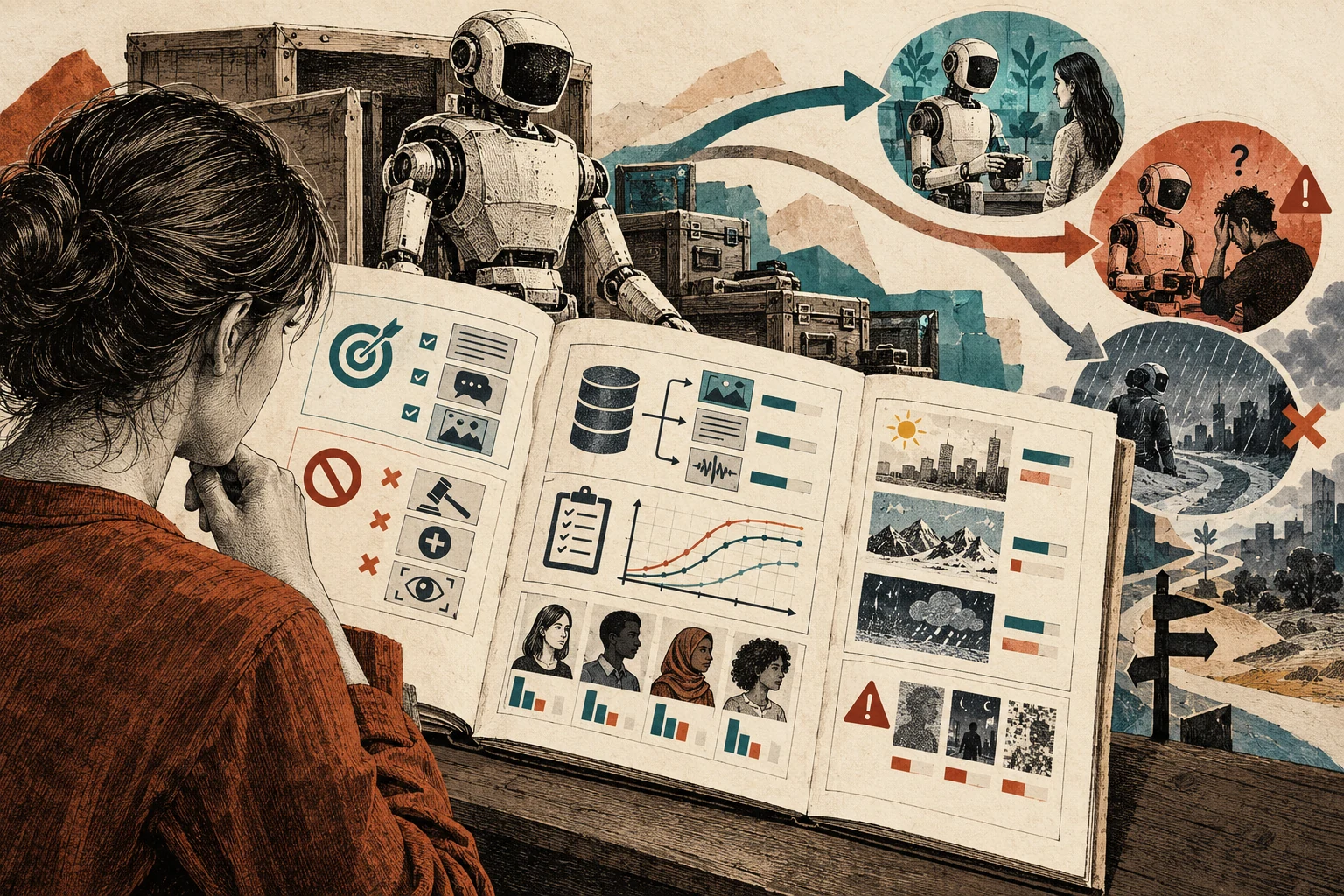
Documentation outlines intended uses, benchmark results, and limitations, helping assess suitability without serving as a blanket certificate of safety.
AI-assisted illustration · conceptual metaphor View in visual quiz →Genesis and Global Lineage
The concept was formulated by a research team at Google (Margaret Mitchell, Simone Wu, Andrew Zaldivar, Parker Barnes, Lucy Vasserman, Ben Hutchinson, Elena Spitzer, Inioluwa Deborah Raji, and Timnit Gebru) in an October 2018 preprint presented at the FAT* (Fairness, Accountability, and Transparency) conference in Atlanta in January 2019. The paper belonged to the first wave of algorithmic-accountability research inspired by Joy Buolamwini and Timnit Gebru’s Gender Shades audit (2018) of commercial facial-analysis systems and by a practical engineering question: why do machine learning models released “for general use” get deployed in high-stakes clinical, legal, or policing settings where nobody has tested their failure modes? Its direct companion was Datasheets for Datasets (Gebru et al., March 2018), which imported the hardware engineering practice of component specification sheets into dataset curation; the model card is its counterpart at the level of the trained artifact. The authors deliberately designed a compact, one-to-two-page format with fixed headings, illustrated with two prototype cards: one for a computer-vision smile detector and one for a text-toxicity classifier. From 2020 onward, the term migrated into two very different institutional orbits: Hugging Face made the model card the default landing page of every model repository, while frontier AI laboratories began publishing sprawling, hundred-page “system cards” (GPT-4 System Card, Claude System Card). In both settings the label survived, even as its function shifted dramatically.
Central European Lineage
We found no documented link between this concept and the intellectual history or historical experience of Central Europe.
We found no documented link between this concept and the intellectual history or historical experience of Central Europe (by our methodology, this means “none found,” not “none exists”; as of October 2026).
Why Now
Three sequences of events between 2020 and 2026 turned model cards from a benign best practice into a contested political and regulatory instrument. First was the conflict inside Google in late 2020 and early 2021 over the “Stochastic Parrots” paper, which culminated in the dismissals of Timnit Gebru and Margaret Mitchell—the two principal architects of model cards—making model documentation a flashpoint over corporate control of AI ethics research. Second was the pivot toward industrial secrecy around frontier foundation models: when OpenAI released the GPT-4 Technical Report and accompanying System Card in March 2023, it disclosed neither model size, architectural details, hardware compute, nor training-data composition, while offering dozens of pages of red-teaming narratives and safety mitigations. A genre invented to enforce transparency began functioning to frame what remained hidden. Third was hard law: Annex IV of the European Union’s AI Act (2024) codified mandatory technical documentation for high-risk AI systems (intended purpose, training data provenance, evaluation metrics, known limitations, and foreseeable misuse)—effectively turning an expanded model card into a statutory compliance requirement backed by fines. Meanwhile, empirical reality lagged behind legal ambition: a 2024 Stanford study by Weixin Liang and colleagues analyzing roughly 32,000 model cards on Hugging Face revealed that the sections on limitations, evaluation details, and environmental impact are the least frequently filled out—precisely the sections for which the format was invented.
Explanatory Power
The concept makes visible that a machine learning model is never just a mathematical file of weights, but an artifact bundled with a set of institutional claims about where it works. Without a card, a model appears to be a universal function; with a card, it becomes clear that a smile detector trained on celebrity photographs has a very different false-negative rate on older adults or darker skin tones, so a headline claim of “94% accuracy” is actually a statement about a specific reference population rather than an intrinsic property of the code. This lens has three concrete uses. First, in public procurement and hospital deployment, requiring a model card forces vendors to report performance disaggregated for the specific demographic population the institution actually serves, rather than citing a leaderboard average. Second, in the debate over “open-weight” models, the model-card framework exposes why releasing raw weight files without training-data datasheets and disaggregated evaluation protocols is openness of the executable binary, not openness of scientific knowledge. Third, when a frontier laboratory publishes a system card, reading its table of contents as a diagnostic map reveals which risks the company treats as quantitatively measurable and which ones it relegates to qualitative prose disclaimers.
Axes of Debate
Documentation as accountability versus documentation as compliance alibi
Algorithmic-auditing researchers—including several coauthors of the original paper in Closing the AI Accountability Gap (Raji et al., 2020)—emphasize that a model card is merely a reporting surface: without an internal governance process empowered to halt deployment when subgroup error rates fail a threshold, filling out a card becomes a ritual of performative transparency. Sociologists of technology add that voluntary self-documentation allows firms to claim ethical diligence at negligible cost. Strongest counterargument: Even an incomplete or self-serving model card creates an auditable paper trail on the record; without a standardized document, regulators, journalists, and litigants cannot even establish whether a developer knew about a limitation prior to deployment. Low-friction standardization is a precondition for external scrutiny. Nature of the dispute: substantive — whether mandatory disclosure without an external enforcement gate alters engineering behavior is an empirical institutional question.
Compact comparable template versus sprawling frontier “system card”
Mitchell and her coauthors designed a concise one-to-two-page specification so that practitioners could compare competing models side by side across standardized subgroup tables. Frontier AI labs have replaced this with 50-to-150-page “system cards” describing an entire deployed product stack (guardrails, classifiers, red-teaming transcripts, usage policies), arguing that a general-purpose foundation model has no single “intended use” or fixed demographic error table that fits into a static two-page grid. Strongest counterargument: A bespoke system card whose structure, benchmarks, and red-teaming prompts are selected entirely by the vendor cannot be compared against any competitor’s card and cannot be independently reproduced; its page count expanded at the exact historical moment when disclosures about training data and architecture disappeared, substituting volume for verifiable transparency. Nature of the dispute: mixed — general-purpose systems genuinely pose multi-task evaluation challenges, but the “no single intended use” argument is also deployed rhetorically to evade concrete performance commitments.
Voluntary research norm versus statutory legal mandate
European regulators (under AI Act Annex IV and the GPAI transparency provisions) and civil-society advocates argue that documentation must be legally mandated with fixed schemas, because voluntary repository culture leaves critical safety and bias fields blank. Segments of the open-source ML community counter that heavy statutory documentation requirements favor incumbent tech giants with dedicated compliance departments and deter academic groups and independent developers from sharing weights. Strongest counterargument: Liang et al.’s analysis of 32,000 Hugging Face cards proves that under purely voluntary norms, limitations and bias sections are systematically omitted; the cost of writing honest evaluation notes is minuscule compared to the compute cost of training a model, so the real barrier is reluctance to disclose flaws rather than administrative burden. Nature of the dispute: substantive — the disagreement concerns the institutional distribution of compliance costs across ecosystem actors rather than the value of documentation itself.
Underappreciated Angle
A model card is a literary genre, and like every genre it carries an implicit assumption about who its reader is. Mitchell and her coauthors designed the original template to address three distinct audiences simultaneously: machine-learning researchers, downstream engineers integrating the model, and affected citizens or policymakers evaluating its societal impact. In actual repository practice, model cards are read almost exclusively by other ML engineers looking for copy-pasteable invocation code—and, increasingly, by automated scripts parsing YAML metadata headers. As a result, the “intended use and limitations” prose is written for an audience that rarely visits a code repository, while the technical metrics table is read by developers who only want to know if the weights fit in GPU memory. This audience mismatch explains why ethical reflection fields decay into boilerplate: nobody reading the file in daily workflow rewards the author for filling them out. It also raises a design question that the technical literature rarely asks: whether model documentation should be formally split into distinct registers for distinct publics—much as pharmaceutical regulation separates the clinical Summary of Product Characteristics for physicians from the plain-language Package Leaflet for patients—rather than pretending that a single markdown file can serve both as an engineering README and as a public accountability charter.
One-Sentence Takeaway
A model card does not explain how a neural network works internally, but marks the boundary of where its creator has agreed to be held accountable for how it performs—which is why the most revealing part of any card is what it leaves blank.
Related Concepts Network
How this concept reinforces, constrains, or complements other analytical frameworks in the corpus. View on graph →
-
Data provenance complements
A model card describes the finished artifact, whereas data provenance traces the supply chain that produced it; without the latter, the “training data” section of a model card is an empty declaration.
-
Algorithmic bias reinforces
Disaggregating performance metrics across demographic and phenotypic subgroups in a model card is an instrument for exposing unequal accuracy, though not in itself for eliminating it.
-
Explainable AI (XAI) complements
A model card explains the boundary conditions and intended scope of a system rather than the internal mechanism of an individual prediction; the two forms of transparency answer different questions.
-
Red teaming complements
Adversarial testing results increasingly populate the “system cards” of frontier models, turning the card from a benchmark summary into a safety-audit protocol.
-
AI governance reinforces
Standardized model documentation is the cheapest and most widely adopted regulatory instrument because it requires verifying whether promised disclosures were made rather than inspecting model weights.
-
Goodhart’s law in tension
Once filling out a model card becomes a checkbox for repository publication or legal compliance, template completion begins to displace the substantive disaggregated evaluation it was meant to record.
-
Synthetic data in tension
Models trained or fine-tuned on outputs generated by other models inherit their undocumented blind spots in ways that standard single-artifact model cards fail to capture.
Reading Canon & Translation Bridge
Foundational texts, introductions, and critical perspectives—with availability of English and Polish editions.
-
foundational text 2019 · English
Margaret Mitchell, Simone Wu, Andrew Zaldivar, Parker Barnes, Lucy Vasserman, Ben Hutchinson, Elena Spitzer, Inioluwa Deborah Raji, Timnit Gebru, Model Cards for Model Reporting
The foundational paper from FAT* 2019 (arXiv preprint October 2018): proposes a short structured document detailing intended use, evaluation metrics, evaluation data, and disaggregated performance across subgroups, illustrated with two prototype cards for smile detection and comment toxicity.
In English: original text written in English
In Polish: no Polish edition
-
foundational text 2018 · English
Timnit Gebru, Jamie Morgenstern, Briana Vecchione, Jennifer Wortman Vaughan, Hanna Wallach, Hal Daumé III, Kate Crawford, Datasheets for Datasets
The dataset-side twin published six months earlier (arXiv March 2018; “Communications of the ACM” December 2021), borrowing the metaphor of component datasheets from electronics hardware.
In English: original text written in English
In Polish: no Polish edition
-
critical perspective 2020 · English
Inioluwa Deborah Raji, Andrew Smart, Rebecca N. White, Margaret Mitchell, Timnit Gebru, Ben Hutchinson, Jamila Smith-Loud, Daniel Theron, Parker Barnes, Closing the AI Accountability Gap: Defining an End-to-End Framework for Internal Algorithmic Auditing
The original authors of model cards demonstrate why a card alone is insufficient: it is only one final artifact within an end-to-end internal audit process that must include scoping, risk analysis, testing, and a binding go/no-go deployment gate.
In English: original text written in English
In Polish: no Polish edition
-
critical perspective 2024 · English
Weixin Liang, Nazneen Rajani, Xinyu Yang, Ezinwanne Ozoani, Eric Wu, Yiqun Chen, Daniel Scott Smith, James Zou, What's documented in AI? Systematic Analysis of 32K AI Model Cards
A large-scale empirical study of roughly 32,000 model cards on Hugging Face: sections on limitations, evaluation data, and environmental impact are the least frequently completed, exposing the gap between template design and everyday practice.
In English: original text written in English
In Polish: no Polish edition
-
introduction & synthesis 2021 · English
Ben Hutchinson, Andrew Smart, Alex Hanna, Emily Denton, Christina Greer, Oddur Kjartansson, Parker Barnes, Margaret Mitchell, Towards Accountability for Machine Learning Datasets: Practices from Software Engineering and Infrastructure
Extends documentation from a one-off static form to the full lifecycle of datasets and models by drawing on software-engineering engineering artifacts (requirements, design docs, testing logs).
In English: original text written in English
In Polish: no Polish edition
-
cross-disciplinary 2021 · English
Emily M. Bender, Timnit Gebru, Angelina McMillan-Major, Shmargaret Shmitchell, On the Dangers of Stochastic Parrots: Can Language Models Be Too Big?
The paper whose internal review dispute led to the departure of Gebru and Mitchell from Google; argues that documenting training corpora and their curation is a baseline obligation rather than an optional nice-to-have.
In English: original text written in English
In Polish: Polish edition not verified
-
cross-disciplinary 2021 · English
Kate Crawford, Atlas of AI: Power, Politics, and the Planetary Costs of Artificial Intelligence
A coauthor of “Datasheets for Datasets” shows what no technical specification sheet can capture: the mineral extraction, planetary energy, and hidden human labor behind AI systems, countering the illusion that documentation exhausts accountability.
In English: original text written in English
In Polish: “Atlas sztucznej inteligencji. Władza, pieniądze i środowisko naturalne”, Wydawnictwo Uniwersytetu Jagiellońskiego (Bo.wiem) 2024, trans. Tadeusz Chawziuk
Primary-Source Quotes
Model cards are short documents accompanying trained machine learning models that provide benchmarked evaluation in a variety of conditions, such as across different cultural, demographic, or phenotypic groups [...].