Epistemology #009
The map is not the territory
original term: the map is not the territory (Eng.) · mapa nie jest terytorium, relacja mapa–terytorium, model to nie rzeczywistość
Central European lineage: 1 thread (author from the region) · 1931–1933 · jump to documentation ↓
Working Definition
“The map is not the territory” is a foundational rule of cognitive hygiene: every representation—whether a cartographic map, a mathematical model, a diagnostic category, a key performance indicator, or a verbal description—is a selective abstraction from what it represents and must never be confused with the thing itself. In everyday conversation the phrase is often invoked simply to shrug off a flawed model (“it's only a model”); in Alfred Korzybski's technical formulation, however, it has an equally important second half: a map is useful precisely to the extent that it shares a similar structure (an order of relations) with the territory, which means maps can be empirically tested, revised, and dated. Operationally, before relying on any model to make a decision, one should state explicitly what features of the territory were left off the map, who drew it and when, and what observation from the ground would prove the map wrong.
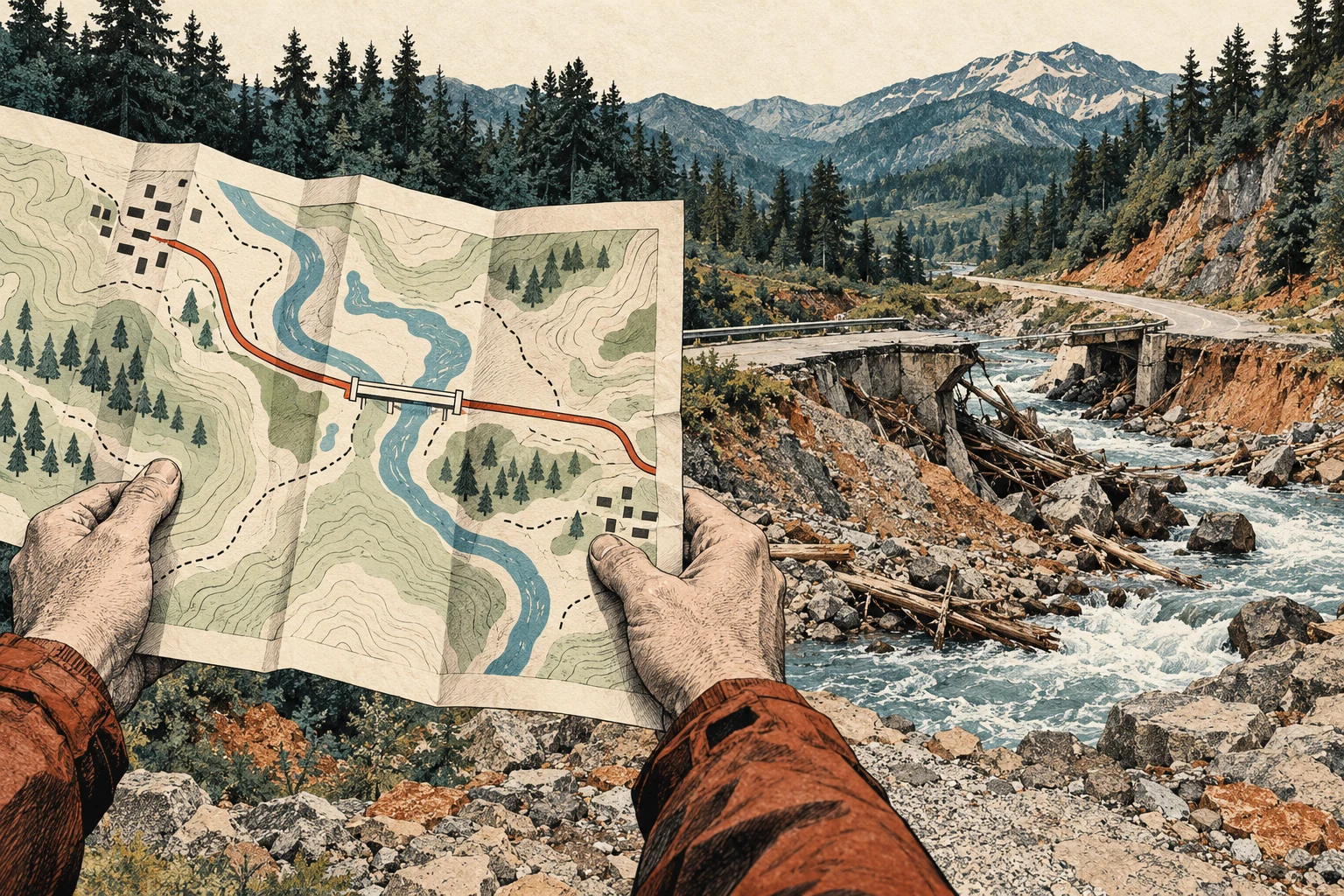
An orderly map omits many properties of the actual landscape. A model helps us navigate, but it does not replace contact with the terrain.
AI-assisted illustration · conceptual metaphor View in visual quiz →Genesis and Global Lineage
The maxim was coined by Alfred Korzybski in his paper “A Non-Aristotelian System and Its Necessity for Rigour in Mathematics and Physics,” delivered on 28 December 1931 at the AAAS meeting in New Orleans, and elaborated in Science and Sanity (1933, p. 58, pp. 747–761), where he also credited mathematician Eric Temple Bell (“the map is not the thing mapped”). In Korzybski's system the metaphor anchors three “non-Aristotelian premises”: non-identity (the word is not the thing; the map is not the territory), non-allness (the map does not represent all of the territory), and self-reflexiveness (an ideal map of a territory that included the mapmaker would have to contain a map of the map, without end). Institutionalized through the Institute of General Semantics (1938) and popularized by S. I. Hayakawa's Language in Thought and Action (1949), the aphorism gained a second life in 1970 when Gregory Bateson delivered his Korzybski Memorial Lecture “Form, Substance, and Difference” (reprinted in Steps to an Ecology of Mind, 1972), arguing that “the territory never gets in at all” and that mental maps encode only difference. Through Bateson the phrase entered systems therapy, cognitive science, and the rationalist community (Eliezer Yudkowsky's Map and Territory). Literature supplied twin parables in Lewis Carroll's Sylvie and Bruno Concluded (1893) and Jorge Luis Borges's “On Exactitude in Science” (1946), while statistician George E. P. Box provided its quantitative cousin in 1976: “All models are wrong, but some are useful.”
Central European Lineage
The author of the maxim was born and intellectually formed in Warsaw. Born in 1879 into an aristocratic Polish family under Russian partition, Alfred Habdank Skarżyński Korzybski attended a Warsaw Realschule (a technical secondary school without Greek or Latin), studied chemical engineering at the Warsaw Polytechnic Institute (Warszawski Instytut Politechniczny, predecessor of today's Warsaw University of Technology), and taught mathematics, physics, French, and German in a Warsaw gymnasium. Growing up quadrilingual in Polish, Russian, French, and German—and learning English only after being sent to North America in December 1915 as an artillery inspector for the Imperial Russian Army—gave him an acute, lived awareness that different languages carve up the same reality along different joints, which biographers such as Lance Strate and Bruce Kodish link directly to his insistence that the word is not the thing. Warsaw also shaped the naming of his discipline: according to his collaborator Charlotte Schuchardt Read (1968), after finishing the first draft of Science and Sanity Korzybski traveled to Warsaw in September 1929 for the first Congress of Mathematicians of Slavic Countries, where encounters with Polish logicians and the semantic theory of Leon Chwistek prompted him by 1931 to rename his “general theory of time-binding” as general semantics.
Documented regional lineage · Link: 1. Compiled: October 2026.
-
author from the region 2 years
Central European Source: Alfred Korzybski, “A Non-Aristotelian System and Its Necessity for Rigour in Mathematics and Physics (referat na zjeździe AAAS w Nowym Orleanie, 28 grudnia 1931; przedruk jako Suplement III „Science and Sanity”)”; Warsaw, Russian Empire (now Poland), 1931
Global Circulation: the map is not the territory — Alfred Korzybski, 1933
author from the region
2 yearsAlfred Korzybski, “A Non-Aristotelian System and Its Necessity for Rigour in Mathematics and Physics (referat na zjeździe AAAS w Nowym Orleanie, 28 grudnia 1931; przedruk jako Suplement III „Science and Sanity”)”
1931 · Warsaw, Russian Empire (now Poland)
the map is not the territory
1933 · Alfred Korzybski
- Claim & Connection
- Korzybski was born (1879) and educated in Warsaw: at the urging of his engineer father he studied chemical engineering at the Warsaw Polytechnic Institute and later taught mathematics, physics, French, and German in a Warsaw secondary school; raised in four languages, he learned English only after arriving in North America in December 1915. He formulated the maxim about the map in English in his 1931 AAAS paper and in Science and Sanity (1933). According to his collaborator Charlotte Schuchardt Read, after completing the first draft of his book he attended the Congress of Mathematicians of Slavic Countries in Warsaw in September 1929, where he was deeply impressed by the semantic school of Leon Chwistek and the Polish logicians; by 1931 he renamed his “general theory of time-binding” as “general semantics.”
- Source Documentation
-
- biographical record Lance Strate, „Between Two Worlds: Alfred Korzybski and General Semantics”, Organon 42 (2010), s. 5–24; p. 5: born in Warsaw, engineering studies at Warsaw Polytechnic Institute, courses in Rome, languages; pp. 13–14: principle of non-identity and the map metaphor; p. 23: influence on Bateson and cybernetics. ihnpan.pl ↗
- biographical record Charlotte Schuchardt Read, „Alfred Korzybski: His Contributions and Their Historical Development”, The Polish Review, Vol. XIII, No. 2, Spring 1968; przedruk w General Semantics Bulletin 35, s. 54–58; p. 54: Polytechnic Institute in Warsaw, Realschule without Greek or Latin, four languages, teaching in a Warsaw gymnasium, departure for Canada and the USA in December 1915; pp. 56–57: Congress of Mathematicians of Slavic Countries in Warsaw (September 1929), Chwistek's school, the name “general semantics” (1931). time-binding.org ↗
- biographical record Institute of General Semantics, „Alfred Korzybski” (nota biograficzna na podstawie szkicu Charlotte Schuchardt Read); paragraphs on birth in Warsaw on 3 July 1879, chemical engineering training at the Polytechnic Institute in Warsaw, and the four languages of his childhood. generalsemantics.org ↗
- scholarly study Wikipedia (en), hasło „Map–territory relation”; section on Korzybski: AAAS paper in New Orleans, reprinted in Science and Sanity pp. 747–761; sentence on the map and similar structure on p. 58; reference to E. T. Bell (Numerology, 1933, p. 138). en.wikipedia.org ↗
- reception / translation Gregory Bateson, „Form, Substance, and Difference”, Nineteenth Annual Alfred Korzybski Memorial Lecture, Harvard Club, Nowy Jork, 9 stycznia 1970, General Semantics Bulletin 37 (1970), s. 5–13; przedruk w Steps to an Ecology of Mind (1972); p. 5: lecture opens with Korzybski's statement on the map; p. 6: what gets onto the map is difference; p. 8: the territory never gets in at all, maps of maps. time-binding.org ↗
- Historical Context
- Both sides refer to the same author (1931: first presentation of the paper; 1933: book publication). While we found no evidence that Polish logic directly inspired the map metaphor itself, Read's account documents the influence of the 1929 Warsaw congress and Leon Chwistek's school on the name “general semantics.”
Why Now
Between 2018 and 2026 three shifts made Korzybski's rule an urgent diagnostic tool. First, the COVID-19 pandemic thrust epidemiological models into daily politics: Imperial College London's Report 9 (March 2020) reshaped lockdown policies overnight, exposing how easily policymakers and citizens mistook conditional scenario projections (maps) for unconditional prophecies (the territory). Second, large language models reignited debates over whether neural networks build coherent “world models”: while Kenneth Li et al. (2023) found that a transformer trained on Othello moves developed a board representation, Keyon Vafa et al. demonstrated at NeurIPS 2024 that a model trained to give turn-by-turn Manhattan driving directions with near-perfect accuracy relied internally on an incoherent map of non-existent streets and impossible flyovers—showing that fluent navigation output does not guarantee a faithful map. Third, the spread of institutional metrics—ESG scores, university rankings, “digital twins,” and synthetic training data—has multiplied settings where bureaucracies govern the map while losing contact with the terrain underneath.
Explanatory Power
The concept distinguishes three failure modes that ordinary talk blurs into “the model failed”: structural error (the map gets relationships wrong), scale error (the map omits a feature decisive for the task), and identification error (treating the representation as reality itself). In the 2008 financial crisis, Gaussian copula models of mortgage default risk were an adequate map of calm credit markets, but a catastrophic scale error once housing prices fell nationwide and correlations jumped toward one—and risk managers committed an identification error by treating AAA ratings as a physical property of the loans. In education and healthcare, when test scores or wait-time indicators become punitive targets, schools and clinics optimize the map while instruction and care deteriorate on the ground (Goodhart's law). And in psychiatry, where Korzybski studied patients under William Alanson White at St. Elizabeths Hospital, a DSM label is a pragmatic map for treatment; equating a living person with their diagnostic code is the classic identification error.
Axes of Debate
Structural realism versus radical constructivism
Philosophers of science in the tradition of structural realism (John Worrall 1989, James Ladyman) read Korzybski's second clause literally: a good map is objective because it preserves the real relational structure of the territory, even if we never grasp the intrinsic “nature” of things in themselves. Constructivists and cyberneticians—from Gregory Bateson, who treated the territory as an unreachable Kantian Ding an sich, to Bruno Latour—reply that we never compare a map directly with raw, unmapped reality, only one map with another. Strongest counterargument: Without an independent territory capable of pushing back, it is impossible to explain why some maps fail catastrophically—why bridges collapse, airplanes stall, or drugs fail clinical trials; even Bateson concedes that the differences encoded on our mental maps originate from differences in the physical world. Nature of the dispute: substantive — it concerns the epistemological status of structural isomorphism and what it means to test a model against reality.
Cognitive hygiene versus quasi-therapeutic cult
Skeptics and analytic philosophers—most famously Martin Gardner in Fads and Fallacies in the Name of Science (1952/1957) and Max Black in Language and Philosophy (1949)—dismissed Korzybski's General Semantics movement as an overblown therapeutic sect promising to cure neuroticism and political folly merely by teaching people to add subscripts, dates, and quotation marks to their words. Strongest counterargument: Whatever the excesses of the mid-century movement, the core map–territory distinction proved its worth by being absorbed into cybernetics, cognitive psychology, systems engineering, and computer science; the validity of the heuristic does not depend on Korzybski's grander psychiatric claims. Nature of the dispute: mixed — substantive regarding the lack of clinical evidence for general-semantics therapy, rhetorical when critics use the movement's eccentricities to dismiss its conceptual tools.
Territory first versus Baudrillard's hyperreality
Jean Baudrillard opens Simulacra and Simulation (1981) by inverting Borges and Korzybski: in late-modern media and financial capitalism, "it is nevertheless the map that precedes the territory (precession of simulacra)," as opinion polls manufacture public opinion and credit ratings create solvency. Defenders of Korzybski and Box reply that performative feedback loops are a special case of social reflexivity that still runs up against biophysical and economic limits. Strongest counterargument: In highly reflexive social systems—financial derivatives, algorithmic feeds, macroeconomics—the “territory” consists largely of other actors' maps, making any clean separation between representation and reality circular. Nature of the dispute: mixed — substantive where sociologists and economists measure model performativity (Donald MacKenzie on Black–Scholes), rhetorical when stretched into the postmodern claim that reality has vanished.
Underappreciated Angle
In popular usage, “the map is not the territory” is often quoted in truncated form as an excuse for relativism: “it's just a model, everyone has their own map.” Korzybski's actual sentence in Science and Sanity (p. 58) says the opposite: “A map is not the territory it represents, but, if correct, it has a similar structure to the territory, which accounts for its usefulness.” The forgotten second half turns a skeptical shrug into a demanding program: maps differ in structural fidelity and can be audited and improved. Equally neglected is Korzybski's third premise—self-reflexiveness: because the mapmaker is part of the territory, every public map (an economic forecast, a pandemic projection, a hospital ranking) alters behavior in the territory the moment it is published. That is why Korzybski insisted on “extensional devices”—attaching an explicit date and index to our concepts ($\text{institution}{1933} \neq \text{institution}{2026}$)—to remind us that the territory keeps moving while our words stand still.
One-Sentence Takeaway
Korzybski's maxim does not excuse us from drawing maps—it obliges us to date them, sign them, and test them against the ground, because a map is worth exactly as much relational structure as it shares with what it represents.
Related Concepts Network
How this concept reinforces, constrains, or complements other analytical frameworks in the corpus. View on graph →
-
Goodhart’s law reinforces
A metric is a map; once it becomes a target, an institution starts optimizing the map instead of the territory and destroys the map's representational value.
-
Legibility reinforces
The state in James C. Scott's account governs through simplified maps of people and forests, and then uses coercion to reshape the territory to match its map.
-
Hyperreality in tension
Baudrillard inverts Korzybski's relation: in a culture of simulacra, the map precedes and generates the territory.
-
Epistemic humility reinforces
Remembering that every map is a selective projection drawn by someone, for a specific purpose, at a specific date is a practical discipline of epistemic humility.
-
Applied Bayesianism complements
Belief updating is the procedure of revising one's mental map under pressure from field observations, without ever pretending that the map has become the territory.
-
Model hallucinations complements
A large language model produces fluent maps without direct contact with the territory, shifting the risk of mistaking map for territory onto the human user.
-
Predictive processing complements
The brain as a generator of top-down world models continuously corrected by sensory prediction errors is the neurobiological version of Bateson's thesis that only differences make it onto the map.
Reading Canon & Translation Bridge
Foundational texts, introductions, and critical perspectives—with availability of English and Polish editions.
-
foundational text 1933 · English
Alfred Korzybski, Science and Sanity: An Introduction to Non-Aristotelian Systems and General Semantics
The primary source: the statement on the map and similar structure (p. 58) and the reprint of the 1931 New Orleans paper (pp. 747–761); a sprawling, idiosyncratic book best approached selectively via Selections from Science and Sanity.
In English: original text written in English
In Polish: no Polish edition
-
cross-disciplinary 1970 · English
Gregory Bateson, Form, Substance, and Difference
The Korzybski Memorial Lecture (General Semantics Bulletin 37; reprinted in Steps to an Ecology of Mind, 1972) that translated the maxim into cybernetics: what gets onto the map is difference, and the territory itself never enters the mind.
In English: original text written in English
In Polish: Polish edition not verified
-
critical perspective 1957 · English
Martin Gardner, Fads and Fallacies in the Name of Science
The chapter “General Semantics, Etc.” delivers the classic critique of Korzybski's movement as a quasi-therapeutic cult with more rhetorical ambition than empirical method (first published in 1952 as In the Name of Science).
In English: original text written in English
In Polish: “Pseudonauka i pseudouczeni”, Państwowe Wydawnictwo Naukowe 1966, trans. Bronisław Krzyżanowski, Włodzimierz Zonn
-
cross-disciplinary 1976 · English
George E. P. Box, Science and Statistics
The paper in Journal of the American Statistical Association (71/356, pp. 791–799) containing the maxim “all models are wrong”: the statistical counterpart to Korzybski, showing how to use an imperfect map parsimoniously and selectively.
In English: original text written in English
In Polish: no Polish edition
-
cross-disciplinary 1946 · Spanish
Jorge Luis Borges, Del rigor en la ciencia
The one-paragraph parable (“On Exactitude in Science”) of an empire whose cartographers drew a map on a scale of one to one; included in El hacedor (1960) and famously used by Baudrillard to open Simulacra and Simulation.
In English: English edition not verified
In Polish: “Twórca”, Czytelnik 1974, trans. Zofia Chądzyńska, Krystyna Rodowska
-
introduction & synthesis 2010 · English
Lance Strate, Between Two Worlds: Alfred Korzybski and General Semantics
A concise, sympathetic overview of Korzybski's Warsaw background and intellectual system in the Warsaw journal Organon (42/2010, pp. 5–24), tracing the reception of his three non-Aristotelian premises from Bateson to Baudrillard.
In English: original text written in English
In Polish: Polish edition not verified
-
introduction & synthesis 2011 · English
Bruce I. Kodish, Korzybski: A Biography
The only full-length biography (Extensional Publishing, Pasadena), drawing on archival letters and notes to reconstruct Korzybski's youth in Russian-ruled Warsaw and his path from artillery engineering to general semantics.
In English: original text written in English
In Polish: Polish edition not verified
-
introduction & synthesis 1949 · English
S. I. Hayakawa, Language in Thought and Action
The bestselling popularization of general semantics through which the map–territory maxim entered American college curricula and everyday English.
In English: original text written in English
In Polish: no Polish edition
Primary-Source Quotes
The territory never gets in at all.