Epistemology #028
Data provenance
original term: data provenance (Eng.) · pochodzenie danych, proweniencja danych, data lineage
Global-circulation concept — no documented lineage in Central Europe. jump to documentation ↓
Working Definition
Data provenance (closely related to data lineage in industrial data engineering) is the documented history of how a specific piece of data came to exist in its current form: from which primary sources it originated, through what sequence of transformations, aggregations, and cleanings it passed, and under which human or institutional agents' responsibility. In its formal computer-science sense (codified in the W3C PROV standard), provenance is a directed graph whose nodes are Entities (data artifacts), Activities (processing steps), and Agents (people, software, organizations), connected by causal and attributive edges such as wasGeneratedBy, wasDerivedFrom, and wasAttributedTo. In everyday parlance the word is often conflated with a simple “source citation,” which misses its core contribution: provenance is not just the initial address, but the entire auditable chain of custody and computation between raw capture and final output. Its diagnostic value lies in letting us interrogate the reliability of a single number, cell, or training token rather than taking an entire database on faith.
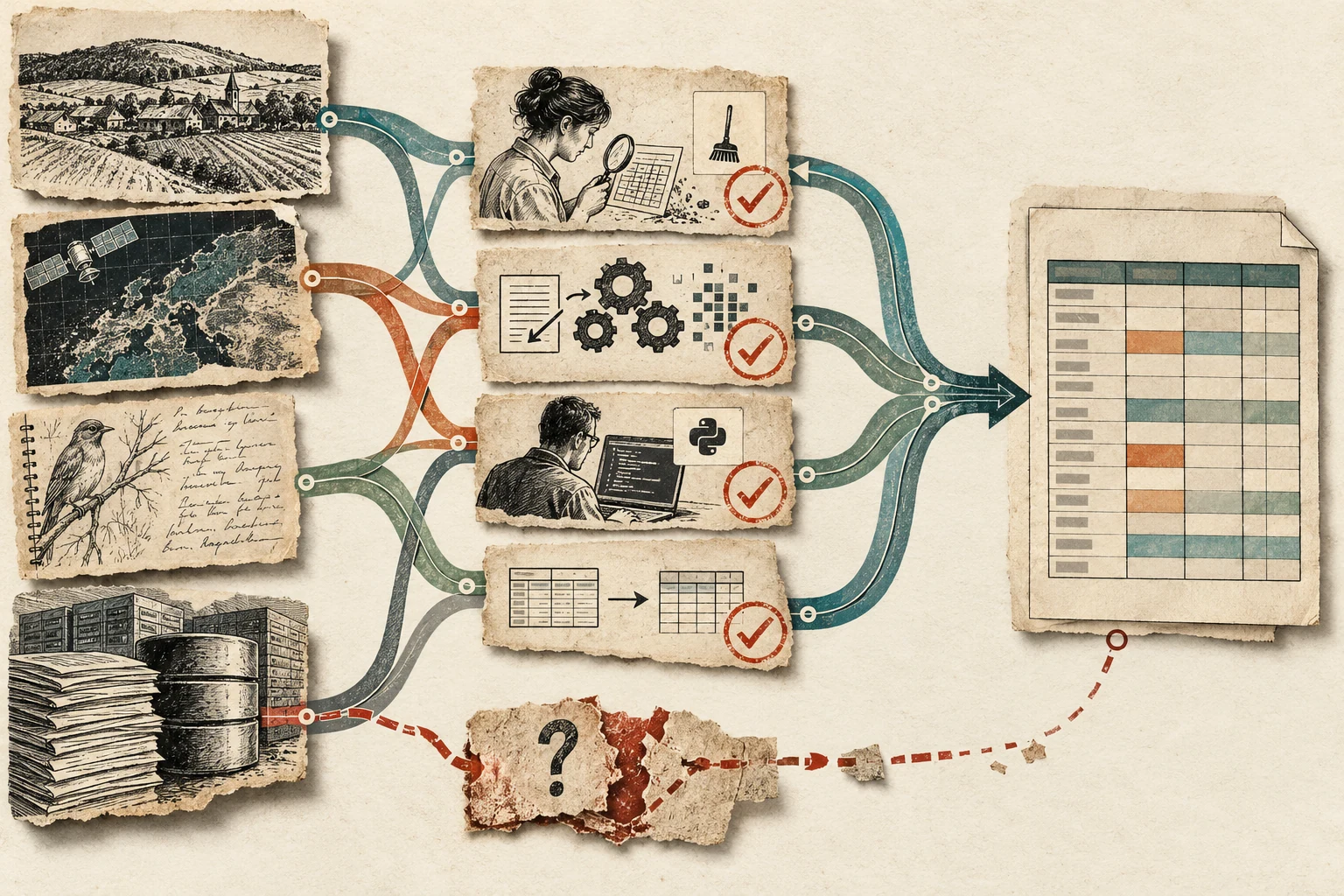
The final record has a trail leading back to observations and subsequent transformations, while a broken link shows where verifiability ends.
AI-assisted illustration · conceptual metaphor View in visual quiz →Genesis and Global Lineage
The term was borrowed from fine-art connoisseurship and archival science, where provenance denotes either the documented chain of ownership of a painting or the nineteenth-century archival principle (Provenienzprinzip, codified in the 1898 Dutch Manual of Muller, Feith, and Fruin) that records originating from the same institution must not be intermingled with others. It entered theoretical computer science around 2000, when Peter Buneman, Sanjeev Khanna, and Wang-Chiew Tan published Why and Where: A Characterization of Data Provenance (2001), distinguishing between why-provenance (which source rows in a relational database justify the presence of an output row) and where-provenance (from which exact source cell a value was copied)—soon completed by how-provenance (algebraic semirings capturing how source tuples combined to produce a result). By the mid-2000s, computational science (e-science) adopted the concept to track complex bioinformatics and physics workflows (surveyed by Simmhan, Plale, and Gannon in 2005). A series of international “Provenance Challenges” led by Luc Moreau produced the Open Provenance Model and culminated on April 30, 2013, in the W3C PROV family of standards. Around 2018, the concept was drafted into two urgent public arenas: machine-learning ethics (Timnit Gebru et al.'s Datasheets for Datasets, 2018/2021) and digital media authentication, where the C2PA coalition uses content provenance for cryptographically signed camera and editing metadata.
Central European Lineage
We found no documented link between this concept and the intellectual history or historical experience of Central Europe.
We found no documented link between this concept and the intellectual history or historical experience of Central Europe (by our methodology, this means “none found,” not “none exists”; as of October 2026).
Why Now
Between 2018 and 2026, three developments turned data provenance from a quiet database specialty into a front-line legal and engineering battleground. First, generative AI models were trained on massive web scrapes stripped of licensing and origin metadata; in October 2023, the Data Provenance Initiative (Longpre, Mahari et al.) audited over 1,800 fine-tuning datasets and discovered that more than 70% had omitted or misstated licenses on platforms like Hugging Face, while high-stakes copyright lawsuits (such as The New York Times v. OpenAI, filed in December 2023) hinge directly on proving which exact training works entered a model's corpus and whether synthetic training data will trigger “model collapse.” Second, the European Union's AI Act (enacted in 2024), building on GDPR (RODO in Poland) data-governance rules, explicitly mandates in Article 10 that providers of high-risk AI systems document “data collection processes and the origin of data,” while requiring general-purpose AI providers to publish sufficiently detailed summaries of training content. Third, the explosion of photorealistic image, audio, and video generators pushed provenance onto consumer screens: the Coalition for Content Provenance and Authenticity (C2PA)—backed by Adobe, Sony, Canon, Microsoft, OpenAI, and the BBC—rolled out Content Credentials, shifting verification from hopeless post-hoc deepfake detection to cryptographic origin signing at the moment a camera shutter clicks.
Explanatory Power
The concept demonstrates that “data quality” is not an intrinsic property of a static file, but a historical property of the pipeline that produced it—and that many intractable disputes over “facts” are actually disputes over undocumented transformations. Three concrete examples illustrate this. First, when Stanford researchers and journalists discovered in 2023–2024 that LAION-5B, the benchmark image-text dataset used to train popular diffusion models, contained thousands of links to illegal child sexual abuse material and private medical photographs, the root failure was a total absence of provenance filtering in bulk Common Crawl scraping: no one could trace or purge downstream derivatives without retraining from scratch. Second, in courtroom forensics, digital evidence is admissible not because a video “looks convincing,” but because a documented chain of custody links the physical recording device via cryptographic hashes to the exhibit presented to the judge—which is W3C PROV dressed in legal robes. Third, in corporate and public analytics, when two ministry departments or business units present conflicting unemployment or active-customer totals at a board meeting, neither SQL query is usually “wrong”: they diverge because one pipeline silently dropped inactive accounts after 90 days while the other used 180 days, and only fine-grained column-level data lineage can resolve the dispute without bureaucratic trench warfare.
Axes of Debate
Formal technical graph versus unrecorded social “cooking” of data
Database engineers, W3C standard-setters, and commercial data-catalog vendors treat provenance as a formal serialization problem: once every SQL join, Python script, and cryptographic signature is logged in a graph, the trustworthiness of the output is secured. Strongest counterargument: Historians of science and critical data scholars following Lisa Gitelman's “Raw Data” Is an Oxymoron (2013) point out that automated provenance only starts recording after the first digital table exists—leaving invisible all the messy, politically loaded human classifications, sensor calibrations, and exclusions that decided what counted as a datum in the first place. Nature of the dispute: substantive — it concerns the boundary between formal computational lineage inside a machine and the institutional sociology of measurement outside it.
Content Credentials (C2PA): shield against deepfakes or surveillance infrastructure
The C2PA coalition, camera manufacturers, and major newsrooms argue that in an era of effortless synthetic media, cryptographic provenance manifests attached at capture are the only scalable way to preserve public trust in visual journalism. Strongest counterargument: Digital-rights advocates, privacy researchers, and human-rights documentarians (such as WITNESS) warn that a media ecosystem in which only hardware-signed images are treated as “authentic” creates a dangerous “liar's dividend” (allowing politicians to dismiss any unsigned leak as fake) while endangering anonymous whistleblowers and street protesters whose safety depends on stripping device metadata. Nature of the dispute: mixed — the tension between cryptographic attribution and source anonymity is a genuine engineering and human-rights trade-off, while battles over who controls the root certificate authorities are institutional turf wars.
Mandatory AI training-data disclosure versus trade secrecy
Publishers, authors' guilds, open-source auditors, and EU regulators insist that full training-data provenance is an indispensable prerequisite for copyright compliance, bias auditing, and scientific reproducibility. Strongest counterargument: Frontier AI laboratories contend that the exact curation, weighting, and synthetic filtering mixture of a multi-trillion-token corpus is their core commercial trade secret, and that publishing exhaustive URL-level manifests acts as an automated roadmap for mass litigation. Nature of the dispute: rhetorical — claims that tracking corpus provenance is “technically impossible” ring hollow given that labs already maintain meticulous internal deduplication and toxicity registries; the dispute is over legal liability and licensing rent, not engineering feasibility.
Underappreciated Angle
Beneath its dry engineering surface, data provenance is the formal computer-science incarnation of the epistemology of testimony. For centuries, philosophers from David Hume and Thomas Reid to contemporary social epistemologists have asked under what conditions we are justified in believing a claim we did not witness firsthand. The W3C PROV model gives a structural answer: epistemic warrant does not reside inside a proposition (or a number in a spreadsheet), but in the topology of the graph connecting agents and transformations—for instance, whether two seemingly independent confirmations actually trace back to the very same upstream scrape (a hidden single point of failure that journalists call “circular reporting” and intelligence analysts call “incestuous amplification”). Yet this reveals a fundamental thermodynamic-style paradox of metadata: fine-grained how-provenance grows faster than the data themselves. If you record every intermediate floating-point operation, your provenance log quickly dwarfs your database; if you summarize, you reintroduce the very opacity provenance was meant to cure. Practical provenance is therefore never a neutral mirror of the past, but an economic bet on which future accountability questions—from a court, a regulator, a peer reviewer, or a debugging engineer—you will eventually be forced to answer.
One-Sentence Takeaway
Reliability is never a property of a number sitting in a table, but of the documented chain of hands and transformations it traveled through—and whoever failed to record that path can no longer prove their data, only ask to be believed.
Related Concepts Network
How this concept reinforces, constrains, or complements other analytical frameworks in the corpus. View on graph →
-
Causal inference reinforces
Without a record of how a dataset was generated and filtered, one cannot tell a real correlation from a sampling or cleaning artifact—the first prerequisite of any causal claim.
-
Synthetic data in tension
Synthetic data have a computational rather than observational provenance by definition; provenance metadata decide whether they can be safely mixed with empirical measurements.
-
Model collapse reinforces
The degradation of generative models trained recursively on AI-generated outputs is a direct failure of data provenance: crawlers lose track of which texts were written by humans.
-
Synthetic media complements
Content Credentials (C2PA) standards port the logic of database provenance to images and audio: instead of trying to detect fakes forensically, they cryptographically attest the origin of authentic captures.
-
Datafication constrains
Provenance records expose that “raw data” are always the product of someone's prior choices about instrumentation, filtering, and labeling.
-
Data brokers in tension
The commercial data-broker business model relies on laundering and obscuring where personal records were scraped or bought; strict provenance auditing threatens their margins.
-
Falsifiability and the replication crisis reinforces
Computational reproducibility requires reconstructing the entire transformation pipeline from raw sensor reading to published plot—that is, recorded computational provenance.
-
Legibility complements
Provenance makes legible not the territory, but the map-making process itself: it records who drew the grid and by what rules.
Reading Canon & Translation Bridge
Foundational texts, introductions, and critical perspectives—with availability of English and Polish editions.
-
foundational text 2001 · English
Peter Buneman, Sanjeev Khanna, Wang-Chiew Tan, Why and Where: A Characterization of Data Provenance
The landmark ICDT conference paper that introduced the formal distinction between why-provenance (which source tuples witness the existence of an output tuple) and where-provenance (from which exact cell a value was copied).
In English: original text written in English
In Polish: no Polish edition
-
foundational text 2013 · English
Luc Moreau, Paolo Missier (red.), PROV-DM: The PROV Data Model. W3C Recommendation
The canonical web standard: Entities, Activities, and Agents linked by relations of generation, usage, derivation, and attribution; essential reading to understand what formal provenance captures and what it leaves out.
In English: original text written in English
In Polish: no Polish edition
-
introduction & synthesis 2009 · English
James Cheney, Laura Chiticariu, Wang-Chiew Tan, Provenance in Databases: Why, How, and Where
A comprehensive survey in “Foundations and Trends in Databases” organizing the three formal questions of provenance and showing how “how-provenance” (provenance semirings) generalizes the other two.
In English: original text written in English
In Polish: no Polish edition
-
introduction & synthesis 2005 · English
Yogesh L. Simmhan, Beth Plale, Dennis Gannon, A Survey of Data Provenance in e-Science
A concise “SIGMOD Record” survey that carried the concept from relational databases into scientific workflow systems and proposed a taxonomy of provenance architectures.
In English: original text written in English
In Polish: no Polish edition
-
critical perspective 2013 · English
Lisa Gitelman (red.), „Raw Data” Is an Oxymoron
A collection of media-history and science-studies essays demonstrating that data are always “cooked” before they enter a database: technical provenance logs only the steps that start after initial capture.
In English: original text written in English
In Polish: Polish edition not verified
-
cross-disciplinary 2018 · English
Timnit Gebru i in., Datasheets for Datasets
The influential proposal that every machine-learning dataset should carry a standardized datasheet like an electronic component (motivation, composition, collection process, recommended uses; published in “Communications of the ACM” in December 2021).
In English: original text written in English
In Polish: no Polish edition
-
cross-disciplinary 2023 · English
Shayne Longpre, Robert Mahari i in., The Data Provenance Initiative: A Large Scale Audit of Dataset Licensing & Attribution in AI
An empirical audit of more than 1,800 text datasets used to fine-tune language models, uncovering license omission and misattribution rates above 70% in popular open repositories.
In English: original text written in English
In Polish: no Polish edition
Primary-Source Quotes
Provenance is information about entities, activities, and people involved in producing a piece of data or thing.