Datafication
original term: datafication (Eng.) · datyfikacja, udanowienie
Central European lineage: 1 thread (author from the region) · 1988–2013 · jump to documentation ↓
Working Definition
Datafication is the transformation of aspects of the world and human life that previously had no quantitative record—bodily posture, casual conversation, mood, friendship ties, physical location, or driving style—into standardized, machine-readable data formats suitable for aggregation, indexing, and algorithmic prediction. Crucially, it is not synonymous with digitization—the conversion of analog media (such as a printed book or vinyl record) into binary zeros and ones: a digitized book is still a text to be read by a human, whereas a datafied reading experience is the real-time telemetry emitted by an e-reader recording which passages a reader highlighted and on which page they stopped. While popular commentary uses the word loosely to mean “everything is measured nowadays,” analytically it denotes a three-part socio-technical operation requiring a sensor or interface, a standardized classification schema, and an institutional actor extracting value from the database. Serious analysis begins by asking who designs the schema and who captures that value.
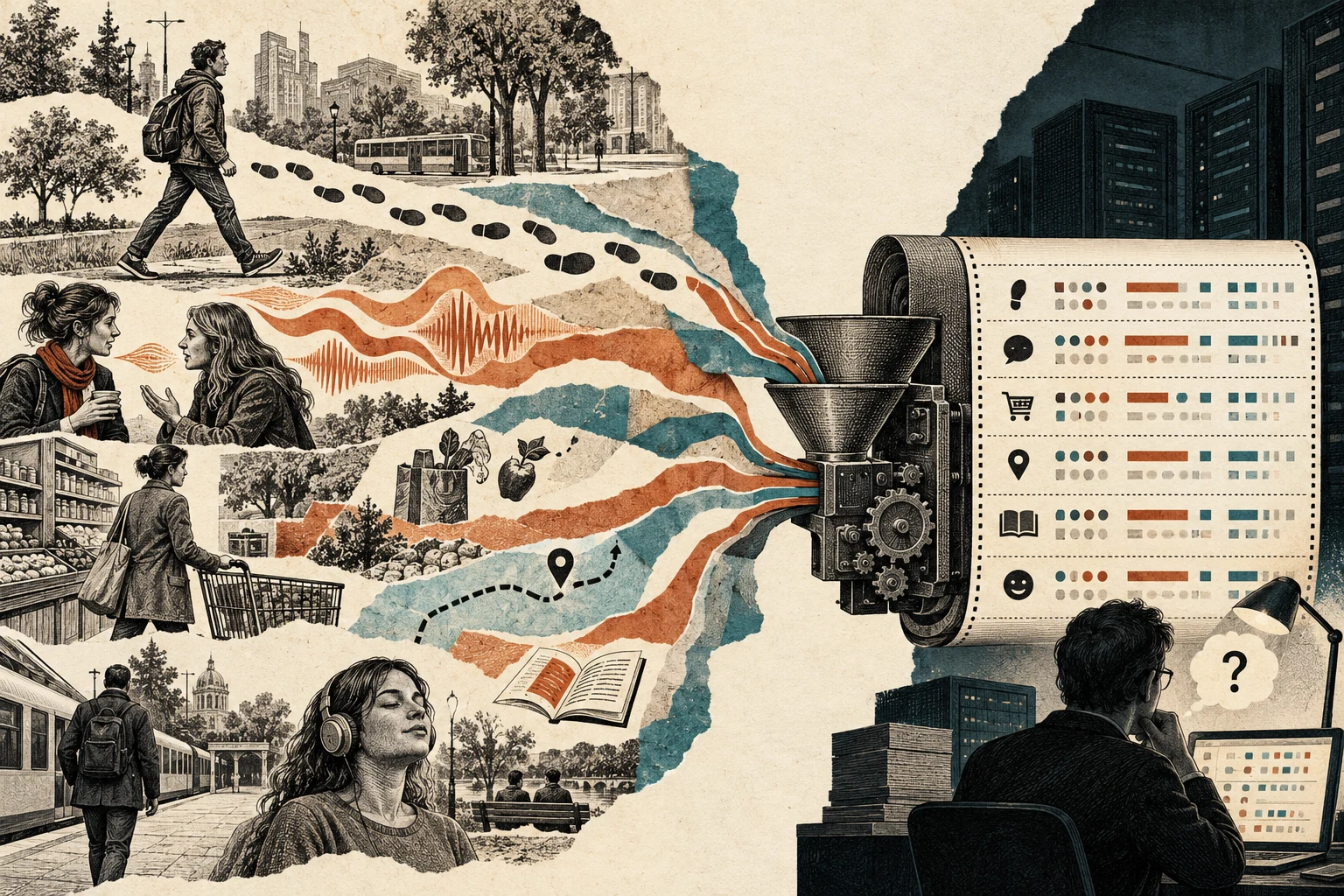
Ordinary activities become records ready for counting and processing, leaving part of lived context outside the table.
AI-assisted illustration · conceptual metaphor View in visual quiz →Genesis and Global Lineage
The term in its contemporary sense was introduced and popularized in 2013 by Viktor Mayer-Schönberger and Economist editor Kenneth Cukier in their bestseller Big Data: A Revolution That Will Transform How We Live, Work, and Think, which devoted its fifth chapter explicitly to “Datafication.” Drawing on examples from Matthew Fontaine Maury's nineteenth-century standardization of ship captains' logbooks to Japanese car seats that identify drivers by posture, Mayer-Schönberger and Cukier wrote in an affirmative register: datafication was presented as a cognitive leap extending early modern scientific measurement and state statistics (Statistik) to everyday life. Within a year, however, critical media scholars turned the concept inside out. In 2014, José van Dijck argued that the celebration of datafication rested on an unexamined ideology she termed dataism—a naive faith that digital traces are neutral footprints of human behavior rather than artifacts shaped by platform algorithms and commercial imperatives. By 2019, Nick Couldry and Ulises Mejias had reframed datafication as the core mechanism of data colonialism (the appropriation of social life as a factor of production), while Jathan Sadowski analyzed data as a distinct form of capital accumulation. Today the concept circulates across management literature and critical platform studies, anchored in the history of quantification pioneered by Theodore Porter and Alain Desrosières.
Central European Lineage
One of the two authors of the concept's canonical 2013 formulation was formed intellectually in the Austrian legal tradition of information and data-protection law. Born in Zell am See, Austria, in 1966, Viktor Mayer-Schönberger studied law at the University of Salzburg (earning his Mag. iur. in 1988 and Dr. iur. in 1991), founded the antivirus and data-security software firm Ikarus Software in Salzburg in 1986, and completed his Habilitation in information law, legal theory, and legal informatics at the University of Graz in 2001, before going on to faculty appointments at the Harvard Kennedy School, the National University of Singapore, and the Oxford Internet Institute. That Central European legal formation is more than a biographical footnote: Mayer-Schönberger came to the phenomenon of datafication not from Silicon Valley ad-tech engineering, but from decades of European scholarship on the legal regulation of information flows and institutional memory—most notably his influential 2009 book Delete: The Virtue of Forgetting in the Digital Age, which helped inspire the European Union's “right to be forgotten.” That background explains why Big Data frames datafication from the outset not merely as a database-engineering trick, but as a profound shift in how legal and social institutions remember, categorize, and judge human beings.
Documented regional lineage · Link: 1. Compiled: October 2026.
-
author from the region 25 years
Central European Source: Viktor Mayer-Schönberger, “Studia prawnicze na Uniwersytecie w Salzburgu (Mag. iur. 1988, Dr. iur. 1991), habilitacja z prawa informacji w Grazu (2001) (Law studies at the University of Salzburg, Mag. iur. 1988, Dr. iur. 1991, and habilitation in information law at the University of Graz, 2001)”; Salzburg and Graz, Austria, 1988
Global Circulation: datafication (the “Datafication” chapter in “Big Data: A Revolution That Will Transform How We Live, Work, and Think”) — Viktor Mayer-Schönberger i Kenneth Cukier, 2013
author from the region
25 yearsViktor Mayer-Schönberger, “Studia prawnicze na Uniwersytecie w Salzburgu (Mag. iur. 1988, Dr. iur. 1991), habilitacja z prawa informacji w Grazu (2001) (Law studies at the University of Salzburg, Mag. iur. 1988, Dr. iur. 1991, and habilitation in information law at the University of Graz, 2001)”
1988 · Salzburg and Graz, Austria
datafication (the “Datafication” chapter in “Big Data: A Revolution That Will Transform How We Live, Work, and Think”)
2013 · Viktor Mayer-Schönberger i Kenneth Cukier
- Claim & Connection
- The co-author of the canonical formulation of datafication was formed intellectually in Austria: born in Zell am See (1966), he studied law at the University of Salzburg, founded the cybersecurity software firm Ikarus Software there in 1986, and earned his habilitation in information law at the University of Graz in 2001, before teaching at the Harvard Kennedy School, in Singapore, and at the Oxford Internet Institute. His path to the concept ran through the Austrian legal tradition of data protection and information law rather than American computer science.
- Source Documentation
-
- biographical record Wikipedia (en), hasło „Viktor Mayer-Schönberger”; sections Early life and education, Career, Books. en.wikipedia.org ↗
- reception / translation José van Dijck, „Datafication, dataism and dataveillance: Big Data between scientific paradigm and ideology”, Surveillance & Society 12(2), 2014, s. 197–208; p. 198: “Datafication, according to Mayer-Schoenberger and Cukier (2013) is the transformation of social action into online quantified data”. ojs.library.queensu.ca ↗
- reception / translation Ulises A. Mejias, Nick Couldry, „Datafication”, Internet Policy Review 8(4), 2019; introduction: attribution of the term's canonical introduction to Mayer-Schönberger and Cukier (2013). policyreview.info ↗
- Historical Context
- Kenneth Cukier (London, “The Economist”) is the co-author of the 2013 book, so this regional lineage link applies to one of the two co-authors. Biographical details are confirmed via the encyclopedic record and Oxford Internet Institute faculty profile. While sporadic uses of the word “datafication” occurred earlier in IT management, its canonical status as a social-scientific concept stems from the 2013 book, as confirmed by subsequent definitional surveys.
Why Now
Three interlocking developments between 2018 and 2026 turned datafication from a descriptive buzzword into a battleground of law and geopolitics. First, the European Union constructed an ambitious regulatory architecture around datafied life: beginning with the General Data Protection Regulation (GDPR, 2018) and expanding through the Data Governance Act (2022), the Digital Services Act and Digital Markets Act (2022–2024), the Data Act (2023, governing industrial and Internet-of-Things telemetry), and the AI Act (2024), European law turned the question “what may be datafied, by whom, and under what access rights?” into hard statutory rules. Second, privacy shocks—from the 2018 Cambridge Analytica revelations to post-2022 controversies over period-tracking apps, connected-car telematics sold to insurers, and workplace bossware—made clear that seemingly trivial lifestyle data can be recombined into intimate behavioral profiles. Third, the generative AI boom after late 2022 revealed the industrial prize of three decades of web datafication: large language and multimodal models devour the datafied archive of human text, speech, art, and code as training fuel, turning copyright lawsuits and licensing deals between publishers and AI laboratories (2023–2026) into a struggle over the retroactive price of datafying human culture.
Explanatory Power
Datafication separates three steps routinely conflated under “Big Data”: reductive measurement, classification standardization, and value extraction. First, it explains the business logic of seemingly unprofitable digital products: a free fitness tracker, smart thermostat, or navigation app is a sensor array converting unrecorded routines into proprietary datasets. Second, it illuminates the power asymmetry in platform work: a driver or warehouse picker sees only isolated dispatch prompts, whereas the platform datafies their braking patterns, route deviations, and acceptance thresholds to train the pricing and routing models that govern their wages. Third, it explains why machine-learning systems reproduce institutional bias: because datafication captures only what an institution previously chose to count (arrests rather than crime, billing codes rather than health, clicks rather than satisfaction), every dataset is an ossified archive of past administrative priorities masquerading as neutral nature.
Axes of Debate
Cognitive scientific breakthrough versus “dataist” ideology
Proponents in data science, public health, and management (following Mayer-Schönberger and Cukier) maintain that datafying previously unmeasured phenomena—from jet-engine vibrations and premature infants' vital signs to urban traffic flows—yields life-saving predictive correlations even when data are noisy ("N = all" beats small clean samples). Critical media theorists led by José van Dijck counter that treating behavioral digital traces as an objective window onto society is an ideological illusion (dataism) because platforms actively engineer the interactions they claim merely to measure. Strongest counterargument: Defenders of empirical data science reply that exposing ideological hype does not invalidate the method: epidemiology, climate modeling, and preventive maintenance have achieved undeniable breakthroughs through high-dimensional datafication, and the practical alternative to imperfect data is flying blind on intuition and hierarchy. Nature of the dispute: mixed — the debate over predictive validity in specific domains is empirically substantive, while clashes over the rhetoric of “the data speak for themselves” concern ideological framing.
Voluntary market exchange versus “data colonialism”
Neoclassical platform economists view everyday datafication as a welfare-enhancing barter transaction: consumers trade non-rival behavioral data that have zero value to them individually for valuable free digital services. Critical political economists such as Nick Couldry, Ulises Mejias, and Jathan Sadowski reject the barter model, arguing that datafication operates like historical colonialism—declaring lived human sociality a terra nullius open for unilateral enclosure and extraction by whoever controls the digital infrastructure. Strongest counterargument: Critics of the “data colonialism” thesis warn that equating smartphone telemetry with the historical violence of plantation slavery and territorial conquest stretches colonialism into a metaphor that obscures crucial differences: users are not subjected to physical coercion, and digital lock-in can be analyzed more precisely through monopoly economics without diluting anti-colonial history. Nature of the dispute: substantive — it centers on whether formal clickwrap consent under infrastructural lock-in constitutes voluntary exchange or structural expropriation.
Individual data-protection rights versus collective governance of population-level inferences
European legal scholars and regulators build on individual fundamental rights (such as the GDPR), assuming that rights to notice, consent, access, and erasure can domesticate datafication. Structural critics (such as Salomé Viljoen and Julie Cohen) argue that individual privacy law is mismatched to modern datafication: a platform uses relational data from millions of people to train population-level models that infer and shape the behavior of other people who never consented at all. Strongest counterargument: Pragmatic regulators reply that while collective models of “data commons” or public data trusts are theoretically attractive, individual data-protection rights and statutory product-safety rules (like the EU AI Act) are the only enforceable legal instruments currently operating at scale. Nature of the dispute: substantive — a dispute over institutional design: whether datafication can be governed through individual rights remedies or requires collective, relational regulation.
Underappreciated Angle
Critiques of datafication almost always ask what is taken from the people being measured (privacy, autonomy, unpaid labor), while rarely examining the institutional blindness inflicted on the organization doing the measuring. Because datafication requires translating qualitative human realities into discrete, standardized tokens, whatever cannot be cheaply tokenized ceases to exist inside the organization's decision loop: the nurse's unrecorded conversation that prevents a patient's panic, the teacher's cultivation of curiosity that does not register on a standardized test, the engineer's tacit sense that a system feels brittle before any sensor trips. As organizations shift from human judgment to dashboard governance, they starve the unmeasured foundations that keep them alive—a pathology that historian Theodore Porter (Trust in Numbers, 1995) diagnosed long before the internet: rigid quantification is rarely the sign of a confident, high-trust institution; it is a defensive substitute adopted when authority no longer trusts its own professionals or is no longer trusted by the public.
One-Sentence Takeaway
Datafication is never the neutral act of measuring the world as it is; it is the political act of deciding which slice of human life will count as real to an institution—and locking everything else out of the ledger.
Related Concepts Network
How this concept reinforces, constrains, or complements other analytical frameworks in the corpus. View on graph →
-
Surveillance capitalism complements
Shoshana Zuboff analyzes the accumulation regime that turns datafied human experience into a market for behavioral predictions; datafication is the socio-technical precondition, while surveillance capitalism is one specific commercial use of it.
-
Platformization reinforces
Digital platforms provide the everyday infrastructure that captures, standardizes, and monetizes behavioral traces; without platformization, the datafication of daily life would lack planetary scale.
-
Algorithmic management reinforces
Datafied labor and consumption become the real-time input streams for algorithmic systems that rate, dispatch, and discipline workers.
-
Goodhart’s law constrains
When a measure becomes a target, it ceases to be a good measure; by multiplying quantitative proxies for complex human activities, datafication multiplies opportunities for gaming metrics.
-
Attention economy complements
Human attention is the underlying scarce resource, but only its datafication (into clicks, dwell time, scroll velocity, and gaze heatmaps) makes it fungible and tradable in automated auctions.
-
Digital sovereignty in tension
Political battles over who holds jurisdiction over citizen and industrial data are struggles over who controls the downstream value of datafication.
-
Postcolonialism complements
Nick Couldry and Ulises Mejias theorize datafication as “data colonialism”: the appropriation of human social life as free raw material for capital, analogous to historic colonial seizures of land and labor.
Reading Canon & Translation Bridge
Foundational texts, introductions, and critical perspectives—with availability of English and Polish editions.
-
foundational text 2013 · English
Viktor Mayer-Schönberger, Kenneth Cukier, Big Data: A Revolution That Will Transform How We Live, Work, and Think
Chapter 5 (“Datafication”) introduces the concept and sharply distinguishes it from mere digitization; written in an optimistic register, the book serves both as the foundational text and as a historical document of early-2010s Big Data enthusiasm.
In English: original text written in English
In Polish: “Big data. Rewolucja, która zmieni nasze myślenie, pracę i życie”, MT Biznes 2014, trans. Michał Głatki
-
critical perspective 2014 · English
José van Dijck, Datafication, dataism and dataveillance: Big Data between scientific paradigm and ideology
The first systematic critical response (Surveillance & Society 12/2): exposes “dataism” as a secular belief system resting on questionable assumptions that raw data are objective depictions of reality and that the corporations collecting them are neutral stewards.
In English: original text written in English
In Polish: Polish edition not verified
-
introduction & synthesis 2019 · English
Ulises A. Mejias, Nick Couldry, Datafication
A concise, authoritative overview in Internet Policy Review (in the “Concepts of the Digital Society” series) mapping the history of the term, its epistemological claims, and its political economy.
In English: original text written in English
In Polish: Polish edition not verified
-
critical perspective 2019 · English
Nick Couldry, Ulises A. Mejias, The Costs of Connection: How Data Is Colonizing Human Life and Appropriating It for Capitalism
Develops the thesis of “data colonialism”: datafication as a new historical stage of resource appropriation that converts the texture of human social relations into a factor of production.
In English: original text written in English
In Polish: Polish edition not verified
-
cross-disciplinary 2019 · English
Jathan Sadowski, When data is capital: Datafication, accumulation, and extraction
A political-economic analysis (Big Data & Society) arguing that data function not merely as a commodity, but as a distinct form of capital—explaining the imperative to hoard data indiscriminately even before a profitable use case exists.
In English: original text written in English
In Polish: Polish edition not verified
-
introduction & synthesis 2014 · English
Rob Kitchin, The Data Revolution: Big Data, Open Data, Data Infrastructures and Their Consequences
A sober, comprehensive sociological handbook on data infrastructures and their epistemology—an ideal antidote to breathy “data revolution” hype.
In English: original text written in English
In Polish: Polish edition not verified
-
cross-disciplinary 2019 · English
Shoshana Zuboff, The Age of Surveillance Capitalism: The Fight for a Human Future at the New Frontier of Power
Traces from the standpoint of organizational sociology how datafied “behavioral surplus” became the raw material for a new regime of instrumentarian power.
In English: original text written in English
In Polish: “Wiek kapitalizmu inwigilacji. Walka o przyszłość ludzkości na nowej granicy władzy”, Zysk i S-ka 2020, trans. Alicja Unterschuetz
-
cross-disciplinary 1995 · English
Theodore M. Porter, Trust in Numbers: The Pursuit of Objectivity in Science and Public Life
A classic in the history of science demonstrating that strict quantification arises as a technology of distance and trust when elites face external suspicion; datafication is the latest chapter in that long history.
In English: original text written in English
In Polish: no Polish edition
Primary-Source Quotes
Datafication, according to Mayer-Schoenberger and Cukier (2013) is the transformation of social action into online quantified data, thus allowing for real-time tracking and predictive analysis.
datafication is a contemporary phenomenon which refers to the quantification of human life through digital information