AI Architecture #125
Privacy-preserving machine learning
original term: privacy-preserving machine learning (Eng.) · uczenie maszynowe z ochroną prywatności, PPML, uczenie federacyjne
Central European lineage: 1 thread (documented influence) · 1961–2017 · jump to documentation ↓
Working Definition
Privacy-preserving machine learning (PPML) is an umbrella term for algorithmic and cryptographic techniques that make it possible to train and deploy machine learning models without allowing an adversary to infer information about any individual training record from the model’s parameters, predictions, or training traffic. Its three technical pillars are differential privacy (bounding the mathematical influence of any single record on the trained model by clipping gradients and injecting calibrated noise), federated learning (keeping raw data on user devices or hospital servers while sharing only model updates), and encrypted computation (homomorphic encryption, secure multiparty computation, and trusted execution environments). In popular corporate communication, “privacy-preserving” often means little more than a promise that raw files remain on the user’s phone; in rigorous technical usage, it requires a formal proof that no observer—regardless of auxiliary side knowledge—can learn more about an individual record than a specified privacy budget \varepsilon permits.
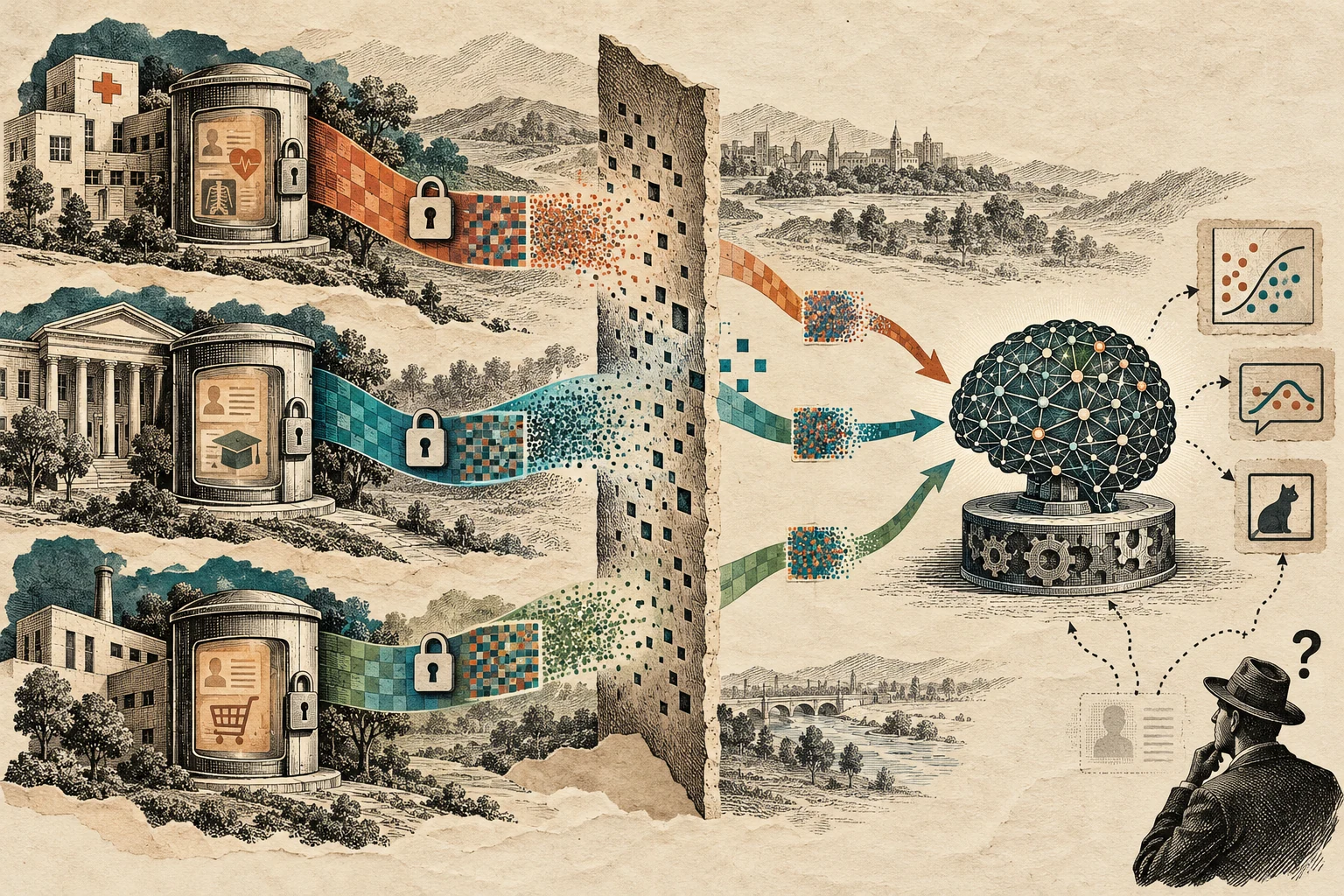
Training draws on protected aggregate signals while restricting access to individual records, with actual protection depending on the method and its assumptions.
AI-assisted illustration · conceptual metaphor View in visual quiz →Genesis and Global Lineage
The field draws on two pre-digital intellectual streams: survey statistics—specifically Stanley Warner’s randomized response technique (1965), which allowed researchers to estimate the prevalence of sensitive behaviors by having respondents flip a coin before answering—and 1980s cryptography, where Andrew Yao and Oded Goldreich formalized secure multiparty computation (MPC). The label “privacy-preserving data mining” emerged simultaneously in 2000 in two independent papers with identical titles: Rakesh Agrawal and Ramakrishnan Srikant at SIGMOD (using statistical perturbation) and Yehuda Lindell and Benny Pinkas at CRYPTO (using cryptographic protocols). The decisive conceptual breakthrough came in 2006 when Cynthia Dwork, Frank McSherry, Kobbi Nissim, and Adam Smith formulated differential privacy, shifting the definition of privacy from a property of a sanitized dataset to a rigorous mathematical property of the randomized algorithm itself—work honored with the Gödel Prize in 2017. In deep learning, the modern PPML synthesis crystallized in 2016–2017: Martín Abadi, Ilya Mironov, and colleagues introduced Differentially Private Stochastic Gradient Descent (DP-SGD), while H. Brendan McMahan’s team at Google coined federated learning. Since then, PPML has operated as an engineering repertoire deployed by Apple, Google, and Meta, where mathematical guarantees frequently collide with product marketing.
Central European Lineage
The documented link to Central Europe is mathematical, precise, and instrumental. When deep-learning researchers needed a tight accounting tool to measure how much privacy budget (\varepsilon) is consumed across thousands of successive gradient steps, they turned to Rényi divergence—a family of information-theoretic measures of distance between probability distributions introduced in 1961 by the Hungarian mathematician Alfréd Rényi in his paper On Measures of Entropy and Information. Rényi was educated in Budapest (studying under Lipót Fejér and Pál Turán between 1940 and 1944 despite wartime anti-Jewish numerus clausus restrictions) and at the university in Szeged in southern Hungary (earning his doctorate under Frigyes Riesz in 1945), and from 1950 until his death directed the Mathematical Institute of the Hungarian Academy of Sciences (Magyar Tudományos Akadémia) in Budapest. After Abadi et al. (2016) used moment-generating functions to tighten privacy composition bounds, Ilya Mironov formalized Rényi Differential Privacy (2017), explicitly citing Rényi’s 1961 paper (Definition 3, ref. [18]). Rényi never worked on personal data protection, so this is not an influence of political or legal philosophy; rather, it is a textbook case of how pure information theory developed in postwar Budapest became the default accounting engine inside industrial privacy libraries such as TensorFlow Privacy and PyTorch Opacus.
Documented regional lineage · Link: 1. Compiled: October 2026.
-
documented influence 56 years
Central European Source: Alfréd Rényi, “On Measures of Entropy and Information”; Budapest, Hungary; Szeged, Hungary, 1961
Global Circulation: Rényi differential privacy as a formal privacy-accounting measure in machine learning — Ilya Mironov, 2017
documented influence
56 yearsAlfréd Rényi, “On Measures of Entropy and Information”
1961 · Budapest, Hungary; Szeged, Hungary
Rényi differential privacy as a formal privacy-accounting measure in machine learning
2017 · Ilya Mironov
- Claim & Connection
- In his 2017 paper “Rényi Differential Privacy,” Ilya Mironov defines a natural relaxation of differential privacy based on Rényi divergence and directly cites Alfréd Rényi’s 1961 paper (Definition 3, reference [18]). Rényi was educated in Budapest (studying under Lipót Fejér and Pál Turán, 1940–1944) and Szeged (earning his doctorate under Frigyes Riesz in 1945), and from 1950 directed the Mathematical Institute of the Hungarian Academy of Sciences in Budapest. The connection concerns a foundational mathematical tool rather than the concept of data protection itself: Rényi divergence became the standard mathematical ledger for tracking cumulative privacy loss in deep-learning libraries.
- Source Documentation
-
- reception / translation Ilya Mironov, „Rényi Differential Privacy”, IEEE Computer Security Foundations Symposium (CSF) 2017; arXiv:1702.07476v3; Definition 3 (Rényi divergence); bibliography item [18]: A. Rényi, “On measures of entropy and information”, Proc. Fourth Berkeley Symposium, vol. 1, 1961, pp. 547–561. arxiv.org ↗
- biographical record MacTutor History of Mathematics, „Alfréd Rényi”; studies at the University of Budapest 1940–1944 (Fejér, Turán); doctorate at Szeged under Frigyes Riesz, March 1945; from 1950 Director of the Institute of Applied Mathematics of the Hungarian Academy of Sciences. mathshistory.st-andrews.ac.uk ↗
- Historical Context
- The link is narrow and instrumental: Rényi did not write about personal data privacy. Rényi divergence entered the PPML canon through the moments accountant of Abadi et al. (2016) and Mironov’s formalization (2017); today it serves as the default privacy accounting engine in libraries such as TensorFlow Privacy and PyTorch Opacus.
Why Now
Three converging forces between 2018 and 2026 moved PPML from theoretical computer science into regulatory and industrial infrastructure. First was data-protection law: the EU’s General Data Protection Regulation (GDPR, enforced since May 2018) turned data minimization and purpose limitation into statutory duties backed by heavy fines, prompting tech firms and healthcare consortia to adopt federated learning and differential privacy to train models across institutional silos without centralizing raw personal data. Second was pervasive memorization in large language models: in December 2020, Nicholas Carlini and colleagues demonstrated that GPT-2 could regurgitate verbatim training sequences containing real names, phone numbers, and street addresses, and subsequent lawsuits (2023–2025) over training data turned “what a model remembers” into a multi-billion-dollar liability. Third was state-scale deployment: the 2020 U.S. Decennial Census became the first national census to protect all published tables with formal differential privacy, igniting a fierce controversy among demographers and voting-rights scholars over how injected noise distorts counts for small rural and minority communities. Simultaneously, Apple and Google embedded federated learning and local differential privacy into hundreds of millions of smartphones, making PPML a centerpiece of Big Tech’s public defense of telemetry collection.
Explanatory Power
The concept disentangles three questions that everyday privacy debates conflate: who holds the raw files, what can be inferred about an individual from aggregate outputs, and what a neural network memorizes in its weights. First, PPML explains why classic “anonymization” via stripping names and ID numbers fails in high dimensions—as Arvind Narayanan and Vitaly Shmatikov proved in 2008 by re-identifying Netflix users from timestamped movie ratings—and why a mathematical guarantee must hold against an adversary possessing arbitrary auxiliary knowledge. Second, it shifts privacy scrutiny from database input to model output: membership inference attacks (Shokri et al., 2017) prove that even when training data is locked on a secure server, black-box access to prediction probabilities reveals whether a specific patient’s record was used in training. Third, it provides a quantitative language for trade-offs: the privacy loss parameter \varepsilon, the accuracy drop from gradient clipping, and the unequal impact of noise on tail subpopulations. Armed with this framework, an auditor can replace vague assurances that an AI system “respects privacy” with three testable questions: what is the cumulative \varepsilon, over what unit of data (a single message or an entire account) is it computed, and who holds the cryptographic keys during aggregation.
Axes of Debate
Mathematical privacy budget versus contextual social norms
Philosophers and legal scholars—most notably Helen Nissenbaum through her theory of contextual integrity (2010)—argue that differential privacy addresses only one narrow threat (identifying whether an individual contributed to an aggregate), while remaining silent on whether extracting behavioral insights to manipulate attention or price insurance is socially legitimate. Strongest counterargument: Cryptographers and computer scientists reply that contextual norms cannot be composed across thousand-step algorithms or verified by code audits; only a formal bound like \varepsilon-differential privacy prevents silent re-identification when datasets are combined in unforeseen ways. Nature of the dispute: substantive — the two camps address non-overlapping layers of the problem (cryptographic non-identifiability versus the political economy of data flows), and neither can substitute for the other.
How much is a high \varepsilon actually worth in practice?
Academic security researchers criticize industrial deployments of differential privacy (by Apple, Google, and Uber) for operating with cumulative privacy budgets of \varepsilon = 8, 15, or higher—where the theoretical worst-case bound e\varepsilon becomes astronomically loose—and for resetting the budget daily or per query rather than per user lifetime. Strongest counterargument: Applied ML engineers respond that worst-case theoretical bounds vastly overestimate realistic attack success: even a moderate \varepsilon combined with gradient clipping defeats known membership-inference and extraction attacks, whereas demanding \varepsilon < 1 on deep networks destroys model accuracy so severely that no practitioner will use the tool. Nature of the dispute: mixed — the gap between worst-case bounds and empirical attack success is a genuine scientific problem, while corporate announcements routinely use the label “differentially private” without disclosing the actual \varepsilon value.
Federated learning: genuine decentralization or platform centralization in disguise?
Critics of platform political economy point out that in cross-device federated learning, although raw keystrokes stay on the phone, the central corporation still defines the objective function, owns the global model, and captures the economic value; moreover, gradient-inversion attacks (Deep Leakage from Gradients, 2019) proved that raw images and text can be reconstructed from unencrypted weight updates. Strongest counterargument: Proponents emphasize that when combined with cryptographic secure aggregation (so the server sees only the sum of thousands of updates) and user-level differential privacy, gradient reconstruction is mathematically blocked—and the real-world alternative is copying all raw user data onto a central cloud server. Nature of the dispute: mixed — substantive regarding which cryptographic combinations prevent gradient leakage, and rhetorical whenever “federated” is marketed as a standalone privacy guarantee.
Underappreciated Angle
The noise and gradient clipping required for differential privacy do not fall equally across society. Because a differentially private training algorithm must bound the maximum influence of any single example, it systematically suppresses signal from rare patterns in the distribution tail. In human datasets, that tail is not random error—it consists of demographic minorities, speakers of non-standard dialects, and patients with rare diseases. As Eugene Bagdasaryan, Omid Poursaeed, and Vitaly Shmatikov showed in 2019 (Differential Privacy Has Disparate Impact on Model Accuracy), training a deep classifier with DP-SGD causes a far steeper accuracy drop for underrepresented subgroups than for the majority class. The same structural tension surfaced in the 2020 U.S. Census, where differential-privacy noise disproportionately distorted counts for small rural towns and Indigenous reservations. Privacy and algorithmic fairness are therefore not harmonious checkboxes: choosing a strict privacy budget \varepsilon is simultaneously a political decision about which minority groups the resulting model is permitted to blur out of recognition.
One-Sentence Takeaway
Privacy in machine learning is not a question of who looked at the raw files, but of how much information about a single human being can be reverse-engineered from the trained model—and that leakage is a quantity that can be mathematically bounded, at the direct cost of erasing the statistical margins.
Related Concepts Network
How this concept reinforces, constrains, or complements other analytical frameworks in the corpus. View on graph →
-
Synthetic data complements
Synthetic data generated under a formal differential-privacy bound is one of the main practical ways to share training distributions without exposing raw records.
-
Surveillance capitalism in tension
PPML techniques allow technology platforms to claim they “never see” raw user data while continuing to extract behavioral models from edge devices—a move critics view as technical legitimation of extraction.
-
Datafication constrains
PPML does not halt the conversion of human life into quantified signals, but bounds what can be reverse-engineered about an individual record from the resulting model.
-
Data brokers in tension
Mathematical guarantees on a model’s output say nothing about how the underlying data was acquired on the brokerage market before training began.
-
Digital sovereignty reinforces
Federated learning and secure multiparty computation provide the technical architecture for training joint models while keeping raw datasets inside national or institutional jurisdictions.
-
Data provenance complements
Training-data provenance and formal privacy accounting are two sides of the same ledger: where a record came from and how much information about it the trained weights can leak.
-
Large language models (LLMs) in tension
Large language models memorize and regurgitate verbatim training sequences, turning training-data extraction attacks into the primary stress test for PPML at scale.
Reading Canon & Translation Bridge
Foundational texts, introductions, and critical perspectives—with availability of English and Polish editions.
-
foundational text 2017 · English
H. Brendan McMahan, Eider Moore, Daniel Ramage, Seth Hampson, Blaise Agüera y Arcas, Communication-Efficient Learning of Deep Networks from Decentralized Data
The AISTATS 2017 paper (PMLR 54, pp. 1273–1282) that coined “Federated Learning” and introduced the FedAvg algorithm: client devices train locally on raw data, and the central server aggregates only weight updates.
In English: original text written in English
In Polish: no Polish edition
-
foundational text 2016 · English
Martín Abadi, Andy Chu, Ian Goodfellow, H. Brendan McMahan, Ilya Mironov, Kunal Talwar, Li Zhang, Deep Learning with Differential Privacy
The ACM CCS 2016 paper (pp. 308–318) introducing Differentially Private Stochastic Gradient Descent (DP-SGD) and the moments accountant, making it possible to train deep neural networks within a computable privacy budget.
In English: original text written in English
In Polish: no Polish edition
-
introduction & synthesis 2014 · English
Cynthia Dwork, Aaron Roth, The Algorithmic Foundations of Differential Privacy
Published in “Foundations and Trends in Theoretical Computer Science” (vol. 9, pp. 211–407), the definitive textbook on definitions, randomized mechanisms, and composition theorems for differential privacy.
In English: original text written in English
In Polish: Polish edition not verified
-
introduction & synthesis 2021 · English
Peter Kairouz, H. Brendan McMahan i in., Advances and Open Problems in Federated Learning
A comprehensive 59-author survey in “Foundations and Trends in Machine Learning” mapping the field: cross-device versus cross-silo settings, gradient-inversion attacks, secure aggregation, and fairness trade-offs.
In English: original text written in English
In Polish: no Polish edition
-
critical perspective 2017 · English
Reza Shokri, Marco Stronati, Congzheng Song, Vitaly Shmatikov, Membership Inference Attacks against Machine Learning Models
IEEE S&P 2017: demonstrates that black-box access to a model’s prediction confidence scores suffices to infer whether a specific individual’s record was in the training set, establishing the standard adversarial benchmark for PPML.
In English: original text written in English
In Polish: no Polish edition
-
critical perspective 2020 · English
Nicholas Carlini, Florian Tramèr, Eric Wallace i in., Extracting Training Data from Large Language Models
The December 2020 arXiv preprint (published at USENIX Security 2021) proving that hundreds of verbatim sequences—including names, phone numbers, and addresses—can be extracted directly from GPT-2.
In English: original text written in English
In Polish: no Polish edition
-
cross-disciplinary 2010 · English
Helen Nissenbaum, Privacy in Context: Technology, Policy, and the Integrity of Social Life
Articulates the philosophical theory of “contextual integrity”: privacy is not absolute secrecy, but the appropriateness of information flows relative to social norms—illuminating what purely mathematical privacy budgets leave out.
In English: original text written in English
In Polish: Polish edition not verified
Primary-Source Quotes
We term this decentralized approach Federated Learning.
We propose a natural relaxation of differential privacy based on the Rényi divergence.