Horizon & Ecology #179
Deepfake
original term: deepfake (Eng.) · deep fake, głębokie fałszerstwo, syntetyczna podmiana twarzy
Central European lineage: 1 thread (historical experience) · 2022 · jump to documentation ↓
Working Definition
A deepfake is an image, audio recording, or video generated or manipulated by deep-learning models so as to depict an identifiable, real person saying or doing something they never said or did, in a manner that appears authentic to an ordinary observer. Three elements define the concept: identity impersonation or synthesis, the appearance of documentary authenticity, and automated neural-network generation (autoencoders, generative adversarial networks, diffusion models, or neural voice cloning). In loose everyday usage, the word is often applied to any AI-generated image; in its strict technical and legal definition—codified in Article 3(60) of the European Union’s 2024 AI Act—it designates AI-generated or manipulated image, audio, or video content that “resembles existing persons, objects, places, entities or events and would falsely appear to a person to be authentic or truthful.” Low-tech edits that require no machine learning (cropping, slowing down speech to mimic intoxication, or attaching a false caption to genuine footage) are called cheap fakes and belong to a different analytical category, even though they often deceive larger audiences.
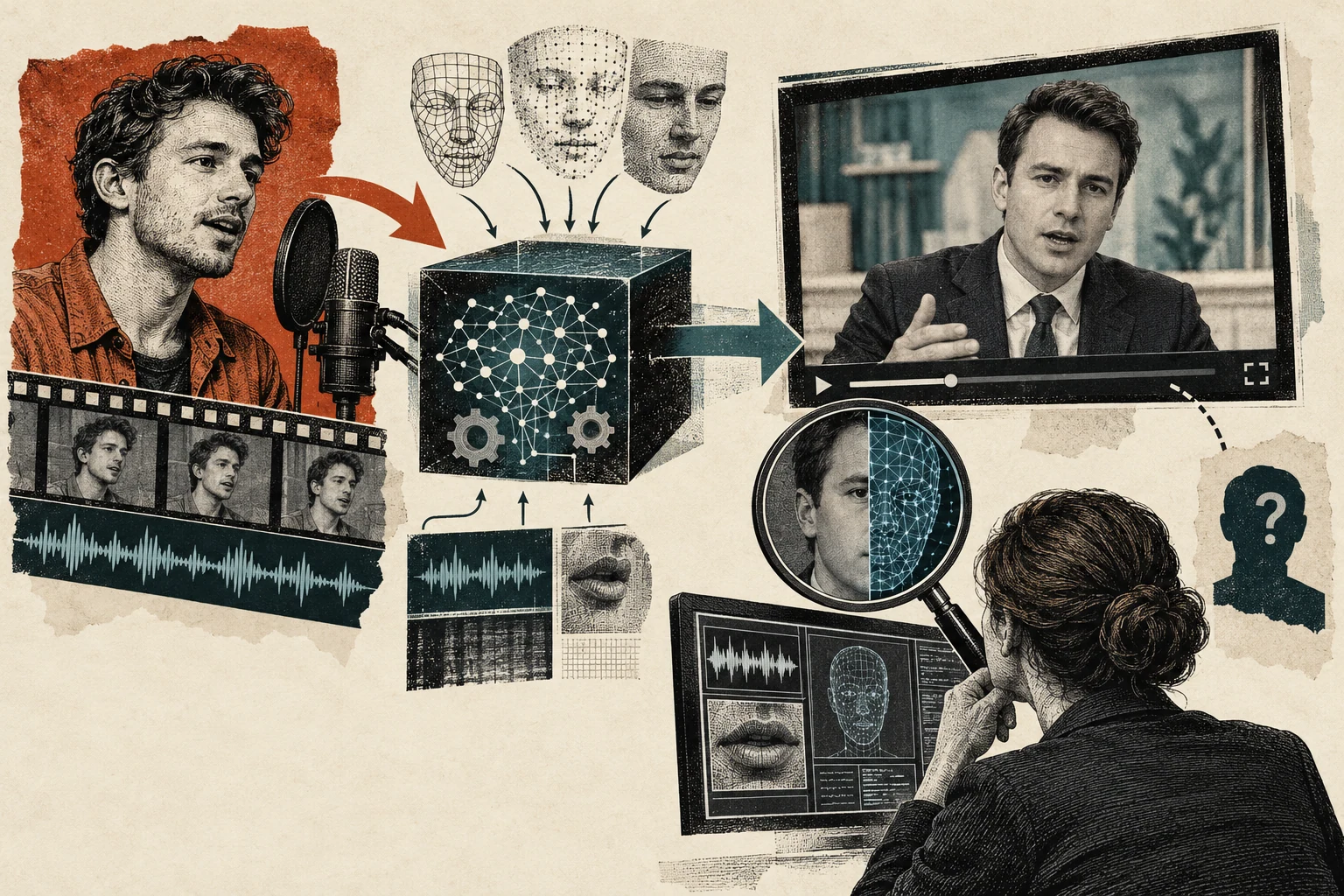
A recording is given the likeness of another person's speech; the illustration shows synthetic identity substitution without depicting a real individual's authentic statement.
AI-assisted illustration · conceptual metaphor View in visual quiz →Genesis and Global Lineage
The technique is older than the name. Automated facial reenactment synced to an audio track was demonstrated in academic computer graphics as early as the Video Rewrite system (1997), followed by the invention of generative adversarial networks (GANs) by Ian Goodfellow and colleagues in June 2014 and real-time facial transfer projects such as Face2Face (2016) and Synthesizing Obama (2017). The word deepfake itself was born on Reddit: on December 11, 2017, journalist Samantha Cole reported in Motherboard (Vice) that an anonymous Reddit user posting under the handle “deepfakes” (a portmanteau of deep learning and fake) was using open-source libraries (TensorFlow, Keras) and publicly scraped photographs to swap the faces of female celebrities onto pornographic videos. The user’s handle quickly became the generic noun for the medium. Over the next three years, the concept was captured by two influential policy circuits: a legal and national-security literature anchored by Bobby Chesney and Danielle Citron’s 2019 California Law Review article (circulated in draft in 2018), which broadened the term to cover all hyper-realistic digital falsification and coined the concept of the liar’s dividend, and a geopolitical commentary wave exemplified by Nina Schick’s Deep Fakes and the Infocalypse (2020). While elite commentary fixated on scenarios of televised election sabotage, empirical audits—beginning with Deeptrace (later Sensity) in 2019, which found that 96% of all deepfake videos online were non-consensual pornography targeting women—showed that the primary real-world harm was gendered sexual abuse, a pattern underscored again in January 2024 when viral deepfake pornography of Taylor Swift finally prompted legislative action.
Central European Lineage
While the technology originated in North American labs, its most famous wartime test case—and one of its sharpest electoral tests—took place in Central and Eastern Europe. On March 16, 2022, three weeks into Russia’s full-scale invasion of Ukraine, hackers compromised the live news ticker of the Ukrainian television channel Ukraine 24 and circulated a synthetic video across social media and pro-Kremlin Telegram channels in which President Volodymyr Zelenskyy appeared to tell Ukrainian citizens that he had fled Kyiv and that soldiers should lay down their weapons. As the Atlantic Council’s DFRLab documented, the video was technically crude—Zelenskyy’s head proportions, lighting, and accent were visibly off—and Zelenskyy neutralized it within hours by posting a real smartphone video from his Kyiv office dismissing the “childish provocation.” Crucially, Ukrainian military intelligence had spent weeks “pre-bunking” the tactic by warning the public in advance that Russia was preparing deepfake surrender videos, turning the March 16 incident into a textbook case study (analyzed by John Twomey et al. in PLOS ONE, 2023) of how institutional preparedness defeats synthetic media. By contrast, in September 2023 in neighboring Slovakia, a fabricated AI audio clip purporting to show liberal leader Michal Šimečka discussing vote-rigging and hiking beer prices was released on social media during the country’s statutory 48-hour pre-election silence period (cisza wyborcza), when media outlets and campaigns were legally barred from publishing rebuttals—demonstrating how local electoral rules can inadvertently amplify a deepfake’s timing advantage.
Documented regional lineage · Link: 1. Compiled: October 2026.
-
historical experience 0 years — same text on both sides
Central European Source: Sfabrykowane nagranie, w którym prezydent Ukrainy wzywa żołnierzy do złożenia broni; równolegle zhakowany pasek informacyjny telewizji Ukraina 24 — Deepfake z kapitulacją Wołodymyra Zełenskiego; Kyiv, Ukraine, 2022
Global Circulation: deepfake as an instrument of information warfare; first widely analyzed political deepfake deployed during an active war — Chesney i Citron (scenariusz z 2019 r.), DFRLab (2022), Twomey i in. (PLOS ONE, 2023), 2022
historical experience
0 years — same text on both sidesSfabrykowane nagranie, w którym prezydent Ukrainy wzywa żołnierzy do złożenia broni; równolegle zhakowany pasek informacyjny telewizji Ukraina 24 — Deepfake z kapitulacją Wołodymyra Zełenskiego
2022 · Kyiv, Ukraine
deepfake as an instrument of information warfare; first widely analyzed political deepfake deployed during an active war
2022 · Chesney i Citron (scenariusz z 2019 r.), DFRLab (2022), Twomey i in. (PLOS ONE, 2023)
- Claim & Connection
- On March 16, 2022, three weeks into Russia's full-scale invasion, a deepfake video surfaced online in which Ukrainian President Volodymyr Zelenskyy appeared to announce that his efforts had failed, that he had fled Kyiv, and that Ukrainian soldiers should lay down their arms; on the same day, hackers injected a similar surrender message into the live news ticker of the television channel Ukraine 24. Technically crude, the video was swiftly debunked by Zelenskyy himself and mocked by Ukrainian users, but it entered the scholarly literature as the first documented combat deployment of a head-of-state deepfake in an active war and a live enactment of the national-security scenarioBobby Chesney and Danielle Citron had theorized in 2019.
- Source Documentation
-
- scholarly study Atlantic Council DFRLab, „Russian War Report: Hacked news program and deepfake video spread false Zelenskyy claims”, 16 marca 2022; section on the hacked Ukraine 24 ticker and the deepfake video: text of the message, file metadata, Zelenskyy's debunking video (“childish provocation”). atlanticcouncil.org ↗
- scholarly study John Twomey, Didier Ching, Matthew Peter Aylett, Michael Quayle, Conor Linehan, Gillian Murphy, „Do deepfake videos undermine our epistemic trust? A thematic analysis of tweets that discuss deepfakes in the Russian invasion of Ukraine”, PLOS ONE 18(10): e0291668, 25 października 2023; abstract (“the first real-life example of deepfakes being used in warfare”) and subsection “Deepfake of Zelensky surrendering to Russia” (the paper dates the hack to March 14; DFRLab and NPR report March 16). journals.plos.org ↗
- scholarly study Bobby Allyn, „Deepfake video of Zelenskyy could be ‘tip of the iceberg’ in info war, experts warn”, NPR, 16 marca 2022; pre-bunking warnings issued by Ukrainian authorities “for weeks” and an early-March military-intelligence explainer video; assessment that the head proportions and voice sounded unnatural. text.npr.org ↗
- primary source Bobby Chesney, Danielle Citron, „Deep Fakes: A Looming Challenge for Privacy, Democracy, and National Security”, California Law Review, Vol. 107, 2019; Part II: scenarios of deepfake deployment in armed conflict and national security (published prior to the 2022 incident, showing that the Kyiv case enacted a predicted theoretical scenario). californialawreview.org ↗
- Historical Context
- Ukraine belongs to the core region. The incident is not the origin of the concept (both term and theory predate 2022), but its most widely cited wartime case study. Fact check Oct 2026: the DFRLab and California Law Review URLs work and confirm the details; the “first real-life example” characterization rests on Twomey et al. (2023). A second regional benchmark—the September 2023 Slovak parliamentary election, when a fabricated audio clip of liberal leader Michal Šimečka circulated during the statutory 48-hour pre-election silence period—is documented by L. de Nadal and P. Jančárik in the HKS Misinformation Review (August 22, 2024, https://misinforeview.hks.harvard.edu/article/beyond-the-deepfake-hype-ai-democracy-and-the-slovak-case/).
Why Now
Three thresholds were crossed between 2018 and 2026. First, the technical barrier collapsed: latent diffusion models (2022), commercial video generators, and zero-shot voice cloning requiring only three seconds of audio (2023) turned a week-long GPU project into a one-click smartphone feature. Second, the global “super-election year” of 2024 tested political deepfakes in the wild—from a robocall impersonating US President Joe Biden in New Hampshire to synthetic campaign clips in India, Indonesia, and Europe—yielding a paradoxical verdict: while voice clones and cheap fakes caused local disruption, the apocalyptic electoral collapse predicted in 2020 did not materialize. Third, legal and financial stakes escalated: the EU’s AI Act (2024) introduced mandatory disclosure and watermarking obligations for deepfakes (Article 50, applicable August 2, 2026), while the US, UK, and South Korea criminalized non-consensual deepfake pornography; meanwhile, a February 2024 Hong Kong heist using a live deepfake video call of a CFO to steal $25 million proved that corporate fraud is a far more lucrative market for deepfakes than election interference.
Explanatory Power
The concept exposes that audiovisual recordings were never self-authenticating “raw facts,” but a fragile social institution whose credibility rested on the high cost of forgery. Three mechanisms stand out. First, Chesney and Citron’s liar’s dividend: once the public knows realistic fake videos exist, wrongdoers caught on genuine tape can plausibly claim “that’s an AI deepfake,” meaning public-awareness campaigns about deepfakes paradoxically strengthen the shield available to liars. Second, the asymmetry of harm: in politics, a deepfake primarily sows momentary doubt, whereas in private life—where over 90% of deepfakes target women and schoolgirls with non-consensual sexual imagery—the harm is immediate humiliation that no forensic “debunking” can undo. Third, the adversarial economics of detection: because every forensic detector can be used as a training loss function to make the next generator undetectable, purely algorithmic detection is a losing race; durable defense depends on institutional provenance (cryptographic capture standards like C2PA, trusted channels, and pre-bunking).
Axes of Debate
Unprecedented epistemic rupture versus old media panic in new dress
Media sociologists Britt Paris and Joan Donovan (Data & Society, 2019) argue that doctored images are as old as photography, that low-tech “cheap fakes” do far more daily political damage than neural networks, and that apocalyptic deepfake hype hands truth-policing power to Big Tech platforms and defense contractors. Strongest counterargument: Philosopher Regina Rini (2020) replies that what is novel is the loss of a systemic epistemic backstop: for a century, the background knowledge that an uneditable recording might surface disciplined public officials against brazen lying; once synthetic generation becomes costless, that deterrent evaporates. Nature of the dispute: substantive — both sides agree on the prevalence of cheap fakes, but disagree over whether zero-cost synthesis produces a qualitative shift in the status of documentary evidence.
Forensic artifact detection versus cryptographic provenance
Digital-forensics researchers (such as Hany Farid) and cybersecurity vendors invest in post-hoc statistical analysis of pixel, lighting, and acoustic anomalies; conversely, the C2PA coalition (Adobe, Microsoft, Sony, BBC, and camera makers) argues that only cryptographic content credentials signed when a shutter clicks can secure authenticity long-term. Strongest counterargument: Civil-liberties and human-rights groups warn that a provenance-only regime inverts the presumption of truth: if courts and audiences trust only cryptographically signed files, an unsigned smartphone video of police brutality or war crimes shot on an older or privacy-scrubbed device will be dismissed as “unverified.” Nature of the dispute: mixed — a technical debate over cryptographic standards entangled with a political struggle over who controls the hardware infrastructure of verifiable truth.
Regulating the generative tool versus punishing downstream harms
EU lawmakers opted in the AI Act (Article 50) for horizontal transparency rules requiring providers to embed machine-readable watermarks and deployers to label deepfakes; many US First Amendment scholars and open-source advocates argue instead for targeting concrete downstream crimes—fraud, defamation, election interference, non-consensual sexual imagery—rather than restricting open-weight models or mandating labels that bad actors strip out anyway. Strongest counterargument: Victim-advocacy groups reply that ex-post lawsuits are useless when an anonymous perpetrator uses an unmoderated “nudify” app to spread synthetic abuse images across Telegram channels in minutes; prevention requires upstream liability on app developers, payment processors, and hosting platforms. Nature of the dispute: substantive — a regulatory design dilemma over where along the value chain (model weights, app, user, or platform) legal intervention is effective and proportionate.
Underappreciated Angle
The most enduring political casualty of the deepfake era may not be the gullible citizen who believes a lie, but the whistleblower or war-crimes witness who can no longer prove a truth. For a century, democratic accountability—from Watergate tapes and human-rights documentation to bystander videos of state violence—relied on a cheap, decentralized presumption of authenticity: an ordinary citizen with a camera could challenge a government minister. As synthetic generation drives the cost of plausible forgery toward zero, that evidentiary subsidy flips. Proving a recording is genuine now requires forensic chain-of-custody logs, cryptographic signatures, and institutional corroboration—resources monopolized by intelligence agencies, wealthy corporations, and legacy newsrooms. The “liar’s dividend” is thus also an incumbent’s dividend: generalized skepticism toward raw audiovisual evidence redistributes epistemic power away from lone witnesses and back toward gatekeeping institutions that can afford to certify reality.
One-Sentence Takeaway
Deepfakes do not destroy truth so much as inflate the price of proving it—which is why the biggest winner is not the forger who makes a fake video, but the powerful actor who can henceforth dismiss any real recording as a fake.
Related Concepts Network
How this concept reinforces, constrains, or complements other analytical frameworks in the corpus. View on graph →
-
Synthetic media complements
A deepfake is a specific subset of synthetic media defined by intent and target: impersonating a real, identifiable person doing or saying something they never did.
-
Generative AI reinforces
Diffusion models and zero-shot voice cloning slashed the cost of producing a convincing deepfake from weeks of GPU training to minutes on a smartphone.
-
Disinformation complements
Deepfakes are one tactical tool of disinformation, but their deepest structural effect—the "liar's dividend"—operates even when no fake video is ever made.
-
Information disorder complements
In Claire Wardle and Hossein Derakhshan's taxonomy, deepfakes occupy the pole of wholly fabricated content alongside simpler decontextualizations.
-
Post-truth reinforces
Once any authentic recording can be dismissed as an AI fabrication, audiovisual evidence loses its power to settle cross-partisan disputes and tribal trust takes over.
-
AI slop constrains
The vast majority of synthetic content flooding the web is low-effort mass filler (“AI slop”) produced without any intent to impersonate a real person, falling outside the strict definition of a deepfake.
-
Epistemic humility in tension
Healthy skepticism toward unverified video clips easily curdles into opportunistic cynicism that dismisses genuine documentary evidence.
Reading Canon & Translation Bridge
Foundational texts, introductions, and critical perspectives—with availability of English and Polish editions.
-
foundational text 2019 · English
Bobby Chesney, Danielle Citron, Deep Fakes: A Looming Challenge for Privacy, Democracy, and National Security
The “California Law Review” article that established the legal and national-security framework for the concept and coined the term "liar's dividend"; remains the baseline reference for legislative debates.
In English: original text written in English
In Polish: Polish edition not verified
-
introduction & synthesis 2020 · English
Nina Schick, Deep Fakes and the Infocalypse: What You Urgently Need to Know
A fast-paced synthesis by a political communications advisor; useful as an early map of geopolitical anxieties, though more alarmist than the subsequent empirical literature.
In English: original text written in English
In Polish: Polish edition not verified
-
critical perspective 2019 · English
Britt Paris, Joan Donovan, Deepfakes and Cheap Fakes: The Manipulation of Audio and Visual Evidence
A Data & Society report that punctures technological panic: low-tech “cheap fakes” (speeding up, slowing down, mislabeling real clips) cause far more real-world harm than neural-network deepfakes, and visual evidence has always rested on social institutions.
In English: original text written in English
In Polish: Polish edition not verified
-
cross-disciplinary 2014 · English
Ian J. Goodfellow i in., Generative Adversarial Networks
The foundational machine-learning paper (arXiv:1406.2661) that introduced the generator–discriminator architecture behind the first wave of deepfakes—the mathematical source of the “counterfeiter versus cop” metaphor.
In English: original text written in English
In Polish: Polish edition not verified
-
introduction & synthesis 2017 · English
Samantha Cole, AI-Assisted Fake Porn Is Here and We’re All Fucked
The December 11, 2017 “Motherboard” (*Vice*) investigation that exposed the Reddit user “deepfakes” and gave the phenomenon its name—the birth certificate of the term.
In English: original text written in English
In Polish: Polish edition not verified
-
critical perspective 2020 · English
Regina Rini, Deepfakes and the Epistemic Backstop
A philosophical analysis in "Philosophers' Imprint“ arguing that photographs and recordings have functioned for a century as an ”epistemic backstop" disciplining human testimony, and that deepfakes erode that systemic backstop even when individual fakes are caught.
In English: original text written in English
In Polish: Polish edition not verified
-
cross-disciplinary 2019 · English
Hany Farid, Fake Photos
A concise MIT Press primer by a leading digital-forensics researcher: explains how image manipulation is actually detected through physics and pixel statistics, and why forensic detection is an unending arms race.
In English: original text written in English
In Polish: Polish edition not verified
Primary-Source Quotes
as shorthand for the full range of hyper-realistic digital falsification of images, video, and audio