Culture & Power #149
Posthumanism
original term: posthumanism (Eng.) · posthumanizm krytyczny, post-humanizm, filozofia po człowieku
Central European lineage: 1 thread (anticipation) · 1964–1977 · jump to documentation ↓
Working Definition
Posthumanism is a theoretical position that rejects the assumption that the human being is the autonomous, exceptional, and central measure of knowledge, ethics, and politics. In its technical sense (the critical posthumanism of Rosi Braidotti, N. Katherine Hayles, and Cary Wolfe), it critiques classical humanism as a historical construction that defined “Man” by excluding animals, machines, non-normative bodies, and colonized peoples, and proposes instead a relational, embodied, and cross-species account of subjectivity. In popular usage the term is routinely conflated with transhumanism—the techno-utopian project of enhancing human capacities through biotechnology and computing—which critical posthumanists regard as an intensification of Enlightenment humanism rather than its overcoming. Operationally, posthumanism asks: who or what had to be excluded from the category of “the human” so that this category could appear self-evident?
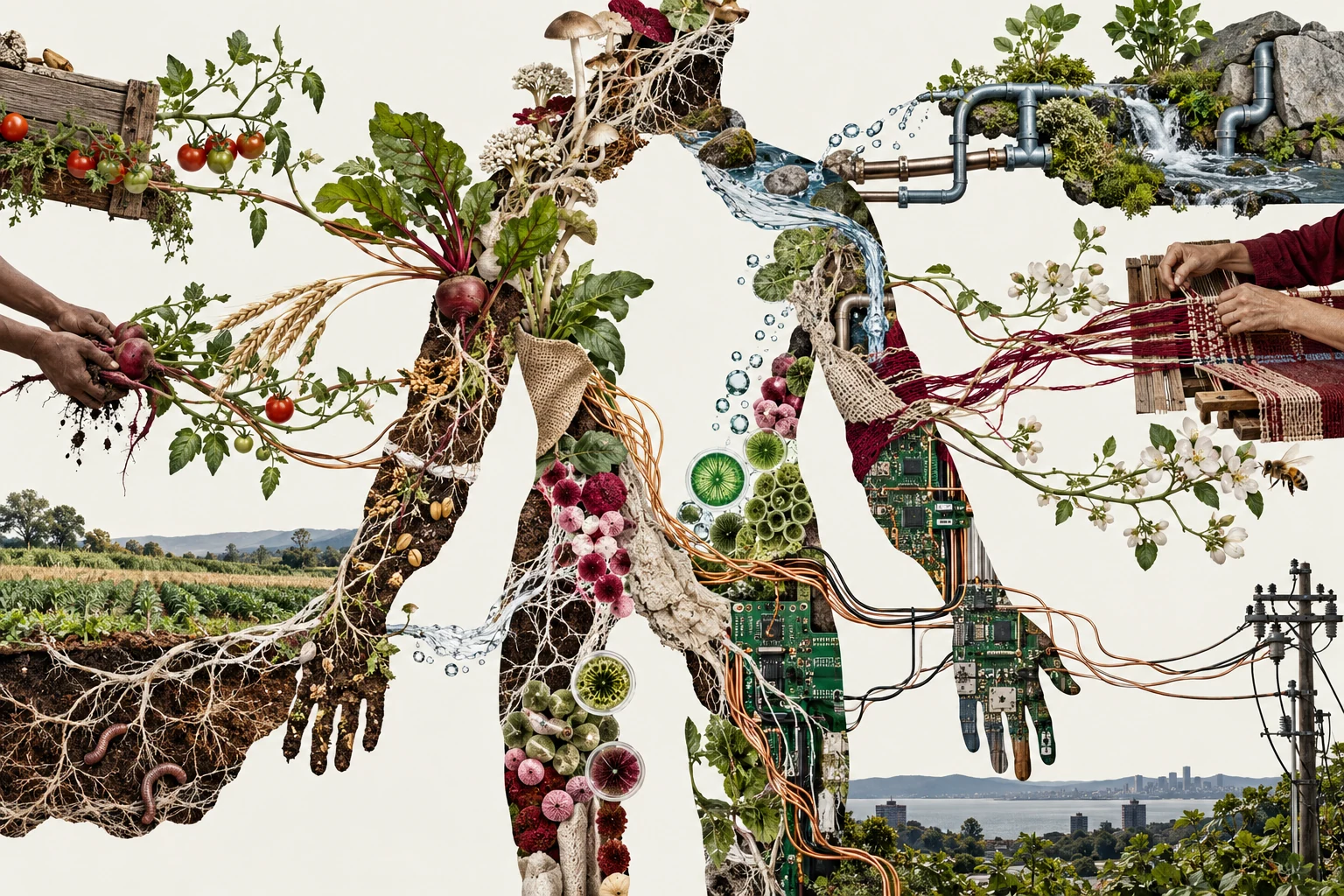
The human silhouette emerges from biological, social, and technical dependencies. The aim is to challenge human self-sufficiency and centrality, though the image also permits a broader systems reading.
AI-assisted illustration · conceptual metaphor View in visual quiz →Genesis and Global Lineage
The word has an exact birth date in literary theory: Ihab Hassan coined it in his essay Prometheus as Performer: Toward a Posthumanist Culture? (The Georgia Review, Winter 1977), calling it a “dubious neologism.” The contemporary concept was forged along three converging lines. The first was feminist science studies: in A Manifesto for Cyborgs (1985), Donna Haraway turned the cyborg into an ironic figure that breaches the boundaries between human and animal, organism and machine, and physical and non-physical, later shifting her focus toward “companion species” and multispecies cohabitation. The second was the history of cybernetics and literature: in How We Became Posthuman (1999), N. Katherine Hayles reconstructed how postwar cybernetics—from the Macy Conferences of 1946–1953 to 1990s artificial-life research—severed information from its material substrate and generated the fantasy of mind as a disembodied pattern ready to be uploaded into a computer; her posthumanism is explicitly embodied and aimed against that fantasy. The third was continental philosophy: Rosi Braidotti (The Posthuman, 2013), drawing on Spinoza, Gilles Deleuze, and feminist theory, combined the critique of anthropocentrism with an affirmative ethics of non-human life (zoe), while Cary Wolfe (What Is Posthumanism?, 2009) used Niklas Luhmann’s systems theory and Derridean deconstruction to draw a sharp boundary against transhumanism.
Central European Lineage
Long before the term entered Anglo-American theory, Stanisław Lem—who began his medical studies in Lwów (now Lviv, Ukraine) in 1940–1941 and 1944 before relocating after the war to Kraków and Jagiellonian University—formulated a remarkably parallel inquiry. In his philosophical-futurological treatise Summa technologiae (published in Kraków in 1964; translated into English by Joanna Zylinska for the University of Minnesota Press in 2013), Lem developed the concepts of “autoevolution”—humanity taking deliberate engineering control over its own biological design—and “phantomatics,” the generation of total virtual realities indistinguishable from physical experience. These are the very questions raised thirteen years later by Hassan and elaborated in 1980s and 1990s American posthumanism. As Paweł Majewski demonstrates in his monograph Between an Animal and a Machine: Stanisław Lem’s Technological Utopia (2007; English edition 2018), the convergence is substantive but independent: Lem and Western posthumanists belong to a shared postwar intellectual arc in which cybernetics and molecular biology destabilized the boundaries of the human, without either side drawing directly on the other (Hayles later wrote chapters on Lem’s fiction, though not on the Summa). One qualification is essential: Lem anticipated above all the technological, autoevolutionary strand of posthuman thought, yet paired it with a sober, skeptical analysis of how engineering projects to transcend human nature founder on their own internal contradictions.
Documented regional lineage · Link: 1. Compiled: October 2026.
-
anticipation 13 years
Central European Source: Stanisław Lem, “Summa technologiae”; Kraków, Poland (formation: Lwów, now Lviv, Ukraine; Kraków), 1964
Global Circulation: posthumanism and posthumanist culture — Ihab Hassan, 1977
anticipation
13 yearsStanisław Lem, “Summa technologiae”
1964 · Kraków, Poland (formation: Lwów, now Lviv, Ukraine; Kraków)
posthumanism and posthumanist culture
1977 · Ihab Hassan
- Claim & Connection
- In “Summa technologiae” (Wydawnictwo Literackie, Kraków 1964), Lem—who began his medical studies in Lwów (1940–1941, again in 1944) and continued them in Kraków from 1946—developed the project of autoevolution (humanity taking deliberate control over its own biological design) and phantomatics (artificial realities indistinguishable from natural reality). Closely related questions about the boundaries of the human were raised thirteen years later by Ihab Hassan and subsequently developed by American posthumanism in the 1980s and 1990s. In his monograph on Lem, Paweł Majewski judges these parallels to be substantive but independent: both projects belong to a single intellectual process without evidence of direct influence. The parallel concerns primarily the technological, autoevolutionary strand rather than Rosi Braidotti’s critique of anthropocentrism.
- Source Documentation
-
- bibliographic record Stanisław Lem, „Summa technologiae”, Wydawnictwo Literackie, Kraków 1964 (rekord Biblioteki Narodowej); bibliographic record: place, publisher, year. data.bn.org.pl ↗
- scholarly study Paweł Majewski, „Between an Animal and a Machine: Stanisław Lem's Technological Utopia”, przeł. Olga Kaczmarek, Peter Lang, Berlin 2018 (seria Modernity in Question, t. 10; open access, DOI 10.3726/978-3-653-06830-6); przekład monografii „Między zwierzęciem a maszyną. Utopia technologiczna Stanisława Lema”, Wydawnictwo Uniwersytetu Wrocławskiego, Wrocław 2007; publisher description: Part III “Autoevolution and Posthumanism”—a thematically related current that emerged independently. peterlang.com ↗
- biographical record Biografia Stanisława Lema, serwis solaris.lem.pl; medical studies in Lwów 1940–1941 and 1944, move to Kraków in 1946 (Jagiellonian University). solaris.lem.pl ↗
- primary source Ihab Hassan, „Prometheus as Performer: Toward a Posthumanist Culture?”, The Georgia Review, Winter 1977; journal page with article metadata (Winter 1977 issue). thegeorgiareview.com ↗
- Historical Context
- Anticipation rather than direct influence. Majewski reads posthumanism primarily as a technocratic project of overcoming biological limits (closer to what is today called transhumanism). There is no evidence that Hassan, Haraway, Hayles, or Braidotti cited “Summa technologiae” as a source of the concept; N. Katherine Hayles wrote on Lem’s fiction (chapters in “Chaos Bound,” 1990, and “My Mother Was a Computer,” 2005), not on the “Summa.”
Why Now
Three developments between 2016 and 2026 moved posthumanism from literary and art-theory seminars into public policy and technology debates. First, the IPCC’s 2018 Special Report on 1.5°C warming and subsequent IPBES biodiversity assessments gave the critique of anthropocentrism hard empirical footing: a species acting as a planetary geological force can no longer frame itself as an external spectator standing apart from “nature.” Second, the public release of large language models (starting with ChatGPT in November 2022) revived the exact debate Hayles had diagnosed in 1999: whether intelligence is a disembodied informational pattern independent of biological embodiment, and whether non-human systems can be authors, interlocutors, or legal persons. Third, the granting of legal personhood to non-human entities—from the Whanganui River in New Zealand and the Atrato River in Colombia to courtroom petitions over great apes and elephants—demonstrated that decentering the human has become an institutional legal question rather than a purely philosophical metaphor.
Explanatory Power
The concept reveals that the universal “Man” of classical humanism was always modeled on a specific historical figure—Leonardo da Vinci’s Vitruvian Man: adult, able-bodied, rational, property-owning, European, and male—while all other beings were ranked by their distance from that prototype. This insight reshapes three active fields. First, in artificial intelligence: embodied posthumanism explains why asking “does the machine think like a human?” starts from a false premise, since it assumes human cognition is disembodied symbol manipulation rather than an activity inseparable from a living body and its environment. Second, in animal ethics: instead of extending liberal individual rights only to great apes or dolphins that resemble “us” cognitively, posthumanism examines the material entanglements in which animals already live alongside humans as co-workers, ecological partners, and laboratory subjects. Third, in climate politics: it shows why geoengineering proposals to “manage the planet” often reproduce the very anthropocentric hubris—treating the Earth as an external machine for a human engineer—that produced the ecological crisis in the first place.
Axes of Debate
Critical posthumanism (Braidotti, Hayles, Wolfe) versus transhumanism (Bostrom, More)
Cary Wolfe and Rosi Braidotti argue that transhumanism is Enlightenment humanism on steroids: it keeps the autonomous, rational liberal subject intact and simply equips it with prosthetic upgrades and immortality ambitions. Transhumanists reply that critical posthumanism is an aesthetic and literary word game devoid of any constructive scientific or engineering program. Strongest counterargument: As Lem’s Summa technologiae and Majewski’s critique show, the prospect of biological autoevolution can be analyzed rigorously without either Silicon Valley hype or continental jargon; dismissing somatic enhancement as mere “ideology” does not answer what legal and ethical norms should govern germline editing and brain–computer interfaces once they become clinical routine. Nature of the dispute: mixed — beneath a terminological battle over who owns the prefix “post-” lies a substantive disagreement over whether technology is an instrument wielded by a pre-existing human subject or a medium that co-constitutes subjectivity itself.
Relational networks (Braidotti, Barad) versus withdrawn objects (Harman, Morton)
Object-oriented ontologists (Graham Harman, Timothy Morton) fault relational posthumanism for dissolving discrete things into flows, networks, and perpetual “becoming,” thereby still reducing beings to how they affect or relate to other beings. Strongest counterargument: Karen Barad and Braidotti reply that a completely “withdrawn object” is a metaphysical fiction that cannot be operationalized in either scientific experimentation or political action, whereas relational ontologies provide concrete tools for tracing how bodies, laboratories, and ecosystems co-produce one another. Nature of the dispute: substantive — a foundational metaphysical disagreement over whether entities precede their relations or emerge from them.
Decolonial critique: whose humanity is being declared over?
Decolonial theorists and Black humanists following Sylvia Wynter ask whether proclaiming the “end of Man” is an intellectual luxury of metropolitan elites whose own humanity was never questioned, whereas historically dehumanized groups still need the legal and political protections of humanism. Strongest counterargument: Haraway and Braidotti accept the historical premise of the critique, replying that critical posthumanism grew directly out of feminist and anticolonial critiques of the Vitruvian norm, and aims not to abolish political agency, but to rebuild it without the racial and species hierarchies baked into classical European humanism. Nature of the dispute: substantive — it concerns strategic political priority and whether one can deconstruct a legal category while still relying on its protections.
Underappreciated Angle
The most durable—and least read—component of posthumanism is its concrete history of science. In How We Became Posthuman, Hayles traced how specific technical choices at the postwar Macy Conferences on cybernetics (1946–1953), where Claude Shannon’s mathematical theory of information triumphed over Donald MacKay’s context-dependent model, stripped information of its material body—and how second-order cybernetics (Heinz von Foerster, Humberto Maturana, Francisco Varela) spent decades trying to put the observer’s body back into the system. That historical reconstruction is far more illuminating today than celebratory manifestos: current disputes over whether large language models “understand” meaning replay the 1950s clash between disembodied Shannon information and embodied autopoiesis almost verbatim, usually without any memory of the first round. A second overlooked angle comes from Central Europe: in postwar Poland and the Eastern Bloc, where cybernetics passed from ideological ban in the early 1950s to official enthusiasm in the 1960s as a science of economic planning and systems engineering, questions about the limits of the human were posed in the sober language of systems design rather than French poststructuralism—explaining both Lem’s early breakthrough in Kraków and the healthy skepticism of Polish scholars toward the more euphoric registers of Western posthumanist prose.
One-Sentence Takeaway
Posthumanism does not announce the extinction of human beings; it shows that the universal “Man” defended by classical humanism was always modeled on a privileged few at the expense of everyone—and everything—else.
Related Concepts Network
How this concept reinforces, constrains, or complements other analytical frameworks in the corpus. View on graph →
-
Agential realism reinforces
Barad supplies posthumanism with an ontology in which agency is not a property of a pre-existing human subject, but emerges from the “intra-action” of matter and measuring apparatuses.
-
Ontological turn complements
The anthropological ontological turn practices in ethnography what posthumanism argues in theory: treating non-human beings as co-participants in worlds rather than as the backdrop for human culture.
-
Anthropocene reinforces
The Anthropocene serves as posthumanism’s empirical warrant: a species that has become a geological force can no longer describe itself as an external observer of nature.
-
Object-oriented ontology (OOO) in tension
Object-oriented ontology shares the rejection of anthropocentrism, but faults relational posthumanism for dissolving things into networks and processes instead of respecting their withdrawn autonomy.
-
Hyperobjects complements
Morton’s hyperobjects decenter the human through vast temporal and spatial scale, whereas Braidotti’s posthumanism does so through entanglement with other life-forms and technologies.
-
Artificial general intelligence (AGI) in tension
The debate over artificial general intelligence revives precisely what critical posthumanism rejected: the fantasy of mind as a disembodied informational pattern that can be uploaded into a machine.
-
Enactivism reinforces
Enactivism provides cognitive-science backing for Hayles’s thesis that cognition is embodied and embedded in an environment rather than disembodied symbol manipulation.
-
Technological solutionism constrains
The critique of solutionism reminds us that technologically transcending human limits is often a commercial business model rather than an ontological breakthrough, separating Silicon Valley transhumanism from critical posthumanism.
Reading Canon & Translation Bridge
Foundational texts, introductions, and critical perspectives—with availability of English and Polish editions.
-
foundational text 2013 · English
Rosi Braidotti, The Posthuman
The most widely cited synthesis of critical posthumanism: diagnoses the crisis of classical humanism, critiques anthropocentrism, and proposes relational subjectivity (zoe) as an alternative to transhumanist enhancement.
In English: original text written in English
In Polish: “Po człowieku”, Wydawnictwo Naukowe PWN 2014, trans. Joanna Bednarek, Agnieszka Kowalczyk
-
foundational text 1985 · English
Donna Haraway, A Manifesto for Cyborgs: Science, Technology, and Socialist Feminism in the 1980s
The starting point of feminist posthumanism: the cyborg as an ironic figure that breaks down the boundaries of human/animal, organism/machine, and physical/non-physical without nostalgia for an Edenic natural wholeness.
In English: original text written in English
In Polish: “Manifest cyborgów: nauka, technologia i feminizm socjalistyczny lat osiemdziesiątych”, Przegląd Filozoficzno-Literacki 2003, trans. Sławomir Królak, Ewa Majewska
-
foundational text 1999 · English
N. Katherine Hayles, How We Became Posthuman: Virtual Bodies in Cybernetics, Literature, and Informatics
An intellectual history showing how cybernetics—from the Macy Conferences to artificial life—stripped information of its material body, and defending an embodied posthumanism against the fantasy of mind uploading.
In English: original text written in English
In Polish: no Polish edition
-
introduction & synthesis 2009 · English
Cary Wolfe, What Is Posthumanism?
The most systematic demarcation of critical posthumanism from transhumanism, combining Luhmann’s systems theory and Derridean deconstruction with animal studies as its primary testing ground.
In English: original text written in English
In Polish: no Polish edition
-
cross-disciplinary 1964 · Polish
Stanisław Lem, Summa technologiae
A futurological treatise on autoevolution, phantomatics, and information farming written before the term existed (English translation by Joanna Zylinska, University of Minnesota Press, 2013); shows how far one can probe the boundaries of the human using cybernetics and evolutionary biology alone.
In English: English edition not verified
In Polish: original text written in Polish
-
critical perspective 2007 · Polish
Paweł Majewski, Między zwierzęciem a maszyną. Utopia technologiczna Stanisława Lema
Reads Lem and Western posthumanism as two variants of technological utopianism rooted in Enlightenment rationalism, critically examining their blind spots around gender and bioethics (open-access English edition).
In English: “Between an Animal and a Machine: Stanisław Lem's Technological Utopia”, Peter Lang 2018, trans. Olga Kaczmarek
In Polish: original text written in Polish
-
introduction & synthesis 2010 · Polish
Monika Bakke, Bio-transfiguracje. Sztuka i estetyka posthumanizmu
A pioneering Polish monograph approaching posthumanism through bio-art and aesthetics; an accessible entry point for readers who prefer concrete artistic and biological practices over abstract manifestos.
In English: English edition not verified
In Polish: original text written in Polish