Ontology #043
Ontological turn
original term: ontological turn (Eng.) · zwrot ontologiczny w antropologii, perspektywizm amerindiański, antropologia ontologiczna
Global-circulation concept — no documented lineage in Central Europe. jump to documentation ↓
Working Definition
The ontological turn is a program in anthropology that treats differences across human societies not as competing interpretations of a single world, but as distinct worlds: where classical ethnography saw Indigenous “beliefs” about jaguar-persons, the ontological turn sees a different determination of what exists at all and what can occupy the position of a subject. Operationally, it requires taking interlocutors’ concepts literally and allowing them to transform the analyst’s own conceptual apparatus rather than translating them into ready-made Western categories. In its colloquial version, the slogan simply means “different cultures have different worldviews”; in its technical version, the exact opposite holds: Amerindian perspectivism posits one culture and multiple natures, rendering the category of “culture” itself suspect.
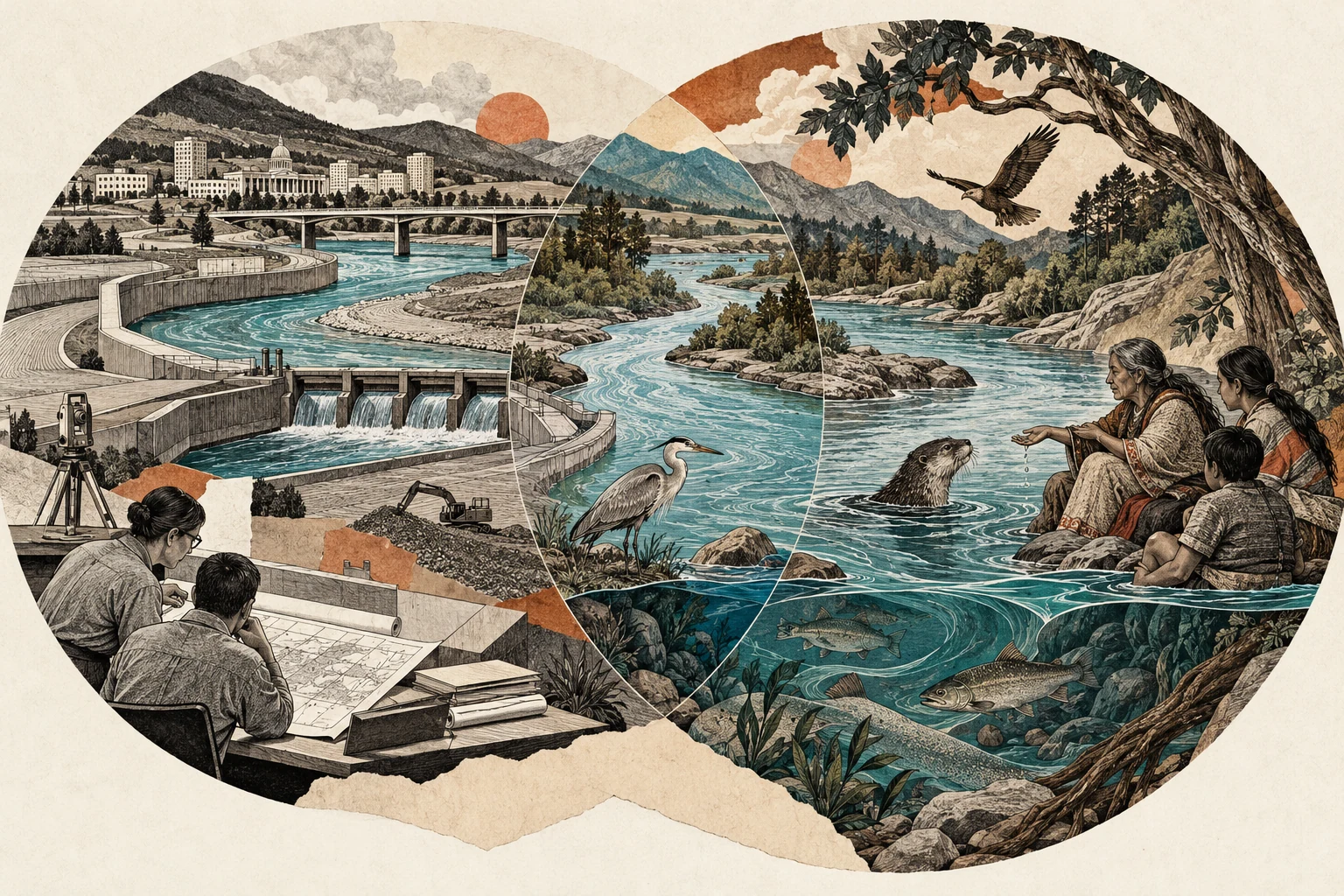
The river participates in distinct orders of relations and practices. The difference concerns what the world and its beings are, not merely differing opinions about one object.
AI-assisted illustration · conceptual metaphor View in visual quiz →Genesis and Global Lineage
The label crystallized in British social anthropology around 2007–2008 with the publication of Thinking Through Things, edited by Amiria Henare, Martin Holbraad, and Sari Wastell, and the February 9, 2008 Manchester debate of the Group for Debates in Anthropological Theory (GDAT) on the motion “Ontology is just another word for culture” (the motion lost 19 to 39; published in Critique of Anthropology 30(2), 2010). The movement draws on three main sources. The first is Eduardo Viveiros de Castro’s Amerindian perspectivism, formulated in Cosmological Deixis and Amerindian Perspectivism (1998) on the basis of Amazonian ethnography and in dialogue with Lévi-Strauss’s structuralism, Roy Wagner, and Marilyn Strathern. The second is the ontological typology of Philippe Descola (Par-delà nature et culture, 2005; Beyond Nature and Culture, 2013), a student of Lévi-Strauss, who reframed Western naturalism as merely one of four schemas of identification alongside animism, totemism, and analogism. The third is Bruno Latour and science studies, which from We Have Never Been Modern (1991/1993) dismantled the nature–society divide from the side of laboratories. Holbraad and Pedersen (The Ontological Turn, 2017) sharply distinguish this methodological program—a heuristic for experimenting with concepts—from phenomenological or metaphysical “ontologies.” The concept was subsequently picked up by the environmental humanities and Anthropocene debates, where it often circulates as a loose slogan of “many worlds” detached from ethnographic rigor.
Central European Lineage
We found no documented link between this concept and the intellectual history or historical experience of Central Europe.
We found no documented link between this concept and the intellectual history or historical experience of Central Europe (by our methodology, this means “none found,” not “none exists”; as of October 2026).
Why Now
Three processes have pushed the concept beyond anthropology seminars. First, the climate crisis and debates over the Anthropocene gave practical urgency to Descola’s and Latour’s thesis that “nature” is a provincial, modern invention: if naturalism is only one ontology among others, ecological devastation can be read as the consequence of a specific cosmology rather than of human nature as such. Second, the movement to grant legal personhood to rivers and ecosystems (New Zealand in 2017, followed by rulings and constitutional provisions in Colombia, India, and Ecuador) drew partly on Indigenous cosmologies that the ontological turn taught scholars to treat as determinations of being rather than folklore. Third, following Latour’s death in October 2022 and Descola’s growing prominence in European public debate, the current entered a phase of critical stocktaking: both proponents (Holbraad and Pedersen, 2017) and critics such as Bessire and Bond (2014) or Graeber (2015) debate whether “ontology” is an instrument for decolonizing knowledge or a new form of exoticization.
Explanatory Power
The concept exposes how much hidden work is performed by the assumption that there is one objective world and many subjective representations of it. First, it explains why conflicts over “traditional ecological knowledge” in conservation so often stall: Western institutions offer respect for a cultural “perspective,” while Indigenous interlocutors are speaking about who actually inhabits a river or mountain, leaving both sides convinced that the other is not listening. Second, it clarifies the mechanism Viveiros de Castro calls controlled equivocation: when an Amazonian shaman says that a jaguar sees blood as manioc beer, he is not describing an optical illusion, but stating the rule that the body determines perspective—and good translation must preserve that difference rather than explaining it away. Third, it provides categories for analyzing modernity itself: Western naturalism (one nature, many cultures) ceases to be the neutral background and becomes an object of ethnography, prompting us to ask which institutions (laboratories, courts, museums) produce and police that divide.
Axes of Debate
Ontology or culture in new clothes?
Michael Carrithers and Matei Candea in the 2008 GDAT debate, and later Pierre Charbonnier, Gildas Salmon, and Peter Skafish, argue that “multiple worlds” is cultural relativism with a rebranded label: the vocabulary changes, the conclusions remain the same. Strongest counterargument: Holbraad and Pedersen reply that the difference is methodological, not metaphysical: “culture” is a concept the anthropologist brings ready-made to the field, whereas “ontology” is what ethnographic inquiry must generate by allowing interlocutors’ concepts to reshape the researcher’s own. Nature of the dispute: mixed — some objections hit genuine ambiguities (what is a “world” that is not a culture?), while others are disputes over terminology.
Decolonizing knowledge versus a new exoticization
Writing from engaged ethnography, Lucas Bessire and David Bond (2014) argue that ontological anthropology defers political critique: it turns Indigenous communities entangled with state violence, Christian missions, and extractive industry into bearers of pristine cosmologies, protecting their “alterity” at the expense of their actual history. Strongest counterargument: Viveiros de Castro in Cannibal Metaphysics (2009/2014) inverts the charge: translating Indigenous thought into “culture” or “ideology” is the truly colonial gesture, and the program of “the permanent decolonization of thought” requires recognizing that Indigenous thinkers practice metaphysics, not folklore. Nature of the dispute: substantive — it concerns who has the authority to decide whether a given statement is a claim about being or a symptom of politics.
Critical realism against “ontological anarchy”
Drawing on Roy Bhaskar’s critical realism and his own fieldwork in Madagascar, David Graeber (2015) argues that anthropologists’ interlocutors themselves think epistemologically—they doubt, test, and distinguish what they know from what is—and that the ontological turn strips them of this critical capacity by enclosing them in self-contained “worlds.” Strongest counterargument: Proponents reply that Graeber’s realism presupposes the very thing at issue: a single underlying reality to which different societies have better or worse access, thereby guaranteeing in advance that modern Western science has the final word. Nature of the dispute: substantive — a classic dispute over relativism and realism, fought here on ethnographic terrain rather than in the philosophy of science.
Underappreciated Angle
The least discussed consequence of the ontological turn is not what it says about Amazonia, but what it does to the concept of ethnographic translation. If differences are ontological, ethnography ceases to be representation (describing a world that exists independently of the description) and becomes the invention of concepts—something closer to philosophy or literature than to empirical social science. This shifts the criteria of evaluation: an anthropological text is judged good not because it is true, but because its equivocations are controlled and generative. Yet the very move that liberates the discipline from positivism also deprives it of the tools to say that an ethnographic account is simply wrong, opening the door to aesthetic appropriation—where “other worlds” become a curatorial trope in art galleries or a marketing idiom for “holistic” commodities. The dispute over whether the ontological turn is a method or a metaphysics is ultimately a dispute over whether anthropology still has an obligation to verification.
One-Sentence Takeaway
The ontological turn does not claim that other peoples see the world differently; it claims that “seeing the same world differently” is our theory of difference, not theirs.
Related Concepts Network
How this concept reinforces, constrains, or complements other analytical frameworks in the corpus. View on graph →
-
Speculative realism complements
Both currents reject the primacy of epistemology over being, though anthropologists arrive at “multiple worlds” through ethnography while philosophers arrive there through a critique of correlationism.
-
Agential realism reinforces
Like Latour and Viveiros de Castro, Barad dissolves the divide between knowing subject and passive object; their differences concern whether the starting point is quantum physics or Indigenous cosmologies.
-
Posthumanism complements
The ontological turn supplies posthumanism with empirical cases of societies in which a jaguar, a river, or an ancestor can occupy the position of a person.
-
Anthropocene reinforces
Descola’s thesis that “nature” is a provincial Western invention serves both as a diagnosis of the roots of the climate crisis and as an argument for alternative ways of inhabiting the Earth.
-
Rights of nature reinforces
Granting legal personhood to rivers and forests is often justified through cosmologies that the ontological turn takes seriously rather than treating as metaphor.
-
Systems thinking in tension
Systems thinking presupposes a single world described at different levels; the ontological turn questions the very unity of the world within which feedback loops are supposed to operate.
Reading Canon & Translation Bridge
Foundational texts, introductions, and critical perspectives—with availability of English and Polish editions.
-
foundational text 1998 · English
Eduardo Viveiros de Castro, Cosmological Deixis and Amerindian Perspectivism
The article in the “Journal of the Royal Anthropological Institute” 4(3) that launched the debate over perspectivism: one culture, multiple natures, and the point of view creates the subject.
In English: original text written in English
In Polish: “Kosmologiczna deixis oraz perspektywizm indiański”, Etnografia. Praktyki, Teorie, Doświadczenia, t. 3 2017, trans. Mariusz Filip, Katarzyna Chlewińska
-
foundational text 2005 · French
Philippe Descola, Par-delà nature et culture
A typology of four ontologies (animism, totemism, analogism, naturalism) that turns the nature–culture opposition from a universal frame into one historical variant among others.
In English: “Beyond Nature and Culture”, University of Chicago Press 2013, trans. Janet Lloyd
In Polish: no Polish edition
-
foundational text 1991 · French
Bruno Latour, Nous n'avons jamais été modernes. Essai d'anthropologie symétrique
A diagnosis of the “Modern Constitution” separating nature from society; without it, it is hard to see why anthropologists began speaking of ontologies rather than cultures.
In English: “We Have Never Been Modern”, Harvard University Press 1993, trans. Catherine Porter
In Polish: “Nigdy nie byliśmy nowocześni. Studium z antropologii symetrycznej”, Oficyna Naukowa 2011, trans. Maciej Gdula
-
introduction & synthesis 2017 · English
Martin Holbraad, Morten Axel Pedersen, The Ontological Turn: An Anthropological Exposition
The single systematic exposition of the movement from within: tracing its genealogy from Wagner and Strathern to Viveiros de Castro, its methodological rules, and replies to critics.
In English: original text written in English
In Polish: Polish edition not verified
-
introduction & synthesis 2004 · English
Eduardo Viveiros de Castro, Perspectival Anthropology and the Method of Controlled Equivocation
A short, accessible statement of method: anthropology as the comparison of anthropologies, and translation as an operation that controls equivocation rather than eliminating it (“Tipití” 2(1)).
In English: original text written in English
In Polish: Polish edition not verified
-
critical perspective 2015 · English
David Graeber, Radical alterity is just another way of saying „reality”: A reply to Eduardo Viveiros de Castro
The sharpest polemic from within the discipline (“HAU” 5(2), pp. 1–41): defending ontological realism combined with theoretical relativism against “ontological anarchy.”
In English: original text written in English
In Polish: Polish edition not verified
-
critical perspective 2014 · English
Lucas Bessire, David Bond, Ontological anthropology and the deferral of critique
Charges ontological anthropology with deferring political critique and turning living communities entangled with states and markets into bearers of pure cosmologies (“American Ethnologist” 41(3), pp. 440–456).
In English: original text written in English
In Polish: Polish edition not verified
-
cross-disciplinary 2013 · English
Eduardo Kohn, How Forests Think: Toward an Anthropology Beyond the Human
Peirce’s semiotics applied to an Ecuadorian forest: an attempt to show that representation and thought are not the exclusive preserve of humans or language.
In English: original text written in English
In Polish: Polish edition not verified
Primary-Source Quotes
a realist ontology, combined with broad theoretical relativism, is a more compelling political position