Ontology #040
Object-oriented ontology (OOO)
original term: object-oriented ontology (Eng.) · ontologia zorientowana na przedmiot, filozofia zorientowana na przedmiot, object-oriented philosophy
Central European lineage: 2 threads (documented influence) · 1894–2009 · jump to documentation ↓
Working Definition
Object-oriented ontology (OOO, often pronounced “triple-O”) is a contemporary metaphysical school founded by Graham Harman holding that the universe is composed at every scale of autonomous objects—unified entities (from quarks, hammers, and oak trees to the Dutch East India Company, fictional characters, and global warming) that cannot be reduced downward to their physical components or upward to their relational effects. Its signature thesis is ontological withdrawal: real objects never touch or exhaust one another directly; whether a mind perceives a tree or a flame burns cotton, the interaction grasps only a translated caricature, leaving an inexhaustible surplus withdrawn from all relations. From this follow flat ontology (all objects stand on an equal metaphysical footing, dethroning the human–world relation) and vicarious causation (objects interact only through “sensual” appearances, making aesthetics the root of causality). In design talk, OOO is used loosely for “taking materiality seriously”; technically, it is Harman's four-pole architecture splitting Real Objects (RO) and Real Qualities (RQ) from Sensual Objects (SO) and Sensual Qualities (SQ).
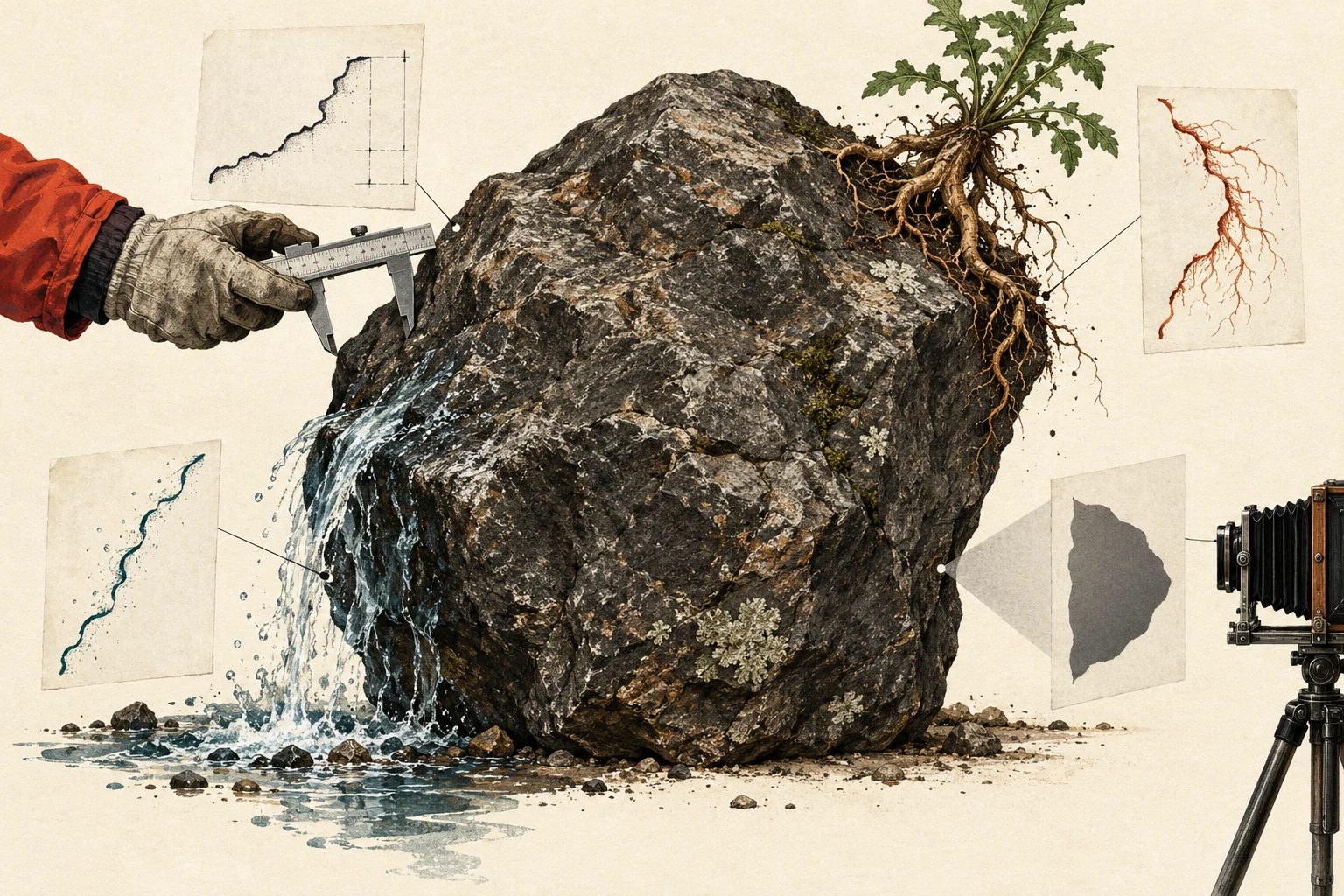
Measurement, root, water, and photography capture different aspects of the same thing without any encounter exhausting it, including non-human relations. Mere multiplicity of perspectives does not capture the entirety of OOO metaphysics.
AI-assisted illustration · conceptual metaphor View in visual quiz →Genesis and Global Lineage
Harman coined object-oriented philosophy in his 1999 DePaul doctoral dissertation, published in 2002 as Tool-Being: Heidegger and the Metaphysics of Objects. There he offered a heterodox reading of Martin Heidegger's Being and Time analysis of the hammer (Zuhandenheit, readiness-to-hand): when a carpenter uses a hammer smoothly, it withdraws from conscious awareness until it breaks. Mainstream phenomenologists read this as a lesson about human practical Dasein; Harman argued that withdrawal is the universal ontological condition of all entities—when a rock slams into a window, the rock also encounters only a thin slice of the window's reality. In 2007, Harman joined Quentin Meillassoux, Ray Brassier, and Iain Hamilton Grant at the Goldsmiths Speculative Realism workshop, and in 2009 Levi Bryant coined Object-Oriented Ontology (OOO) to unite Harman's work with Bryant (The Democracy of Objects, 2011), Ian Bogost (Alien Phenomenology, 2012), and Timothy Morton (Hyperobjects, 2013). By 2011 (The Quadruple Object), Harman had combined his Heideggerian “withdrawn real object” with an inverted reading of Edmund Husserl's “intentional object” and Bruno Latour's actor-network theory to complete his fourfold system, which migrated into architecture, curatorial practice, and ecology.
Central European Lineage
Two of the four poles of Harman's quadruple object have a documented Central European pedigree running through late-Habsburg Vienna, Moravia, and Lwów—a lineage Harman reconstructs in Prince of Networks (2009, pp. 136, 191–194). If Heidegger gave Harman the vertical axis of the withdrawn real object, the horizontal axis of the sensual object and its shifting qualities comes out of Franz Brentano's Vienna school via Kazimierz Twardowski and Edmund Husserl. Born in Prossnitz in Moravia (now Prostějov, Czechia) and educated in Vienna (earning his mathematics doctorate in 1883 and attending Brentano's lectures in 1884–1886), Husserl struggled with a riddle left by Brentano's doctrine of intentionality. In 1894, Brentano's younger Vienna student Kazimierz Twardowski—one year before moving to Lwów (now Lviv, Ukraine) to found the Lvov–Warsaw School—published his Vienna habilitation treatise Zur Lehre vom Inhalt und Gegenstand der Vorstellungen (On the Content and Object of Presentations). Twardowski argued that every presentation must be split into the immanent mental content (Inhalt) and the target object (Gegenstand). As Harman emphasizes (calling Twardowski “a rival and catalyst for the young Husserl even more than Brentano was”), Husserl reacted by folding that split inside the phenomenal realm itself: when I look at a mailbox from different angles, the sensory profiles (content) change every second, yet the intentional object—the unified mailbox—remains identical. Harman rechristens Husserl's intentional object the sensual object (SO) and pairs it with the Twardowskian real object outside the mind.
Documented regional lineage · Links: 2. Compiled: October 2026.
-
documented influence 115 years
Central European Source: Kazimierz Twardowski, “Zur Lehre vom Inhalt und Gegenstand der Vorstellungen”; Vienna, Austria-Hungary (now Austria), 1894
Global Circulation: the real object and the sensual object in OOO — Graham Harman, 2009
-
documented influence 108 years
Central European Source: Edmund Husserl, “Teoria przedmiotu intencjonalnego (wykłady Brentana w Wiedniu 1884–1886; „Intentionale Gegenstände” z lat 90. XIX w.; „Logische Untersuchungen” 1900–1901)”; Vienna, Austria-Hungary (now Austria); Halle, Germany, 1901
Global Circulation: the sensual object in Object-Oriented Ontology — Graham Harman, 2009
documented influence
108 yearsEdmund Husserl, “Teoria przedmiotu intencjonalnego (wykłady Brentana w Wiedniu 1884–1886; „Intentionale Gegenstände” z lat 90. XIX w.; „Logische Untersuchungen” 1900–1901)”
1901 · Vienna, Austria-Hungary (now Austria); Halle, Germany
the sensual object in Object-Oriented Ontology
2009 · Graham Harman
- Claim & Connection
- Harman explicitly adopts from Husserl the split between a unified intentional object and its shifting manifold of surface qualities, renaming Husserl's intentional object the “sensual object”—one of the two object poles of his fourfold ontology. Born in Prossnitz in Moravia (now Prostějov, Czechia), Husserl received his mathematical doctorate (1883) and his philosophical formation in Vienna under Franz Brentano (1884–1886).
- Source Documentation
-
- reception / translation Graham Harman, Prince of Networks: Bruno Latour and Metaphysics, re.press, Melbourne 2009; p. 136 (Husserl and “sensual objects”), pp. 193–194 (object and content in Husserl). re-press.org ↗
- biographical record Christian Beyer, „Edmund Husserl”, Stanford Encyclopedia of Philosophy; §1: Prossnitz 1859, Vienna 1881–1883 (doctorate), Brentano's lectures 1884–1886, habilitation in Halle 1887. plato.stanford.edu ↗
- Historical Context
- The year 1901 refers to the “Logical Investigations” (“Logische Untersuchungen”), from which Harman draws Husserl's account of the object given through shifting adumbrations; Harman introduces the term “sensual object” in “Prince of Networks” (2009) and systematizes it in “The Quadruple Object” (2011).
documented influence
115 yearsKazimierz Twardowski, “Zur Lehre vom Inhalt und Gegenstand der Vorstellungen”
1894 · Vienna, Austria-Hungary (now Austria)
the real object and the sensual object in OOO
2009 · Graham Harman
- Claim & Connection
- In the chapter “Object-Oriented Philosophy” of “Prince of Networks” (2009), Harman analyzes Kazimierz Twardowski's 1894 Vienna habilitation treatise, remarks that its title could be rewritten as “On Intentional and Real Objects,” and credits Twardowski as “a rival and catalyst for the young Husserl even more than Brentano was.” Twardowski's doubling of the presentation into mental content and target object—which Husserl subsequently folded inside the phenomenal realm—supplies Harman with the structural prototype for his own split between the real object and the sensual object.
- Source Documentation
-
- reception / translation Graham Harman, Prince of Networks: Bruno Latour and Metaphysics, re.press, Melbourne 2009; pp. 191–194, nn. 47–51 (Twardowski, On the Content and Object of Presentations, trans. R. Grossmann, Nijhoff 1977; Ingarden cited via Barry Smith). re-press.org ↗
- biographical record Arianna Betti, „Kazimierz Twardowski”, Stanford Encyclopedia of Philosophy; §1: Theresianum and University of Vienna (from 1885), student of Brentano, habilitation 1894, chair in Lwów from 1895; §2.1: “triggering effect” on Husserl. plato.stanford.edu ↗
- Historical Context
- Born and educated in Vienna, Twardowski moved in 1895 to Lwów (then in Austrian Galicia, later interwar Poland, now Lviv, Ukraine), where he founded the Lvov–Warsaw School; the habilitation treatise itself was written in Vienna. In n. 51 Harman notes that he does not read Polish and cites Roman Ingarden's assessment of Twardowski via Barry Smith's “Austrian Philosophy” (1994).
Why Now
Between 2018 and 2026, OOO consolidated as a theoretical language across three fields outside philosophy departments. First, in architecture and design theory (Harman's Object-Oriented Ontology: A New Theory of Everything, 2018, and Architecture and Objects, 2022), OOO provided an alternative to parametricism and functionalism: a building is neither a bundle of circulation flows (overmining) nor a raw pile of steel and concrete (undermining), but a formal autonomous object with tension between its structural reality and sensual presence. Second, in environmental humanities, Timothy Morton's OOO-derived concept of hyperobjects remained a widely used framework for explaining why ecological catastrophe defies traditional realist narrative: because global warming is non-local and withdrawn, no single hot afternoon or IPCC chart ever presents the whole object. Third, opaque frontier AI models after 2022 gave OOO's anti-reductionism fresh resonance: a multi-trillion-parameter neural network resists both undermining (raw weights tell little about what the model will do) and overmining (benchmark outputs miss its latent capacities).
Explanatory Power
Harman's most durable diagnostic is his twin critique of undermining and overmining—the two pincer movements by which modern thought tries to explain away mid-sized objects. Undermining claims that a thing (a table, a cell, a city) is “nothing but” a superficial aggregate of smaller pieces (atoms, quarks, selfish genes, or pre-individual flux). Overmining claims the opposite: that a thing has no reality underneath its appearances, being “nothing but” a bundle of sensory qualities, a node in discourse, or the sum of its current network effects (as in social constructivism or Latour's Actor-Network Theory). Often the two combine into duomining—declaring that nothing is real except subatomic particles and mathematical equations. Armed with this diagnostic, three problems look different. First, in historical sociology, OOO asks why the Dutch East India Company, the Polish state, or a university persists across centuries after every member and building has been replaced (refuting undermining) and during dormant periods when it exercises no external effects (refuting overmining): because an institution is an emergent real object. Second, in art criticism, OOO defends a formalism in which an artwork possesses a withdrawn structural autonomy resisting paraphrase. Third, in media archaeology (Ian Bogost), it shifts analysis to how technical objects—an Atari chip, a trading algorithm, a camera sensor—translate one another without humans in the loop.
Axes of Debate
Withdrawn real objects versus Kantian noumena in disguise (Wolfendale)
Rationalist philosopher Peter Wolfendale (Object-Oriented Philosophy: The Noumenon's New Clothes, 2014) and Ray Brassier argue that Harman's thesis—that real objects withdraw completely from direct access—merely takes Kant's unknowable thing-in-itself (noumenon) and projects it onto every stone and teacup, locking every object inside its own phenomenal bubble. Strongest counterargument: Harman replies that Kant's split was anthropocentric (pitting one human subject against an undifferentiated X), whereas OOO democratizes finitude into a universal principle: fire cannot exhaust the cotton ball it burns any more than a poet can, and indirect access through allusion and vicarious causation is how change and art happen. Nature of the dispute: substantive — whether positing an unformalizable, withdrawn core inside every entity explains causal autonomy or mystifies ignorance.
Substance ontology of discrete objects (Harman) versus process philosophy (Shaviro, Whiteheadians)
Process philosophers and new materialists (Steven Shaviro, Jane Bennett, followers of Whitehead, Deleuze, and Simondon) object that OOO revives an archaic Aristotelian metaphysics of static substances: in modern physics and biology, dynamic processes, fields, and relations come first, and “objects” are temporary eddies in a continuous flow. Strongest counterargument: Harman counters that if an entity were 100% exhausted by its current relations right now, it would have zero unspent reserve by which to detach from its context or act differently tomorrow; change itself requires that objects hold something back from their current relations. Nature of the dispute: substantive — a restaging of the metaphysical war between Heraclitean flux and Aristotelian substance.
Metaphor and aesthetics as “first philosophy” versus natural science
Philosophers of science charge that when Harman elevates metaphor (Homer's “wine-dark sea,” fusing sensual qualities of wine onto the withdrawn real object of the sea) to the paradigm of how we touch reality—and declares aesthetics first philosophy—OOO abandons empirical explanation for literary mystique. Strongest counterargument: Harman responds that natural science excels at mapping how objects break into pieces (undermining) and covary mathematically (overmining), and philosophy should stop being a handmaiden to physics; aesthetics is central to ontology because metaphor performs in miniature how two non-communicating substances enter into shared tension. Nature of the dispute: mixed — disagreement over the epistemic authority of physics is substantive, while the clash between analytic argument and Harman's aphoristic prose is stylistic.
Underappreciated Angle
Most readers encounter OOO through its exotic bestiary—“Latour litanies” of quarks, Popeye, tectonic plates, and plastic bags—and assume it is a philosophy about stuff. What is rarely appreciated is that Harman's system is a revival of occasionalism and theatrical rhetoric as the logic of causality. In seventeenth-century Islamic (Ash'arite) and Cartesian occasionalism (Nicolas Malebranche), two finite substances can never touch directly, so God must step in at every instant as the sole mediator. Harman calls himself the first secular occasionalist: real objects (RO1 and RO2) are so withdrawn that they can never touch directly; instead, they interact only inside the theatrical interior of a sensual vicar (vicarious causation), where RO1 confronts the sensual caricature (SO2) of the other. That is why Harman's work moves from metaphysics into architectural façade theory, Marshall McLuhan's media tetrad, and modernist painting: if nothing touches anything else in the raw, then mediation, translation, framing, and staging are not superficial human decorations added onto brute reality—they are the only mechanism by which anything in the cosmos ever affects anything else.
One-Sentence Takeaway
Things are neither reducible to the smaller pieces they are made of (undermining) nor exhausted by the effects they currently have on us (overmining)—and it is precisely the hidden reserve each object holds back from every relation that allows the world to change at all.
Related Concepts Network
How this concept reinforces, constrains, or complements other analytical frameworks in the corpus. View on graph →
-
Speculative realism complements
OOO was one of the four founding currents of the 2007 Speculative Realism workshop, breaking with Meillassoux's mathematical rationalism and Brassier's scientism in favor of a metaphysics of autonomous, withdrawn objects.
-
Hyperobjects reinforces
Timothy Morton builds “hyperobjects” directly on OOO's thesis of ontological withdrawal: global warming is a real object that massively outscales and withdraws from any local weather event we experience.
-
Agential realism in tension
Karen Barad holds that individual objects do not pre-exist their relational “intra-actions,” whereas OOO insists on the exact opposite: objects must exist prior to and in excess of their relations if anything is ever to change.
-
Ontological turn complements
Both movements reject the modern reduction of ontology to epistemology, but the anthropological ontological turn focuses on multiple human-enacted worlds whereas OOO focuses on object–object interactions even where no humans are present.
-
Network theory constrains
Harman admires Bruno Latour's flat democracy of human and non-human actors, yet critiques Actor-Network Theory for reducing an entity entirely to its current network of effects (“overmining”).
-
Posthumanism complements
OOO supplies posthumanism with a non-anthropocentric metaphysics in which human–world relations are treated as just one special case of object–object relations (like fire burning cotton).
-
Anthropocene reinforces
Ecology, architecture, and climate aesthetics in the Anthropocene became the primary arenas outside philosophy departments to adopt OOO's non-human scale.
Reading Canon & Translation Bridge
Foundational texts, introductions, and critical perspectives—with availability of English and Polish editions.
-
foundational text 2011 · English
Graham Harman, The Quadruple Object
The most compact systematic statement of Harman's metaphysics: two kinds of objects (real and sensual), two kinds of qualities (real and sensual), and the four tensions between them (time, space, essence, eidos).
In English: original text written in English
In Polish: “Traktat o przedmiotach”, Wydawnictwo Naukowe PWN 2013, trans. Marcin Rychter
-
introduction & synthesis 2018 · English
Graham Harman, Object-Oriented Ontology: A New Theory of Everything
The accessible Pelican Books introduction cited in the source list, featuring chapters on aesthetics, architecture, politics, and the critique of “undermining” and “overmining.”
In English: original text written in English
In Polish: no Polish edition
-
foundational text 2002 · English
Graham Harman, Tool-Being: Heidegger and the Metaphysics of Objects
Based on Harman's 1999 DePaul doctoral dissertation; reads Heidegger's famous analysis of the broken hammer (Zuhandenheit) against the grain as a universal ontology of how all objects withdraw from one another, not merely from human users.
In English: original text written in English
In Polish: no Polish edition
-
introduction & synthesis 2009 · English
Graham Harman, Prince of Networks: Bruno Latour and Metaphysics
Both the first treatise on Bruno Latour as a metaphysician and the book in which Harman most thoroughly works out his debt to Brentano, Twardowski, and Husserl (available open-access).
In English: original text written in English
In Polish: “Książę sieci. Bruno Latour i metafizyka”, Fundacja Augusta hr. Cieszkowskiego 2016, trans. Grzegorz Czemiel, Marcin Rychter
-
critical perspective 2014 · English
Peter Wolfendale, Object-Oriented Philosophy: The Noumenon's New Clothes
The most comprehensive philosophical critique of OOO: argues that Harman's withdrawn “real object” is simply Kant's unknowable thing-in-itself (noumenon) multiplied and projected onto every relation.
In English: original text written in English
In Polish: no Polish edition
-
cross-disciplinary 2012 · English
Ian Bogost, Alien Phenomenology, or What It's Like to Be a Thing
A videogame designer and media theorist brings OOO into media studies, proposing “ontography” and “carpentry” (building philosophical artifacts to explore how non-human things—from camera sensors to microprocessors—encounter their worlds).
In English: original text written in English
In Polish: no Polish edition
-
cross-disciplinary 2013 · English
Timothy Morton, Hyperobjects: Philosophy and Ecology after the End of the World
The flagship ecological application of OOO: entities such as global warming, Styrofoam, or the biosphere that are real objects yet so vast in time and space that humans only ever experience local slices of them.
In English: original text written in English
In Polish: no Polish edition
-
critical perspective 2006 · French
Quentin Meillassoux, Après la finitude. Essai sur la nécessité de la contingence
The rival pole within Speculative Realism: shares Harman's rejection of correlationism, but argues that mathematics gives direct, non-withdrawn rational access to the absolute.
In English: “After Finitude: An Essay on the Necessity of Contingency”, Continuum 2008, trans. Ray Brassier
In Polish: “Po skończoności. Esej o koniecznej przygodności”, Fundacja Augusta hr. Cieszkowskiego 2015, trans. Piotr Herbich
Primary-Source Quotes
In what follows I will often refer to ‘intentional objects’ with the unconventional name ‘sensual objects’.