Ontology #042
Agential realism
original term: agential realism (Eng.) · realizm sprawczy, intra-akcja
Global-circulation concept — no documented lineage in Central Europe. jump to documentation ↓
Working Definition
Agential realism is the ontological position formulated by Karen Barad according to which the primary unit of reality is not independent things interacting with one another, but phenomena: inseparable entanglements of “object” and “apparatus” out of which a specific agential cut carves the observed and the observing. Because the components of a phenomenon do not exist prior to their relation, Barad replaces interaction with the term intra-action: activity within a configuration that produces its own relata rather than finding them ready-made. Operationally, when asking about any entity, we ask what apparatus (laboratory, discursive, institutional) cut it out and what that apparatus is accountable for. While the colloquial version popular in pedagogy, art, and management studies boils down to the slogan “everything is entangled with everything else,” the technical version is sharper: entanglement is locally severed, and every cut carries ethical consequences.
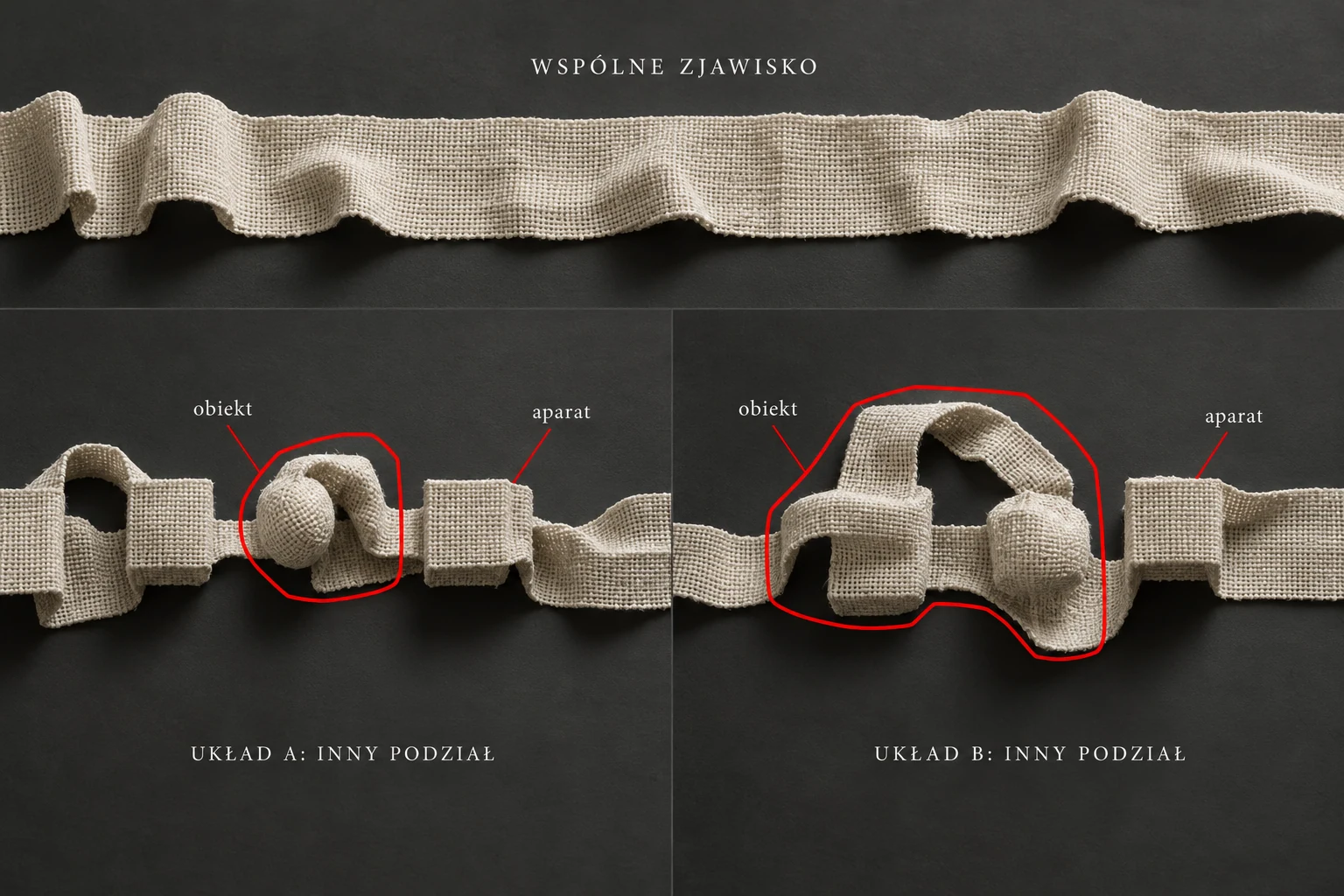
Object and apparatus are parts of a shared fabric whose boundary shifts with the setup. The metaphor illustrates how a cut is enacted within a phenomenon, though it does not exhaust Barad's full account.
AI-assisted illustration · conceptual metaphor View in visual quiz →Genesis and Global Lineage
Barad, a theoretical physicist with a doctorate in lattice gauge theory from Stony Brook, formulated the position in the 1990s (“Getting Real,” 1998), presented it programmatically in “Posthumanist Performativity” (Signs, 2003), and developed it at full length in Meeting the Universe Halfway (2007). Her point of departure is Niels Bohr’s philosophy-physics: the thesis that concepts such as position and momentum have determinate meaning only within a specific experimental arrangement, and that phenomena include that arrangement. Barad shifts this epistemological lesson onto the plane of ontology: indeterminacy is not a limit of our knowledge, but an ontological indeterminacy of the world that the apparatus resolves. A second lineage comes from feminist science studies: Donna Haraway’s “situated knowledges” and diffraction, Judith Butler’s performativity (which Barad extends from the human body to matter as such), and Michel Foucault’s analysis of dispositifs and apparatuses. Since the mid-2010s, the concept has been co-opted as a banner of new materialism and dissolved into a broad idiom of “relationality,” where the argument from physics often drops away and only the vocabulary remains.
Central European Lineage
We found no documented link between this concept and the intellectual history or historical experience of Central Europe.
We found no documented link between this concept and the intellectual history or historical experience of Central Europe (by our methodology, this means “none found,” not “none exists”; as of October 2026).
Why Now
The concept gained a second life when disputes over the status of knowledge ceased to be purely academic. After 2018, the environmental humanities needed a language in which climate, a virus, or microplastics are neither brute “facts of nature” nor mere “social constructions”; agential realism promised a third way. The COVID-19 pandemic of 2020–2022 displayed the apparatus in action: the PCR test, the cycle-threshold cutoff, and the administrative case definition enacted “a case of infection” as a phenomenon, showing that disputes over case numbers were disputes over agential cuts. In artificial intelligence research after 2022, the term intra-action has been used to describe how training data, model weights, and user prompts do not confront one another as pre-existing parties, but mutually calibrate and constitute one another. Meanwhile, reception in Central Europe has matured institutionally, marked in 2024 by the full Polish translation of Meeting the Universe Halfway co-published with the Center for Environmental Humanities at the University of Warsaw.
Explanatory Power
The greatest practical payoff of agential realism is that it refuses to let the apparatus remain invisible. First, in controversies over measurement (GDP, IQ, ESG scores, diagnostic thresholds), the question “does this indicator accurately measure the thing?” turns into “what thing does this indicator cut out, and whom does it render accountable?”—immediately revealing that two institutions using different cuts are not describing the same object. Second, in the ethics of technology, it allows us to speak of responsibility without attributing it either solely to a human subject or to “the algorithm”: accountability is a property of the configuration rather than of an isolated element, analyzed as the capacity to respond (response-ability). Third, in social-science methodology, it explains why the researcher can never step outside the arrangement and why “neutrality” is itself an agential cut that requires justification. The price is that the concept can just as easily explain everything, so its force depends on disciplined use: one must point to a concrete apparatus and a concrete cut, or else be left with a mantra.
Axes of Debate
Does ontology follow from quantum physics?
Trevor Pinch and other sociologists of science (2011) ask why Bohr’s interpretation in particular should serve as the foundation of metaphysics, given that physicists themselves disagree over the interpretation of quantum mechanics and that physics is a social practice that can be studied without adopting its conclusions as ontology. Strongest counterargument: Barad does not claim that her ontology follows deductively from experiment, but rather that Bohr’s philosophy-physics is the most thoroughly worked-out case of the inseparability of measurement and the measured; agential realism reads it diffractively alongside other traditions rather than as a proof. Nature of the dispute: mixed — in the background lies a substantive question about the status of the Copenhagen interpretation, but much of the exchange concerns the rhetorical license of humanities scholars to invoke quantum physics.
Relations before things versus things before relations
Object-oriented ontology (Graham Harman) and speculative realism charge relationalism with dissolving entities into their relations and thereby stripping them of their capacity to surprise us: if nothing exists prior to the cut, there is nothing left to discover. Strongest counterargument: Barad replies that pre-cut indeterminacy is real and recalcitrant; it is precisely what prevents apparatuses from carving out just any phenomenon at will, so realism remains realism, only without classical substances. Nature of the dispute: substantive — it concerns what should count as the basic unit of description and how to account for the world’s resistance to our practices.
An ethics of the cut versus an ethics without a subject
Critics from normative ethics and critical theory argue that extending agency to matter diffuses responsibility: if the configuration is responsible, no one is responsible, and the language of entanglement masks asymmetries of power. Strongest counterargument: Barad locates accountability squarely in the cut enacted within a specific apparatus, making her ethics more rather than less demanding: it forces us to interrogate every distinction that has been naturalized as given. Nature of the dispute: mixed — whether responsibility can be assigned without a sovereign subject is a substantive question, whereas charges of “mysticism” are largely rhetorical.
Underappreciated Angle
The least read chapters of Meeting the Universe Halfway are its political and historical case studies: Barad does not stop at the physics laboratory, but shows how obstetric ultrasound produces the “fetus” as a legal and political subject, and how military technologies produce a target. Here agential realism operates as a tool for analyzing institutions that, through the technical settings of their apparatuses, decide what publicly exists before any debate even begins. A second neglected thread is time: in Barad’s later writings on diffraction and haunting, the agential cut is neither singular nor irreversible, meaning that the past can be re-cut anew. This is closer to the work of archivists and historians than of physicists, and it explains why the concept has taken root in fields where no one measures momentum.
One-Sentence Takeaway
Do not ask what a thing is in isolation; ask what apparatus cut it out of entanglement and who is accountable for that cut.
Related Concepts Network
How this concept reinforces, constrains, or complements other analytical frameworks in the corpus. View on graph →
-
Posthumanism reinforces
Agential realism supplies posthumanism with an ontology in which the human is not an external observer, but one component of the world’s measuring apparatus.
-
Enactivism complements
Both approaches reject representationalism, but enactivism stops at the cognizing organism, whereas Barad extends co-constitution to inanimate matter and apparatuses.
-
Speculative realism in tension
Speculative realists seek a reality independent of all relations, whereas Barad argues that relations precede relata; both schools call themselves realism, but mean opposite things by it.
-
Object-oriented ontology (OOO) in tension
Harman charges relationalism with dissolving objects into relations; intra-action is precisely what OOO regards as a category mistake.
-
Ontological turn complements
The anthropological multiplicity of worlds and Barad’s multiplicity of agential cuts describe the same gesture: ontological differences are enacted in practices rather than found ready-made.
-
Extended mind constrains
The extended mind thesis preserves a boundary between subject and tool that it merely shifts outward; Barad denies that boundary any primary status and makes it an effect of measurement.
-
Hyperobjects complements
Morton and Barad both read twentieth-century physics as an argument against locality and the externality of the observer, though Morton retains objects while Barad privileges phenomena.
Reading Canon & Translation Bridge
Foundational texts, introductions, and critical perspectives—with availability of English and Polish editions.
-
foundational text 2007 · English
Karen Barad, Meeting the Universe Halfway: Quantum Physics and the Entanglement of Matter and Meaning
The monograph in which the entire architecture (phenomenon, apparatus, agential cut, intra-action, ethico-onto-epistem-ology) is laid out through Bohr’s interpretation of quantum mechanics and case studies from the laboratory and politics.
In English: original text written in English
In Polish: “Spotkanie z wszechświatem w pół drogi. Fizyka kwantowa a splątanie materii ze znaczeniem”, Wydawnictwo WBPiCAK w Poznaniu; Centrum Humanistyki Środowiskowej UW 2024, trans. Sławomir Królak
-
foundational text 2003 · English
Karen Barad, Posthumanist Performativity: Toward an Understanding of How Matter Comes to Matter
An article in “Signs” (vol. 28, no. 3, pp. 801–831), the most widely cited and concise statement of the position, moving from a critique of representationalism to a performative ontology of matter.
In English: original text written in English
In Polish: Polish edition not verified
-
cross-disciplinary 1958 · English
Niels Bohr, Atomic Physics and Human Knowledge
Bohr’s essays on complementarity and the inseparability of a phenomenon from its measuring arrangement; essential for seeing what Barad inherits and what she adds.
In English: original text written in English
In Polish: “Fizyka atomowa a wiedza ludzka”, Państwowe Wydawnictwo Naukowe 1963, trans. Wacław Staszewski, Armin Teske, Stanisław Szpikowski
-
critical perspective 2011 · English
Trevor Pinch, Review Essay: Karen Barad, Quantum Mechanics, and the Paradox of Mutual Exclusivity
A review essay in “Social Studies of Science” (vol. 41, no. 3, pp. 431–441): a sociologist of science asks why ontology should follow specifically from physics and why Barad bypasses sociological studies of quantum physics itself.
In English: original text written in English
In Polish: no Polish edition
-
introduction & synthesis 1988 · English
Donna Haraway, Situated Knowledges: The Science Question in Feminism and the Privilege of Partial Perspective
The article in “Feminist Studies” (vol. 14, no. 3) from which Barad draws the figure of diffraction and the program of objectivity without a view from nowhere; the best entry point into feminist science studies.
In English: original text written in English
In Polish: Polish edition not verified
-
introduction & synthesis 2021 · Polish
Monika Rogowska-Stangret, Być ze świata. Cztery eseje o etyce posthumanistycznej
Polish essays in the new materialist vein (published by słowo/obraz terytoria), reading agential realism as an ethics of responsibility for cuts rather than purely as metaphysics.
In English: English edition not verified
In Polish: original text written in Polish