AI Architecture #127
Artificial general intelligence (AGI)
original term: artificial general intelligence (Eng.) · sztuczna inteligencja ogólna, ogólna sztuczna inteligencja, AI na poziomie człowieka
Central European lineage: 1 thread (anticipation) · 1964–1997 · jump to documentation ↓
Working Definition
Artificial general intelligence (AGI) refers to a machine system capable of learning and performing a broad range of cognitive tasks at or above the level of a competent human without being re-engineered for each new domain. All three components of this definition are contested independently: breadth (how wide a range of tasks counts as general), depth (measured against an average worker, a specialist, or the pinnacle of human science), and autonomy (whether the system selects its own long-horizon goals or executes prompted instructions). Whereas popular usage equates AGI with “an AI that can do everything,” technical frameworks such as Google DeepMind’s 2023 taxonomy treat it as a multi-level matrix on which existing foundation models already occupy the lower rungs of general capability. In any serious analysis, one must first ask which of those three axes a speaker has in mind, because most disputes over whether AGI is imminent are actually disputes over definitions.
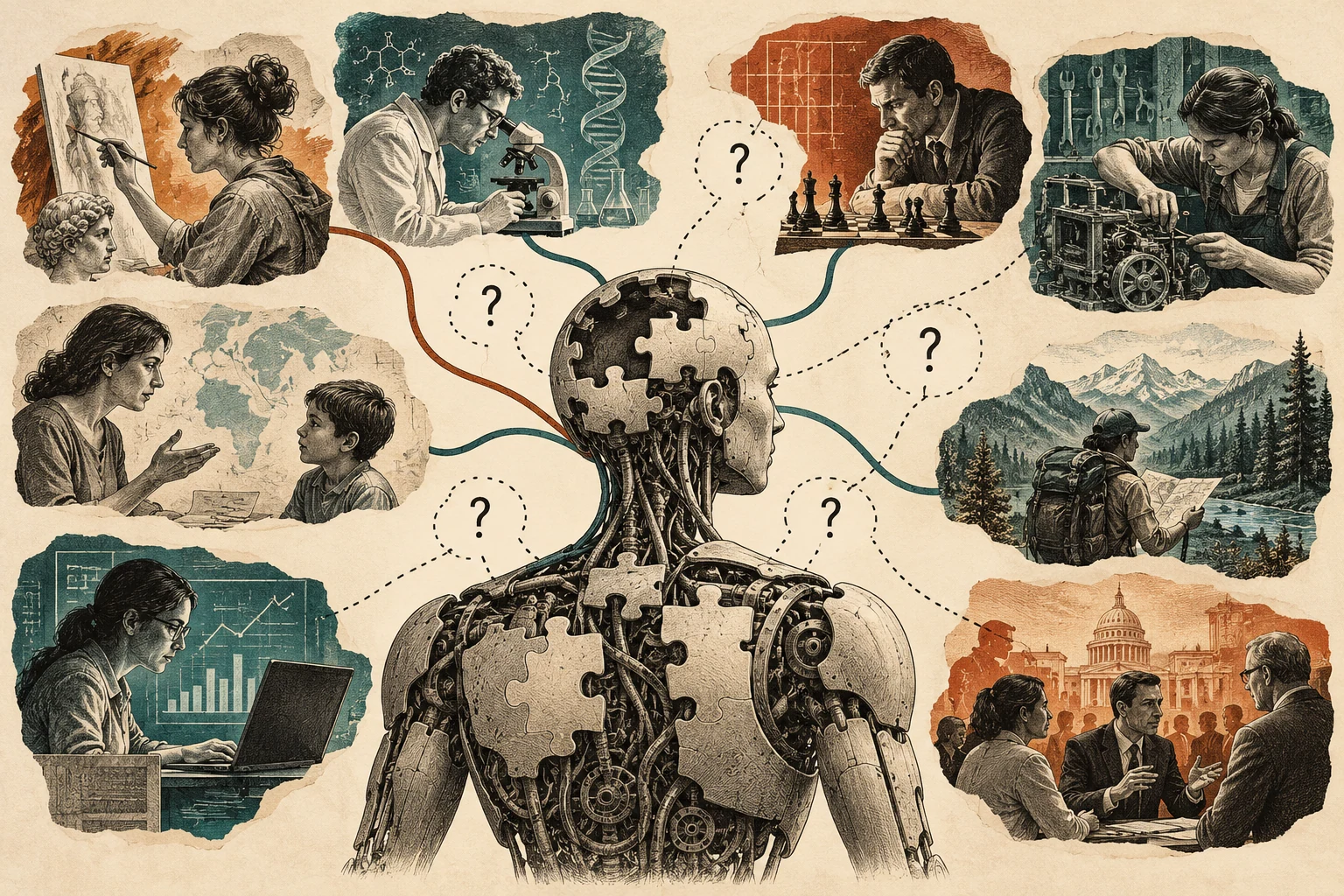
The system is meant to transfer capabilities across diverse, unfamiliar tasks; unfinished links represent an aspiration and contested criteria rather than achieved AGI.
AI-assisted illustration · conceptual metaphor View in visual quiz →Genesis and Global Lineage
The question of a generally thinking machine is as old as computer science: Alan Turing (1950) framed it through the imitation game, the 1956 Dartmouth workshop assumed every aspect of learning could be mechanized, and I. J. Good (1965) formulated the “ultraintelligent machine.” Yet the compound term artificial general intelligence appeared late and from the margins. Physicist Mark Gubrud used it in 1997 in an essay on automated nanotechnology and military systems, and around 2002 Shane Legg proposed the name to Ben Goertzel and Cassio Pennachin for an edited volume published by Springer in 2007. For Goertzel and the AGI conference series launched in 2008, “general” was a manifesto breaking with post-1990s “narrow AI,” which solved isolated tasks like chess or spam filtering. In 2007, Legg and Marcus Hutter formulated universal intelligence (weighting performance across all computable environments by Kolmogorov/Solomonoff complexity), before Legg co-founded DeepMind in 2010 with the slogan “solve intelligence.” Philosopher Nick Bostrom (Superintelligence, 2014) then cast AGI as the trigger for an existential control crisis, while OpenAI wrote AGI into its 2015 founding charter—turning a philosophical horizon into a clause in multi-billion-dollar commercial contracts, where AGI increasingly means an economic threshold (automating most economically valuable cognitive labor).
Central European Lineage
Half a century before the modern AGI debate crystallized in Silicon Valley and Oxford, the Polish writer and philosopher Stanisław Lem explored the same civilizational horizon in his philosophical treatise Summa technologiae (Wydawnictwo Literackie, Kraków 1964). In Chapter IV, “Intelektronika” (Intellectronics), Lem analyzed a future in which cybernetic “intelligence amplifiers” equal and surpass human cognitive capacity across scientific, administrative, and strategic domains. Dismissing pulp tropes of a melodramatic robot rebellion, Lem diagnosed a subtler epistemic trap: human civilization becoming structurally dependent on black-box cybernetic regulators whose solutions surpass the capacity of human scientists to verify or comprehend. Born in interwar Lwów (then Poland, now Lviv, Ukraine) in 1921, where he began medical studies in 1940 and witnessed Soviet and Nazi occupations before relocating to Kraków in 1945, Lem brought a skeptical Central European sensibility toward grand teleological systems to cybernetics. Because Summa technologiae was not translated into English until Joanna Zylinska’s 2013 edition (University of Minnesota Press), the anglophone AGI tradition—from Gubrud and Goertzel to Legg and Bostrom—developed without direct contact with Lem’s work, making this a striking historical anticipation rather than a chain of textual transmission.
Documented regional lineage · Link: 1. Compiled: October 2026.
-
anticipation 33 years
Central European Source: Stanisław Lem, “Summa technologiae, rozdz. IV „Intelektronika””; Kraków, Poland, 1964
Global Circulation: artificial general intelligence (AGI) — Mark Gubrud (termin, 1997); Shane Legg i Ben Goertzel (rozpowszechnienie, ok. 2002), 1997
anticipation
33 yearsStanisław Lem, “Summa technologiae, rozdz. IV „Intelektronika””
1964 · Kraków, Poland
artificial general intelligence (AGI)
1997 · Mark Gubrud (termin, 1997); Shane Legg i Ben Goertzel (rozpowszechnienie, ok. 2002)
- Claim & Connection
- In Chapter IV (“Intelektronika” / “Intellectronics”) of “Summa technologiae” (Wydawnictwo Literackie, Kraków 1964), Stanisław Lem—formed intellectually in interwar Lwów (where he began medical studies in 1940) and postwar Kraków (where he settled in 1945)—examined a future in which machine intelligence equals or surpasses human intelligence, analyzing the epistemic and civilizational consequences of “intelligence amplifiers.” This represents an independent, earlier formulation of the problem horizon; we found no evidence that Gubrud, Legg, Goertzel, or Bostrom drew on Lem.
- Source Documentation
-
- scholarly study Hasło „Summa technologiae”, Wikipedia (pl); section on chapters: Chapter IV “Intelektronika”; first edition 1964, Wydawnictwo Literackie. pl.wikipedia.org ↗
- scholarly study „Summa Technologiae”, serwis english.lem.pl (oficjalna strona Stanisława Lema); book description: anticipation of artificial intelligence and the technological singularity; English translation by Joanna Zylinska, University of Minnesota Press 2013. english.lem.pl ↗
- biographical record Hasło „Stanisław Lem”, Wikipedia (pl); biographical section: born 1921 in Lwów, medical studies in Lwów from 1940, relocation to Kraków in July 1945. pl.wikipedia.org ↗
- reception / translation Ben Goertzel, „Who coined the term AGI?”, goertzel.org; full post: Gubrud 1997 as earliest known usage; Legg proposes the term ca. 2002; Goertzel and Pennachin edited volume in Springer (dated 2005 in the blog post, 2007 in Springer catalogs). goertzel.org ↗
- Historical Context
- Lem writes about machines surpassing human intellect and about an “intelligence amplifier” rather than “generality” in the formal mathematical sense of Legg and Hutter; the parallel concerns the civilizational horizon and control dilemma rather than the formal definition.
Why Now
Until 2020, “AGI” was confined to rationalist blogs, a niche academic conference, and existential-risk books; three shifts moved it to the center of global politics and finance. First, scaling autoregressive Transformers from GPT-3 (2020) to GPT-4 (2023) and multimodal reasoning models demonstrated cross-domain transfer that narrow AI deemed impossible: a single pretrained network could pass bar exams, write code, translate languages, and debug proofs, prompting Microsoft researchers in March 2023 to claim “sparks of AGI” (sparking a controversy over test-set contamination). Second, AGI became a binding legal and geopolitical term: the OpenAI–Microsoft partnership tied profit caps and IP licenses to whether OpenAI’s board declared AGI achieved (reportedly benchmarked in 2025 negotiations to a $100 billion profit threshold), while the March 2023 pause letter and the November 2023 Bletchley Park AI Safety Summit placed general-purpose frontier systems on the agenda of heads of state. Third, measurement moved to structured taxonomies: Google DeepMind’s Levels of AGI (Meredith Ringel Morris et al., November 2023) and François Chollet’s ARC-AGI benchmark forced researchers to distinguish rote template memorization from on-the-fly skill acquisition, even as lab CEOs began quoting AGI timelines in years rather than decades.
Explanatory Power
Unpacking the concept separates three dimensions that public commentary tangles together. First is breadth versus depth: Stockfish or AlphaFold is superhumanly deep within a single formal ruleset while having zero competence outside it, showing why superhuman performance on one benchmark says nothing about general intelligence. Second is cognitive competence versus operational autonomy: a model can score in the 99th percentile on medical licensing or olympiad math problems in a single turn while lacking the ability to pursue a week-long engineering project across changing environments without human scaffolding; safety and labor policy must track autonomy as closely as test scores. Third is cognitive architecture versus economic substitutability: defining AGI as outperforming humans at most economically valuable work is a statement about labor markets and software interfaces, not minds, and could be satisfied by a patchwork of narrow tools without solving general reasoning. Through this lens, debates over whether LLMs “truly understand” become concrete empirical questions, contract clauses referencing AGI stand revealed as revenue triggers, and forecasts of “AGI by 2027” usually mean automating ML engineering workflows rather than universal intelligence.
Axes of Debate
Can generality be formalized without solving the philosophy of mind?
Theorists following Legg and Hutter—and operationalists like the DeepMind Levels of AGI team—argue that intelligence can be defined behaviorally as goal achievement across a distribution of environments or task benchmarks without metaphysical definitions of consciousness. Cognitive scientists like Melanie Mitchell and François Chollet reply that everything hinges on prior training data: without measuring sample efficiency (how fast a system learns a genuinely novel task from a few examples), benchmark breadth merely measures training-corpus size. Strongest counterargument: Even an imperfect behavioral matrix or benchmark like ARC-AGI yields falsifiable, comparative predictions across models, whereas appeals to “genuine comprehension” continually move the goalposts without specifying a decisive test. Nature of the dispute: substantive — concerning whether generality is a property of external task coverage or internal learning efficiency.
Will scaling existing paradigms suffice, or is a core architectural ingredient missing?
Proponents of the scaling hypothesis (at OpenAI, Anthropic, and DeepMind) contend that scaling Transformers, multimodal data, and test-time reinforcement learning provides a continuous path to human-level generality. Critics including Yann LeCun, Gary Marcus, and Hubert Dreyfus’s philosophical heirs argue that autoregressive token predictors lack grounded physical world models, persistent working memory, and causal planning. Strongest counterargument: Every specific capability wall declared insurmountable by skeptics between 2019 and 2025—multi-step arithmetic, working code generation, competition math, tool use—was breached within years through scale and inference search, shifting the burden of proof onto claims that the next barrier is qualitatively different. Nature of the dispute: mixed — an empirical question about scaling asymptotes, heavily amplified by billions of dollars in competing capital allocation.
Scientific north star versus ideological and financial instrument
Critical AI scholars (Timnit Gebru, Émile P. Torres, Meredith Whittaker) argue that “AGI” functions as an ideological narrative mobilizing venture capital, justifying energy and data extraction, and deflecting regulation away from immediate harms (copyright infringement, labor displacement, bias) toward speculative apocalypse. Frontier lab leaders reply that general-purpose capability is their explicit roadmap, and refusing to prepare for it out of distaste for hype would leave society defenseless. Strongest counterargument: That a concept serves the financial interests of its promoters does not entail that the capability trajectory is fake; nuclear physicists in the 1940s also used apocalyptic rhetoric to secure state funding, and the bomb still exploded. Nature of the dispute: rhetorical — the two camps talk past each other across a divide between political economy and capability forecasting.
Underappreciated Angle
The least appreciated dynamic surrounding AGI is a self-consuming measurement paradox: every benchmark that gains authority as a test of “general intelligence” immediately becomes an optimization target for training pipelines, destroying its validity as a measure of generality. Tasks universally cited forty years ago as hallmarks of general human intellect—grandmaster chess, idiomatic translation, code generation, bar exams—are routinely reclassified as “mere narrow pattern matching” the week after a model masters them (the AI effect). Consequently, the boundary of AGI recedes because humanity unconsciously defines “general intelligence” negatively—as whatever machines still cannot do today. Stanisław Lem saw the end of this loop in 1964: the decisive crisis arrives not when a machine passes a philosophical test of thinking “like a human,” but when human institutions begin acting on machine-generated strategies whose validity no human committee can check.
One-Sentence Takeaway
Every debate over whether artificial general intelligence is two years or fifty years away is secretly a dispute over which of three dimensions—task breadth, expert depth, or autonomous agency—counts as the finish line, and whoever controls that definition controls the timetable for both capital investment and public regulation.
Related Concepts Network
How this concept reinforces, constrains, or complements other analytical frameworks in the corpus. View on graph →
-
Frontier AI complements
“Frontier AI” names the most capable models currently in existence, whereas AGI names the aspirational horizon toward which they are directed; the former is an operational regulatory category, the latter a programmatic goal.
-
Scaling laws reinforces
Empirical scaling laws supplied the core argument that the path to AGI runs through scaling compute and training data rather than awaiting a fundamentally new theoretical paradigm.
-
AI alignment complements
The technical alignment program acquires its full urgency under the assumption that humanity will build a general, autonomous system whose goals cannot simply be patched after deployment.
-
Existential risk reinforces
Since Bostrom’s work, AGI has served as the primary candidate source of technological existential risk because it combines cross-domain generality with potential recursive self-improvement.
-
Emergence in tension
The debate over whether capabilities in large models are genuinely emergent is at bottom a debate over whether general intelligence will arrive abruptly or accumulate smoothly and predictably.
-
Goodhart’s law constrains
Every benchmark proposed as a test of AGI ceases to measure generality the moment laboratories optimize directly against it, explaining why conquered leaderboards never settle the debate.
Reading Canon & Translation Bridge
Foundational texts, introductions, and critical perspectives—with availability of English and Polish editions.
-
foundational text 2007 · English
Ben Goertzel, Cassio Pennachin (red.), Artificial General Intelligence
The edited volume (Springer, Cognitive Technologies series) that established the term in academic circulation, framing AGI as a research program distinct from narrow task-specific AI long before the rise of large language models.
In English: original text written in English
In Polish: no Polish edition
-
foundational text 2007 · English
Shane Legg, Marcus Hutter, Universal Intelligence: A Definition of Machine Intelligence
Formulates a mathematical definition of intelligence as an agent’s expected performance across all computable environments weighted by Solomonoff complexity—the most rigorous attempt to give “generality” formal meaning.
In English: original text written in English
In Polish: no Polish edition
-
introduction & synthesis 2014 · English
Nick Bostrom, Superintelligence: Paths, Dangers, Strategies
The book that moved AGI and superintelligence from niche forums into public debate and tied them to the control problem; best read critically because it treats an “intelligence explosion” as a starting premise rather than an empirical hypothesis.
In English: original text written in English
In Polish: Polish edition not verified
-
introduction & synthesis 2023 · English
Meredith Ringel Morris i in., Levels of AGI for Operationalizing Progress on the Path to AGI
Google DeepMind’s proposal to replace binary “is it AGI yet?” debates with a matrix measuring depth (performance percentile), breadth (generality across tasks), and autonomy level; now the most widely cited operational taxonomy.
In English: original text written in English
In Polish: no Polish edition
-
critical perspective 2024 · English
Melanie Mitchell, Debates on the nature of artificial general intelligence
A concise essay in “Science” demonstrating that contemporary disputes over how close we are to AGI are largely disputes over the unexamined concept of intelligence itself rather than disagreements over engineering facts.
In English: original text written in English
In Polish: no Polish edition
-
critical perspective 1972 · English
Hubert L. Dreyfus, What Computers Can't Do: A Critique of Artificial Reason
The classic phenomenological critique of symbolic AI: human general intelligence presupposes an embodied, non-formalizable background of common-sense skills—an argument that resurfaces in every debate over the limits of disembodied language models.
In English: original text written in English
In Polish: Polish edition not verified
-
cross-disciplinary 1964 · Polish
Stanisław Lem, Summa technologiae
Chapter IV (“Intellectronics”) poses the question of machines surpassing human cognition and asks what a civilization does when it can no longer understand the answers produced by its own “intelligence amplifiers.”
In English: “Summa Technologiae”, University of Minnesota Press 2013, trans. Joanna Zylinska
In Polish: original text written in Polish