Culture & Power #148
Biopolitics
original term: biopolitique (Fr.) · biowładza, biopolitics, biopouvoir
Central European lineage: 1 thread (historical experience) · 1940–1998 · jump to documentation ↓
Working Definition
Biopolitics is a form of power whose object is the biological life of human beings taken as a population: birth and mortality rates, morbidity, fertility, life expectancy, public hygiene, and racial classification. Unlike disciplinary power, which trains and punishes individual bodies in barracks, schools, or prisons, biopolitics measures, normalizes, and optimizes an entire collectivity through demography, epidemiology, social insurance, and urban planning. In Michel Foucault’s technical sense, it is the historical regime of power that emerged in the eighteenth century to “make live and let die”; in loose contemporary usage, the word is applied to almost any political dispute involving the body—abortion, vaccination mandates, masks, or gender. Keeping the two distinct is essential, because loose usage obscures Foucault’s central insight: that power over life operates primarily through care, statistical norms, and optimization rather than through legal prohibition.
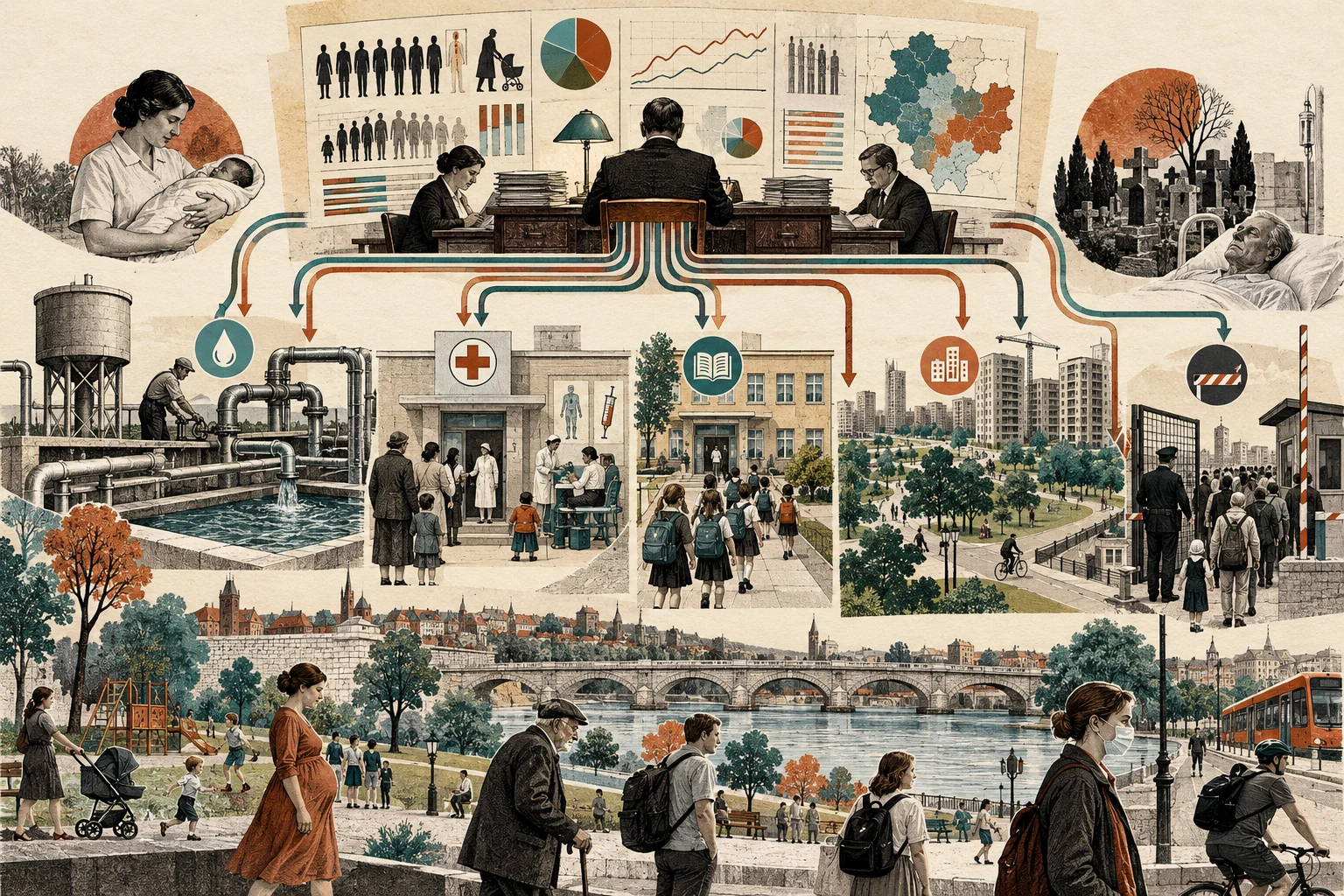
Institutions organize population life through care, administration, and regulation, showing how power operates productively by shaping conditions of living.
AI-assisted illustration · conceptual metaphor View in visual quiz →Genesis and Global Lineage
The word itself was coined by the Swedish political scientist Rudolf Kjellén (1905; developed in Staten som lifsform, 1916) in an organicist register that treated the state as a living organism. Its contemporary meaning comes from Michel Foucault, who in the final chapter of The History of Sexuality, Vol. 1 (La volonté de savoir, 1976) and in his Collège de France lecture of March 17, 1976 (“Society Must Be Defended”) traced the historical shift from the sovereign right of the sword (“to take life or let live”) to modern biopower (“to foster life or disallow it to the point of death”), operating across two poles: the anatomo-politics of the human body and the biopolitics of the population. In his 1977–1979 lectures Foucault shifted emphasis toward “governmentality” (gouvernementalité) and liberalism as an art of governing populations. A second wave arrived with Giorgio Agamben (Homo Sacer, 1995), who fused Foucault with Carl Schmitt’s theory of the state of exception and Hannah Arendt’s reflections on statelessness (first published in Poland in 1989 by the underground samizdat press NOWa): for Agamben, sovereign power has from antiquity produced “bare life” (nuda vita), making the concentration camp rather than the clinic the hidden matrix of modern politics. Roberto Esposito (2004) added the paradigm of “immunization,” Michael Hardt and Antonio Negri inverted the term to celebrate the productive biopolitical power of the multitude, and Achille Mbembe (2003) charged the European canon with Eurocentrism, introducing “necropolitics” to describe colonial and occupied spaces governed through the administration of death.
Central European Lineage
The documented link to Central Europe concerns a historical site and extreme experience on the region’s soil rather than a theorist’s academic formation. In the third volume of his Homo Sacer series (Quel che resta di Auschwitz, 1998; English Remnants of Auschwitz, 1999), Giorgio Agamben builds his theory of testimony and of the biopolitical threshold between the human and the non-human on the figure of the Muselmann in the German Nazi concentration and extermination camp Auschwitz-Birkenau in occupied Oświęcim, Poland—the prisoner reduced by starvation and exhaustion to radical apathy and sheer biological survival, known globally from Primo Levi’s If This Is a Man and in Polish literature from the camp stories of survivor Tadeusz Borowski. While Agamben’s first volume (1995) reconstructs the juridical genealogy of the camp largely from German legal history—Prussian “protective custody” (Schutzhaft), the emergency decree of February 28, 1933, and the opening of Dachau—it is Auschwitz that becomes in the philosophical literature the central test case for his thesis that the camp is the nomos of modernity, provoking sharp debate from historians and philosophers who object that turning Auschwitz into a general paradigm of modern governance flattens the historical specificity of the Shoah.
Documented regional lineage · Link: 1. Compiled: October 2026.
-
historical experience 58 years
Central European Source: Niemiecki obóz koncentracyjny i zagłady w okupowanej Polsce; relacje więźniów (m.in. Primo Levi) o »muzułmanach« — Obóz Auschwitz-Birkenau i figura »muzułmana« (Muselmann); Auschwitz (Oświęcim), German-occupied Poland (now Poland), 1940
Global Circulation: the camp as the biopolitical paradigm of the modern; the Muselmann as the figure of bare life — Giorgio Agamben, 1998
historical experience
58 yearsNiemiecki obóz koncentracyjny i zagłady w okupowanej Polsce; relacje więźniów (m.in. Primo Levi) o »muzułmanach« — Obóz Auschwitz-Birkenau i figura »muzułmana« (Muselmann)
1940 · Auschwitz (Oświęcim), German-occupied Poland (now Poland)
the camp as the biopolitical paradigm of the modern; the Muselmann as the figure of bare life
1998 · Giorgio Agamben
- Claim & Connection
- In the third volume of his “Homo Sacer” series (“Quel che resta di Auschwitz”, 1998; English “Remnants of Auschwitz”, 1999), Agamben builds his theory of testimony and of the biopolitical threshold between the human and the non-human on the figure of the “Muselmann” in Auschwitz, known from the accounts of Primo Levi and other survivors. While the first volume (1995) reconstructs the legal structure of the camp primarily from German material (Schutzhaft, Dachau), Auschwitz becomes the central historical case against which the literature tests his thesis of the camp as the biopolitical paradigm of modernity.
- Source Documentation
-
- scholarly study Hasło „Muselmann”, Wikipedia (en); paragraph on Agamben: the Muselmann as the key exemplar of bare life; Levi’s note in “If This Is a Man”. en.wikipedia.org ↗
- scholarly study Hasło „Homo Sacer: Sovereign Power and Bare Life”, Wikipedia (en); list of volumes in the series: “Quel che resta di Auschwitz. L’archivio e il testimone” (1998); English trans. Daniel Heller-Roazen, Zone Books 1999. en.wikipedia.org ↗
- primary source Giorgio Agamben, Homo Sacer: Sovereign Power and Bare Life, przeł. Daniel Heller-Roazen, Stanford University Press 1998; Part III, §7.1 (“The Camp as the ‘Nomos’ of the Modern”): the camp as the “hidden matrix and nomos” of politics; §7.1–7.2: Schutzhaft, decree of February 28, Dachau 1933; closing “Threshold” of Part III: the Muselmann from Primo Levi’s account as the extreme figure of the camp inhabitant. public.3.basecamp.com ↗
- bibliographic record Giorgio Agamben, Co zostaje z Auschwitz. Archiwum i świadek, przeł. Sławomir Królak, Wydawnictwo Sic!, Warszawa 2008, ISBN 9788360457511; National Library of Poland catalog record (API data.bn.org.pl). data.bn.org.pl ↗
- bibliographic record Giorgio Agamben, Lo que queda de Auschwitz. El archivo y el testigo. Homo sacer III, przeł. Antonio Gimeno Cuspinera, Pre-Textos 2005; table of contents in the Universidad de Cuenca catalog: 1. El testigo, 2. El musulmán, 3. La vergüenza, o del sujeto, 4. El archivo y el testimonio. vufind.ucuenca.edu.ec ↗
- Historical Context
- The link concerns a place and historical experience rather than an author’s formation: Agamben, Foucault, Esposito, and Mbembe were not trained in the region. Verification 2026-10: in the text of “Homo Sacer” (1995), the Muselmann from Levi’s account appears in the closing “Threshold” of Part III, and Chapter 2 of Volume III is devoted entirely to “Il musulmano” (The Muselmann).
Why Now
The COVID-19 pandemic (2020–2022) turned biopolitics into front-page vocabulary: lockdowns, digital vaccine passports, intensive-care triage protocols, and epidemiological R-number models dictating whether citizens could leave their homes. When Giorgio Agamben published L’invenzione di un’epidemia on February 26, 2020, denouncing emergency public-health measures as the normalization of the state of exception, the resulting dispute split continental philosophy (drawing sharp replies from Jean-Luc Nancy, Roberto Esposito, and Sergio Benvenuto) and demonstrated how easily the critique of biopower could slide into a refusal of civic solidarity. Simultaneously, struggles over reproductive rights—most notably the Polish Constitutional Tribunal’s ruling of October 22, 2020 imposing a near-total ban on abortion, followed by the US Supreme Court’s Dobbs decision in 2022—reconfirmed that state regulation of fertility remains a core battlefield of biopower. A third front opened in digital technology: population-scale genomic biobanks, actuarial health scoring in insurance, biometric surveillance in Xinjiang, and post-2018 debates over “algorithmic biopolitics.” Finally, full-scale warfare after 2022 made Mbembe’s necropolitics indispensable for analyzing siege, infrastructure destruction, and border regimes—from Mariupol and Gaza to pushbacks along the Polish–Belarusian border since 2021, where migrants are held in a legal limbo of bare survival.
Explanatory Power
The concept makes power visible where the classical vocabulary of laws, rights, and prohibitions sees only technical administration. First, in public health: a national vaccination schedule, a cancer registry, or a pro-natalist family subsidy does not operate by threatening citizens with the scaffold, yet it shapes the biological composition and longevity of the population; biopolitics explains why disputes over mask mandates or quarantine rules quickly became disputes over political sovereignty. Second, in state racism: Foucault showed in his 1976 lectures that a power whose mission is to “make live” faces a paradox whenever it wishes to kill or expose to death, and resolves that paradox by introducing a biological caesura within the population between life worth fostering and life treated as a threat or burden—illuminating the structural continuity between early twentieth-century eugenics and contemporary rhetoric about “burdens on the healthcare system.” Third, at borders: airport transit zones, detention centers, and forest pushback zones are spaces where human beings are managed as biological bodies rather than legal subjects, combining Agamben’s state of exception with Mbembe’s politics of letting die.
Axes of Debate
Historical modernity (Foucault) versus archaic structure of sovereignty (Agamben)
Historians and Foucauldian sociologists (such as Thomas Lemke and Judith Butler in Precarious Life) argue that by ontologizing biopolitics and projecting it back to archaic Roman law (homo sacer), Agamben erases what is most valuable in Foucault: the historical contingency of specific administrative techniques and the local possibilities of resistance. Strongest counterargument: Agamben replies that Foucault never adequately explained why a modern power devoted to fostering life produced the twentieth century’s unprecedented genocides; only the concepts of bare life and the sovereign exception connect the public-health clinic to the extermination camp. Nature of the dispute: substantive — it concerns whether biopolitics is a specific modern historical epoch or the permanent transhistorical structure of Western sovereignty.
Fostering life versus administering death (Mbembe’s necropolitics)
Achille Mbembe and postcolonial scholars argue that Foucault’s model of a power that “makes live and lets die” describes the European metropolitan welfare state, whereas on the slave plantation, in the colony, and under military occupation, sovereignty has always operated by creating “death-worlds” and exposing whole populations to destruction. Strongest counterargument: Foucauldians respond that state racism in Foucault’s March 1976 lecture is precisely the mechanism that translates biopower into mass death; necropolitics does not refute biopolitics, but expands its chapter on colonial racism to a global scale. Nature of the dispute: mixed — an empirical shift in which historical cases are treated as paradigmatic is often staged as a fundamental theoretical refutation.
Critique of biopower versus defense of public health (post-2020)
Epidemiologists and public-health ethicists after 2020 fault radical critics of biopolitics (above all Agamben) for equating temporary infection control and vaccination with totalitarian selection, thereby supplying philosophical alibis for anti-scientific libertarianism. Strongest counterargument: Without the critical lens of biopolitics, public debate lacks the tools to name what was genuinely troubling during the pandemic: age-based ICU triage formulas, stark vaccine apartheid between the Global North and Global South, and emergency digital-surveillance infrastructures that outlived the medical emergency. Nature of the dispute: rhetorical — the two sides rarely disagree over epidemiological facts, clashing instead over whether emergency health administration may legitimately be compared to the logic of the camp.
Underappreciated Angle
At its operational core, biopolitics is the power of counting. Foucault emphasized that “the population” only comes into existence as a governable object alongside modern statistics: mortality tables, censuses, birth registers, and probability calculus. That administrative thread—often overshadowed in humanities departments by high-altitude philosophical debates over “bare life”—is today the most consequential layer of the concept. Epidemiological compartmental models, Quality-Adjusted Life Year (QALY) thresholds used by health agencies to price drugs, hospital readmission risk algorithms, and genomic databases are not ideological superstructures sitting atop biopolitics; they are its actual machinery. Asking who defines the unit of account for human life (QALYs, excess mortality, total fertility rate) is a far more concrete inquiry into contemporary sovereignty than invoking the state of exception in the abstract. In Central Europe, the long administrative continuity of state statistics—from eighteenth-century Habsburg cameralism and Medizinische Polizei through the sanitary and demographic campaigns of postwar state socialism—remains one of the richest, least explored laboratories of biopower in practice.
One-Sentence Takeaway
The most pervasive modern power is not the sovereign who threatens you with death, but the administrative apparatus that, in caring for the health of the population, quietly decides whose life counts toward the total.
Related Concepts Network
How this concept reinforces, constrains, or complements other analytical frameworks in the corpus. View on graph →
-
Postcolonialism complements
Mbembe’s necropolitics shifts the analysis of biopower from the European welfare state to the colony, the plantation, and military occupation, where sovereignty consists in the power to expose populations to death.
-
Posthumanism in tension
Biopolitics analyzes power over the biological life of the human species, whereas posthumanism challenges the very human/non-human boundary on which that power operates.
-
Cultural hegemony complements
Gramsci explains consent through culture and ideology, Foucault through the administration of bodies and populations; both describe forms of power that do not rely on overt coercion alone.
-
Surveillance capitalism complements
Digital platforms measure and modulate population behavior at a scale nineteenth-century state statistics could only dream of; the debate concerns whether this is still biopower or a new regime of power.
-
Algorithmic management reinforces
Credit scoring, healthcare triage, and actuarial risk models are technical extensions of the “apparatuses of security” Foucault analyzed in his 1977–1979 lectures.
-
Anthropocene in tension
When the stakes shift from the human population to the biosphere as a whole, biopolitics must decide whether it expands into “geopower” or reaches the limit of its object.
-
State capacity constrains
Scholarship on state capacity reminds us that biopolitical ambitions (registries, vaccination campaigns, public hygiene) require an administrative apparatus that many states lack; biopower without capacity is a fantasy.
Reading Canon & Translation Bridge
Foundational texts, introductions, and critical perspectives—with availability of English and Polish editions.
-
foundational text 1976 · French
Michel Foucault, Histoire de la sexualité, t. 1: La volonté de savoir
The final chapter (“Right of Death and Power over Life”) is the canonical fifteen-page formulation of biopower as a power that “fosters life or disallows it to the point of death.”
In English: “The History of Sexuality, vol. 1”, Vintage Books 1980, trans. Robert Hurley
In Polish: “Historia seksualności”, Czytelnik 1995, trans. Bogdan Banasiak, Tadeusz Komendant, Krzysztof Matuszewski
-
foundational text 1997 · French
Michel Foucault, Il faut défendre la société. Cours au Collège de France, 1976
The lecture of March 17, 1976 introduces the biopolitics of the population alongside the anatomo-politics of the disciplined body and links it to state racism (delivered in 1976; French publication in 1997; English translation “Society Must Be Defended,” 2003).
In English: English edition not verified
In Polish: “Trzeba bronić społeczeństwa. Wykłady w Collège de France, 1976”, KR 1998, trans. Małgorzata Kowalska
-
foundational text 1995 · Italian
Giorgio Agamben, Homo sacer. Il potere sovrano e la nuda vita
Pushes biopolitics back from modernity to the origins of Western politics (zoē/bios, homo sacer) and makes the concentration camp rather than the clinic its paradigm; the book against which most contemporary critics of the concept write.
In English: “Homo Sacer: Sovereign Power and Bare Life”, Stanford University Press 1998, trans. Daniel Heller-Roazen
In Polish: “Homo sacer. Suwerenna władza i nagie życie”, Prószyński i S-ka 2008, trans. Mateusz Salwa
-
critical perspective 2003 · English
Achille Mbembe, Necropolitics
The Public Culture 15(1) essay charging Foucault with Eurocentrism: in the colony, on the plantation, and under occupation, power does not primarily foster life, but creates “death-worlds.”
In English: original text written in English
In Polish: “Polityka wrogości; Nekropolityka”, Wydawnictwo Karakter 2018, trans. Urszula Kropiwiec, Katarzyna Bojarska
-
critical perspective 2004 · Italian
Roberto Esposito, Bíos. Biopolitica e filosofia
Proposes the paradigm of immunization: modern politics protects life by injecting it with a controlled dose of its own negation, and the way out requires an “affirmative biopolitics.”
In English: English edition not verified
In Polish: Polish edition not verified
-
introduction & synthesis 2007 · German
Thomas Lemke, Biopolitik zur Einführung
The best concise introduction (English translation “Biopolitics: An Advanced Introduction,” NYU Press, 2011): traces the term from Kjellén through Foucault to Agamben, Esposito, and Hardt and Negri without hagiography.
In English: English edition not verified
In Polish: “Biopolityka”, Wydawnictwo Sic! 2010, trans. Tomasz Dominiak
-
introduction & synthesis 2004 · French
Michel Foucault, Naissance de la biopolitique. Cours au Collège de France, 1978–1979
Despite its title, devoted almost entirely to neoliberalism (German Ordoliberals and the Chicago School) as an art of government, demonstrating that for Foucault biopolitics is a problem of governmentality rather than biology.
In English: English edition not verified
In Polish: “Narodziny biopolityki. Wykłady w Collège de France 1978–1979”, Wydawnictwo Naukowe PWN 2011, trans. Michał Herer
-
cross-disciplinary 1951 · English
Hannah Arendt, The Origins of Totalitarianism
Arendt’s analysis of stateless persons and camps as spaces where human beings reduced to naked humanity lose the “right to have rights” is an explicit source for Agamben and a vital corrective to Foucault, who wrote relatively little on totalitarianism.
In English: original text written in English
In Polish: “Korzenie totalitaryzmu”, Niezależna Oficyna Wydawnicza 1989, trans. Daniel Grinberg, Mariola Szawiel
Primary-Source Quotes
This will lead us to regard the camp not as a historical fact and an anomaly belonging to the past (even if still verifiable) but in some way as the hidden matrix and nomos of the political space in which we are still living.