Ontology #041
Hyperobjects
original term: hyperobjects (Eng.) · hiperobiekty, obiekty masowo rozproszone
Global-circulation concept — no documented lineage in Central Europe. jump to documentation ↓
Working Definition
A hyperobject is an entity so massively distributed in time and space relative to humans that it is never available as a whole: global warming, plutonium, ocean plastic, the biosphere, capitalism. We experience only its local manifestations (a heatwave, a flood, a sensor reading), while the object itself exists on a scale that exceeds our perception and our lifespan. In Timothy Morton’s technical formulation, a hyperobject exhibits five properties: viscosity, nonlocality, molten temporality, phasing, and interobjectivity. In its colloquial version, co-opted by journalism and the art world, it simply means “a problem too big to wrap your head around,” losing its ontological stake in the process.
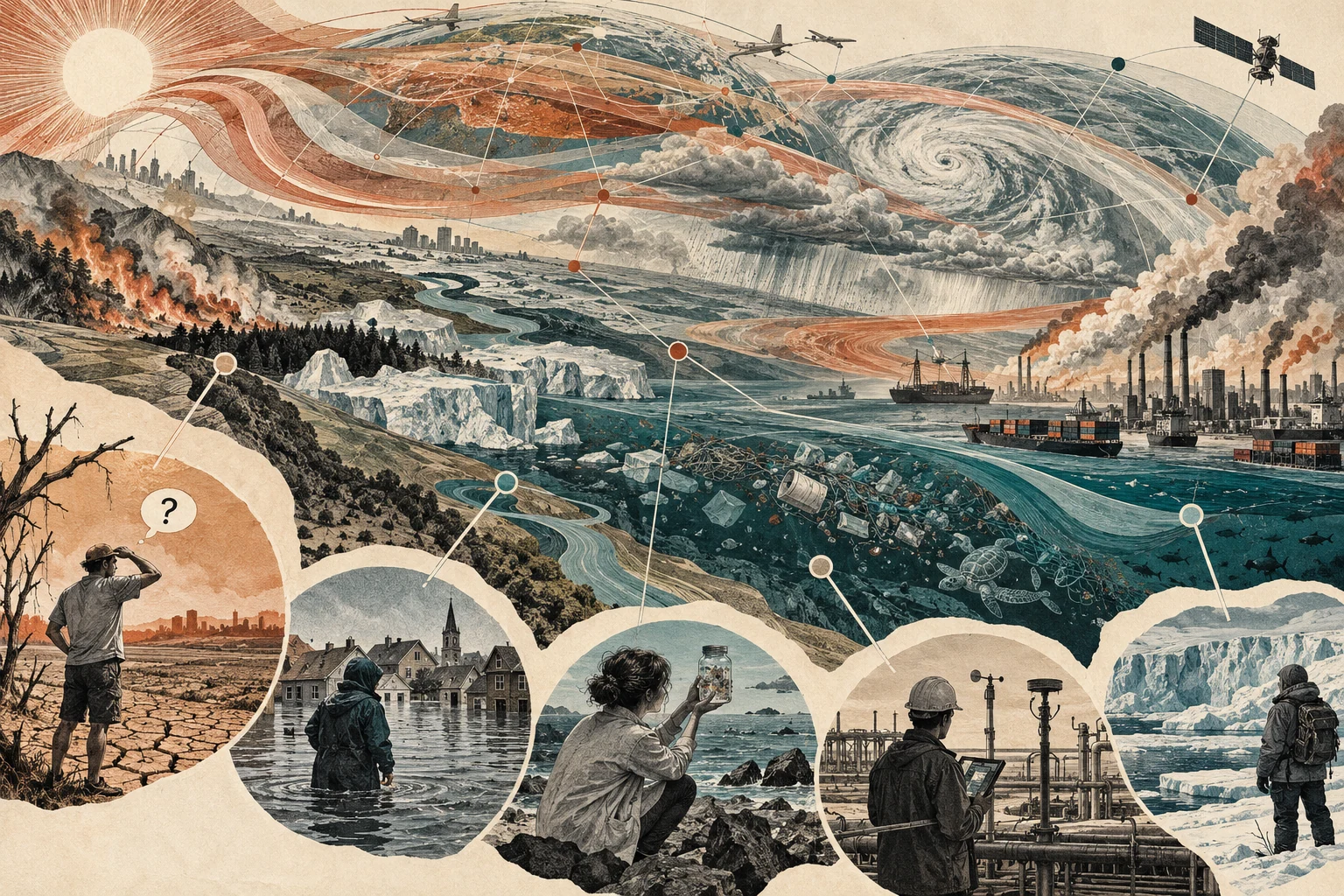
Different observers see only local manifestations of a phenomenon stretched across space and time; no single vantage point takes in the whole.
AI-assisted illustration · conceptual metaphor View in visual quiz →Genesis and Global Lineage
The term was coined by Timothy Morton, a literary scholar and philosopher trained at Oxford (Magdalen College), in The Ecological Thought (2010) and developed in Hyperobjects: Philosophy and Ecology after the End of the World (University of Minnesota Press, 2013). Morton writes from the standpoint of Graham Harman’s object-oriented ontology (OOO), a branch of speculative realism that rejects “correlationism”—the thesis that we can speak of things only as correlates of human cognition. For Harman, every object withdraws from access; Morton observed that planetary-scale objects make that withdrawal palpable. The problem the concept addresses is the helplessness of traditional ecology in the face of climate change: romantic “Nature” as a neutral backdrop for human action, already critiqued in Ecology without Nature (2007), cannot describe something that surrounds us, penetrates us, and will outlive us. As Morton himself acknowledges, the word was inspired by Björk’s 1996 single “Hyperballad.” In artistic and curatorial circles, the term caught on much faster than in academic philosophy, at some cost to its analytical precision.
Central European Lineage
We found no documented link between this concept and the intellectual history or historical experience of Central Europe.
We found no documented link between this concept and the intellectual history or historical experience of Central Europe (by our methodology, this means “none found,” not “none exists”; as of October 2026).
Why Now
Between 2018 and 2026, the concept ceased to be a curiosity of literary theory. The IPCC Special Report on 1.5°C warming (2018) and the Sixth Assessment Report (2021–2023) framed climate change precisely as Morton describes it: the cumulative outcome of billions of actions that no one sees in full, whose consequences unfold over centuries. The COVID-19 pandemic of 2020–2022 provided a mass experience of a nonlocal and viscous entity: the virus was everywhere and nowhere, and ironic detachment offered no protection. European heatwaves, the September 2024 floods across Central Europe (including Lower Silesia in south-western Poland), and the record temperatures of 2023–2024 reinforced the sense that local “weather” is now a passing manifestation of something vastly larger. In parallel, large language models and global computing infrastructure began to be described in similar terms—as systems whose agency cannot be localized in any single server or decision. The concept has also flourished in exhibition-making and design, where it is often used loosely.
Explanatory Power
The concept explains why knowledge of the climate crisis translates so poorly into action: not because people are ignorant or misinformed, but because the entity in question does not fit within frames of perception and responsibility tailored to a human lifespan. First, it illuminates the mechanics of disputes over “single events”: no individual flood is global warming, so a skeptic can always deny the link while a scientist must speak in probability distributions; this is not a failure of communication, but a structural property of the object. Second, it accounts for viscosity: there is no outside vantage point to stand on, because our cars, diets, and pension funds are already inside the object, and every “observer” position turns out to be immersed. Third, it names the strange temporality of such entities: plutonium-239 will remain radioactive for 24,000 years, making a nuclear waste repository a decision about a society we cannot even imagine. Finally, the concept helps diagnose when institutions pretend a hyperobject is an ordinary problem—bringing a quarterly plan to a multi-century process.
Axes of Debate
Does scale mean anything if “every object is a hyperobject”?
The ecocritic Ursula K. Heise, in her 2014 review in Critical Inquiry, objects that if in some sense everything is a hyperobject, the concept distinguishes nothing, while its author leaps from quantum mechanics to hurricanes without regard for what physical science actually demonstrates. Strongest counterargument: Morton replies that the relevant scale is relative to humans, not absolute: a hyperobject is whatever exceeds the horizon of human perception and accountability, and this relational definition is a feature of the concept, not a bug. Nature of the dispute: substantive — it concerns whether the concept has a criterion of demarcation, without which it cannot explain anything.
Ontology of objects versus processes and relations
Process philosophers, actor-network theorists, and new materialists (including critics of OOO drawing on Whitehead and Latour) ask why global warming should be called an “object” when it is a dynamic web of relations; reification obscures the agency of the human actors and institutions driving the process. Strongest counterargument: Proponents of OOO point out that relational language is precisely what allows responsibility to dissolve into “the system,” whereas treating warming as an object with its own stubborn properties makes it something we must reckon with, like a mountain or an adversary. Nature of the dispute: substantive — a disagreement over which ontology better captures agency in an ecological crisis.
Paralysis versus mobilization
Critics on the climate left and environmental activists argue that the rhetoric of “the end of the world has already occurred” and of ungraspable entities demobilizes action, replacing politics with an aesthetics of sublime catastrophe; Morton himself has admitted he would write the book differently today. Strongest counterargument: Accepting that the object exceeds us in scale does not excuse inaction, but changes its form—from heroic “saving the planet” to coexisting with what outscales us, offering an answer to the exhaustion of apocalyptic ethics rather than its continuation. Nature of the dispute: mixed — part of the argument concerns the political effects of rhetoric, while part is a clash of style and temperament.
Underappreciated Angle
The least discussed property of a hyperobject is interobjectivity: the object is never given directly, but only through the footprints it leaves in other objects, including measuring instruments. Global warming “exists” for us as thermometers, ice cores, numerical models, and air-conditioning bills. This shifts the weight of controversy from the question “is warming real?” to the question “whom do we trust regarding the traces?” A hyperobject is therefore a problem not only of ontology, but of social epistemology—of trust in institutions of measurement. From this perspective, the crisis of trust in science and the climate crisis are two sides of the same phenomenon, and disinformation campaigns attack not the object itself, which remains indifferent, but the chain of traces through which alone we can perceive it. The same schema applies to seasonal coal smog in Polish cities, microplastics in human blood, and long-term public debt: entities that exist for us only as a readout.
One-Sentence Takeaway
A hyperobject is not a problem too big to solve, but an entity too vast to see in full, which is why every dispute over it is a dispute over traces rather than the thing itself.
Related Concepts Network
How this concept reinforces, constrains, or complements other analytical frameworks in the corpus. View on graph →
-
Object-oriented ontology (OOO) reinforces
A hyperobject is the best-known application of object-oriented ontology: an entity that is never exhausted by any of its local manifestations.
-
Speculative realism complements
Morton adopts the speculative realist thesis that reality is not a correlate of human cognition and translates it into the language of ecology.
-
Anthropocene complements
Whereas the Anthropocene dates an epoch, the hyperobject describes how that epoch is experienced: as something that encompasses us yet can never be seen as a whole.
-
Planetary boundaries in tension
Planetary boundaries assume that the Earth system can be measured and governed by thresholds; the hyperobject insists that data are merely footprints of the object, never the object itself.
-
Existential risk constrains
Existential risk literature calculates probabilities and searches for leverage points; Morton argues that toward a hyperobject, the engineer’s posture is itself part of the problem.
-
Systems thinking in tension
Systems thinking seeks a map of feedback loops; a hyperobject is what always leaks out of the map because it exceeds every scale at which we draw it.
-
Posthumanism reinforces
Both concepts dethrone the human from the position of central observer, though Morton does so through scale rather than through relations with other beings.
Reading Canon & Translation Bridge
Foundational texts, introductions, and critical perspectives—with availability of English and Polish editions.
-
foundational text 2013 · English
Timothy Morton, Hyperobjects: Philosophy and Ecology after the End of the World
The monograph defining the concept and its five properties, using global warming, nuclear weapons, evolution, and plastic as examples of entities that exceed the human scale.
In English: original text written in English
In Polish: Polish edition not verified
-
foundational text 2010 · English
Timothy Morton, The Ecological Thought
The book where the term first appears, embedded in the idea of the “mesh” of interdependence among all beings; shorter and less speculative than “Hyperobjects.”
In English: original text written in English
In Polish: Polish edition not verified
-
introduction & synthesis 2016 · English
Timothy Morton, Dark Ecology: For a Logic of Future Coexistence
The Wellek Library Lectures, introducing Morton’s ontology through the “strange loop” of ecological awareness and the origins of the crisis in agricultural logistics.
In English: original text written in English
In Polish: Polish edition not verified
-
critical perspective 2014 · English
Ursula K. Heise, Ursula K. Heise reviews Timothy Morton's Hyperobjects
The most widely cited critical review (“Critical Inquiry,” June 4, 2014): charges Morton with blurring scale, misusing physics, and advancing a self-canceling argument.
In English: original text written in English
In Polish: no Polish edition
-
introduction & synthesis 2018 · English
Graham Harman, Object-Oriented Ontology: A New Theory of Everything
An accessible exposition of object-oriented ontology, without which one cannot understand why Morton calls global warming an object rather than a process.
In English: original text written in English
In Polish: Polish edition not verified
-
cross-disciplinary 1986 · German
Ulrich Beck, Risikogesellschaft. Auf dem Weg in eine andere Moderne
A sociological diagnosis of invisible, nonlocal risks written in the year of Chernobyl; shows how much of Morton’s intuition existed earlier without a metaphysics of objects.
In English: English edition not verified
In Polish: Polish edition not verified
-
cross-disciplinary 2009 · English
Dipesh Chakrabarty, The Climate of History: Four Theses
A historian’s essay on how climate change forces human history to merge with geological history; the best non-philosophical context for the problem of scale.
In English: original text written in English
In Polish: Polish edition not verified
-
introduction & synthesis 2021 · Polish
Andrzej Marzec, Antropocień. Filozofia i estetyka po końcu świata
A Polish study of dark ecology and Morton’s philosophy from the standpoint of aesthetics; a useful entry point into the terminology in Polish.
In English: English edition not verified
In Polish: original text written in Polish