Culture & Power #150
Accelerationism
original term: accelerationism (Eng.) · akceleracjonizm lewicowy, akceleracjonizm bezwarunkowy, e/acc
Global-circulation concept — no documented lineage in Central Europe. jump to documentation ↓
Working Definition
Accelerationism is the position that the way out of the prevailing socio-economic order lies not in slowing down, returning to local tradition, or incremental regulation, but in intensifying and accelerating the technological and economic forces that are already destabilizing that order from within. In its unconditional or right-wing theoretical version (Nick Land and the 1990s Cybernetic Culture Research Unit), it is a descriptive-fatalist thesis: capital is an autonomous, self-amplifying cybernetic process assembling machine intelligence out of human history, in which human beings are components rather than pilots. In its left-wing political version (Alex Williams and Nick Srnicek), it is a strategic program: repurpose the fixed capital, automation, and planetary logistics built by neoliberalism toward post-capitalist ends that the market itself fetters. In loose 2020s usage—spanning Silicon Valley’s “effective accelerationism” (e/acc) and security reports on violent far-right extremists—the word often means simply “push the pedal to the floor,” making it essential to specify which variant is under discussion.
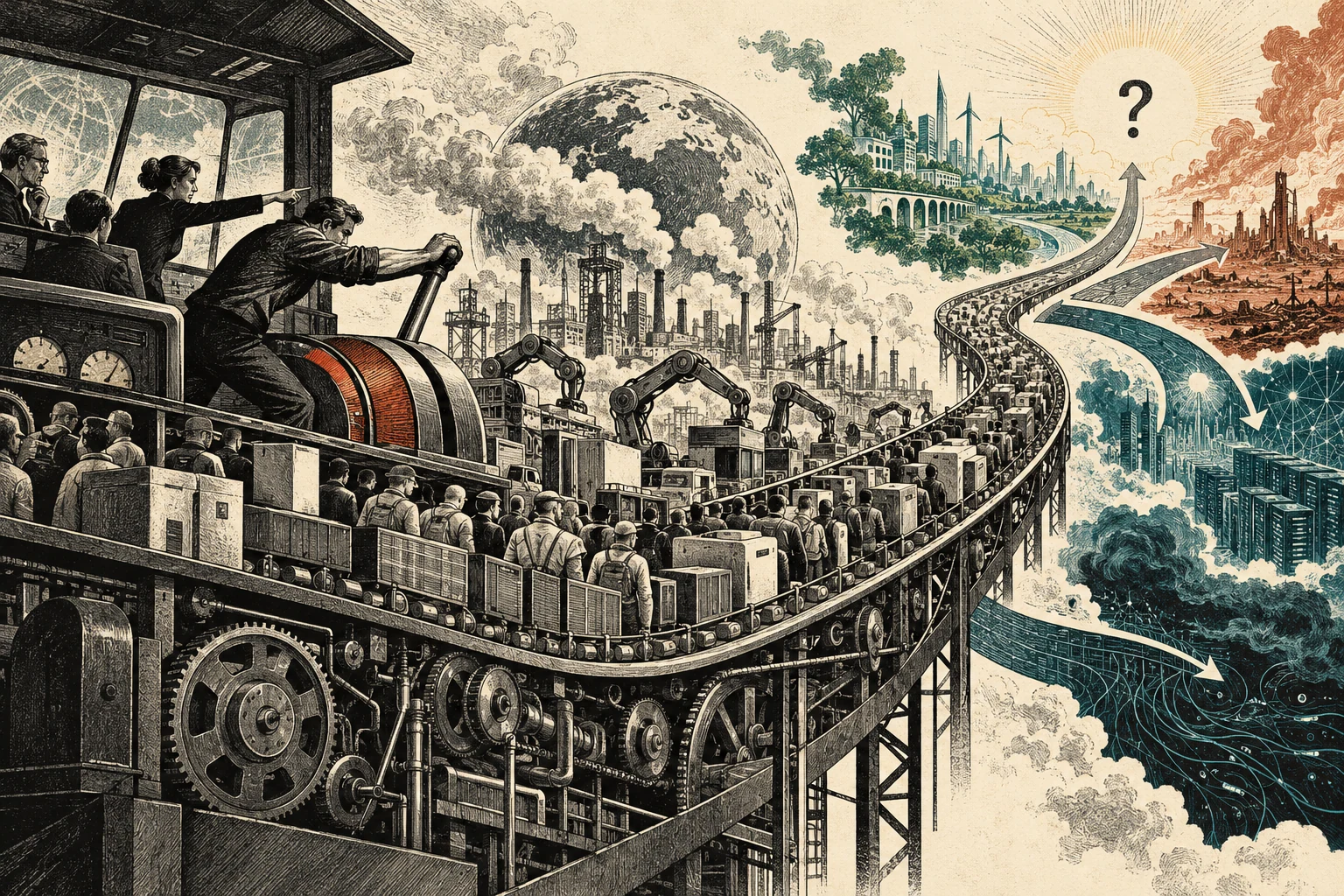
Speeding up existing processes is meant to break through into a different order; the illustration depicts a contested strategy and the uncertainty of its outcomes.
AI-assisted illustration · conceptual metaphor View in visual quiz →Genesis and Global Lineage
The term was coined by a critic rather than a proponent: Benjamin Noys used “accelerationism” in The Persistence of the Negative (2010) to name a strand of post-1968 French theory—above all Gilles Deleuze and Félix Guattari’s Anti-Oedipus (1972), with its famous suggestion “to go still further, that is, in the movement of the market, of decoding and deterritorialization… to accelerate the process,” alongside Jean-François Lyotard’s Libidinal Economy (1974). In the 1990s that line was radicalized by Nick Land and the Cybernetic Culture Research Unit (CCRU) at the University of Warwick, who fused Deleuze and cyberpunk into a vision of technocapital as an alien intelligence arriving from the future to dissolve human subjectivity. After the 2008 financial crash, a younger generation of left theorists reclaimed the term: on May 14, 2013, Alex Williams and Nick Srnicek published #Accelerate: Manifesto for an Accelerationist Politics, rejecting both Landian techno-fatalism and the neo-primitivist localism of the Occupy movement in favor of full automation, a shorter working week, universal basic income, and sociotechnical planning. Robin Mackay and Armen Avanessian’s 2014 anthology #Accelerate: The Accelerationist Reader retroactively constructed a lineage reaching back to Karl Marx’s Fragment on Machines. Meanwhile, Land himself pivoted toward neo-reaction (NRx) and the “Dark Enlightenment,” while after 2022 a fourth variant—effective accelerationism (e/acc)—emerged in Silicon Valley as a pro-compute counter-ideology against AI-safety caution.
Central European Lineage
We found no documented link between this concept and the intellectual history or historical experience of Central Europe.
We found no documented link between this concept and the intellectual history or historical experience of Central Europe (by our methodology, this means “none found,” not “none exists”; as of October 2026).
Why Now
Three largely independent developments between 2018 and 2026 thrust accelerationism into mainstream vocabulary. First, following the Christchurch mosque shootings in March 2019, counter-terrorism agencies and journalists began using “accelerationism” to designate white-supremacist and neo-fascist networks that seek to trigger societal collapse through terror attacks; in security briefings the word now appears far more often in this violent collapse sense than in its philosophical sense. Second, the breakthrough of large language models in 2022–2023 gave rise in Silicon Valley to the explicit e/acc movement, championed by venture capitalists and engineers who cast AI-safety regulation and “doomer” longtermism as a brake on thermodynamic progress; the November 2023 boardroom crisis at OpenAI was publicly interpreted across the tech industry as a clash between AI safetyists and accelerationists. Third, on the political left, the collision between post-work automation hopes and the physical limits of the climate crisis forced a direct confrontation between left accelerationism (and its American policy cousin, “supply-side progressivism” or the “abundance agenda”) and advocates of ecological degrowth. The concept is indispensable today precisely because three mutually hostile camps—Silicon Valley venture capitalists, Marxist theorists of automation, and violent anti-system extremists—all invoke the same word.
Explanatory Power
Accelerationism makes visible how disputes over speed and technology have displaced traditional left–right disputes over ownership and distribution. First, it explains an otherwise baffling rhetorical convergence: a San Francisco venture capitalist, a post-Marxist theorist, and an online extremist can all publish manifestos in the same week calling for “cutting the brakes,” even though they disagree completely on what the engine is and where it leads; the concept forces analysts to ask what each camp treats as the motor of history and what it treats as a fetter. Second, it clarifies the political economy of automation: Srnicek and Williams’s argument that technological unemployment is a crisis of wage-labor distribution rather than a reason to smash machines provides a coherent baseline for evaluating universal basic income and industrial policy. Third, it exposes the shared nostalgia of its opponents: through the lens of the 2013 manifesto, both conservative promises to restore a lost social “normality” and left-wing “folk politics” of small-scale local protest are reactive postures that neither slow technocapital down nor steer it anywhere.
Axes of Debate
Emancipatory lever (Williams, Srnicek) versus cybernetic trap (Land, Noys)
Left accelerationists (Williams, Srnicek, Helen Hester) argue that the fixed capital, global supply chains, and algorithmic models built by capitalism can be decoupled from capitalist property relations and repurposed for collective emancipation. Both Nick Land (from the right) and Benjamin Noys (from the critical left) reply—for opposite reasons—that this is an illusion: capitalist technology is not a neutral tool waiting for a new driver, because the drive toward relentless optimization is baked into the machinery itself. Strongest counterargument: If, as Williams and Srnicek document, contemporary monopoly capitalism actually suppresses risky innovation in favor of financial rent extraction and low-wage service work, then capital is no longer “accelerating” on its own—meaning that public investment and sociotechnical planning are ordinary industrial policy rather than a ride on an autonomous tiger. Nature of the dispute: substantive — it hinges on whether technological infrastructures are socially neutral instruments or materializations of the social relations that created them.
Structural theory of modernity versus futurist aesthetics of speed (Rosa, Noys)
Sociologists of time such as Hartmut Rosa (Social Acceleration, 2005) and critics such as Noys charge that accelerationists lack a rigorous empirical theory of social time and substitute a mood—an aesthetic intoxication with speed and machinery inherited from early twentieth-century Italian Futurism and Soviet productivism. Strongest counterargument: Left accelerationists reply that the 2013 manifesto explicitly distinguishes blind velocity (speed) from directional steering (navigation), rejecting speed for speed’s sake; the charge of aesthetic intoxication hits Land’s 1990s cyberpunk prose, not the post-work policy program of Inventing the Future (2015). Nature of the dispute: mixed — part of the disagreement concerns the empirical dynamics of technological modernity, while part is a dispute over rhetorical style.
One concept or an accidental homonym across philosophy, tech, and extremism?
Scholars of political violence and many academic philosophers insist that neo-fascist “collapse accelerationism” (which is simply nineteenth-century politique du pire—“the worse, the better”) has nothing conceptually in common with Deleuze, Srnicek, or Silicon Valley e/acc, and that lumping them together muddies analysis. Critics on the anti-fascist and ecological left reply that Land’s personal trajectory from 1990s Warwick accelerationism to the neo-reactionary Dark Enlightenment is a documented bridge, and that all variants share an apocalyptic fantasy of purging the sluggish democratic present. Strongest counterargument: While violent collapse terrorists do not read Deleuze, Land’s anti-democratic writings genuinely cross-pollinated online extremist subcultures; acknowledging that documented intellectual genealogy is necessary without pretending that a universal-basic-income advocate and a terrorist share a political program. Nature of the dispute: mixed — the textual reception paths can be traced empirically, though in media commentary the shared label is frequently used for guilt by association.
Underappreciated Angle
The most revealing feature of left accelerationism is not what it says about speed, but what it says about economic planning. Beneath the cyberpunk rhetoric of the 2013 manifesto—and openly in Inventing the Future (2015), where Srnicek and Williams quietly dropped the word “accelerationism” after its toxic associations grew—lies the oldest project of the modern socialist tradition: rational, large-scale coordination of production, now updated with algorithmic logistics and Salvador Allende’s 1971–1973 Chilean Project Cybersyn as its historical icon. For readers in Central and Eastern Europe, where cybernetics was embraced in the 1960s by economists such as Oskar Lange precisely as a mathematical rescue for socialist central planning, this turn looks immediately familiar—and exposes a shared blind spot between left accelerationism and Silicon Valley e/acc. Both camps assume that greater computational power and better predictive models can bypass the messy politics of conflicting interests, rarely asking who sets the objective function of the optimization model or how citizens can contest a plan once it is encoded as technical infrastructure.
One-Sentence Takeaway
Accelerationism is ultimately a dispute not over how fast technology is moving, but over whether anyone can still steer the machine once everyone agrees the brakes no longer work.
Related Concepts Network
How this concept reinforces, constrains, or complements other analytical frameworks in the corpus. View on graph →
-
Hyperstition reinforces
Both concepts emerged from the CCRU circle and Nick Land: hyperstition describes how fictions about the future bring themselves into existence, and accelerationism treats capital as precisely such a self-actualizing machine.
-
Late capitalism complements
Accelerationism responds to the same diagnosis of stagnation and the exhaustion of alternatives, but instead of mourning capitalism proposes racing all the way through it to the other side.
-
Degrowth in tension
Degrowth seeks to slow down the metabolic throughput of the economy, whereas left accelerationism seeks to automate and plan production at a planetary scale; the dispute hinges on whether technology is the disease or the lever of emancipation.
-
Longtermism complements
Silicon Valley’s effective accelerationism (e/acc) crystallized as an explicit counter-manifesto against the caution of longtermists and effective altruists regarding AI risk.
-
Technological solutionism reinforces
In its Silicon Valley variant, accelerationism elevates solutionism into a philosophy of history: every social problem is solvable through greater compute and faster deployment.
-
Technofeudalism constrains
If digital platforms are building a rentier order outside competitive markets rather than a faster capitalism, then the vision of capital as an unstoppable engine of deterritorialization loses its object.
-
Artificial general intelligence (AGI) reinforces
The promise of artificial general intelligence gave 2020s accelerationism a concrete object of desire and a concrete adversary in the form of AI safety regulation.
Reading Canon & Translation Bridge
Foundational texts, introductions, and critical perspectives—with availability of English and Polish editions.
-
foundational text 2013 · English
Alex Williams, Nick Srnicek, #Accelerate: Manifesto for an Accelerationist Politics
The text that gave the concept an explicit political program: three sections (diagnosis of the conjuncture, typology of accelerationisms, twenty-four programmatic theses), published May 14, 2013 on Critical Legal Thinking.
In English: original text written in English
In Polish: Polish edition not verified
-
foundational text 2011 · English
Nick Land, Fanged Noumena: Collected Writings 1987–2007
Collected writings from Land’s Warwick and CCRU years, including “Meltdown” and “Machinic Desire”—the source of the vision of capital as an alien intelligence assembling itself out of human history.
In English: original text written in English
In Polish: Polish edition not verified
-
introduction & synthesis 2014 · English
Robin Mackay, Armen Avanessian (red.), #Accelerate: The Accelerationist Reader
The anthology that retrofitted a canon for the concept from Marx and Veblen through Deleuze, Lyotard, and Land to Srnicek, Williams, and Negarestani; the best entry point for seeing what is continuous in this tradition and what was retroactively stitched together.
In English: original text written in English
In Polish: Polish edition not verified
-
critical perspective 2014 · English
Benjamin Noys, Malign Velocities: Accelerationism and Capitalism
A critique by the theorist who coined the term in 2010: reads accelerationism as a fantasy of libidinal fusion with the machine that repeats twentieth-century Futurist and productivist illusions.
In English: original text written in English
In Polish: Polish edition not verified
-
foundational text 2015 · English
Nick Srnicek, Alex Williams, Inventing the Future: Postcapitalism and a World Without Work
The book-length sequel to the 2013 manifesto, which drops the word “accelerationism” altogether in favor of full automation, a shorter working week, and universal basic income—revealing how much of left accelerationism is left once the aesthetics of speed is removed.
In English: original text written in English
In Polish: Polish edition not verified
-
cross-disciplinary 2005 · German
Hartmut Rosa, Beschleunigung. Die Veränderung der Zeitstrukturen in der Moderne
A sociological theory of social acceleration (English translation “Social Acceleration: A New Theory of Modernity,” 2013) that analyzes the same dynamic without normative affirmation, allowing readers to test whether accelerationists are describing structural dynamics or merely a mood.
In English: English edition not verified
In Polish: Polish edition not verified
-
cross-disciplinary 1972 · French
Gilles Deleuze, Félix Guattari, L’Anti-Œdipe. Capitalisme et schizophrénie
Source of the famous passage asking whether the revolutionary path might be “to accelerate the process” of market deterritorialization (English translation “Anti-Oedipus,” 1977).
In English: English edition not verified
In Polish: Polish edition not verified
Primary-Source Quotes
It is Marx, along with Land, who remains the paradigmatic accelerationist thinker.