Horizon & Ecology #167
Anthropocene
original term: Anthropocene (Eng.) · epoka człowieka, kapitałocen (termin konkurencyjny)
Central European lineage: 1 thread (anticipation) · 1926–2000 · jump to documentation ↓
Working Definition
The Anthropocene is the name of a proposed geological epoch in which human activity has become the dominant force shaping the Earth system: atmospheric composition, the nitrogen and phosphorus cycles, species distributions, and sedimentary strata. In its strict technical version, it is a stratigraphic claim: there exists a globally synchronous signal legible in rock and sediment layers—plutonium fallout from thermonuclear tests, microplastics, spheroidal carbonaceous fly ash—that justifies drawing a formal boundary on the Geologic Time Scale. In its broader humanistic and public version, the word names a shift in historical consciousness: humanity has ceased to be an external observer of nature and has become its planetary co-author. Both versions continue to circulate, though since March 2024 only the second is free of a formal veto from institutional geology.
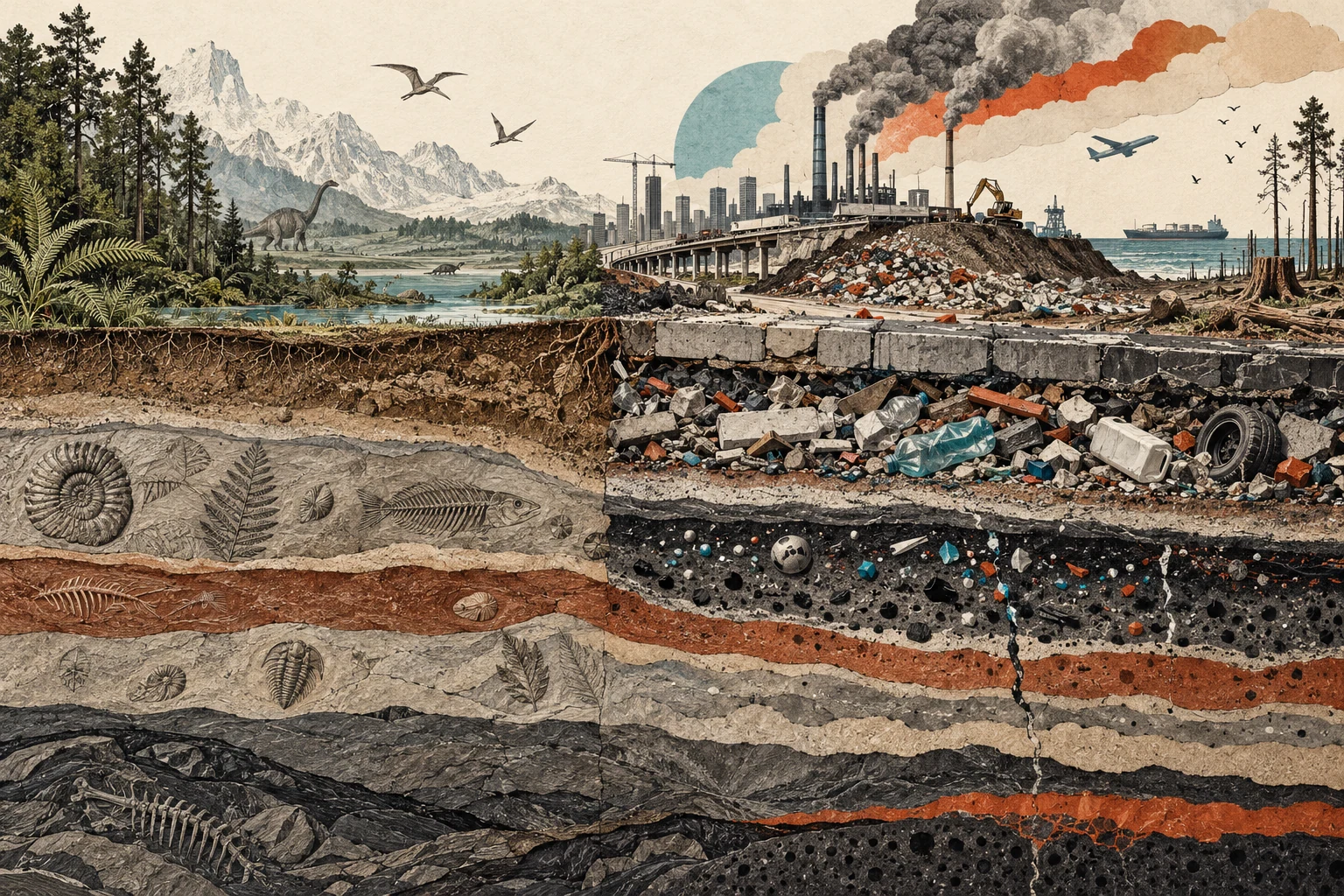
Human activity leaves an extensive footprint across environments and sediments; the illustration does not adjudicate the formal stratigraphic status of a geological epoch.
AI-assisted illustration · conceptual metaphor View in visual quiz →Genesis and Global Lineage
Atmospheric chemist Paul J. Crutzen (who won the 1995 Nobel Prize for his work on ozone depletion) and freshwater ecologist Eugene F. Stoermer introduced the term in a brief note in the International Geosphere-Biosphere Programme (IGBP) newsletter in 2000, and Crutzen’s one-page commentary “Geology of mankind” in Nature (2002) carried it into global circulation. Stoermer had used the word informally since the 1980s; Crutzen famously blurted it out during a 2000 conference in Cuernavaca out of impatience with hearing the present still called the Holocene. Growing out of Earth system science, the concept was linked by its authors to earlier precursors: the Italian geologist Antonio Stoppani wrote in 1873 of an “Anthropozoic era” and humanity as a “new telluric force,” while between the 1920s and 1940s Vladimir Vernadsky and Pierre Teilhard de Chardin wrote of the biosphere and the noosphere. Crutzen and Stoermer initially proposed dating the epoch’s onset to the late eighteenth century and James Watt’s steam engine; the Anthropocene Working Group (AWG), established in 2009 under the Subcommission on Quaternary Stratigraphy (SQS), shifted the candidate boundary to the mid-twentieth century—the “Great Acceleration” around 1950. In July 2023 the AWG nominated Crawford Lake in Ontario as the “golden spike” reference site, but in March 2024 the SQS voted down formalization, a rejection ratified by the International Union of Geological Sciences (IUGS). Meanwhile, following Dipesh Chakrabarty’s 2009 essay, the humanities adopted the term not as a stratigraphic unit, but as a diagnosis of the modern condition.
Central European Lineage
Decades before Crutzen, the mineralogist and geochemist Vladimir Vernadsky (in Polish scholarship, Władimir Wiernadski) articulated a closely related vision of humanity as a geological agent. Educated at St. Petersburg University (graduating in 1885) and later a professor in Moscow, Vernadsky spent the pivotal years 1918–1919 in Kyiv (then capital of the short-lived Ukrainian State, now Ukraine), where he co-founded the Ukrainian Academy of Sciences, served as its first president, and initiated his first systematic experimental work in biogeochemistry. In his book The Biosphere (Biosfera, 1926) and his late essays on the noosphere—published in Uspekhi sovremennoy biologii (1944) and in English as “The Biosphere and the Noosphere” in American Scientist (1945)—he described human scientific thought and technical labor as a planetary geological force reorganizing the living envelope of the Earth. In his 2002 Nature commentary, Crutzen explicitly cites Vernadsky alongside Stoppani as a thinker who recognized humanity’s growing impact in 1926, noting that Teilhard de Chardin and Vernadsky used the term “noösphere” (itself coined in Paris in the 1920s by Édouard Le Roy). This link is an anticipation rather than a direct derivation: Crutzen invokes Vernadsky as a historical precedent rather than the methodological source of his proposal, and while St. Petersburg/Leningrad lies in Russia, Vernadsky’s Kyiv institution-building and early biogeochemical program anchor his work in the region’s scientific history.
Documented regional lineage · Link: 1. Compiled: October 2026.
-
anticipation 74 years
Central European Source: Władimir Wiernadski, “Биосфера (Biosfera); później koncepcja noosfery (1938–1945)”; St Petersburg, Russian Empire (now Russia); Kiev (now Kyiv, Ukraine); Leningrad (now St Petersburg, Russia), 1926
Global Circulation: Anthropocene — Paul J. Crutzen i Eugene F. Stoermer, 2000
anticipation
74 yearsWładimir Wiernadski, “Биосфера (Biosfera); później koncepcja noosfery (1938–1945)”
1926 · St Petersburg, Russian Empire (now Russia); Kiev (now Kyiv, Ukraine); Leningrad (now St Petersburg, Russia)
Anthropocene
2000 · Paul J. Crutzen i Eugene F. Stoermer
- Claim & Connection
- Vladimir Vernadsky (Władimir Wiernadski), educated at St. Petersburg University (degree 1885) and co-founder and first president of the Ukrainian Academy of Sciences in Kyiv (1918), described human scientific thought in “The Biosphere” (1926) and his later writings on the noosphere as a geological force transforming the biosphere. In “Geology of mankind” (2002), Crutzen lists him among his predecessors, citing his 1926 recognition and the term “noösphere” used by Teilhard de Chardin and Vernadsky. This is an earlier, closely related idea rather than the direct source from which the concept was derived: Crutzen cites Vernadsky as a precedent rather than the basis of his own proposal.
- Source Documentation
-
- reception / translation Paul J. Crutzen, „Geology of mankind”, Nature, vol. 415, 3 I 2002, s. 23; opening paragraph: Stoppani 1873, Vernadsky 1926, the term “noösphere” in Teilhard de Chardin and Vernadsky. nature.com ↗
- biographical record Wikipedia (pl), hasło „Władimir Wiernadski”; biographical paragraphs: studies in St. Petersburg (1885), Moscow University, Ukrainian Academy of Sciences (1918), “The Biosphere” (1926), noosphere, death in Moscow (1945). pl.wikipedia.org ↗
- biographical record Wikipedia (ru), hasło „Вернадский, Владимир Иванович”; 1917–1921 period: geochemistry lectures at Kyiv University and biogeochemical research; footnote quoting B. F. Mitskevich that Vernadsky began his biogeochemical research in Ukraine in 1918. ru.wikipedia.org ↗
- scholarly study Wikipedia (ru), hasło „Ноосфера” — bibliografia tekstów Wiernadskiego o noosferze; “Neskolko slov o noosfere,” Uspekhi sovremennoy biologii 1944, vol. 18, no. 2, pp. 113–120; “The Biosphere and the Noosphere,” American Scientist 1945, vol. 33, no. 1, pp. 1–12; Sorbonne lectures 1922–1923. ru.wikipedia.org ↗
- Historical Context
- St. Petersburg and Leningrad belong to the neighboring region (Russia/USSR); Vernadsky's Kyiv episode (1918–1919) belongs to the core region and coincides with the start of his biogeochemical research, predating “The Biosphere.” The term “noosphere” itself comes from Édouard Le Roy (Paris, 1920s), whom Vernadsky adopted and developed. No evidence was found that Crutzen and Stoermer derived the Anthropocene from Vernadsky; the 2000 text (IGBP Newsletter 41) was not opened (the igbp.net domain is defunct, checked 2026-10), so it is unknown whether he is mentioned there as well. Review 2026-10: the opening passage of “Geology of mankind” was read on the Nature website (article preview) and matches the claim.
Why Now
Between 2018 and 2026 the concept reached its cultural peak and suffered formal stratigraphic defeat. In May 2019 the AWG voted (29 to 4) that the Anthropocene warranted formalization as a mid-twentieth-century epoch, and in July 2023 it selected Crawford Lake in Ontario, whose varved sediments preserve a sharp plutonium spike from 1950s thermonuclear tests. In March 2024, however, the Subcommission on Quaternary Stratigraphy rejected the proposal (12 to 4, with 3 abstentions), and on March 20, 2024, the IUGS upheld the rejection as final while declaring that the term would remain “an invaluable descriptor of human impact on the Earth system.” Stratigraphers concluded that seventy years of sediment is too thin to define an epoch and that a 1950 boundary privileges presentism over the longer history of agriculture and empire. Meanwhile, the concept was institutionalized across museums, curricula, and environmental-humanities book series (such as Poznań’s Humanistyka Środowiskowa), leaving it vibrantly alive as a civilizational diagnosis and officially dead on the Geologic Time Scale.
Explanatory Power
The concept forces scale and irreversibility into a single frame where conventional policy sees separate “environmental issues.” First, it integrates phenomena that disciplines and ministries compartmentalize: global warming, ocean acidification, the sixth mass extinction, and synthetic nitrogen fixation are all legible as traces of one planetary driver in one geological archive. Second, it transforms political time: once we recognize that plutonium from 1952 and plastics from the 1950s will remain readable in rock strata millions of years from now, industrial policies cease to be “short-term” choices. Third, it inverts modern epistemology: humanity can no longer study nature from the outside when industrial metabolism is an endogenous variable in the Earth system. Concrete applications include analyzing the post-1950 “Great Acceleration” as coupled exponential curves, framing solar geoengineering as assuming a planetary role humanity already plays blindly, and rewriting environmental history (with Bonneuil and Fressoz) around two centuries of ignored warnings.
Axes of Debate
Species versus system: Anthropocene versus Capitalocene
Jason W. Moore, Andreas Malm, and critical environmental historians argue that attributing planetary disruption to an undifferentiated anthropos falsifies historical agency: coal and steam power were deployed by a specific class of British capitalists in the late eighteenth century, whereas the majority of humanity inherited the fallout without making the decisions. They propose Capitalocene instead. Strongest counterargument: Stratigraphy does not require a sociological theory of blame: the geochemical signal in lake sediments is planetary regardless of which social class lit the furnace, and twentieth-century state-socialist regimes in the USSR and China emitted greenhouse gases and transformed landscapes just as aggressively without Western private capital. Nature of the dispute: mixed — the debate over historical causation is substantive, while the battle over naming is largely a rhetorical struggle to pre-program the political conclusion.
When did it begin: 1784, 1950, or never?
Crutzen and Stoermer pointed to the Industrial Revolution; the AWG under Jan Zalasiewicz selected the mid-twentieth century because radionuclide fallout provides a globally synchronous marker; archaeologists and palaeoclimatologists (such as William Ruddiman’s “early Anthropocene” hypothesis or Simon Lewis and Mark Maslin’s 1610 “Orbis spike”) push the onset back to Neolithic agriculture or the colonial collision of the Old and New Worlds. Strongest counterargument: The SQS majority in 2024 argued that a seventy-year unit fails the basic criteria of chronostratigraphy, and that human transformation of the planet is better conceptualized as an unfolding, diachronous “geological event” (analogous to the Great Oxidation Event) rather than a sharply bounded epoch. Nature of the dispute: substantive — it turns on the methodological rules of stratigraphy, even though every candidate start date carries different implications for historical responsibility.
Mobilizing diagnosis versus political paralysis
Polish philosopher of science Ewa Bińczyk (in her 2018 book on the “torpor” or marazm of the Anthropocene) and historians Bonneuil and Fressoz observe that framing ecological crisis as a species-wide geological fate induces institutional paralysis: the sheer scale of the diagnosis strips citizens of agency while grand narratives of sudden scientific awakening obscure decades of deliberate lobbying and political inaction. Strongest counterargument: Ecomodernists reply that recognizing humanity as a geological force is precisely what licenses active planetary stewardship, from nuclear power to carbon removal; what paralyzes action is not the geological diagnosis, but apocalyptic moralizing. Nature of the dispute: substantive — both camps debate the real-world institutional effects of scientific framing on public policy, operating from competing theories of political mobilization.
Underappreciated Angle
The March 2024 rejection of the Anthropocene by the IUGS is usually read as a defeat for the concept, yet it may represent something far more interesting: a rare case in which a hard science refused to grant a term formal taxonomic status while explicitly endorsing the reality of the phenomenon it names. In the very same statement that closed the door on the Geologic Time Scale, the IUGS affirmed that the word would remain indispensable across Earth science, economics, and public policy. That decision cleanly pried apart two functions that had been fused for twenty years: a unit of formal stratigraphic classification and an orienting concept of public reason. Freed from the technical quarrel over whether a lake-bed core in Ontario starts in 1950 or 1952, the Anthropocene now operates as “geology without stratigraphy”—exposing how much of the humanities debate had been leaning on the borrowed bureaucratic authority of a geological chart it never actually needed.
One-Sentence Takeaway
The Anthropocene lost its vote for a formal slot on the geological time chart, and that rejection made clear what the debate was really about all along: not a boundary line in lake mud, but who signs their name to the sediment layer we are leaving behind.
Related Concepts Network
How this concept reinforces, constrains, or complements other analytical frameworks in the corpus. View on graph →
-
Planetary boundaries reinforces
The planetary boundaries framework (Rockström et al., 2009) operationalizes the Anthropocene as a set of measurable thresholds whose transgression pushes the Earth system outside the Holocene envelope.
-
Climate tipping points complements
Climate tipping points describe the nonlinear dynamics of the very same anthropogenic pressure that the Anthropocene names at the scale of a geological epoch.
-
Degrowth in tension
Degrowth derives from the diagnosis of the Anthropocene a political program of planned contraction that proponents of a technological “good Anthropocene” reject as unconvincing and unworkable.
-
Late capitalism in tension
The debate over the Capitalocene asks whether the driver of the new epoch is the human species as a whole or a historically specific system of capital accumulation built on fossil fuels.
-
Posthumanism complements
The environmental humanities read the Anthropocene as the collapse of the nature–culture divide and a warrant for rethinking humans as one planetary actor among many.
-
Climate justice constrains
The collective “we” of the Anthropocene obscures the fact that emissions and benefits are distributed with extreme inequality across regions, classes, and generations.
-
Existential risk complements
The Anthropocene describes an epoch in which humanity has become a force capable of permanently disrupting the conditions of its own survival, forming the backdrop for existential-risk calculations.
Reading Canon & Translation Bridge
Foundational texts, introductions, and critical perspectives—with availability of English and Polish editions.
-
foundational text 2000 · English
Paul J. Crutzen, Eugene F. Stoermer, The „Anthropocene”
The two-page note in “Global Change Newsletter” (IGBP) no. 41, pp. 17–18, that put the term into scientific circulation and dated the start of the epoch to the late eighteenth century and James Watt's steam engine.
In English: original text written in English
In Polish: Polish edition not verified
-
foundational text 2002 · English
Paul J. Crutzen, Geology of mankind
A one-page commentary in “Nature” (vol. 415, p. 23) and the concept's most cited text; includes a brief lineage from Stoppani and Vernadsky and suggests that geoengineering may become a task for science.
In English: original text written in English
In Polish: Polish edition not verified
-
introduction & synthesis 2011 · English
Will Steffen, Jacques Grinevald, Paul J. Crutzen, John R. McNeill, The Anthropocene: conceptual and historical perspectives
An article in “Philosophical Transactions of the Royal Society A” organizing the prehistory of the concept (Buffon, Marsh, Stoppani, Vernadsky, Teilhard) and arguing for formal geological recognition.
In English: original text written in English
In Polish: Polish edition not verified
-
introduction & synthesis 2018 · Polish
Ewa Bińczyk, Epoka człowieka. Retoryka i marazm antropocenu
The most comprehensive Polish study of the debate (Wydawnictwo Naukowe PWN, Warsaw 2018): maps positions from stratigraphy to the humanities and develops the thesis of “torpor” (marazm)—action paralysis amid a surplus of diagnoses.
In English: English edition not verified
In Polish: original text written in Polish
-
critical perspective 2016 · English
Jason W. Moore (red.), Anthropocene or Capitalocene? Nature, History, and the Crisis of Capitalism
An edited volume (PM Press) featuring essays by Moore, Donna Haraway, Eileen Crist, and Elmar Altvater, charging that the Anthropocene uses species-wide blame to mask a historically specific regime of accumulation.
In English: original text written in English
In Polish: “Antropocen czy kapitałocen? Natura, historia i kryzys kapitalizmu”, Wydawnictwo Wojewódzkiej Biblioteki Publicznej i Centrum Animacji Kultury w Poznaniu; Uniwersytet im. Adama Mickiewicza w Poznaniu (seria „Humanistyka Środowiskowa”, t. 1) 2021, trans. Krzysztof Hoffmann, Patryk Szaj, Weronika Szwebs
-
critical perspective 2013 · French
Christophe Bonneuil, Jean-Baptiste Fressoz, L’Événement Anthropocène. La Terre, l’histoire et nous
Historians of science show that the “grand narrative” of the Anthropocene as a sudden awakening erases two centuries of conscious political choices and suppressed warnings; introduces the term “Oliganthropocene.”
In English: English edition not verified
In Polish: Polish edition not verified
-
cross-disciplinary 2009 · English
Dipesh Chakrabarty, The Climate of History: Four Theses
The “Critical Inquiry” essay that launched the reception of the Anthropocene in the humanities: examines the collapse of the distinction between natural and human history and the problem of the species as a historical subject.
In English: original text written in English
In Polish: “Klimat historii. Cztery tezy”, Instytut Badań Literackich PAN („Teksty Drugie” 2014, nr 5, s. 168–199) 2014, trans. Magda Szcześniak
Primary-Source Quotes
Despite its rejection as a formal unit of the Geologic Time Scale, Anthropocene will nevertheless continue to be used not only by Earth and environmental scientists, but also by social scientists, politicians and economists, as well as by the public at large. It will remain an invaluable descriptor of human impact on the Earth system.