Horizon & Ecology #174
Just transition
original term: just transition (Eng.) · transformacja sprawiedliwa, solidarna i sprawiedliwa transformacja
Central European lineage: 3 threads (historical experience) · 1998–2021 · jump to documentation ↓
Working Definition
A just transition is the principle that the socioeconomic costs of phasing out fossil-fuel-intensive industries must not be dumped onto the workers and local communities that depended on them for their livelihoods, and that the shift must be negotiated with those workers rather than imposed upon them. In its technical policy version, codified in the International Labour Organization’s 2015 Guidelines, it designates a concrete policy package: employment-impact assessment, social protection and early-retirement bridges, retraining, collective bargaining, and targeted regional investment in replacement jobs. In loose political and media usage, it often serves as a label for any fiscal handout accompanying mine or power-plant closures—or even as a rhetorical pretext for delaying decarbonization altogether. Keeping the two apart is essential: the ILO framework governs how a phaseout is executed, not how to postpone it.
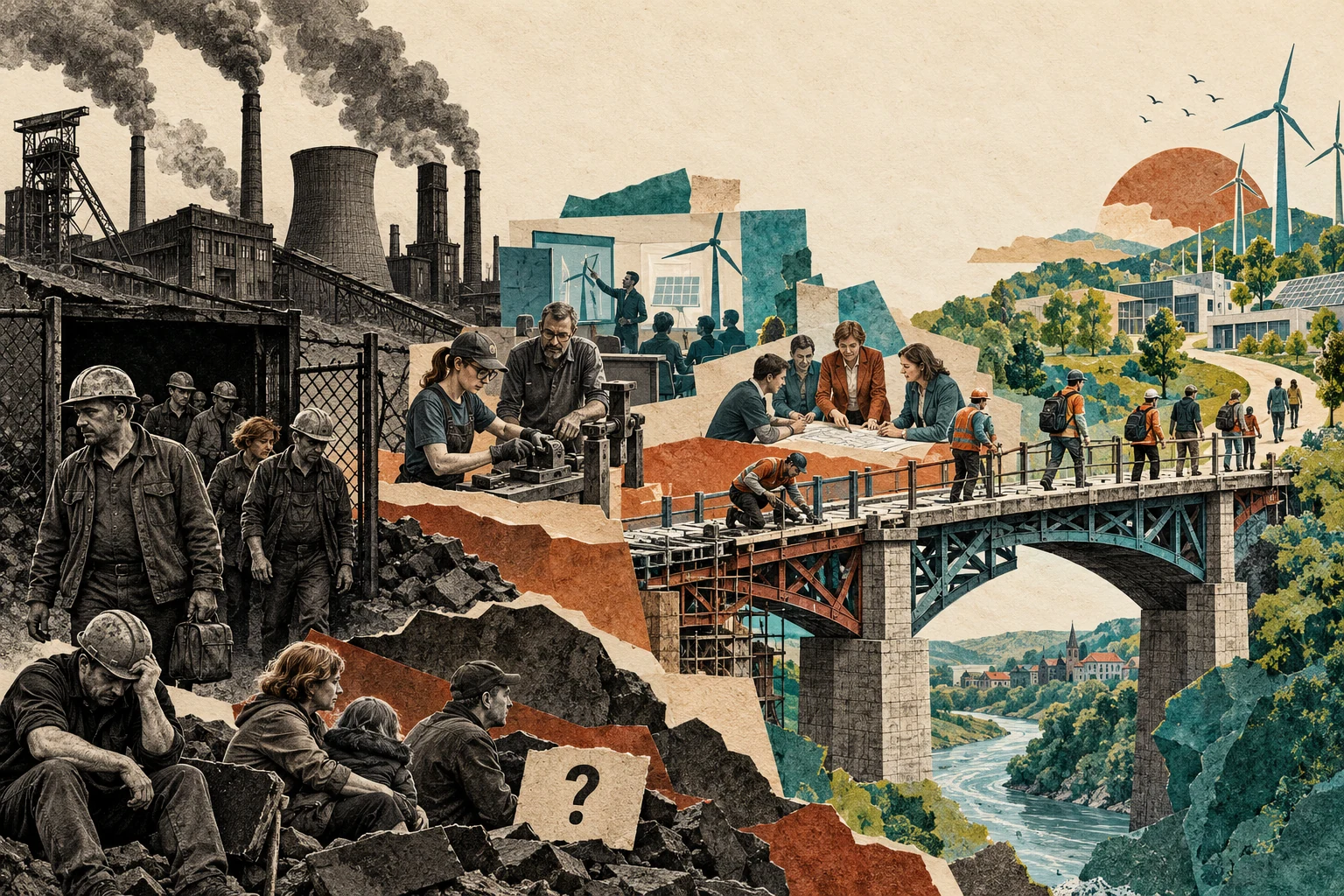
Economic transition includes safety nets, retraining, and community voice in decisions so its costs do not simply fall on displaced workers.
AI-assisted illustration · conceptual metaphor View in visual quiz →Genesis and Global Lineage
The concept was born in the North American labor movement, not in academia. In the early 1990s, Tony Mazzocchi of the Oil, Chemical and Atomic Workers International Union (OCAW) campaigned for a “Superfund for Workers” modeled on the federal toxic-waste cleanup fund—arguing in 1993 that if there is a Superfund for dirt, there ought to be one for workers displaced by environmental rules. Because “Superfund” carried toxic associations for communities, labor and environmental-justice organizers rebranded the demand around 1995 as a just transition; the Just Transition Alliance formed in 1997, and Canadian unions and international labor federations carried the phrase into global diplomacy. The International Trade Union Confederation (ITUC) made it the centerpiece of its climate platform in 2010, leading to a double institutional breakthrough in late 2015: in October an ILO tripartite meeting of experts in Geneva adopted the Guidelines for a Just Transition, and in December the preamble of the Paris Agreement wrote “the imperatives of a just transition of the workforce and the creation of decent work” into international climate law. From there the concept expanded into two new arenas: climate-justice movements broadened it beyond unionized industrial workers to indigenous peoples and the Global South, while the European Union turned it in 2020 into a dedicated structural-funds instrument—transforming a labor-rights demand into a regional budget allocation key.
Central European Lineage
Central Europe’s link to the concept lies not in coining the phrase, but in serving as its primary European testing ground—and living with the memory of what happens when industrial transitions are botched. In Poland, the word transformacja carries the heavy ambivalence of the post-1989 market shock: in the Lower Silesian basin of Wałbrzych, rapid pit closures in the early 1990s without an adequate territorial program left generational unemployment and urban decay. By contrast, under the November 1998 Coal Restructuring Act negotiated by the post-Solidarity government with mining unions, Upper Silesia—the European Union’s largest hard-coal basin—implemented the Mining Social Package (Górniczy Pakiet Socjalny), combining generous severance payouts, bridging benefits, and up to five years of paid pre-retirement “miners’ leave.” As energy economist Wojciech Suwała documented for the IISD (2010) and Warsaw’s Institute for Structural Research (IBS) analyzed in 2019, more than 53,000 workers left Polish coal mining between 1998 and 2002 (33,000 via the social package, which consumed 60% of program spending), making it a benchmark case study for international transition planners. A second regional milestone came in December 2018 at COP24 in Katowice, the capital of Upper Silesia, where the Polish presidency sponsored the Solidarity and Just Transition Silesia Declaration, endorsed by heads of state and government. Third, under the EU’s Just Transition Fund (€17.5 billion agreed in December 2020 under Regulation 2021/1056), Poland’s five designated coal regions—Upper Silesia, Bełchatów (home to Europe’s largest lignite power plant), Eastern Greater Poland, Wałbrzych, and Western Lesser Poland—became the largest national recipient; a May 2026 IBS evaluation estimates that contracted Polish JTF projects cover roughly 97,500 people and create around 4,800 jobs.
Documented regional lineage · Links: 3. Compiled: October 2026.
-
historical experience 17 years
Central European Source: Ustawa z 26 listopada 1998 r. o dostosowaniu górnictwa węgla kamiennego do funkcjonowania w warunkach gospodarki rynkowej oraz szczególnych uprawnieniach i zadaniach gmin górniczych; towarzyszący jej górniczy pakiet socjalny — Restrukturyzacja górnictwa węgla kamiennego w Polsce (program 1998–2002); Upper Silesia, Poland, 1998
Global Circulation: just transition as a public-policy framework — ILO, Guidelines for a just transition (Tripartite Meeting of Experts), 2015
-
historical experience 0 years — same text on both sides
Central European Source: Solidarity and Just Transition Silesia Declaration — COP24 w Katowicach — Śląska Deklaracja o Solidarnej i Sprawiedliwej Transformacji; Katowice, Poland, 2018
Global Circulation: just transition in the UN climate negotiation architecture — szefowie państw i rządów obecni na COP24 (prezydencja polska), 2018
-
historical experience 0 years — same text on both sides
Central European Source: Just Transition Fund (rozporządzenie (UE) 2021/1056) i terytorialne plany sprawiedliwej transformacji — Polskie regiony węglowe jako główny adresat Funduszu na rzecz Sprawiedliwej Transformacji; Upper Silesia, Eastern Greater Poland, Bełchatów, Wałbrzych and Western Lesser Poland areas, Poland, 2021
Global Circulation: the Just Transition Mechanism in the European Green Deal — Parlament Europejski i Rada UE (rozporządzenie (UE) 2021/1056, po propozycji Komisji ze stycznia 2020 r.), 2021
historical experience
17 yearsUstawa z 26 listopada 1998 r. o dostosowaniu górnictwa węgla kamiennego do funkcjonowania w warunkach gospodarki rynkowej oraz szczególnych uprawnieniach i zadaniach gmin górniczych; towarzyszący jej górniczy pakiet socjalny — Restrukturyzacja górnictwa węgla kamiennego w Polsce (program 1998–2002)
1998 · Upper Silesia, Poland
just transition as a public-policy framework
2015 · ILO, Guidelines for a just transition (Tripartite Meeting of Experts)
- Claim & Connection
- Poland's 1998–2002 coal restructuring program, negotiated with trade unions and built around severance payments, bridging benefits, and miners' pre-retirement leave, was a major early case of managed employment phaseout in coal mining: according to Wojciech Suwała's analysis, more than 53,000 workers left the sector between 1998 and 2002, of whom 33,000 used the social package. A 2010 IISD study treats the Polish program as a set of policy lessons for future transitions, and a 2019 IBS report analyzes the miners' leave and severance instruments used since the mid-1990s in its chapter on policy tools supporting a just transition in coal regions.
- Source Documentation
-
- scholarly study Wojciech Suwala, Lessons learned from the restructuring of Poland's coal-mining industry, Global Subsidies Initiative / IISD, Geneva 2010; Ch. 4 (pp. 8–10): 1998 program, union participation, social-package instruments, 60% share of spending (Table 4, p. 8), 53,000 departures (p. 9); Ch. 6 (p. 14): lessons learned. iisd.org ↗
- scholarly study Daniel Kiewra, Aleksander Szpor, Jan Witajewski-Baltvilks, Sprawiedliwa transformacja węglowa w regionie śląskim. Implikacje dla rynku pracy, IBS Research Report 02/2019; Sections 4.1–4.3 (pp. 33–39): genesis of the concept and transition instruments in the Silesian region, including miners' leave and severance packages used since the mid-1990s (p. 38). ibs.org.pl ↗
- Historical Context
- Suwała does not use the phrase “just transition”; the link lies in the fact that Poland's 1990s–2000s restructuring became a comparative case study in the international transition literature rather than the origin of the term itself. 1989 baseline employment figures were not checked in this round. Fact check Oct 2026: removed the phrase “one of the largest in Europe” as unsupported by the two cited reports; the 2019 IBS report does not cite Suwała directly; statutory title corrected. Table 5 of Suwała's study (p. 10) gives higher cumulative numbers than the sentence on p. 9 (net reduction of 102,600, social-program departures of 67,000); the claim quotes the sentence on p. 9.
historical experience
0 years — same text on both sidesSolidarity and Just Transition Silesia Declaration — COP24 w Katowicach — Śląska Deklaracja o Solidarnej i Sprawiedliwej Transformacji
2018 · Katowice, Poland
just transition in the UN climate negotiation architecture
2018 · szefowie państw i rządów obecni na COP24 (prezydencja polska)
- Claim & Connection
- At COP24 in Katowice (December 2018), the Polish presidency put forward the Solidarity and Just Transition Silesia Declaration, adopted by heads of state and government; the document invokes the preamble of the Paris Agreement and the 2015 ILO Guidelines and encourages parties to incorporate just transition into their Nationally Determined Contributions (NDCs). The host region was Upper Silesia, the European Union's largest hard-coal basin.
- Source Documentation
-
- scholarly study Wikipedia (en), hasło „Just transition”, sekcja o Deklaracji Śląskiej z przypisami do cop24.gov.pl i ITUC (3 XII 2018); section History / Silesia Declaration; footnote to Solidarity_and_Just_Transition_Silesia_Declaration_2_.pdf. en.wikipedia.org ↗
- scholarly study Wikipedia (pl), hasło „Sprawiedliwa transformacja”; section on the Silesia Declaration. pl.wikipedia.org ↗
- Historical Context
- The primary text of the declaration was hosted at cop24.gov.pl/fileadmin/user_upload/Solidarity_and_Just_Transition_Silesia_Declaration_2_.pdf; the cop24.gov.pl domain was offline during verification, and the Internet Archive copy could not be retrieved. We omit the exact number of signatory states as unverified in a primary source.
historical experience
0 years — same text on both sidesJust Transition Fund (rozporządzenie (UE) 2021/1056) i terytorialne plany sprawiedliwej transformacji — Polskie regiony węglowe jako główny adresat Funduszu na rzecz Sprawiedliwej Transformacji
2021 · Upper Silesia, Eastern Greater Poland, Bełchatów, Wałbrzych and Western Lesser Poland areas, Poland
the Just Transition Mechanism in the European Green Deal
2021 · Parlament Europejski i Rada UE (rozporządzenie (UE) 2021/1056, po propozycji Komisji ze stycznia 2020 r.)
- Claim & Connection
- Proposed by the European Commission in January 2020 and agreed in December 2020 (€17.5 billion in 2018 prices: €7.5 billion under the 2021–2027 budget and €10 billion from the Recovery Instrument), the Just Transition Fund concentrates funding on coal-dependent regions; in Poland it covers five coal regions, with Upper Silesia as the largest single beneficiary. A 2026 IBS report estimates that JTF support in Poland has covered roughly 97,500 people and that contracted projects will create around 4,800 direct jobs.
- Source Documentation
-
- scholarly study Parlament Europejski, „Just Transition Fund: helping EU regions adapt to green economy” (artykuł tematyczny); amount €17.5 billion, dates: Jan 2020, Dec 2020, Feb and May 2021; conditions. europarl.europa.eu ↗
- scholarly study Komisja Europejska, strona „The Just Transition Mechanism: making sure no one is left behind”; three pillars, Territorial Just Transition Plans. commission.europa.eu ↗
- scholarly study Joanna Mazurkiewicz, Jan Frankowski, Aleksandra Prusak, Transformacja regionów węglowych w toku. Rola Funduszu na rzecz Sprawiedliwej Transformacji, IBS Research Report 04/2026, maj 2026 (streszczenie ang.: Coal regions in transition. The role of the Just Transition Fund); abstract (p. 2): five regions, Silesia as largest beneficiary, 97,500 people, 4,800 jobs, local governments as primary beneficiaries; Ch. 1 (p. 4) and 2.2 (p. 6): five transition areas, Silesia receiving over half the national allocation. ibs.org.pl ↗
- Historical Context
- Poland's share of the total EU fund (roughly 20%) is reported in secondary sources but was not checked directly in the Regulation annex, so it is omitted from the claim. Fact check Oct 2026: the full IBS 04/2026 report is in Polish (with an English abstract); Western Lesser Poland was added as the fifth eligible area.
Why Now
Between 2018 and 2026, just transition moved from diplomatic preambles into multi-billion-euro budgets and geopolitical friction. After the 2018 Katowice summit, the European Green Deal (2019) and Just Transition Mechanism (2020) required every coal region to draft a Territorial Just Transition Plan with a credible phaseout horizon to unlock EU funds. At COP26 in Glasgow (2021), donor nations launched the first Just Energy Transition Partnership (JETP) with South Africa (later extended to Indonesia, Vietnam, and Senegal), exporting the model into North–South climate finance. Simultaneously, domestic tensions sharpened: in May 2021 the Polish government and Silesian mining unions signed a “social contract” stretching hard-coal mining out to 2049, only for Russia’s 2022 invasion of Ukraine and the European energy crisis to collide with phaseout schedules. The concept is central today because governments have learned that decarbonization without a territorial compact triggers electoral backlash that stalls climate policy itself.
Explanatory Power
The concept explains why resistance to climate policy is often a rational reaction to the distribution of adjustment costs rather than climate denialism. First, it clarifies electoral geography: in monostructural coal or auto-manufacturing towns, residents may agree that global warming is real while voting against green parties because the losses from a plant closure are immediate, concentrated, and certain, whereas the promised green jobs are diffuse, distant, and uncertain. Second, comparing Poland’s two 1990s coal trajectories—unbuffered shock closure in Wałbrzych versus the negotiated 1998 social package in Upper Silesia—demonstrates the difference between passive deindustrialization and managed transition, explaining why Wałbrzych still required inclusion in EU transition funds thirty years later. Third, the framework exposes the crucial gap between compensation and economic conversion: as the 2019 and 2026 IBS reports show, paying a miner a lump-sum severance check buys short-term social peace, but unless industrial policy builds new tradable sectors in the same county, the next generation simply emigrates.
Axes of Debate
Unionized workers versus wider communities and global justice
Trade unions defend the original, focused meaning of just transition centered on formal employment, collective bargaining, wage parity, and pension bridges for displaced fossil-fuel workers; climate-justice scholars and activists (such as Edouard Morena, Dunja Krause, and Dimitris Stevis, 2019) argue for a broader societal definition encompassing fenceline communities, energy-poor households, and Global South populations harmed by green-mineral extraction, charging that a narrow union focus can become corporatist defense of fossil-fuel incumbents. Strongest counterargument: Labor representatives reply that stretching “just transition” to mean all of social and environmental justice dissolves its operational teeth: what made the concept politically effective was having a concrete bargaining agent at the table capable of signing and enforcing a closure schedule. Nature of the dispute: substantive — it concerns who holds a seat at the negotiating table and whose losses have standing against public transition budgets.
Social compensation versus regional industrial renewal
Regional economists and the authors of the 2026 IBS evaluation point out that in practice EU Just Transition Fund grants flow heavily toward municipal public goods, land reclamation, and training courses, while generating relatively few high-wage industrial jobs capable of replacing mining payrolls. Strongest counterargument: Architects of the fund reply that a €17.5 billion cohesion instrument was never sized to single-handedly reindustrialize Europe’s coalfields; its primary political function is to lower local veto power and fund social and municipal buffers while broader industrial policy and private capital drive new investment. Nature of the dispute: mixed — the empirical evaluation of job-creation multipliers is substantive, while the debate over what the fund was “really” supposed to achieve anticipates post-2027 EU budget battles.
Prerequisite for climate action versus excuse for delay
Political economists such as Peter Newell and Dustin Mulvaney (2013) and environmental NGOs warn that incumbent utilities and coal-friendly governments routinely weaponize “just transition” rhetoric to slow-walk decarbonization—pointing to Poland’s 2021 government–union social contract, which scheduled the last hard-coal mine closures for 2049, far beyond any Paris-compatible timeline. Strongest counterargument: Labor sociologists and policy historians reply that top-down closures imposed without union consent breed populist backlash that repeals climate laws outright, costing the atmosphere far more carbon in the long run than a negotiated, front-funded phaseout. Nature of the dispute: substantive — an empirical question of political economy over whether negotiated corporatist pacts accelerate or retard cumulative emission reductions.
Underappreciated Angle
The least examined assumption built into the concept of just transition is that an organized labor partner actually exists on the other side of the table. The classic toolkit of just transition—tripartite commissions, sectoral collective agreements, pre-retirement bridging leaves—was forged in heavily unionized, state-owned or oligopolistic industries like underground coal mining and utility power generation. Yet in contemporary economies, the majority of jobs tied to high-carbon value chains—subcontracted maintenance crews, trucking fleets, local catering, small automotive parts suppliers, agricultural laborers—have little or no union representation. When a government signs a high-profile “social contract” with flagship mineworkers, it protects the best-organized core while leaving the unorganized periphery of the regional economy to absorb the shock on the open market. Upper Silesia illustrates this asymmetry starkly: both the 1998 Mining Social Package and the 2021 social contract covered miners on the payroll of state coal companies, while researchers at IBS had to build separate input-output models just to count the tens of thousands of indirect workers outside the deal. Far from being too radical, existing just-transition institutions are often too narrow in a direction their critics rarely notice.
One-Sentence Takeaway
A just transition is not a bribe that climate policy pays to workers to buy their silence; it is the only known institutional mechanism that allows decarbonization to survive the next election cycle.
Related Concepts Network
How this concept reinforces, constrains, or complements other analytical frameworks in the corpus. View on graph →
-
Climate justice reinforces
Just transition is the operational, labor-centered branch of climate justice: it moves the question of cost distribution from the level of nation-states down to individual plants and mining regions.
-
Degrowth in tension
Degrowth questions the premise that transition should preserve full employment and aggregate growth in a green form, whereas for trade unions that promise is the condition of political consent.
-
Industrial policy complements
Without active industrial policy, a just transition shrinks to severance pay and early pensions because there are no new industries into which displaced workers can move.
-
Polycrisis complements
The post-2022 energy shock demonstrated that decarbonization schedules and coal-region protections are negotiated simultaneously with acute energy security.
-
ESG constrains
ESG screening and the EU Taxonomy cut off private financing for coal faster than public policy builds regional alternatives, raising the social costs that just transition seeks to buffer.
-
Climate adaptation complements
Adaptation addresses the physical impacts of climate change while just transition addresses the socioeconomic impacts of climate policy; both ask who pays for adjustment.
Reading Canon & Translation Bridge
Foundational texts, introductions, and critical perspectives—with availability of English and Polish editions.
-
foundational text 2015 · English
International Labour Organization, Guidelines for a just transition towards environmentally sustainable economies and societies for all
The output of a Tripartite Meeting of Experts (Geneva, October 5–9, 2015) that translated a trade-union slogan into an operational checklist: social dialogue, social protection, skills retraining, and labor rights.
In English: original text written in English
In Polish: Polish edition not verified
-
introduction & synthesis 2019 · English
Edouard Morena, Dunja Krause, Dimitris Stevis (red.), Just Transitions: Social Justice in the Shift Towards a Low-Carbon World
The first scholarly volume dedicated entirely to the concept, reconstructing its labor-movement origins and asking whether mainstream adoption has dulled its political edge.
In English: original text written in English
In Polish: Polish edition not verified
-
critical perspective 2013 · English
Peter Newell, Dustin Mulvaney, The political economy of the 'just transition'
An article in “The Geographical Journal” demonstrating that clean-energy transitions produce their own winners and losers, and that without analyzing power and ownership, “just” remains an empty ornament.
In English: original text written in English
In Polish: Polish edition not verified
-
cross-disciplinary 2010 · English
Wojciech Suwała, Lessons learned from the restructuring of Poland's coal-mining industry
An energy-economics case study (IISD/GSI) of Poland's 1990–2002 coal restructuring programs: examines delayed closures, subsidies, the 1998 Mining Social Package, and its fiscal costs.
In English: original text written in English
In Polish: Polish edition not verified
-
introduction & synthesis 2019 · Polish
Daniel Kiewra, Aleksander Szpor, Jan Witajewski-Baltvilks, Sprawiedliwa transformacja węglowa w regionie śląskim. Implikacje dla rynku pracy
An IBS report (02/2019) combining macroeconomic modeling with a survey of Silesian miners: analyzes who will retire naturally, which sectors can absorb younger workers, and what wage subsidies or hiring preferences work.
In English: English edition not verified
In Polish: original text written in Polish
-
critical perspective 2026 · Polish
Joanna Mazurkiewicz, Jan Frankowski, Aleksandra Prusak, Transformacja regionów węglowych w toku. Rola Funduszu na rzecz Sprawiedliwej Transformacji
An IBS assessment (04/2026) of Just Transition Fund implementation across Poland's five coal regions: finds that funds flow predominantly to municipal infrastructure while direct job creation remains modest relative to program scale.
In English: no English edition
In Polish: original text written in Polish
-
cross-disciplinary 1944 · English
Karl Polanyi, The Great Transformation
The theory of the “double movement”: every rapid market dislocation triggers societal self-protection; allows us to read just transition as an attempt to design that protective counter-movement in advance.
In English: original text written in English
In Polish: Polish edition not verified
Primary-Source Quotes
Taking into account the imperatives of a just transition of the workforce and the creation of decent work and quality jobs in accordance with nationally defined development priorities
These coherent policies also need to provide a just transition framework for all to promote the creation of more decent jobs, including as appropriate: anticipating impacts on employment, adequate and sustainable social protection for job losses and displacement, skills development and social dialogue, including the effective exercise of the right to organize and bargain collectively.