Horizon & Ecology #173
Carbon dioxide removal (CDR)
original term: carbon dioxide removal (Eng.) · emisje ujemne, negative emissions, pochłanianie dwutlenku węgla
Central European lineage: 1 thread (author from the region) · 1993–2001 · jump to documentation ↓
Working Definition
Carbon dioxide removal (CDR) is any deliberate human activity that extracts CO2 from the open atmosphere and stores it durably in soils, terrestrial biomass, geological formations, the oceans, or long-lived mineral products. Two operational criteria define the concept: the removal must be additional to natural carbon-cycle sinks, and the storage must have verifiable permanence measured in decades to millennia. In popular shorthand, CDR is often conflated either with “planting trees” or with giant fan walls sucking carbon out of the sky; technically, it spans a spectrum of methods from afforestation, soil carbon sequestration, and biochar, through bioenergy with carbon capture and storage (BECCS) and enhanced rock weathering, to direct air capture with geological storage (DACCS). Crucially, CDR is neither point-source carbon capture at a smokestack (CCS)—which merely prevents a new emission from entering the air—nor solar radiation management (SRM), which reflects sunlight without reducing atmospheric greenhouse gas concentrations.
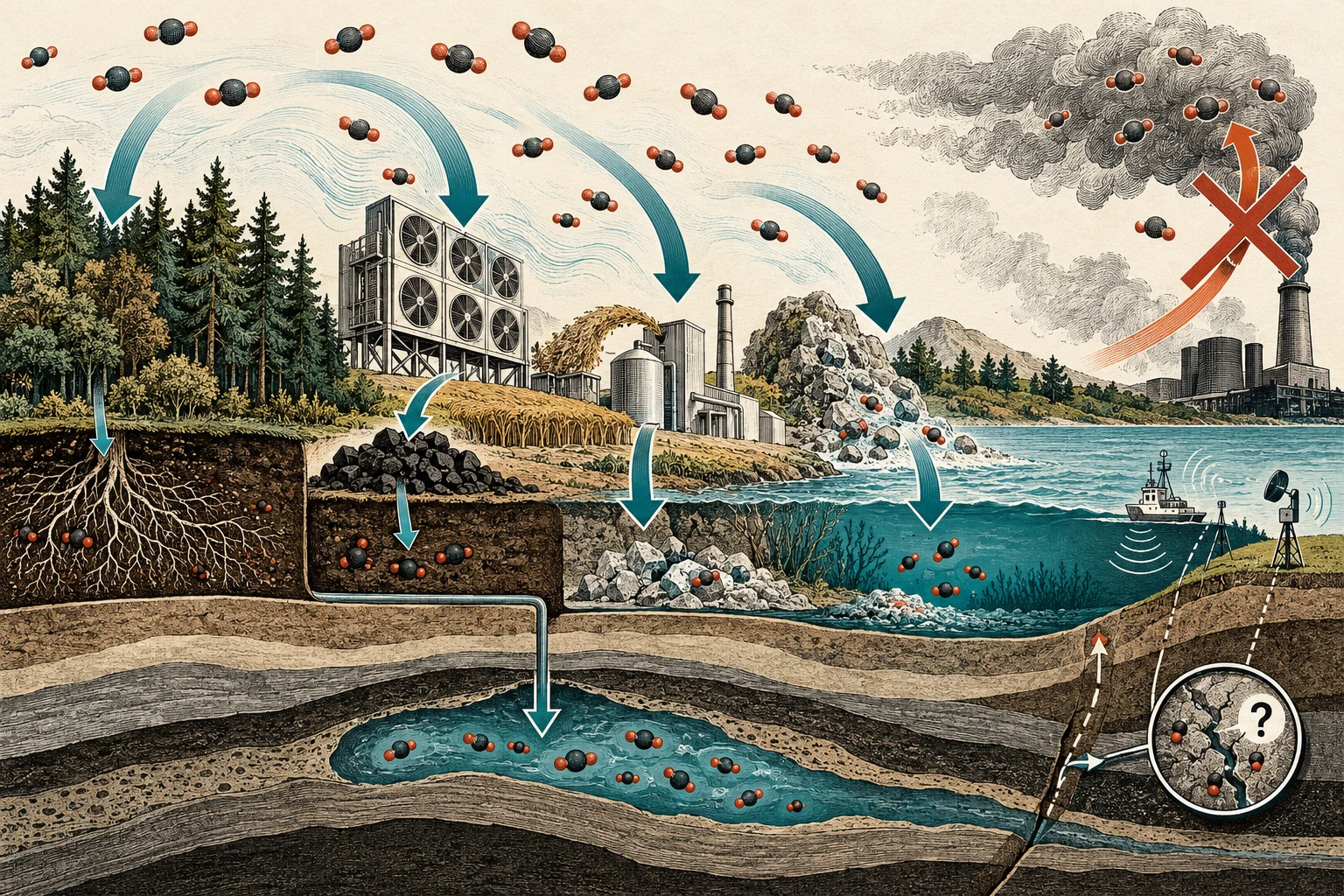
Carbon moves from the atmosphere into storage; durability, monitoring, and the risk of reversal matter alongside initial capture.
AI-assisted illustration · conceptual metaphor View in visual quiz →Genesis and Global Lineage
The concept emerged from carbon-budget arithmetic rather than industrial engineering. When integrated assessment modelers in the late 1990s began calculating emission trajectories compatible with stabilizing greenhouse gas concentrations at low levels, they discovered that after decades of delayed mitigation the equations could only be closed by introducing negative emissions in the second half of the twenty-first century. Around the turn of the millennium, several research clusters almost simultaneously formalized bioenergy with carbon capture and storage (BECCS): Kenneth Möllersten and Jinyue Yan in Stockholm, David Keith in Pittsburgh, and an international group centered at IIASA in Laxenburg, Austria, whose letter “Managing Climate Risk” appeared in Science in October 2001. In parallel, physicist Klaus Lackner began developing direct air capture (DAC) in the late 1990s. The decisive institutional turning point was the absorption of negative emissions into IPCC scenarios: in the Fifth Assessment Report (AR5, 2014), the majority of pathways holding warming below 2^\circC relied heavily on BECCS, and the Special Report on Global Warming of 1.5°C (SR15, 2018) made CDR an indispensable feature of every single 1.5^\circC trajectory. SR15 also separated CDR from solar geoengineering, under which it had previously been grouped, and the Sixth Assessment Report (AR6, 2022) codified its modern taxonomy. In public circulation, however, the term has been partially captured by voluntary carbon markets, where avoided-emission credits and fragile forestry offsets are routinely marketed as “carbon removal.”
Central European Lineage
A key founding text of the negative-emissions literature grew out of the research ecosystem of Vienna and Laxenburg, Austria. Michael Obersteiner, lead author of the October 2001 Science letter “Managing Climate Risk,” completed his graduate training in Vienna—at the University of Natural Resources and Life Sciences (BOKU) and the Institute for Advanced Studies (IHS)—and from 1993 worked in the Forestry Program at the International Institute for Applied Systems Analysis (IIASA) in Laxenburg outside Vienna, where he later directed the Ecosystems Services and Management program. Co-authored with Christian Azar, Kenneth Möllersten, Keywan Riahi, and others, the 2001 letter framed BECCS not as a silver bullet replacing mitigation, but as a risk-management insurance policy: if climate sensitivity turned out to be high or near-term abatement proved politically sluggish, humanity would need a technical lever capable of physically drawing down atmospheric carbon. Laxenburg was a natural incubator for that synthesis: since the 1970s, IIASA had housed both global energy-systems modeling and global forestry and land-use modeling under one roof—the exact two halves that BECCS couples together. While parallel work was underway in Stockholm and Pittsburgh, the Vienna–Laxenburg group played a central role in embedding negative emissions inside the integrated assessment models that subsequently shaped IPCC scenarios.
Documented regional lineage · Link: 1. Compiled: October 2026.
-
author from the region 8 years
Central European Source: Michael Obersteiner, “Studia podyplomowe na Universität für Bodenkultur i w Institut für Höhere Studien w Wiedniu; od 1993 r. praca w programie leśnym IIASA w Laxenburgu”; Vienna and Laxenburg, Austria, 1993
Global Circulation: BECCS as a source of negative emissions and a tool of climate risk management (Managing Climate Risk) — Michael Obersteiner i współautorzy, 2001
author from the region
8 yearsMichael Obersteiner, “Studia podyplomowe na Universität für Bodenkultur i w Institut für Höhere Studien w Wiedniu; od 1993 r. praca w programie leśnym IIASA w Laxenburgu”
1993 · Vienna and Laxenburg, Austria
BECCS as a source of negative emissions and a tool of climate risk management (Managing Climate Risk)
2001 · Michael Obersteiner i współautorzy
- Claim & Connection
- The 2001 “Science” letter “Managing Climate Risk,” with Michael Obersteiner as lead author and Christian Azar, Kenneth Möllersten, and Keywan Riahi among the co-authors, was one of the earliest publications to frame bioenergy with carbon capture and storage (BECCS) as a negative-emissions technology serving as insurance against climate risk. Obersteiner trained in Vienna and from 1993 worked in the Forestry Program at IIASA in Laxenburg, where he was based when the letter was published.
- Source Documentation
-
- bibliographic record M. Obersteiner, Ch. Azar, P. Kauppi, K. Möllersten, J. Moreira, S. Nilsson, P. Read, K. Riahi, B. Schlamadinger, Y. Yamagata, J. Yan, J.-P. van Ypersele, „Managing Climate Risk”, Science, Vol. 294, No. 5543, 26 X 2001, s. 786–787; Crossref record: title, authors, volume, pages, date. api.crossref.org ↗
- biographical record Environmental Change Institute, University of Oxford, „Professor Michael Obersteiner”; biographical paragraph: studies at BOKU and IHS in Vienna, Columbia, and Novosibirsk; from 1993 in the IIASA Forestry Program, from 2011 director of the ESM Program. eci.ox.ac.uk ↗
- scholarly study Wikipedia (en), hasło „Bioenergy with carbon capture and storage”, sekcja „Negative emission”; footnote to Obersteiner et al. 2001 as the source of the thesis on BECCS and DAC as negative-emissions methods. en.wikipedia.org ↗
- Historical Context
- Bibliographic details of the letter (Crossref) and the author's formation (ECI Oxford) are confirmed in open sources. Author affiliations on the letter were not checked directly. At the turn of the century, the BECCS concept was also developed by Möllersten and Yan (Stockholm) and David Keith (Pittsburgh); Möllersten and Yan are co-authors of the Science letter, so their papers are part of the same cluster. IIASA is an international institute, but its seat and working research environment are in Austria.
Why Now
Three developments between 2018 and 2026 thrust CDR from modeling appendices into the center of climate and industrial policy. First, the IPCC’s 2018 1.5^\circC report and 2022 Sixth Assessment Report made explicit that every pathway limiting warming to 1.5^\circC or 2^\circC requires removing hundreds of gigatons of CO2 this century—both to balance “hard-to-abate” residual emissions (aviation, agriculture, cement) and to reverse temperature overshoot. Second, national and corporate net-zero pledges shifted massive weight onto the word “net,” creating immediate demand for a removal industry that barely existed. Third, public subsidies and advance market commitments began to flow: in 2022 the private buyers’ coalition Frontier committed $925 million to permanent carbon removal, Climeworks switched on its Orca (2021) and Mammoth (2024) direct-air-capture plants in Iceland, and the 2022 US Inflation Reduction Act raised the Section 45Q tax credit for DAC with geological storage to $180 per ton. Yet The State of Carbon Dioxide Removal (2023, updated in 2024 and 2026) found that humanity removes roughly 2 GtCO2 per year—almost entirely through conventional forestry—while novel high-permanence methods (BECCS, biochar, DACCS) account for only about 0.1%.
Explanatory Power
The concept makes clear that “net zero” is an equation with two variables, not one. First, when a national strategy projects 10% or 20% residual emissions in 2050, CDR forces the audit question: “Which physical sink will remove that tonnage every year, who will pay for it, and how long will it stay stored?”—exposing whether a net-zero plan is an engineering budget or a wish list. Second, in corporate claims, CDR draws a bright line between avoided emissions (paying not to cut down an existing forest) and physical removal (extracting CO2 from ambient air and storing it for centuries); because only the latter neutralizes ongoing fossil-fuel combustion, most cheap voluntary carbon credits fail the net-zero test. Third, in coal-dependent regions (such as Polish debates over retrofitting plants like Bełchatów to burn biomass), CDR reframes the question from “keep open or shut down?” to “does a sustainable biomass supply and geological sink exist to make this net-negative?” Finally, CDR is the only physical mechanism by which early industrializers could clean up their historical stock of cumulative emissions.
Axes of Debate
Risk insurance versus mitigation deterrence
Climate scientists Kevin Anderson and Glen Peters (2016) and political ecologist Duncan McLaren (2020) argue that building hundreds of gigatons of future CDR into climate models creates severe mitigation deterrence: the promise of future negative emissions weakens pressure to phase out fossil fuels today, with McLaren estimating that substitution and rebound effects could add up to 1.4^\circC of warming if promised removals fail. Strongest counterargument: Jan Minx et al. (2018) and the State of CDR authors reply that no 1.5^\circC pathway exists without CDR even under the steepest emission cuts; the remedy for moral hazard is enacting legally separate targets for gross reductions and for carbon removals so that one cannot substitute for the other. Nature of the dispute: substantive — both sides agree on carbon-budget arithmetic and disagree over institutional design and political responses to technological promises.
Biological sinks versus engineered geological storage
Ecologists and land-stewardship advocates champion nature-based approaches (afforestation, wetland restoration, agroforestry) as low-cost, biodiversity-friendly, and deployable immediately; chemical engineers and permanent-removal buyers counter that biological carbon is vulnerable to wildfires, droughts, and pests, and that only mineralization or deep geological injection truly neutralizes fossil carbon on a like-for-like timescale. Strongest counterargument: Permanence is a continuum rather than a binary: well-governed ecosystems can store carbon for centuries while delivering vital co-benefits, whereas direct air capture currently costs several hundred dollars per ton and consumes vast amounts of clean electricity, meaning a realistic portfolio must combine near-term biological sinks with long-term geological scaling. Nature of the dispute: mixed — genuine biophysical differences in storage durability are entangled with fierce competition over public subsidies and carbon-credit standards.
Whose land bears the footprint?
Climate-justice researchers and land-rights advocates point out that global IAM scenarios relying on several hundred million hectares of bioenergy crops or monoculture tree plantations locate much of that land grab in the Global South, threatening food security and smallholder tenure to mop up the historical emissions of the Global North. Strongest counterargument: Proponents of engineered CDR reply that land-use conflict is an indictment of over-relying on BECCS and afforestation, not of carbon removal as a whole: direct air capture and enhanced weathering have a vastly smaller land footprint per ton and can be sited directly in high-income emitting countries. Nature of the dispute: substantive — it concerns the spatial and social distribution of land, energy, and financial costs across alternative CDR portfolios.
Underappreciated Angle
The hardest problem in carbon dioxide removal is not chemical engineering, but institutional longevity. Every ton of CO2 stored in a forest, a peatland, or agricultural soil requires a legal and administrative custodian to keep it from returning to the atmosphere over a century or more—longer than the lifespan of almost all private corporations and most constitutional regimes. Even geological storage requires long-term monitoring and liability rules for wellhead leaks a hundred years after the injection company has dissolved. CDR is therefore at bottom a problem of intergenerational law and insurance: who remains the debtor to the atmosphere long after the upfront payment has been spent? Here the historical experience of Central and Eastern Europe offers a sobering lesson: state forests in Poland or the Czech Republic—today counted as national LULUCF carbon sinks—changed sovereign borders, property regimes, and political systems four times over the twentieth century alone. Seen from this angle, the decisive question about CDR is not “how many gigatons can we capture?” but “how long a contract can human institutions credibly enforce?”
One-Sentence Takeaway
Carbon dioxide removal is not a futuristic technology that rescues our climate targets, but a physical debt that those targets have already run up—and post-Paris climate politics is a negotiation over who will actually pay it back and when.
Related Concepts Network
How this concept reinforces, constrains, or complements other analytical frameworks in the corpus. View on graph →
-
Net zero complements
The word “net” in a net-zero target means precisely as much as the credible CO2 removal backing residual emissions; without CDR, net zero is unquantifiable.
-
Planetary boundaries constrains
The scale of land-based removal assumed in climate scenarios collides with planetary boundaries for land-system change, freshwater, and biosphere integrity, which are already transgressed.
-
Technological solutionism in tension
Critics read CDR as a technological promise that postpones institutional and consumption change; proponents reply that without removal the carbon budget simply cannot close.
-
Path dependence reinforces
Every ton of emissions justified today by promised future removal locks in high-carbon infrastructure from which it will be difficult to exit if scalable removal fails to materialize.
-
Externalities complements
Removing CO2 is a pure global public good with no natural market buyer, raising the question of who pays for a negative externality run in reverse and who guarantees storage permanence.
-
Just transition in tension
Global integrated assessment models routinely locate BECCS and afforestation on land in the Global South, shifting land and food-price burdens onto populations that emitted the least.
-
Anthropocene complements
CDR completes the logic of the Anthropocene: once humanity alters atmospheric composition, it assumes responsibility for deliberately reversing that alteration.
Reading Canon & Translation Bridge
Foundational texts, introductions, and critical perspectives—with availability of English and Polish editions.
-
foundational text 2001 · English
Michael Obersteiner, Christian Azar, Pekka Kauppi, Kenneth Möllersten, José Moreira, Sten Nilsson, Peter Read, Keywan Riahi, Bernhard Schlamadinger, Yoshiki Yamagata, Jinyue Yan, Jean-Pascal van Ypersele, Managing Climate Risk
A two-page letter in “Science” (vol. 294, pp. 786–787) introducing BECCS into the climate debate as an insurance policy in case emission cuts prove too slow—a founding document of negative-emissions logic.
In English: original text written in English
In Polish: no Polish edition
-
foundational text 2018 · English
Jan C. Minx, William F. Lamb, Max W. Callaghan, Sabine Fuss i in., Negative emissions—Part 1: Research landscape and synthesis
A scientometric synthesis in “Environmental Research Letters” (vol. 13, 063001) mapping the field, quantifying the literature explosion, and formulating six conclusions on potentials, barriers, and the deployment gap.
In English: original text written in English
In Polish: no Polish edition
-
critical perspective 2016 · English
Kevin Anderson, Glen Peters, The trouble with negative emissions
The most widely cited warning (“Science”, vol. 354, pp. 182–183): integrated assessment models assume removal at a scale no one can guarantee, risking lock-in to a high-temperature pathway.
In English: original text written in English
In Polish: no Polish edition
-
critical perspective 2020 · English
Duncan P. McLaren, Quantifying the potential scale of mitigation deterrence from greenhouse gas removal techniques
An attempt to quantify “mitigation deterrence”: substitution, rebound effects, and imagined offsets could together add up to roughly 1.4°C of warming (“Climatic Change”).
In English: original text written in English
In Polish: no Polish edition
-
introduction & synthesis 2023 · English
Stephen M. Smith i in., The State of Carbon Dioxide Removal – 1st Edition
The first independent global assessment of CDR deployment: roughly 2 GtCO2 per year, of which novel technological methods account for only about 0.1%; followed by 2nd and 3rd editions in 2024 and 2026.
In English: original text written in English
In Polish: no Polish edition
-
cross-disciplinary 2018 · English
David W. Keith, Geoffrey Holmes, David St. Angelo, Kenton Heidel, A Process for Capturing CO2 from the Atmosphere
An engineering paper detailing Carbon Engineering's direct air capture process (“Joule”, vol. 2, pp. 1573–1594), shifting the DAC discussion from theoretical thermodynamics to industrial cost estimates.
In English: original text written in English
In Polish: no Polish edition
-
cross-disciplinary 2019 · English
Holly Jean Buck, After Geoengineering: Climate Tragedy, Repair, and Restoration
A sociological and field-reported study of carbon removal as labor, landscape, and political economy rather than a curve in a model, asking who would actually build and run it.
In English: original text written in English
In Polish: Polish edition not verified
Primary-Source Quotes
capturing CO₂ from the atmosphere and storing it away for decades to millennia