Horizon & Ecology #181
Climate justice
original term: climate justice (Eng.) · etyka klimatyczna, sprawiedliwy podział obciążeń klimatycznych
Global-circulation concept — no documented lineage in Central Europe. jump to documentation ↓
Working Definition
Climate justice is a structured set of ethical, legal, and political questions about how to distribute three kinds of burdens across states, generations, and social groups: the cost of reducing greenhouse gas emissions (mitigation), the cost of adjusting to climate changes that can no longer be avoided (adaptation), and the cost of irreversible harms to which societies can neither adapt nor prevent (loss and damage). In its analytical version, practiced in political philosophy and international law, it is a calculus of distributive principles examining who emitted, who benefited from past industrialization, who possesses the financial and technological capacity to act, and who is most exposed to harm. In its activist version, forged by grassroots and Global South movements, it is above all a demand for procedural and political self-determination: that climate policy be shaped by those who bear its consequences rather than those who caused the crisis. Both versions share a foundational rejection of the premise that climate change is merely an engineering or economic optimization problem with a socially neutral solution.
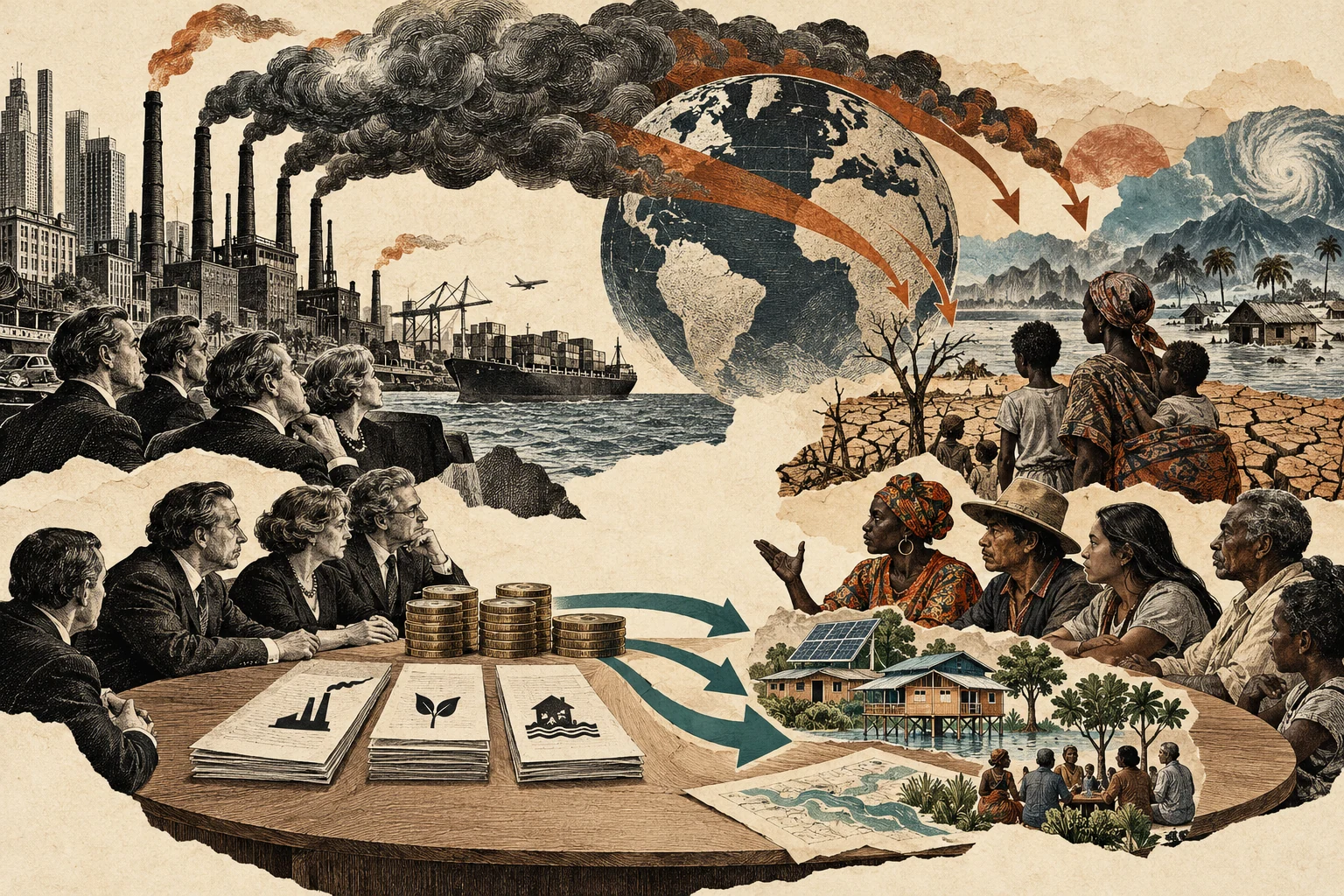
Responsibility for emissions and exposure to harm are unevenly distributed, and debates over funding and governance take that asymmetry into account.
AI-assisted illustration · conceptual metaphor View in visual quiz →Genesis and Global Lineage
The concept traces back to two parallel interventions in the early 1990s. The first was the landmark 1991 report Global Warming in an Unequal World by Anil Agarwal and Sunita Narain of the Centre for Science and Environment (CSE), an independent think tank in New Delhi. Responding to Western rankings that placed India and China among the top global polluters, Agarwal and Narain charged Northern statistical models with “environmental colonialism”: aggregating emissions by nation-state concealed the moral gulf between “survival emissions” generated by methane from rice paddies or livestock in poor agrarian economies and “luxury emissions” generated by private automobiles and air conditioning in the affluent North. The second source was philosopher Henry Shue’s 1993 article “Subsistence Emissions and Luxury Emissions” in Law & Policy, which brought the same distinction into analytical moral philosophy and demonstrated that no climate treaty can avoid normative judgments about fairness—it can only smuggle them in under technical formulas.
From this lineage grew the academic climate ethics of the 2000s. Simon Caney systematized the three rival distributive principles—the Polluter Pays Principle (PPP), the Beneficiary Pays Principle (BPP), and the Ability to Pay Principle (APP)—while Stephen M. Gardiner diagnosed climate change as a “perfect moral storm” in which spatial dispersion of cause and effect, intergenerational time lags, and theoretical inadequacy conspire to incentivize moral buck-passing. Simultaneously, the term was adopted by transnational social movements: the Bali Principles of Climate Justice (2002), drafted by a coalition of environmental justice and indigenous organizations modeled on the 1991 US Environmental Justice principles, expanded the concept beyond carbon accounting to include ecological debt, food and energy sovereignty, and representation of frontline communities. Within UN diplomacy, the underlying logic was codified in the 1992 UNFCCC principle of “common but differentiated responsibilities and respective capabilities” (CBDR-RC), while the exact phrase “climate justice” entered the preamble of the 2015 Paris Agreement—albeit hedged with the diplomatic qualifier “noting the importance for some of the concept of ‘climate justice.’”
Central European Lineage
We found no documented link between this concept and the intellectual history or historical experience of Central Europe.
We found no documented link between this concept and the intellectual history or historical experience of Central Europe (by our methodology, this means “none found,” not “none exists”; as of October 2026).
Why Now
Three converging developments between 2018 and 2026 moved climate justice from seminar rooms and activist banners into binding institutional decisions. First, a wave of constitutional and human-rights climate litigation turned intergenerational equity into enforceable law: the Dutch Supreme Court’s Urgenda ruling (2019), the German Federal Constitutional Court’s 2021 Neubauer decision—which held that weak near-term emission cuts unconstitutionally offload drastic freedom restrictions onto younger generations after 2030—and the European Court of Human Rights’ KlimaSeniorinnen v. Switzerland judgment (2024) established that states have positive legal duties to protect citizens from disproportionate climate burdens. Second, after three decades of diplomatic resistance from wealthy nations, COP27 in Sharm el-Sheikh (2022) established the Loss and Damage Fund, operationalized a year later at COP28 in Dubai: the first multilateral institution built on the premise that financial transfers are owed for climate harms already incurred. Third, domestic decarbonization within affluent economies began generating visible internal losers—from coal miners to suburban commuters reliant on combustion cars and households facing higher heating bills—as seen in France’s Gilets Jaunes (Yellow Vests) protests in 2018 and fierce European debates over extending emissions trading to buildings and road transport (ETS2). A concept born as a North–South claim had to be reformulated to address class and spatial inequalities within the North itself.
Explanatory Power
The lens of climate justice reveals that beneath every seemingly technical parameter in climate policy lies a political choice about distribution. First, baseline years: the 1997 Kyoto Protocol measured emission cuts against 1990, automatically rewarding post-communist Central and Eastern European states whose heavy industry collapsed after 1989 without climate policy, while penalizing economies that industrialized later. Second, metrics: current territorial emissions per state put China first; per capita emissions put Qatar and the United States first; cumulative emissions since 1850 indict the US and Europe; consumption footprints shift responsibility back to Western buyers. No measurement can decide which metric is right—only a principle of justice can. Third, discount rates: the clash between Nicholas Stern (near-zero pure time discount rate, demanding immediate investment) and William Nordhaus (higher market-derived discount rate) was an ethical dispute over the moral weight of people living in 2100 disguised as financial arithmetic.
Axes of Debate
Historical responsibility: should living generations pay for their ancestors’ emissions?
Northern governments and policy commentators—alongside philosophical proponents of a pure Ability to Pay Principle—argue that pre-1990 greenhouse gases were emitted in excusable scientific ignorance of their atmospheric effects, and that holding today’s citizens liable for their great-grandparents’ coal combustion violates moral individualism by punishing the innocent. Strongest counterargument: Proponents of the Beneficiary Pays Principle (such as Henry Shue and Simon Caney) bypass personal fault altogether: the issue is not who lit the furnace in 1890, but who today enjoys the inherited infrastructure, universities, wealth, and life expectancy built through carbon-intensive industrialization. In every domestic legal system, accepting an inheritance means accepting the liabilities attached to the estate. Nature of the dispute: substantive — it turns on whether reparative duties attach to transgenerational political communities and inherited structural wealth, or strictly to individual intentional agents.
Per capita versus grandfathering: what is the fair unit of allocation?
Delegations from populous developing nations and scholars following Agarwal and Narain argue for equal per capita entitlements to the remaining global carbon budget, which at current emission rates implies massive financial and technological transfers to the Global South. Northern negotiators and some economists counter that per capita allocation rewards demographic growth and ignores objective differences in geography, heating needs, and economic structure. Strongest counterargument: Every alternative allocation baseline—whether “grandfathering” entitlements based on current emissions, indexing to GDP, or appealing to custom-tailored “needs”—requires an ad hoc normative justification that locks in existing privilege, whereas an equal per-person share of a global commons is the only default rule that does not reward prior appropriation. Nature of the dispute: mixed — a genuine philosophical disagreement over egalitarian theories of resource ownership is inseparable from a multi-trillion-dollar bargaining calculation over who pays whom.
Justice versus speed: do distributive disputes delay planetary action?
Pragmatic diplomats and realpolitik scholars (such as David Victor or Cass Sunstein) contend that insisting on historical guilt and binding distributive formulas paralyzed UN negotiations for twenty years from Rio to Copenhagen, and that global climate governance only moved forward in Paris (2015) when mandatory burden-sharing was replaced by voluntary, bottom-up national pledges (NDCs). Strongest counterargument: Stephen Gardiner and Southern negotiators reply that it is the evasion of justice, not its pursuit, that delays effective action: voluntary pledges without equitable finance consistently add up to warming well above Paris targets, and appeals to “pragmatism” serve as a rhetorical shield for wealthy high emitters to preserve the status quo. Nature of the dispute: rhetorical — both sides agree that current action is dangerously slow, but it is empirically difficult to isolate the drag of distributive deadlocks from the straightforward obstruction of fossil-fuel interests.
Underappreciated Angle
Most global literature frames climate justice as a binary confrontation between an affluent, historically guilty Global North and an impoverished, low-emitting Global South. Yet some of the hardest theoretical and political cases lie in the semi-periphery between these poles: post-socialist economies that emitted heavily throughout the twentieth century under Soviet-style central planning, without accumulating the Western capital stocks or living standards that the Beneficiary Pays Principle presupposes, and whose sharp drop in emissions after 1989 resulted from painful industrial collapse rather than green policy. Central Europe—and coal-dependent regions like Upper Silesia in Poland, where the Katowice COP24 summit adopted the “Solidarity and Just Transition Silesia Declaration” in 2018—exposes the blind spots of all three canonical rules: these societies polluted heavily under non-sovereign command economies, possess an ability to pay far above the Global South yet well below Western Europe, and experienced their post-1990 “emission reductions” as acute regional deindustrialization. A theory of climate justice capable of guiding real transition politics must account for this middle tier rather than operating solely with a two-pole world map.
One-Sentence Takeaway
There is no technically neutral climate policy: every baseline year, accounting metric, and discount rate is an implicit answer to the question of who pays, and climate justice simply refuses to pretend that this question was never asked.
Related Concepts Network
How this concept reinforces, constrains, or complements other analytical frameworks in the corpus. View on graph →
-
Just transition complements
Just transition shifts the question of burden-sharing from the level of nation-states to the level of regions and workers whose livelihoods are eliminated by decarbonization.
-
Loss and damage (L&D) reinforces
The loss and damage mechanism is an institutional attempt to pay for what neither mitigation nor adaptation managed to prevent; without a concept of climate justice, it is impossible to justify who ought to contribute to it.
-
Climate adaptation complements
The costs of adaptation are borne most heavily by those who emitted the least, making the dispute over adaptation finance a practical test of climate justice.
-
Tragedy of the commons in tension
The tragedy of the commons framing implies a symmetric coordination problem among equal users, whereas climate justice begins from the observation that users are unequal in both historical emissions and vulnerability.
-
Planetary boundaries reinforces
If the remaining carbon budget is finite, every allocation of that budget is a distributive decision that can no longer be presented as technically neutral.
-
Degrowth in tension
Degrowth accepts the argument about luxury emissions, but rejects the assumption held by most climate justice theories that decarbonization can be reconciled with continued economic growth in wealthy countries.
-
Anthropocene constrains
The collective “we” of the Anthropocene narrative blurs precisely what climate justice insists on separating: who emitted, who benefited, and who will pay.
Reading Canon & Translation Bridge
Foundational texts, introductions, and critical perspectives—with availability of English and Polish editions.
-
foundational text 1993 · English
Henry Shue, Subsistence Emissions and Luxury Emissions
An article in “Law & Policy” (Vol. 15, No. 1, pp. 39–60) that introduced the distinction between subsistence emissions and luxury emissions and posed the foundational question of whose emissions must be cut first.
In English: original text written in English
In Polish: Polish edition not verified
-
foundational text 1991 · English
Anil Agarwal, Sunita Narain, Global Warming in an Unequal World: A Case of Environmental Colonialism
A report from the Centre for Science and Environment (CSE) in New Delhi that challenged state-level emission accounting and demanded an equal per capita right to the atmosphere as a global commons.
In English: original text written in English
In Polish: Polish edition not verified
-
foundational text 2002 · English
International Climate Justice Network, Bali Principles of Climate Justice
Twenty-seven principles proclaimed by a coalition of environmental and indigenous peoples’ organizations in 2002; the document that carried the term from moral philosophy into the language of social movements.
In English: original text written in English
In Polish: Polish edition not verified
-
introduction & synthesis 2005 · English
Simon Caney, Cosmopolitan Justice, Responsibility, and Global Climate Change
An article in the “Leiden Journal of International Law” (Vol. 18, No. 4, pp. 747–775) systematizing the “polluter pays,” “beneficiary pays,” and “ability to pay” principles along with their respective vulnerabilities.
In English: original text written in English
In Polish: Polish edition not verified
-
critical perspective 2011 · English
Stephen M. Gardiner, A Perfect Moral Storm: The Ethical Tragedy of Climate Change
Shows why three overlapping “storms” (global, intergenerational, and theoretical) foster moral corruption and self-deception, making a fair settlement unlikely even when principles are agreed upon.
In English: original text written in English
In Polish: Polish edition not verified
-
introduction & synthesis 2018 · English
Mary Robinson, Climate Justice: Hope, Resilience, and the Fight for a Sustainable Future
A narrative account written by the former President of Ireland and UN Special Envoy: stories of frontline communities rather than a calculus of principles, showing how the term functions in diplomacy and grassroots mobilization.
In English: original text written in English
In Polish: Polish edition not verified
-
cross-disciplinary 2018 · Polish
Ewa Bińczyk, Epoka człowieka. Retoryka i marazm antropocenu
A Polish philosopher of science analyzes how the rhetoric of the Anthropocene and climate discourse produces political paralysis; valuable background for asking why justice arguments translate so weakly into policy action.
In English: English edition not verified
In Polish: original text written in Polish