Industrial policy
original term: industrial policy (Eng.) · państwo przedsiębiorcze, polityka sektorowa, nowa polityka przemysłowa
Central European lineage: 2 threads (author from the region) · 1928–1951 · jump to documentation ↓
Working Definition
Industrial policy is deliberate state action designed to alter the structure of economic activity in favor of specific sectors, technologies, or productive capabilities, rather than confining government to neutral horizontal framework conditions. Its toolkit spans targeted subsidies, tax credits, tariffs, public procurement, R&D funding, state development banks, and infant-industry protection; the common denominator is that the state consciously chooses which activities should grow. In everyday political debate the term is loosely applied to any government handout to industry, whereas in analytical economics it denotes a targeted intervention justified by a specific coordination failure, learning-by-doing externality, or scale economy, paired with a mechanism for performance evaluation and exit. The gap between these two meanings is wider than it appears: the former props up what already exists, while the latter attempts to bring into being capabilities that the market would not generate on its own.
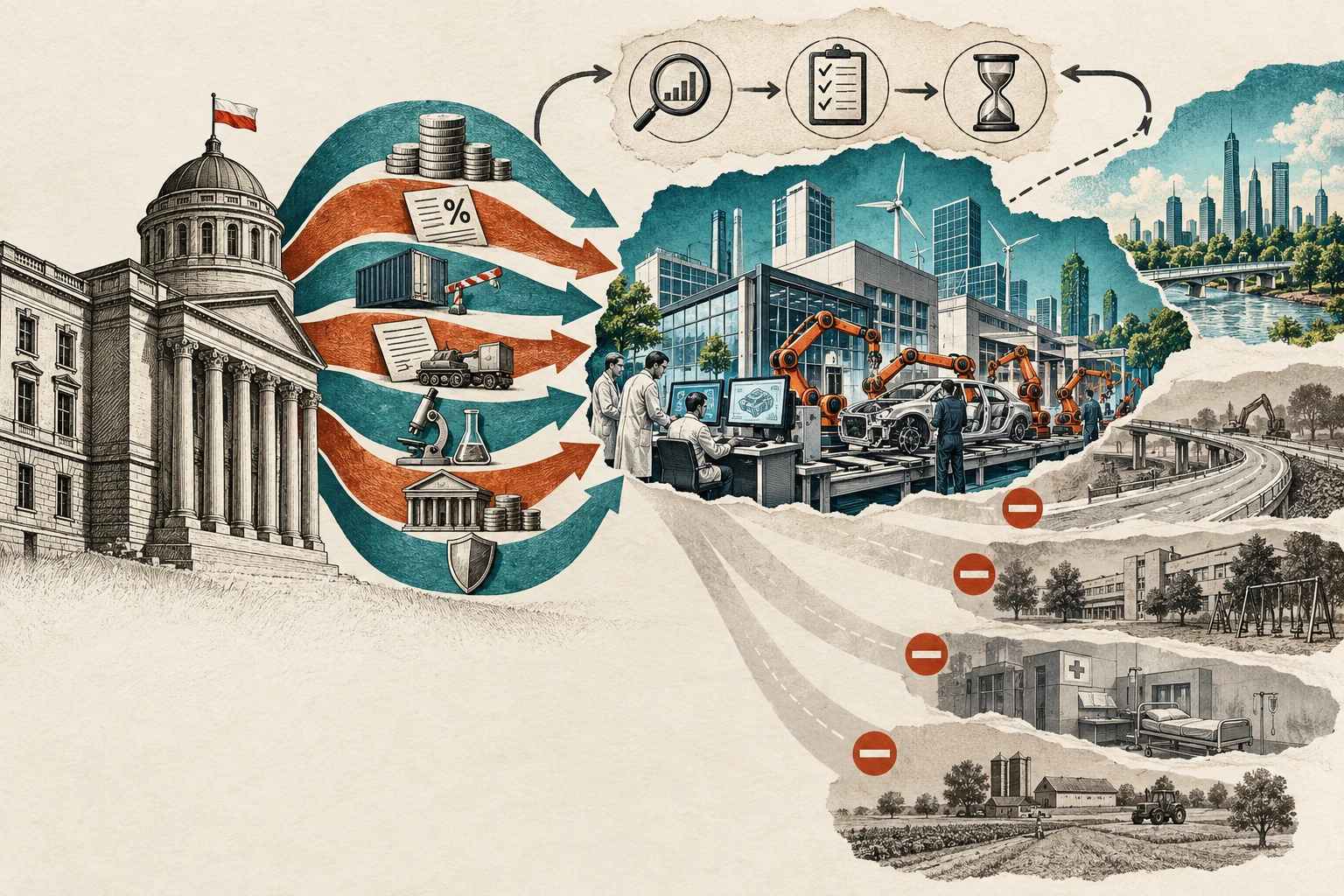
Public policy tools channel resources toward selected productive capabilities, though results depend on implementation and cost discipline rather than merely announcing a goal.
AI-assisted illustration · conceptual metaphor View in visual quiz →Genesis and Global Lineage
State practice preceded the modern analytical concept by centuries: early modern mercantilism, Alexander Hamilton's Report on Manufactures (1791), and Friedrich List's The National System of Political Economy (1841), with its infant-industry argument, form the first lineage. A second emerged in 1940s–1950s development economics, which deduced from investment complementarities that without a coordinated state-led push, an agrarian economy stays stuck in a low-level equilibrium trap. A third grew out of the postwar East Asian miracles of Japan, South Korea, and Taiwan, analyzed by Chalmers Johnson (MITI and the Japanese Miracle, 1982), Alice Amsden, and Robert Wade—and later domesticated in the World Bank's The East Asian Miracle (1993), which credited macroeconomic stability rather than sectoral targeting. During the neoliberal consensus of the 1980s and 1990s, the term was banished to the dictionary of policy errors—nowhere more emphatically than in post-1989 Central Europe, where Poland's Industry Minister Tadeusz Syryjczyk declared that “the best industrial policy is no industrial policy.” Its intellectual rehabilitation arrived via two routes: Dani Rodrik (2004) redefined industrial policy as an iterative discovery process between government and firms, while Mariana Mazzucato (The Entrepreneurial State, 2013) shifted the emphasis from defensive protection to the state as a bold investor of first resort willing to bear uncertainty that private venture capital shuns.
Central European Lineage
Two foundational theorists from whom the modern analytical lineage of industrial policy descends were formed intellectually in interwar Vienna and built their models on the historical experience of Central and Eastern Europe. Paul Rosenstein-Rodan—born in Kraków (then in Austro-Hungarian Galicia, now Poland) and trained under Hans Mayer in the Austrian school at the University of Vienna—published his landmark article Problems of Industrialisation of Eastern and South-Eastern Europe in The Economic Journal in 1943. Studying the agrarian belt between the Baltic and the Balkans (a region that had already experimented with state-led modernization in interwar Poland through the building of the port city of Gdynia and the Central Industrial Region, or COP, in 1936–1939), Rosenstein-Rodan demonstrated that economies with vast agricultural surplus labor cannot industrialize through isolated private investments because a single shoe factory cannot survive unless wages paid in dozens of other newly created factories generate sufficient aggregate demand; the only exit is a planned, simultaneous wave of investment across complementary industries—the famous “Big Push.” Alongside him, Alexander Gerschenkron—who fled Odessa after the Russian Revolution, earned his doctorate in economics at the University of Vienna (1924–1928), and worked in Austrian economic research until the 1938 Anschluss—generalized the nineteenth-century experience of Germany, Austria-Hungary, and Russia in his classic essay Economic Backwardness in Historical Perspective (1951/1962): the later a country enters industrialization relative to the technological frontier, the more state ministries and large universal banks must substitute for missing private capital markets and dispersed entrepreneurship. Both formulations belong to the canon of development and industrial policy, even if Mariana Mazzucato's recent work on the entrepreneurial state draws primarily on postwar American innovation agencies rather than directly on the Viennese development pioneers.
Documented regional lineage · Links: 2. Compiled: October 2026.
-
author from the region 23 years
Central European Source: Alexander Gerschenkron, “Studia ekonomiczne na Uniwersytecie Wiedeńskim (1924–1928) i praca w Wiedniu do 1938 r. (Economics studies at the University of Vienna, 1924–1928, and research work in Vienna until 1938)”; Odessa, Russian Empire (now Odesa, Ukraine); Vienna, Austria, 1928
Global Circulation: economic backwardness thesis: the later a country industrializes, the greater the coordinating role of the state and investment banks — Alexander Gerschenkron, 1951
-
author from the region 0 years — same text on both sides
Central European Source: Paul Rosenstein-Rodan, “Problems of Industrialisation of Eastern and South-Eastern Europe”; Kraków, Austria-Hungary (now Poland); Vienna, Austria; London, UK, 1943
Global Circulation: the Big Push — the foundational economic argument for coordinated, state-planned industrialization — Paul Rosenstein-Rodan, 1943
author from the region
0 years — same text on both sidesPaul Rosenstein-Rodan, “Problems of Industrialisation of Eastern and South-Eastern Europe”
1943 · Kraków, Austria-Hungary (now Poland); Vienna, Austria; London, UK
the Big Push — the foundational economic argument for coordinated, state-planned industrialization
1943 · Paul Rosenstein-Rodan
- Claim & Connection
- Born in Kraków and trained in the Viennese school of economics under Hans Mayer, Paul Rosenstein-Rodan argued in his seminal 1943 article in “The Economic Journal” that the agrarian economies of Eastern and South-Eastern Europe, burdened by massive agrarian surplus labor, could not escape a low-level equilibrium trap without a planned, simultaneous wave of investment across multiple complementary industries. The paper is recognized as the birthplace of the “Big Push” model—one of the core theoretical justifications for modern industrial policy—and its empirical subject was Central and South-Eastern Europe itself.
- Source Documentation
-
- primary source P. N. Rosenstein-Rodan, „Problems of Industrialisation of Eastern and South-Eastern Europe”, The Economic Journal, Vol. 53, No. 210/211, 1943, s. 202–211; full article; journal page confirms title, volume, and pagination. academic.oup.com ↗
- biographical record Hasło „Paul Rosenstein-Rodan”, Wikipedia (en); sections on birthplace (Kraków), studies under Hans Mayer in Vienna, and the 1943 article as the origin of the Big Push model. en.wikipedia.org ↗
- Historical Context
- Biographical details rely on an encyclopedic entry; a reviewer should confirm his Viennese academic formation in a scholarly reference (e.g., an obituary or his entry in “The New Palgrave”). London is the place of publication after his 1930 emigration, not his intellectual formation.
author from the region
23 yearsAlexander Gerschenkron, “Studia ekonomiczne na Uniwersytecie Wiedeńskim (1924–1928) i praca w Wiedniu do 1938 r. (Economics studies at the University of Vienna, 1924–1928, and research work in Vienna until 1938)”
1928 · Odessa, Russian Empire (now Odesa, Ukraine); Vienna, Austria
economic backwardness thesis: the later a country industrializes, the greater the coordinating role of the state and investment banks
1951 · Alexander Gerschenkron
- Claim & Connection
- Alexander Gerschenkron, who after fleeing Odessa studied economics at the University of Vienna (1924–1928) and worked there until the 1938 Anschluss, formulated in his essay “Economic Backwardness in Historical Perspective” (written in 1951, collected in his 1962 book) the thesis that the greater a country's relative economic backwardness on the eve of industrialization, the more likely it is that the state and large investment banks must substitute for missing private markets in supplying capital and entrepreneurial coordination. This provides the classic historical foundation for the argument that late industrialization requires deliberate industrial policy.
- Source Documentation
-
- biographical record Hasło „Alexander Gerschenkron”, Wikipedia (en); sections on studies at the University of Vienna (1924–1928), emigration in 1938, and the economic backwardness thesis. en.wikipedia.org ↗
- Historical Context
- The primary text was not opened directly; the summary of the thesis relies on an encyclopedic entry. Odesa belongs to the broader regional core (present-day Ukraine), and the regional formation criterion is fulfilled by his Viennese university education and early career.
Why Now
Since 2018, industrial policy has moved from an ideological taboo in wealthy Western capitals to the centerpiece of economic statecraft. Several shocks drove this reversal: Beijing's Made in China 2025 strategy (2015) and the US–China trade war from 2018; acute shortages of masks, pharmaceuticals, and semiconductors during the 2020–2022 pandemic, which showed that hyper-efficient supply chains had been bought at the price of fragility; and Russia's full-scale invasion of Ukraine in 2022, which returned energy and defense industrial capacity to the heart of economic calculation. Washington responded with the CHIPS and Science Act and the Inflation Reduction Act (August 2022), given doctrinal form by Jake Sullivan's April 2023 Brookings speech proclaiming a “new Washington Consensus.” The European Union answered with the European Chips Act (2023), the Net-Zero Industry Act (2024), Mario Draghi's competitiveness report (September 2024), and the Clean Industrial Deal (February 2025), while US tariffs in 2025 shifted the mix further toward protection. Across Central Europe, debates over national recovery plans and subsidies for battery and chip plants represent the regional front of this turn.
Explanatory Power
The concept makes visible that the “free market” in advanced technologies was never a spontaneous natural order, but the product of prior political decisions about who bears the risk of the first step. First, it explains why Taiwan's TSMC dominates global chipmaking: founded in 1987 on the initiative of the Taiwanese state, which recruited Morris Chang from the US, provided nearly half the initial capital, and spun off public labs, it illustrates why the US and Europe struggle to buy with crash subsidies what Taiwan built institutionally over decades. Second, it exposes the “hidden industrial policy” embedded in defense and health budgets: DARPA, the NIH, and Pentagon procurement underwrote the internet, GPS, mRNA vaccines, and touchscreens long before Silicon Valley commercialized them. Third, it diagnoses policy failures: Germany's Energiewende subsidized consumer demand for solar panels, but manufacturing migrated to China because demand subsidies without supply-side scaling export industrial learning curves abroad.
Axes of Debate
Market failure versus government failure
Public-choice economists and authors of skeptical surveys (Howard Pack and Kamal Saggi, 2006) argue that bureaucrats lack the price information required to pick winning sectors better than markets, and that every subsidy creates a rent-seeking lobby that prevents shutting failing programs down. Strongest counterargument: Dani Rodrik replies that the state need not know more than private firms; rather, it must design an institutional discovery process in which firms reveal bottlenecks, and recent causal-inference studies (Réka Juhász, Nathan Lane, and Dani Rodrik, 2023) show that well-designed industrial policies generated measurable, lasting productivity gains. Nature of the dispute: substantive — decided by empirical evaluation of institutional design and specific program outcomes rather than ideological axioms.
The entrepreneurial state versus corporate welfare
Mariana Mazzucato argues that the public sector should set bold “missions” and retain an equity-like share of upside rewards; critics from left and right counter that post-2022 Western programs socialize risk while privatizing profits, handing billions to multinationals like Intel without binding public stakes. Strongest counterargument: Without mechanisms for sharing returns—public equity stakes, royalties, bans on stock buybacks, and local R&D commitments—industrial policy degenerates into a fiscal transfer from taxpayers to shareholders under the banner of national security. Nature of the dispute: mixed — the dispute over contract conditionalities is substantive, though both sides deploy “the entrepreneurial state” rhetorically.
Strategic security versus allocative efficiency
Trade economists view the 2022–2025 wave of subsidies as a costly return to protectionism that inflates prices, duplicates capacity across allies, and triggers retaliation; proponents of de-risking reply that reliance on a single rival for logic chips or rare-earth magnets is an existential tail risk that market prices ignore. Strongest counterargument: The fiscal cost of duplicating supply chains is paid every year, whereas the security benefit materializes only in a major crisis; without an explicit estimate of crisis probability, “national security” becomes a blank check for any politically connected industry. Nature of the dispute: mixed — part insurance calculus under uncertainty, part foreign policy and domestic politics dressed up as economics.
Underappreciated Angle
The least discussed element of contemporary industrial policy is the exit mechanism. Classic East Asian industrial policies succeeded not because bureaucrats in Tokyo or Seoul were infallible, but because they built in a ruthless external performance test—export discipline: a subsidized Korean chaebol that failed to compete on world markets within a few years lost its preferential credit, because the global market served as a judge that domestic politicians could not bribe. By contrast, today's flagship industrial policies in the US and the EU are justified by national security and resilience, and security has no objective market test—one cannot export resilience. The “new industrial policy” thus discards the very disciplinary device that kept the East Asian model from rotting into permanent rent-seeking. What institutional mechanism will replace export discipline—sunset clauses, independent audits, or clawback rules—is far more consequential than the headline size of the subsidies, yet remains almost absent from public debate.
One-Sentence Takeaway
The real debate over industrial policy is not about whether the state picks winners, but whether it admits that it always does—even when it calls its choices market neutrality.
Related Concepts Network
How this concept reinforces, constrains, or complements other analytical frameworks in the corpus. View on graph →
-
State capacity reinforces
Every instrument of industrial policy is only as effective as the public administration capable of selecting, monitoring, and withdrawing support on time.
-
Rent-seeking in tension
The classic public-choice critique: targeted sectoral support attracts political lobbying and turns market discipline into a race for bureaucratic favor.
-
De-risking complements
Reducing strategic dependence on China has become since 2022 the primary political justification for massive new industrial subsidies in the US and EU.
-
Geoeconomic fragmentation complements
The subsidy race among the United States, the European Union, and China is simultaneously a symptom and a driver of global geoeconomic fragmentation.
-
Supply chain resilience reinforces
Shortages of semiconductors, medical gear, and pharmaceuticals in 2020–2022 supplied a concrete political argument for subsidizing domestic production capacity in critical sectors.
-
Creative destruction in tension
Protecting incumbent industries can block Schumpeterian firm turnover, although Mariana Mazzucato argues that an entrepreneurial state can also ignite entirely new waves of innovation.
-
Path dependence complements
A state decision to back a specific sector creates physical infrastructure, specialized skills, and vested political interests that shape an economy's trajectory long after the subsidy program expires.
Reading Canon & Translation Bridge
Foundational texts, introductions, and critical perspectives—with availability of English and Polish editions.
-
foundational text 2013 · English
Mariana Mazzucato, The Entrepreneurial State: Debunking Public vs. Private Sector Myths
The influential argument that the state often acts as the boldest first-resort investor (behind the internet, GPS, and touchscreens), giving rise to the contemporary concept of “mission-oriented” industrial policy.
In English: original text written in English
In Polish: “Przedsiębiorcze państwo”, Wydawnictwo Ekonomiczne Heterodox 2016, trans. Joanna Bednarek
-
foundational text 1943 · English
Paul N. Rosenstein-Rodan, Problems of Industrialisation of Eastern and South-Eastern Europe
Ten pages from which development economics grew: investment complementarities and the low-level equilibrium trap as the reason why the state must coordinate large-scale industrialization.
In English: original text written in English
In Polish: Polish edition not verified
-
cross-disciplinary 1962 · English
Alexander Gerschenkron, Economic Backwardness in Historical Perspective: A Book of Essays
The economic history of Germany and Russia as proof that latecomers industrialize through different institutional substitutes than early-industrializing Britain—relying on investment banks and the state rather than dispersed private entrepreneurs.
In English: original text written in English
In Polish: Polish edition not verified
-
introduction & synthesis 2002 · English
Ha-Joon Chang, Kicking Away the Ladder: Development Strategy in Historical Perspective
A historical survey demonstrating that today's wealthy economies actively used tariffs, infant-industry protection, and subsidies during their own ascent before advising developing nations against them.
In English: original text written in English
In Polish: Polish edition not verified
-
introduction & synthesis 2023 · English
Réka Juhász, Nathan J. Lane, Dani Rodrik, The New Economics of Industrial Policy
A comprehensive review of recent causal-inference empirical studies (NBER Working Paper 31538) that breaks with mainstream economics' blanket skepticism and organizes the rationales, instruments, and governance challenges of industrial policy.
In English: original text written in English
In Polish: no Polish edition
-
critical perspective 2006 · English
Howard Pack, Kamal Saggi, Is There a Case for Industrial Policy? A Critical Survey
A skeptical survey in the World Bank Research Observer: market failures are real in theory, but the informational and political requirements for successful state intervention are rarely met in practice.
In English: original text written in English
In Polish: no Polish edition
-
foundational text 1841 · German
Friedrich List, Das nationale System der politischen Ökonomie
The nineteenth-century source of the “infant industry” argument and the thesis that a nation's long-term productive powers matter more than immediate static exchange value.
In English: English edition not verified
In Polish: Polish edition not verified