Horizon & Ecology #180
Climate adaptation
original term: climate change adaptation (Eng.) · adaptacja do zmian klimatu, przystosowanie do zmiany klimatu, climate adaptation
Global-circulation concept — no documented lineage in Central Europe. jump to documentation ↓
Working Definition
Climate adaptation is the process of adjusting human and natural systems to actual or expected climate change and its effects in order to moderate harm or exploit beneficial opportunities. In its technical IPCC formulation, the concept rests on three distinct components that should never be conflated: exposure (the presence of people, livelihoods, or assets in places that could be adversely affected), vulnerability (propensity to be harmed, shaped by social and material inequalities), and adaptive capacity (the institutional, financial, and cognitive resources available to adjust). In everyday speech, “adaptation” simply means coping with heatwaves, droughts, or floods; in rigorous policy analysis, it is a political decision about how risk and adjustment costs are distributed across social groups, river basins, and generations—a process bounded by soft and hard adaptation limits and haunted by its own characteristic failure mode: maladaptation.
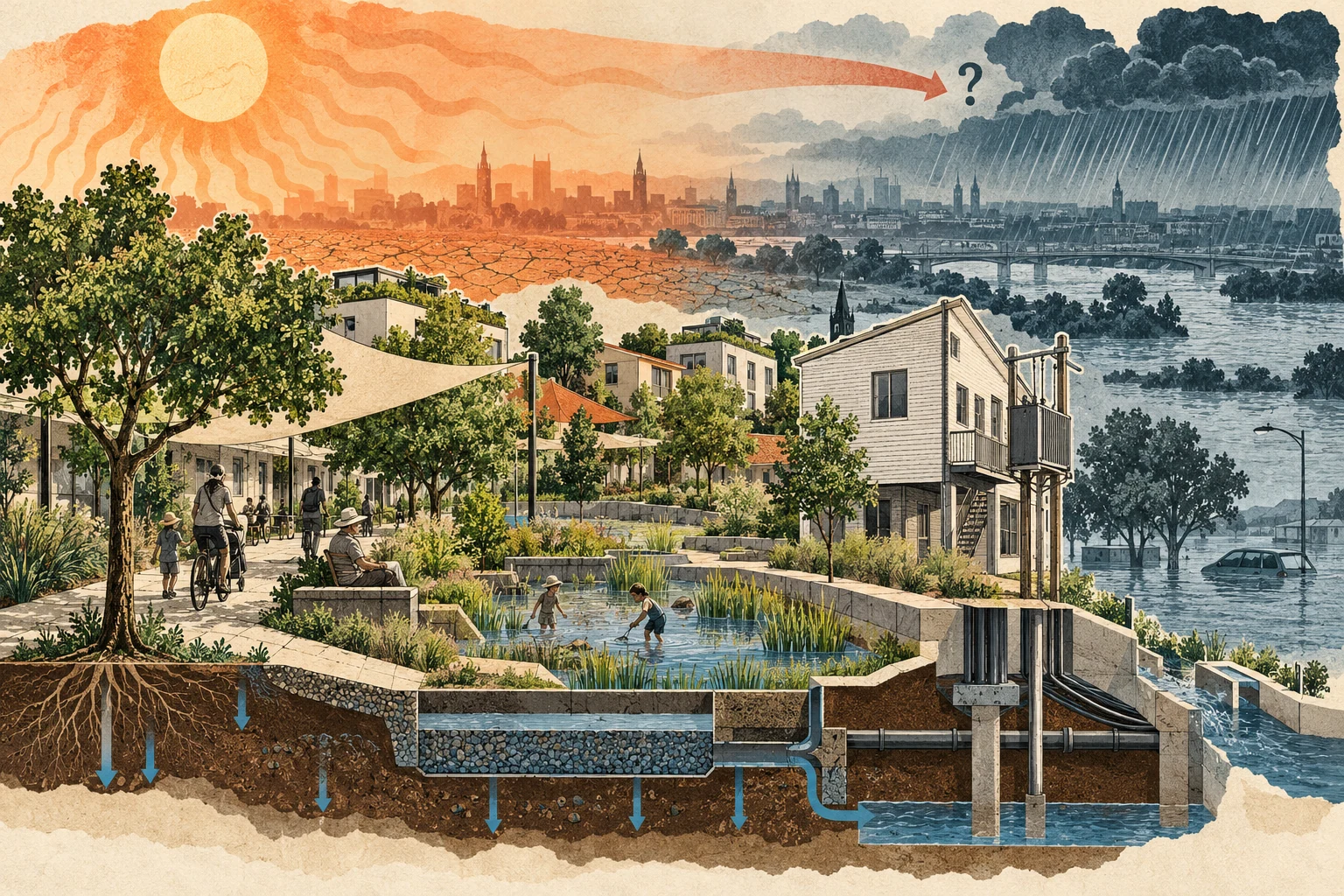
Shade, room for floodwater, and hardened infrastructure reduce vulnerability to hazards, though adaptation alone does not halt warming.
AI-assisted illustration · conceptual metaphor View in visual quiz →Genesis and Global Lineage
The intellectual roots of the concept lie in mid-twentieth-century North American natural-hazards geography: in his landmark 1945 dissertation Human Adjustment to Floods, Gilbert F. White showed that societies choose from a behavioral repertoire of “adjustments” rather than merely fighting nature with concrete, and demonstrated how building higher levees paradoxically increases catastrophic flood losses by encouraging denser settlement on the floodplain (the “levee effect”). White’s students Ian Burton and Robert Kates carried this framework into early climate-impact studies. The word entered international law through Article 4 of the 1992 UN Framework Convention on Climate Change (UNFCCC), which committed parties to prepare national adaptation plans for coastal zones, water resources, and agriculture. Yet for the next two decades, adaptation was treated in environmental politics as mitigation’s disreputable cousin: advocates feared that talking openly about adapting to a warmer world would sap political will to cut greenhouse gas emissions (a taboo Al Gore famously voiced in 1992). Scholars such as Burton (1994) and Roger Pielke Jr. (1998) challenged that binary, while in the 2000s Barry Smit, Johanna Wandel, and W. Neil Adger built the modern analytical apparatus linking adaptation to social vulnerability and political ecology. The diplomatic turning point arrived after the 2009 Copenhagen summit: the Cancún Adaptation Framework (2010), Article 7 of the Paris Agreement establishing a “Global Goal on Adaptation” (2015), and the IPCC Working Group II Sixth Assessment Report (February 2022), which made the adaptation gap, soft and hard limits, and maladaptation official diplomatic vocabulary. Meanwhile, the term was partially captured by corporate finance under the banner of “climate resilience,” where it often designates insuring high-value private real estate while leaving surrounding public vulnerability untouched.
Central European Lineage
We found no documented link between this concept and the intellectual history or historical experience of Central Europe.
We found no documented link between this concept and the intellectual history or historical experience of Central Europe (by our methodology, this means “none found,” not “none exists”; as of October 2026).
Why Now
Three developments between 2018 and 2026 moved adaptation from municipal planning documents to the front lines of fiscal and electoral politics. First, extreme weather in temperate zones ceased to look like a distant mid-century forecast: lethal European heatwaves (2019, 2022), the July 2021 Ahr Valley flood in Germany, and the September 2024 Storm Boris floods across Czechia, Austria, and southwestern Poland (Lower Silesia and the Oder basin) showed that twentieth-century civil-engineering standards are already failing under twenty-first-century extremes. Second, the IPCC’s February 2022 Working Group II report concluded that some human and natural systems (warm-water coral reefs, low-lying coastal settlements) have already reached or neared soft and hard adaptation limits, while most adaptation efforts remain fragmented and reactive. Third, the fight over money and metrics came to a head: UNEP’s Adaptation Gap Report (Underfinanced. Underprepared., 2023) estimated developing countries’ adaptation finance needs at 215–387 billion per year—ten to eighteen times actual public flows—while the UAE Framework adopted at COP28 in Dubai (2023) culminated at COP30 in Belém (November 2025) in a list of 59 global adaptation indicators.
Explanatory Power
The concept makes visible that “protecting society from the climate” is never a socially neutral engineering task, but a choice between competing interventions that create different winners and losers. First, consider river flood control: raising a concrete embankment along the Vistula or the Oder and restoring an upstream floodplain retention zone both address floodwater, yet the embankment inflates short-term land values behind the wall while accelerating the flood wave onto downstream towns, whereas managed retreat requires buying out property owners today. Second, compare responses to urban heat islands: private residential air conditioning is an individual adaptation that increases peak electricity demand and pumps waste heat straight into the street, worsening heat stress for low-income residents and outdoor workers who cannot afford it, whereas urban tree canopies, shaded transit stops, and cool roofs provide a collective public good with the opposite distributive profile. Third, in property insurance markets, private insurers “adapt” to rising wildfire and flood risk by repricing annual premiums and withdrawing coverage from high-risk zip codes (as seen in Florida and California), shifting the residual balance-sheet liability onto homeowners and state insurers of last resort. Without the analytical vocabulary of adaptive capacity, maladaptation, and distributive equity, all three look like technical adjustments; through that vocabulary, they stand revealed as reallocations of risk across space, class, and time.
Axes of Debate
Moral hazard against mitigation versus inescapable realism
From the 1990s onward, segments of the climate movement and mitigation-focused economists argued that emphasizing adaptation breeds fatalism and moral hazard, diverting scarce public capital from decarbonization and signaling that societies can simply engineer their way through a 2.5^\circC or 3^\circC world. Strongest counterargument: As Roger Pielke Jr. (1998) and the IPCC Working Group II reports point out, historical greenhouse gas emissions already locked into the atmosphere guarantee decades of intensifying climate impacts regardless of how fast emissions fall tomorrow; because a lack of adaptation hurts the poorest and least responsible populations first, refusing to fund adaptation in the name of mitigation purity punishes the victims of warming without cooling the planet by a single tenth of a degree. Nature of the dispute: mixed — scientifically settled in favor of pursuing both simultaneously, yet persistently alive in budget politics where adaptation and mitigation compete for the same finite climate-finance pots.
Incremental engineering versus transformational adaptation
Municipal engineers, water boards, and infrastructure ministries overwhelmingly favor incremental adaptation: higher seawalls, larger storm-water detention basins, drought-tolerant crop varieties—interventions that fit within existing legal mandates and four-year electoral cycles. Resilience scholars (such as Mark Pelling and Karen O’Brien) counter that incremental fixes often lock in maladaptation by preserving the very settlement and land-use patterns that generate vulnerability, arguing instead for transformational adaptation: managed coastal retreat, redesigning agricultural river basins, and overhauling property regimes. Strongest counterargument: Practitioners reply that “transformational adaptation” without deep democratic consent and generous compensation budgets easily degenerates into green eviction: historically, state-mandated “managed retreat” and hazard-zone clearances have disproportionately displaced low-income and minority communities while wealthy waterfront districts receive public seawalls. Nature of the dispute: substantive — it concerns how to weigh near-term political feasibility against long-term path dependence under deep climate uncertainty.
Biophysical limits versus social and cultural limits
Physical scientists and cost-benefit economists define the limits to adaptation through hard thermal thresholds (such as wet-bulb temperatures exceeding human thermoregulatory capacity or freshwater salinization) and marginal abatement curves; W. Neil Adger and co-authors (2009) argue that in human societies adaptation limits are endogenous and cultural: a limit is reached when a community’s core values, sense of place, or heritage would be destroyed by the adjustment itself. Strongest counterargument: Negotiators from vulnerable countries warn that treating adaptation limits as subjective and cultural can be weaponized by wealthy donor states in Loss and Damage negotiations to claim that no hard limit has yet been crossed and that affected populations simply need to “adjust their expectations” further. Nature of the dispute: substantive — how the boundary between possible adaptation and unavoidable loss is defined directly determines international legal and financial responsibility.
Underappreciated Angle
The least appreciated dimension of climate adaptation is that it is governed less by climate models than by institutional memory. As Barry Smit and Johanna Wandel observed in 2006, practical adaptation almost always responds to hazards that have already caused visible political pain rather than novel risks projected for 2050. In practice, this means that governments systematically prepare for the last disaster they remember rather than the next one on the horizon: after the catastrophic 1997 Oder “Flood of the Millennium” (powódź tysiąclecia) in Poland, Czechia, and Germany, decades of Polish water infrastructure spending focused on large river-channel reservoirs and embankments, leaving municipalities unprepared for the alternating hydrological whipsaw of multi-year agricultural droughts and sudden urban flash floods that characterizes the 2020s—and when Storm Boris struck the same borderlands in September 2024, both the value of completed retention reservoirs (such as Racibórz Dolny) and the cost of neglected catchment land-use planning became immediately visible. Because human memory of a catastrophe fades within a generation while electoral cycles last four years, concrete alone never stays adapted for long. The most durable adaptation tools are therefore epistemic and legal rather than hydraulic: statutory flood- and heat-hazard maps that local developers cannot politically redraw, mandatory climate-risk disclosure at the point of real-estate sale, and dynamic adaptation pathways that pre-commit agencies to trigger specific land-use shifts the moment an observed physical threshold is crossed.
One-Sentence Takeaway
Climate adaptation is never a neutral technical response to the weather; it is a political decision about which communities’ losses will be prevented by public investment and which will be written off as unavoidable fate.
Related Concepts Network
How this concept reinforces, constrains, or complements other analytical frameworks in the corpus. View on graph →
-
Climate tipping points constrains
Crossing Earth-system tipping points defines hard biophysical limits to adaptation: beyond certain thresholds there is no longer a stable baseline to adjust to, only irreversible loss.
-
Loss and damage (L&D) complements
Loss and damage begins where adaptation runs out; the two concepts form a single continuum, and diplomatic battles turn on who decides where the boundary between them lies.
-
Climate justice in tension
Locally financed adaptation systematically favors the wealthy, because the populations that contributed least to historical warming possess the fewest fiscal resources to shield themselves from its impacts.
-
Path dependence reinforces
Concrete levees, irrigation canals, and air-conditioning grids lock in settlement patterns in places from which communities may eventually have to retreat; maladaptation is path dependence poured in concrete.
-
Decision reversibility reinforces
Robust adaptation design privileges reversible, staged options (“dynamic adaptation pathways”) over irreversible megaprojects under deep uncertainty about local climate trajectories.
-
Antifragility in tension
Climate resilience is often defined as bouncing back to a pre-shock baseline, whereas antifragility requires a system to reorganize and gain from volatility; transformational adaptation attempts to bridge the two.
-
Just transition complements
Both frameworks ask who bears the costs of structural adjustment: just transition governs the exit from fossil-fuel emissions, while climate adaptation governs living with the impacts of emissions we failed to avoid.
Reading Canon & Translation Bridge
Foundational texts, introductions, and critical perspectives—with availability of English and Polish editions.
-
foundational text 2022 · English
IPCC (Hans-Otto Pörtner, Debra C. Roberts i in., red.), Climate Change 2022: Impacts, Adaptation and Vulnerability. Working Group II Contribution to the Sixth Assessment Report
The assessment report that codified today's conceptual grid: the adaptation gap, soft and hard adaptation limits, maladaptation, and climate-resilient development.
In English: original text written in English
In Polish: Polish edition not verified
-
critical perspective 1998 · English
Roger A. Pielke Jr., Rethinking the role of adaptation in climate policy
An early intervention in “Global Environmental Change” (vol. 8, no. 2, pp. 159–170) arguing during the height of mitigation-only orthodoxy that adaptation is an indispensable pillar of climate policy rather than a defeatist excuse.
In English: original text written in English
In Polish: no Polish edition
-
introduction & synthesis 2006 · English
Barry Smit, Johanna Wandel, Adaptation, adaptive capacity and vulnerability
The field's most widely cited conceptual review (“Global Environmental Change”, vol. 16, no. 3, pp. 282–292): clarifies the relationship between exposure, sensitivity, and adaptive capacity, showing that real-world adaptation is almost never undertaken for climate reasons alone.
In English: original text written in English
In Polish: no Polish edition
-
critical perspective 2010 · English
Jon Barnett, Saffron O’Neill, Maladaptation
A concise three-page editorial in “Global Environmental Change” (vol. 20, no. 2, pp. 211–213) that gave the concept of maladaptation an operational five-point diagnostic checklist, illustrated through Melbourne's water crisis.
In English: original text written in English
In Polish: no Polish edition
-
critical perspective 2009 · English
W. Neil Adger, Suraje Dessai, Marisa Goulden, Mike Hulme, Irene Lorenzoni, Donald R. Nelson, Lars Otto Naess, Johanna Wolf, Anita Wreford, Are there social limits to adaptation to climate change?
A landmark paper in “Climatic Change” (vol. 93, pp. 335–354) shifting the debate on limits to adaptation from engineering and cost thresholds to ethics, culture, and identity: a limit is reached when a community refuses to pay the cultural price of adjustment.
In English: original text written in English
In Polish: no Polish edition
-
cross-disciplinary 1945 · English
Gilbert F. White, Human Adjustment to Floods: A Geographical Approach to the Flood Problem in the United States
The classic University of Chicago natural-hazards dissertation that anticipated modern adaptation theory by half a century: asks why societies rely on levees that encourage floodplain settlement (“the levee effect”) rather than land-use retreat.
In English: original text written in English
In Polish: no Polish edition
-
cross-disciplinary 2018 · Polish
Ewa Bińczyk, Epoka człowieka. Retoryka i marazm antropocenu
A Polish philosophical analysis of environmental-crisis rhetoric (Wydawnictwo Naukowe PWN), illuminating why adaptation is alternately framed as pragmatic realism or fatalistic surrender.
In English: English edition not verified
In Polish: original text written in Polish
Primary-Source Quotes
Practical adaptation initiatives tend to focus on risks that are already problematic, climate is considered together with other environmental and social stresses, and adaptations are mostly integrated or mainstreamed into other resource management, disaster preparedness and sustainable development programs.