Horizon & Ecology #168
Degrowth
original term: degrowth (Eng.) · dewzrost, postwzrost, odejście od wzrostu
Central European lineage: 1 thread (documented influence) · 1971–2007 · jump to documentation ↓
Working Definition
Degrowth is the planned, democratically negotiated reduction of material and energy throughput in wealthy economies to bring them back within planetary ecological limits while simultaneously improving human well-being and reducing inequality. It is not an economic recession: a recession is an unplanned contraction of GDP inside an economy that remains structurally dependent on growth for stability, whereas degrowth aims to redesign core institutions (work, provisioning, money, care) so that rising output is no longer required to prevent social collapse. In everyday shorthand, the term is often reduced to “consuming less”; in its academic version, it addresses the scale of social metabolism, combining the selective scaling down of ecologically destructive sectors with the expansion of public goods. Operationally, it asks not “is GDP growing?” but “how many tons of material and joules of energy flow through the economy, and whose human needs do they actually meet?”
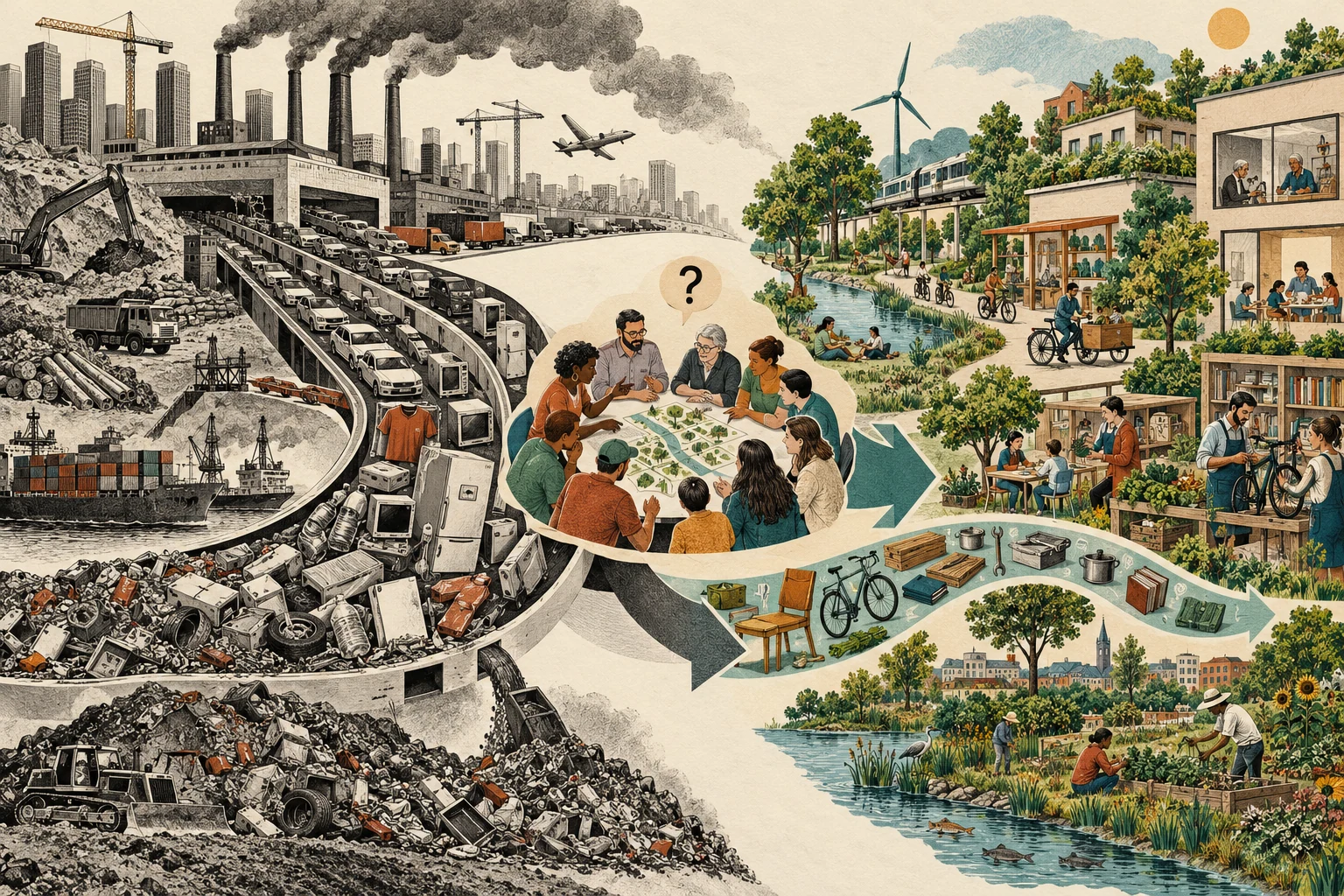
Lower material throughput pairs with a larger role for repair, care, and shared services; the movement's aim is not unplanned impoverishment.
AI-assisted illustration · conceptual metaphor View in visual quiz →Genesis and Global Lineage
The French word décroissance entered economic debate through André Gorz (writing under the pseudonym Michel Bosquet) in Le Nouvel Observateur in June 1972, in the immediate wake of the Club of Rome’s Limits to Growth report. Its theoretical foundation came from the bioeconomics of Nicholas Georgescu-Roegen, a selection of whose essays was published in French in 1979 under the title Demain la décroissance (Tomorrow, Degrowth). The term revived as an activist and political slogan around 2001–2002 (through Bruno Clémentin and Vincent Cheynet and a landmark February 2002 issue of the magazine S!lence), before Serge Latouche gave it manifesto form in Petit traité de la décroissance sereine (2007; English translation Farewell to Growth, 2009). The English word degrowth gained traction after the first international conference in Paris in 2008, migrating from French post-development critique into ecological economics (Joan Martínez-Alier, Giorgos Kallis) and economic anthropology (Jason Hickel). In media commentary it is frequently conflated with zero-GDP austerity or personal lifestyle minimalism, obscuring its institutional core: the question of why modern economies plunge into unemployment and debt crises the moment aggregate growth slows.
Central European Lineage
The concept’s deepest theoretical foundation has a Bucharest formation. Nicholas Georgescu-Roegen, born in 1906 in the Romanian Black Sea port of Constanța, studied mathematics on a scholarship at the University of Bucharest (graduating in 1926), trained in mathematical statistics in Paris under Émile Borel and in London under Karl Pearson, and visited Joseph Schumpeter at Harvard before returning to Bucharest, where he taught for over a decade and held senior posts in the Romanian civil service, including secretary-general of the Armistice Commission during negotiations with the Soviet Union at the end of the Second World War. In February 1948, following the Communist takeover of Romania, he fled the country with his wife stowed away on a freighter and settled at Vanderbilt University. His magnum opus The Entropy Law and the Economic Process (1971) and his polemical essay “Energy and Economic Myths” (1975), which outlined a “minimal bioeconomic program,” argued that economic production is a unidirectional degradation of low entropy, making perpetual material growth physically impossible. When Jacques Grinevald and Ivo Rens edited a French volume of his papers in Lausanne as Demain la décroissance (1979), Latouche hailed Georgescu-Roegen as the main theoretical source of décroissance, and Mauro Bonaiuti called his work an analytical cornerstone of the movement. Moreover, secondary scholarship notes that his early experience of interwar Romania’s agrarian, peasant-dominated economy convinced him that neoclassical economics described only industrial capitalism, linking his 1960s peasant-economy studies to his later bioeconomics.
Documented regional lineage · Link: 1. Compiled: October 2026.
-
documented influence 36 years
Central European Source: Nicholas Georgescu-Roegen, “The Entropy Law and the Economic Process”; Bucharest, Romania, 1971
Global Circulation: décroissance / degrowth as a political program — Serge Latouche, 2007
documented influence
36 yearsNicholas Georgescu-Roegen, “The Entropy Law and the Economic Process”
1971 · Bucharest, Romania
décroissance / degrowth as a political program
2007 · Serge Latouche
- Claim & Connection
- Nicholas Georgescu-Roegen (born 1906 in Constanța) studied mathematics at the University of Bucharest (scholarship from 1923, degree 1926), then statistics in Paris and London; he taught in Bucharest and held posts in the Romanian administration until his emigration in 1948. His 1971 book and 1975 article “Energy and Economic Myths” established the thesis that the economic process irreversibly degrades low-entropy resources. A French selection of his essays appeared in 1979 under the title “Demain la décroissance” (edited by Jacques Grinevald and Ivo Rens), and Serge Latouche named him the main theoretical source of décroissance. Georgescu-Roegen himself did not coin the term, and his relationship to the later movement is more nuanced than the title of the French collection suggests.
- Source Documentation
-
- scholarly study „Nicholas Georgescu-Roegen”, Wikipedia (en); sections “Life and career”, “Studying in Paris and London”; paragraphs on degrowth: Latouche — “main theoretical source of degrowth”, Bonaiuti — “one of the analytical cornerstones of the degrowth perspective”; fn. 42 (Energy and Economic Myths, Southern Economic Journal vol. 41, no. 3, 1975, pp. 347–381), fns. 45 and 47 (Latouche, Farewell to Growth, Polity 2009 [2007], pp. 13–16); section “Work”: “Having lived in Romania, an underdeveloped and peasant-dominated economy” and continuity “through his writings on peasant economies in the 1960s” to bioeconomics. en.wikipedia.org ↗
- scholarly study „Nicholas Georgescu-Roegen”, Wikipédia (fr); biography: Bucharest 1926, Institut de statistique Paris 1927–1930, UCL 1930–1932, emigration February 1948; bibliography: “Demain la décroissance. Entropie, écologie, économie”, Lausanne: Pierre-Marcel Favre 1979, ed. J. Grinevald and I. Rens; "moins tranchés qu'il n'y paraît". fr.wikipedia.org ↗
- biographical record „Nicholas Georgescu-Roegen”, History of Economic Thought Website; biographical paragraph: “trained in mathematical statistics at Bucharest and the Sorbonne”, return to Bucharest, flight 1948, Vanderbilt; list of works 1971, 1976, 1979. hetwebsite.net ↗
- scholarly study „Décroissance (économie)”, Wikipédia (fr); section on the origin of the term: Gorz 1972, Georgescu-Roegen “inventeur et principal théoricien” without using the word, Grinevald 1979, Clémentin and Cheynet 2001, “S!lence” no. 280 (February 2002). fr.wikipedia.org ↗
- Historical Context
- Formation and career in Bucharest confirmed across three open secondary sources; attribution of Latouche's statement comes via Wikipedia (fn. The source-side place denotes intellectual formation (studies 1923–1926, teaching and civil service 1932–1948); the 1971 book itself was written at Vanderbilt and published by Harvard University Press. Fact check 2026-10-24: corrected page range of the 1975 article (347–381). The global-side year refers to Latouche's “Petit traité”; the French term had circulated since 1972 (Gorz), and the English word since the 2008 Paris conference.
Why Now
Three developments between 2019 and 2026 carried degrowth from activist margins into mainstream policy institutions. First, the empirical debate over decoupling came to a head: the European Environment Agency briefing and the European Environmental Bureau’s report Decoupling Debunked (2019), alongside Jason Hickel and Giorgos Kallis’s review article “Is Green Growth Possible?” (2019), concluded that there is no empirical evidence for absolute, global, fast-enough decoupling of resource throughput and emissions from GDP growth, stripping “green growth” of its status as an unexamined axiom. Second, the movement achieved institutional visibility: in December 2022 Nature published a commentary by leading researchers (including Hickel, Kallis, Juliet Schor, and Julia Steinberger) outlining a degrowth research agenda for climate modeling, and in May 2023 twenty Members of the European Parliament across five political groups hosted the three-day “Beyond Growth” conference in Brussels with the backing of Parliament President Roberta Metsola. Third, the 2022 European energy shock and post-pandemic inflation demonstrated that an unplanned drop in energy throughput without institutional redesign looks exactly as degrowth theorists had warned: like an inequitable recession that hits low-income households hardest.
Explanatory Power
Degrowth forces analysts to separate GDP growth from the social outcomes growth is merely assumed to deliver. First, it explains why decades of gains in energy and material efficiency per dollar of output have coincided with rising total emissions and extraction: through the Jevons rebound effect, unit savings are eaten up by an expanding aggregate scale, which is why degrowth insists on hard resource caps rather than intensity targets. Second, it reveals a single structural problem behind what otherwise look like disconnected social-policy proposals: a shorter working week, universal basic services, and a public job guarantee are all mechanisms for decoupling household security and employment from the requirement of expanding aggregate output. Third, it disaggregates the global economy into North and South, showing that planetary averages hide a world in which high-income countries that have overshot their fair share of the biosphere must contract their material footprint precisely so that low-income countries retain the ecological space to build out essential infrastructure.
Axes of Debate
Decoupling: is green growth empirically viable?
Mainstream economists and international organizations (the OECD, World Bank, and European Commission) maintain that carbon pricing, electrification, and clean innovation can cut emissions and material footprints while GDP continues to grow; Hickel, Kallis, and the authors of Decoupling Debunked counter that data from 1990 to 2019 show mostly relative decoupling, with absolute emission reductions in wealthy states occurring far too slowly to stay within the 1.5°C or 2°C carbon budget. Strongest counterargument: More than thirty high-income economies have achieved absolute reductions in both territorial and consumption-based carbon emissions while growing their GDP over the past fifteen years, proving that absolute decoupling is not physically impossible; the real dispute is over speed and material extraction rather than direction. Nature of the dispute: substantive — both sides analyze the same datasets on material footprint and emissions, differing over whether deployment rates can be accelerated fast enough without demand reduction.
Global scale and North–South justice
Development economists such as Branko Milanović (2017) argue that freezing global GDP would either lock the majority of humanity into poverty or require slashing average incomes in wealthy democracies by roughly two-thirds—a program no electorate would ever vote for. Strongest counterargument: Academic degrowth proposals explicitly apply only to high-income economies that exceed planetary boundaries per capita, while affirming that low-income countries need material growth to meet human needs; the objection attacks a global-freeze caricature rather than the actual thesis. Nature of the dispute: mixed — part of the clash rests on a straw-man reading of degrowth’s geographical scope, but a real political-economy problem remains because shrinking Northern consumption also shrinks export markets on which many Global South economies currently depend.
Degrowth versus a-growth
Ecological economist Jeroen van den Bergh (2011) identifies five mutually inconsistent definitions of degrowth (GDP, consumption, work time, radical institutional change, physical throughput) and proposes a-growth instead: policy indifference toward GDP combined with strict environmental caps and carbon prices. Strongest counterargument: Kallis replies that capitalist institutions—interest-bearing credit, funded pensions, tax revenues, labor markets—are structurally wired for growth, so “indifference” toward GDP is an illusion; if hard ecological caps actually bite, aggregate output will contract anyway, and the only question is whether we prepare institutions for it in advance. Nature of the dispute: substantive — it concerns whether existing fiscal and financial institutions can remain stable when GDP stagnates or declines.
Underappreciated Angle
The least developed part of the degrowth program is neither ecology nor social policy, but money and debt. Modern credit-money systems price the future through positive interest rates that presuppose tomorrow’s economy will be larger than today’s; capitalized pension funds, sovereign debt servicing, and equity valuations are all institutional claims written against future growth. Calling for a smaller physical numerator while leaving that financial denominator intact is a recipe for a banking and fiscal crisis. How central banks, government bonds, and old-age security can function in an economy with a stable or shrinking material throughput remains a marginal topic within degrowth scholarship—yet whether planned contraction differs in practice from a debt deflation depends almost entirely on answering it.
One-Sentence Takeaway
Degrowth does not ask whether we would enjoy having less; it asks whether we can build economic institutions that do not collapse when growth stops—because physics has already decided that material growth cannot continue forever.
Related Concepts Network
How this concept reinforces, constrains, or complements other analytical frameworks in the corpus. View on graph →
-
Planetary boundaries reinforces
Degrowth treats transgressed planetary boundaries as proof that the physical scale of the economy, and not merely its technology, must change.
-
Doughnut economics complements
Raworth's model supplies degrowth with a target map: human thriving between a social foundation and an ecological ceiling, without tying welfare to GDP growth.
-
Jevons paradox reinforces
The rebound effect is degrowth's central argument against the hope that efficiency gains alone will reduce aggregate resource use.
-
Anthropocene complements
Degrowth reads the Anthropocene as the product of the post-1950 Great Acceleration, and thus as a crisis of the scale of social metabolism.
-
Just transition in tension
Both programs seek to protect workers, but just transition usually assumes expanding green industrial sectors, whereas degrowth calls for contracting aggregate production in the Global North.
-
Accelerationism in tension
Left accelerationism seeks to resolve crisis through more technology and automation, whereas degrowth calls for reducing material and energetic throughput.
-
Externalities constrains
Mainstream economics replies to degrowth that the problem is unpriced environmental externalities, not economic growth as such.
-
Tragedy of the commons complements
The atmosphere as an unenclosed sink serves in degrowth literature to show how growth privatizes monetary gains while socializing ecological damages.
Reading Canon & Translation Bridge
Foundational texts, introductions, and critical perspectives—with availability of English and Polish editions.
-
foundational text 1971 · English
Nicholas Georgescu-Roegen, The Entropy Law and the Economic Process
The thermodynamic foundation of the entire tradition: the economic process is a unidirectional degradation of low entropy, so there is no material production without irreversible loss.
In English: original text written in English
In Polish: Polish edition not verified
-
foundational text 2007 · French
Serge Latouche, Petit traité de la décroissance sereine
The manifesto of French décroissance with its program of the “eight Rs” (from re-evaluate to recycle); circulates in English as “Farewell to Growth” (Polity, 2009).
In English: English edition not verified
In Polish: Polish edition not verified
-
foundational text 2019 · English
Jason Hickel, Giorgos Kallis, Is Green Growth Possible?
A review of decoupling research in “New Political Economy” that became the standard reference after 2019: absolute decoupling of resource use from GDP at a pace compatible with climate targets lacks empirical support.
In English: original text written in English
In Polish: no Polish edition
-
introduction & synthesis 2018 · English
Giorgos Kallis, Degrowth
A concise statement of the academic version of the concept, distinguishing degrowth from economic recession and from personal asceticism.
In English: original text written in English
In Polish: Polish edition not verified
-
introduction & synthesis 2020 · English
Jason Hickel, Less is More: How Degrowth Will Save the World
The most widely read introduction, combining a history of capitalist enclosure with empirical data on decoupling.
In English: original text written in English
In Polish: “Mniej znaczy lepiej. O tym, jak odejście od wzrostu gospodarczego ocali świat”, Wydawnictwo Karakter 2021, trans. Jerzy Paweł Listwan
-
introduction & synthesis 2014 · English
Giacomo D'Alisa, Federico Demaria, Giorgos Kallis (red.), Degrowth: A Vocabulary for a New Era
A lexicon of entries ranging from “bioeconomics” to “dépense,” demonstrating that degrowth is a constellation of concepts rather than a single monolithic doctrine.
In English: original text written in English
In Polish: “Dewzrost. Słownik nowej ery”, Łucja Lange 2020, trans. Łucja Lange
-
critical perspective 2011 · English
Jeroen C.J.M. van den Bergh, Environment versus growth — A criticism of „degrowth” and a plea for „a-growth”
The most cited critique from within ecological economics: identifies five inconsistent meanings of the term and proposes indifference toward GDP (“a-growth”) instead of a program of contraction.
In English: original text written in English
In Polish: no Polish edition
-
cross-disciplinary 2017 · English
Kate Raworth, Doughnut Economics: Seven Ways to Think Like a 21st-Century Economist
Proposes “growth agnosticism” from the intersection of development economics and institutional design, frequently used as a more palatable policy alternative to degrowth.
In English: original text written in English
In Polish: “Ekonomia obwarzanka. Siedem sposobów myślenia o ekonomii XXI wieku”, Wydawnictwo Krytyki Politycznej 2021, trans. Aleksandra Paszkowska
Primary-Source Quotes
Green growth theory asserts that continued economic expansion is compatible with our planet's ecology, as technological change and substitution will allow us to absolutely decouple GDP growth from resource use and carbon emissions.