Horizon & Ecology #175
Abundance agenda
original term: abundance agenda (Eng.) · agenda dostatku, liberalizm podażowy, supply-side progressivism
Global-circulation concept — no documented lineage in Central Europe. jump to documentation ↓
Working Definition
The abundance agenda is a political and policy program arguing that the most acute scarcities afflicting wealthy democracies—housing, clean energy, high-speed transit, physicians, and scientific bottlenecks—stem not from a lack of money or technological know-how, but from an institutional inability to build. Its operational thesis is straightforward: instead of subsidizing consumer demand for goods whose physical supply is legally throttled, the state must dismantle the supply bottlenecks it has erected over the past half-century and rebuild its own administrative capacity to deliver projects. In everyday political shorthand, it boils down to the slogan “build more”; in its analytical form, it is the diagnosis that post-1970s procedural liberalism—environmental impact statements, citizen lawsuits, multi-layered local vetoes—has mutated into a veto-ocracy whose costs fall heaviest on the working-class and younger citizens it was meant to protect.
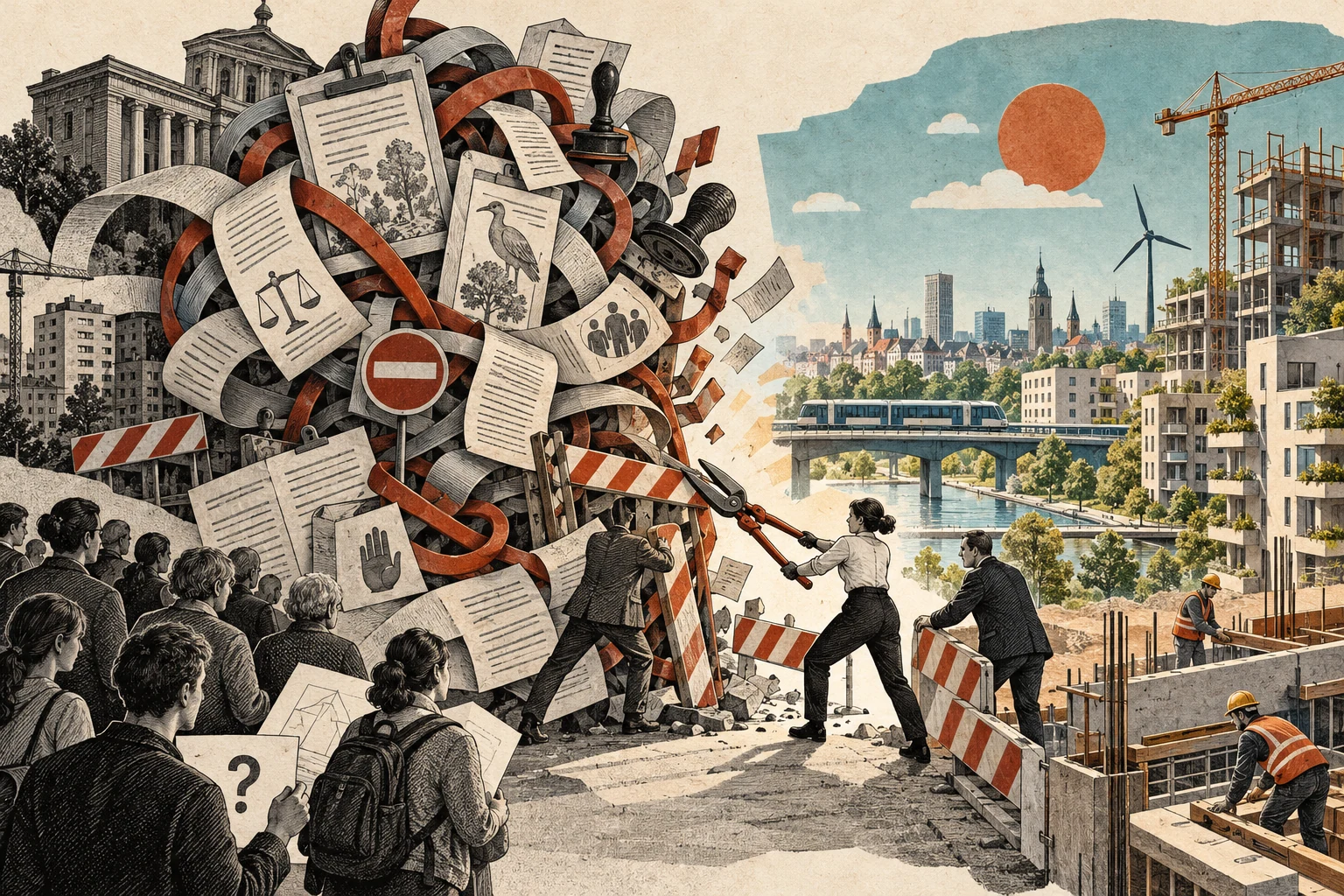
Clearing bottlenecks expands the supply of housing, energy, and essential goods, pairing institutional capacity to build with appropriate oversight.
AI-assisted illustration · conceptual metaphor View in visual quiz →Genesis and Global Lineage
The concept crystallized in American center-left policy journalism and think tanks between 2021 and 2025. In a September 2021 New York Times column, Ezra Klein called on Democrats to embrace “supply-side progressivism”; that same month, the Niskanen Center published Cost Disease Socialism by Samuel Hammond and Daniel Takash, supplying a fiscal diagnosis showing how pairing demand subsidies with restricted supply fuels runaway price inflation in housing, healthcare, and education. Derek Thompson coined the phrase abundance agenda in a January 2022 essay in The Atlantic, uniting urban YIMBY (“Yes In My Backyard”) housing reform, clean-energy permitting reform, immigration of skilled workers, and biomedical innovation under a single banner. Klein and Thompson’s co-authored book Abundance (March 2025) synthesized these threads alongside Marc J. Dunkelman’s Why Nothing Works (2025), offering a historical narrative of how 1960s and 1970s public-interest lawyers and environmentalists—reacting against the bulldozers of Robert Moses and unregulated industrial pollution—constructed a legal architecture designed to stop the state from acting. Intellectually, the agenda draws on urban economics, the state-capacity literature, and classical productivism. Almost immediately, it was pulled in competing directions: free-market conservatives hailed it as a belated progressive concession to deregulation, anti-monopoly leftists attacked it as neoliberalism rebranded, and tech and energy lobbies adopted its vocabulary to push their own permitting wish lists.
Central European Lineage
We found no documented link between this concept and the intellectual history or historical experience of Central Europe.
We found no documented link between this concept and the intellectual history or historical experience of Central Europe (by our methodology, this means “none found,” not “none exists”; as of October 2026).
Why Now
Three converging pressures between 2021 and 2026 turned the abundance agenda into a defining fault line of Western domestic politics. First, climate policy entered its physical construction phase: after the 2022 US Inflation Reduction Act and European industrial packages unlocked hundreds of billions of dollars in clean-tech subsidies, policymakers discovered that the binding constraint on decarbonization was no longer capital or solar-panel prices, but multi-year permitting queues for high-voltage transmission lines, wind farms, and grid interconnections. Second, housing affordability in major metropolitan areas became an explosive electoral issue across North America and Europe, backed by empirical housing-economics research proving that single-family zoning and local planning vetoes drive wealth inequality. Third, the Democrats’ defeat in the November 2024 US presidential election triggered a fierce intra-party battle over why blue states like California and New York had become unaffordable to live in and incapable of completing flagship public works such as high-speed rail. When Klein and Thompson’s Abundance appeared in March 2025, it immediately became the manifesto of one camp in that struggle—and its rapid translation into other languages (including its 2025 Polish edition, Dostatek, published by the left-wing press Wydawnictwo Krytyki Politycznej and debated simultaneously by conservative-republican circles such as Klub Jagielloński around megaprojects like Poland’s Central Communication Port, CPK) showed that the anxiety over state capacity to build extends far beyond the United States.
Explanatory Power
The concept makes visible how scarcity in an affluent society can be actively manufactured by legal procedure rather than resource limits or market monopoly alone. First, it explains the paradox of progressive governance in high-cost jurisdictions: California suffers from the highest housing costs and homelessness rates in the United States not in spite of its dense thicket of environmental and community-review laws (such as CEQA), but largely because those laws give incumbent property owners a low-cost veto over multifamily construction. Second, it clarifies why demand-side welfare programs—housing vouchers, student-loan subsidies, tax credits—repeatedly evaporate into higher prices when supply is inelastic: pouring money into a market where new entry is illegal simply transfers public revenue into the pockets of incumbent asset owners. Third, it exposes the institutional irony of twenty-first-century environmentalism: procedural statutes written in 1970 to stop highways and coal plants are today the single most effective legal weapon used to delay solar arrays, geothermal wells, transit lines, and lithium mines. Across all three domains, the framework shifts the policy question from “how much public money are we spending?” to “who holds the legal right to say no, and at what cost to everyone else?”
Axes of Debate
Deregulation in disguise versus rebuilding state capacity
Writers on the anti-monopoly left and labor advocates (such as Dylan Gyauch-Lewis in The American Prospect, 2024) argue that the abundance agenda is a glossy rebrand of 1980s supply-side deregulation that fixates on local zoning and environmental rules while ignoring how corporate consolidation, private equity, and monopoly power intentionally restrict supply to pad margins. Strongest counterargument: Klein, Thompson, and Dunkelman reply that their program is pro-state rather than anti-state: they want public agencies with the in-house engineering talent and legal authority to build public housing, transit, and grids directly, arguing that a government strangled by its own procedural lawsuits and consultant contractors is weak, not strong. Nature of the dispute: mixed — beneath the partisan polemics over the word “neoliberalism” lies a substantive disagreement over whether the primary bottleneck in housing and energy is public permitting or private market concentration.
Local environmental protection versus planetary climate speed
Traditional environmental NGOs and environmental-justice lawyers defend rigorous impact assessments and citizen-suit provisions as the only tools preventing corporations and highway departments from dumping pollution onto marginalized neighborhoods; they warn that fast-tracking permits for “clean” infrastructure will inevitably be exploited by fossil-gas pipelines and sprawl developers. Strongest counterargument: Proponents of the abundance agenda reply that at current permitting speeds—where approving a high-voltage transmission line takes longer than building it—statutory net-zero deadlines are mathematically impossible to meet, and that using environmental law to block a solar farm or urban infill housing protects local viewsheds at the expense of the global climate; procedural neutrality in practice favors the fossil-fuel status quo. Nature of the dispute: substantive — a genuine trade-off between local procedural voice and systemic speed, turning on whether legislatures can design selective green fast-tracks.
Growing the pie versus redistributing power
Egalitarian critics (including historian Samuel Moyn in his New York Times review of Abundance) ask whether a politics centered on material supply evades fundamental conflicts over wealth taxation, labor power, and oligarchy, treating political-economic struggle as a technocratic engineering problem. Strongest counterargument: Supply-side progressives reply that in an economy of physical shortage, redistribution becomes a bitter zero-sum fight over scarce homes and medical slots, whereas expanding physical supply directly breaks the rent-seeking power of landlords and cartelized professions—the largest drivers of modern middle-class cost pressure. Nature of the dispute: substantive — a classic dispute over political sequencing and whether distribution can succeed without relaxing physical supply constraints.
Underappreciated Angle
The least examined blind spot of the abundance agenda is its institutional geography. Born in coastal American metropolises paralyzed by neighborhood lawsuits, fragmented municipal zoning, and judicial review, the agenda prescribes concentrating executive authority, shortening appeal paths, and fast-tracking strategic projects—assuming a state that knows how to plan rationally, but is legally prevented from executing. In Central and Eastern Europe, the institutional pathology is often the exact reverse: for two decades, governments in Poland and across the region have routinely bypassed ordinary planning, environmental, and property rules through special-purpose fast-track statutes (specustawy for roads, flood embankments, terminals, and megaprojects), while suffering from weak spatial planning, politicized civil services, and low institutional trust. Importing an anti-procedural gospel into a state that already rules by specustawa risks accelerating white elephants rather than solving bottlenecks. A second regional contrast is historical memory: in societies that lived through the chronic shortages of the pre-1989 planned economy—analyzed in Hungarian economist János Kornai’s classic Economics of Shortage (1980)—the word “abundance” (dostatek) rings very differently than in California. Kornai showed how chronic shortage arises from soft budget constraints and bureaucratic hoarding; Klein and Thompson show how shortage arises in rich capitalist democracies from hard procedural vetoes and incumbent rent protection. Putting the two side by side reveals that modern economies have invented more than one institutional way to make goods scarce.
One-Sentence Takeaway
Scarcity in a wealthy democracy is rarely a law of nature; it is usually a political choice dispersed across so many procedural veto points that no single official ever has to take responsibility for making it.
Related Concepts Network
How this concept reinforces, constrains, or complements other analytical frameworks in the corpus. View on graph →
-
State capacity reinforces
In practice, the abundance agenda is a program for rebuilding the state's capacity to physically build and execute, rather than merely regulate and transfer money.
-
Rent-seeking complements
Procedural rules that block the supply of housing, clean energy, and transit protect the economic rents of incumbent homeowners and industries; the abundance agenda names this directly as a public cost.
-
Chesterton’s fence in tension
The agenda's deregulatory impulse must answer why each procedural fence was erected in the first place, especially in environmental and citizen-suit law.
-
Degrowth in tension
Both camps treat the climate crisis as central, but one seeks to build vastly more clean infrastructure while the other seeks to reduce aggregate material and energy throughput.
-
Jevons paradox constrains
If cheaper, abundant clean energy boosts total consumption, promising abundance without ecological overshoot requires additional assumptions about demand limits.
-
Industrial policy complements
The abundance agenda is the supply-side twin of the return of industrial policy: public subsidies cannot build factories or power lines if permitting and lawsuits halt them.
-
Technological solutionism in tension
Critics read the agenda as a belief that technology and physical supply can dissolve distributive conflicts; its authors reply that the bottlenecks they target are institutional, not technical.
Reading Canon & Translation Bridge
Foundational texts, introductions, and critical perspectives—with availability of English and Polish editions.
-
foundational text 2025 · English
Ezra Klein, Derek Thompson, Abundance
The canonical exposition of the program: explains why wealthy democracies stopped building housing, clean energy, and public infrastructure, and how 1970s procedural liberalism blocked its own substantive goals.
In English: original text written in English
In Polish: “Dostatek”, Wydawnictwo Krytyki Politycznej 2025, trans. Aleksandra Paszkowska
-
foundational text 2022 · English
Derek Thompson, A Simple Plan to Solve All of America's Problems
The January 2022 essay in “The Atlantic” that coined the phrase “abundance agenda” as a shared frame for shortages of housing, physicians, vaccines, and clean energy.
In English: original text written in English
In Polish: no Polish edition
-
introduction & synthesis 2021 · English
Samuel Hammond, Daniel Takash, Cost Disease Socialism: How Subsidizing Costs While Restricting Supply Drives America's Fiscal Imbalance
The September 2021 Niskanen Center report that supplied the agenda's fiscal diagnosis: subsidizing demand while restricting supply drives a Baumol cost spiral in healthcare, housing, and higher education.
In English: original text written in English
In Polish: no Polish edition
-
introduction & synthesis 2025 · English
Marc J. Dunkelman, Why Nothing Works: Who Killed Progress—and How to Bring It Back
An institutional history of American progressivism showing how the post-1960s reaction against Robert Moses and executive overreach built a veto-ocracy that now paralyzes public investment.
In English: original text written in English
In Polish: Polish edition not verified
-
cross-disciplinary 2022 · English
Jenny Schuetz, Fixer-Upper: How to Repair America's Broken Housing Systems
A Brookings Institution study of housing economics: details how local zoning and land-use rules choke supply and who captures the gains, providing empirical backing for the agenda's strongest pillar.
In English: original text written in English
In Polish: Polish edition not verified
-
cross-disciplinary 1980 · English
János Kornai, Economics of Shortage
The classic theory of chronic shortage in state-socialist planned economies; a contrasting lens that distinguishes shortages caused by soft budget constraints from shortages caused by procedural veto points.
In English: original text written in English
In Polish: “Niedobór w gospodarce”, Państwowe Wydawnictwo Ekonomiczne 1985, trans. Urszula Grzelońska, Zofia Wiankowska-Ładyka
-
critical perspective 2024 · English
Dylan Gyauch-Lewis, The Abundance Agenda: Neoliberalism's Rebrand
A critique in “The American Prospect” from the anti-monopoly left: argues that the abundance agenda is a repackaged deregulation program that ignores corporate power over supply.
In English: original text written in English
In Polish: no Polish edition