Systems & Complexity #049
Polycrisis
original term: polycrisis (Eng.) · polycrise, wielokryzys, kryzys splątany
Global-circulation concept — no documented lineage in Central Europe. jump to documentation ↓
Working Definition
A polycrisis is a condition in which disparate crises across multiple global systems—climate, energy, finance, public health, geopolitics—do not merely occur simultaneously, but causally interact and reinforce one another so that the combined harm exceeds the sum of what each crisis would produce in isolation. Its defining requirement is causal entanglement: a shock in one system alters the probability, trajectory, or severity of shocks in others, while policy responses to one crisis become fuel for the next. In colloquial usage, the word simply means “a lot of bad things happening at once,” which strips it of analytical value; in its technical usage, it demands specifying the coupling mechanisms, transmission channels, and structural reasons why the crises cannot be solved one by one.
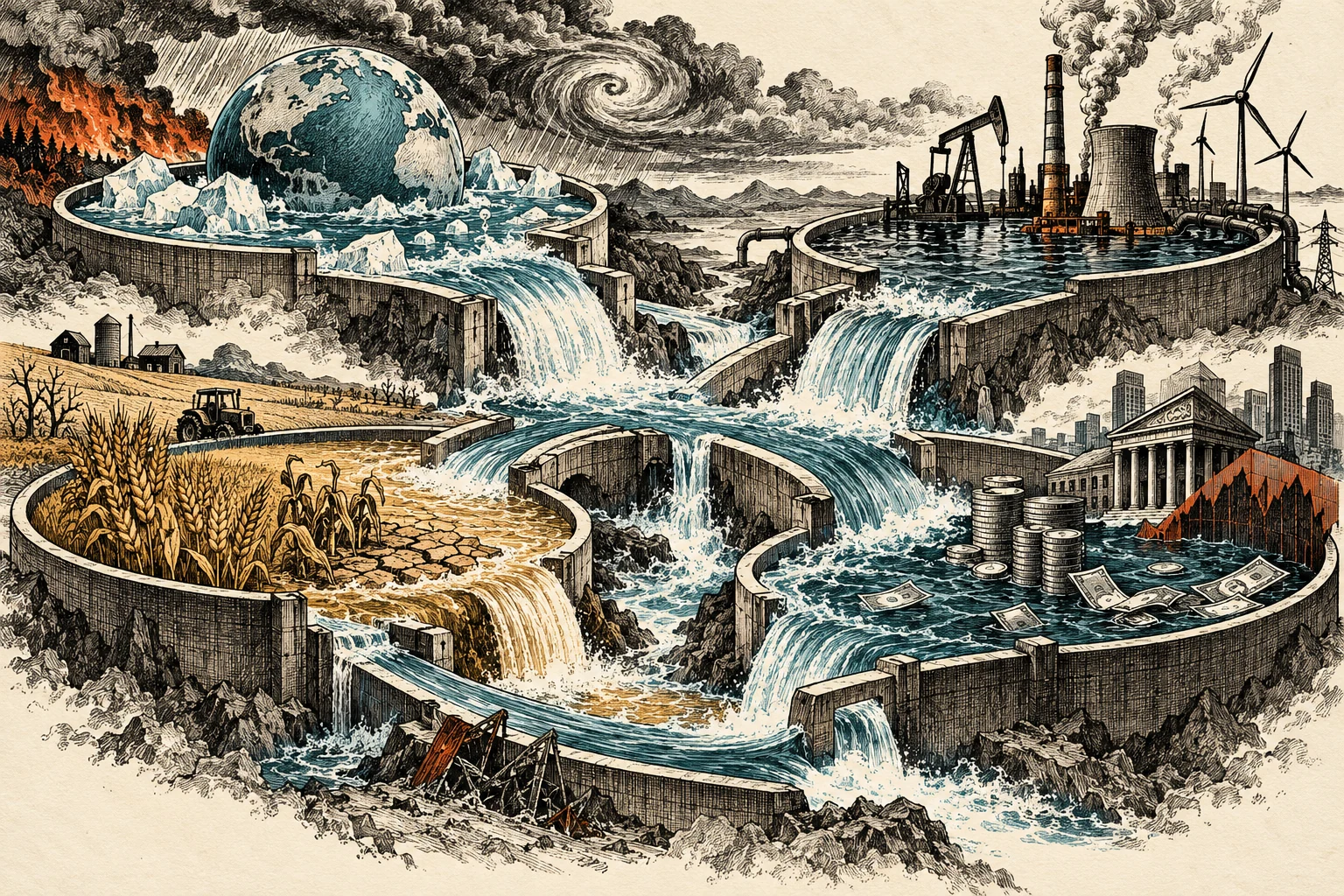
Crises across several domains spill over between connected arenas, and their combined impact stems from mutual reinforcement.
AI-assisted illustration · conceptual metaphor View in visual quiz →Genesis and Global Lineage
The word was coined by the French philosopher and sociologist of complexity Edgar Morin and Anne Brigitte Kern in Terre-Patrie (1993; English translation Homeland Earth, 1999), where polycrise named the “complex intersolidarity of problems, antagonisms, crises, and uncontrolled processes” of the planetary era—more a civilizational diagnosis than an operational model. The term circulated in global political economy (notably in the work of Mark Swilling) before entering European Union politics in the mid-2010s: as President of the European Commission, Jean-Claude Juncker used it in 2015–2016 (including a landmark speech in Athens in June 2016) to describe how the Eurozone debt crisis, the refugee crisis, Ukraine, and Brexit were feeding off one another. The economic historian Adam Tooze borrowed the term from Juncker in Shutdown (2021) and, following Russia’s invasion of Ukraine in 2022, gave it its current analytical form: not a laundry list of woes, but a matrix of cross-system interactions. In parallel, Canada’s Cascade Institute (Thomas Homer-Dixon, Michael Lawrence, Scott Janzwood) together with Johan Rockström and colleagues built an operational definition and a taxonomy of entanglement mechanisms. After the World Economic Forum made “polycrisis” the centerpiece of its Global Risks Report 2023 at Davos, the term was rapidly co-opted by conference and consultancy circuits—provoking pushback that it was merely a fashionable label for an old reality.
Central European Lineage
We found no documented link between this concept and the intellectual history or historical experience of Central Europe.
We found no documented link between this concept and the intellectual history or historical experience of Central Europe (by our methodology, this means “none found,” not “none exists”; as of October 2026).
Why Now
The years 2020–2023 delivered a textbook case of the phenomenon. Within weeks in spring 2020, the COVID-19 pandemic cascaded from a biological shock into a sovereign-debt, supply-chain, and political crisis; Russia’s full-scale invasion of Ukraine on February 24, 2022 then superimposed an acute energy and food shock that disrupted climate transition plans, stoked global inflation, and destabilized governments from Sri Lanka to Central Europe, where the sudden cutoff of Russian pipeline gas and coal shortages collided with double-digit inflation. Tooze brought the concept into wide circulation in June 2022 in his Chartbook newsletter and in October 2022 in the Financial Times, shortly before Davos 2023 enshrined it. In 2024 the review paper by Lawrence and co-authors in Global Sustainability gave the term rigorous academic footing, while subsequent developments—from the wave of national elections in 2024 to the tariff wars and industrial-policy rivalries of 2025—cemented the sense that policymakers no longer enjoy the luxury of sequential crisis management.
Explanatory Power
The concept forces analysts to map transmission channels rather than compiling static risk registers. First, it explains why a rational policy response to one crisis frequently triggers or worsens another: central-bank interest-rate hikes enacted in 2022–2023 to tame energy-driven inflation sharply raised the cost of capital for wind, solar, and grid investments, slowing the very decarbonization needed to reduce exposure to fossil-fuel price shocks. Second, it accounts for synchronization across unrelated origins: a drought restricting the Panama Canal, Houthi attacks in the Red Sea, and geopolitical export controls on semiconductors all hit the same tightly coupled global logistics network, so their impacts compound even though their causes are independent. Third, it directs attention to shared background stresses—breached planetary boundaries, high sovereign debt, and hyper-connectivity—that leave systems brittle, ensuring that separate shocks land on an already taut fabric. Without this frame, each ministry optimizes locally within its silo while the macro-system drifts toward tipping points that no single agency monitors.
Axes of Debate
A genuinely new systemic regime or a Davos buzzword?
Economic historians and sceptics (including Niall Ferguson and several commentators at Davos 2023) argue that 1914–1945 or the stagflationary 1970s were every bit as entangled, dismissing “polycrisis” as a linguistic fad of conference elites dressing up ordinary historical turbulence as a discovery. Strongest counterargument: Proponents (Tooze, the Cascade Institute) reply that what is historically novel is the sheer density and speed of global couplings—just-in-time supply chains, real-time dollar funding markets, and a shared biophysical ceiling—as well as the fact that multiple Earth-system boundaries are approaching nonlinear thresholds simultaneously for the first time in human history. Nature of the dispute: mixed — irritation at the Davos circuit is rhetorical, but the question of whether cross-system coupling density is structurally higher today than in 1914 or 1973 is an empirical question open to measurement.
Diagnostic precision versus an alibi for political paralysis
Critics on the political left and in the social sciences (including the anthropologists David Henig and Daniel M. Knight, 2023) warn that portraying everything as entangled with everything else diffuses political agency: if “complex systems” are to blame, no specific class, corporation, or government is accountable, and politics shrinks to technocratic risk management. Strongest counterargument: Mapping the specific causal mechanisms of entanglement can do the exact opposite—pinpointing the concrete institutional nodes (central-bank mandates, wholesale electricity pricing rules, maritime insurance) where a single regulatory intervention alters the trajectory of several crises at once. Nature of the dispute: substantive — it concerns whether the concept in practice guides analysts toward high-leverage institutional bottlenecks or encourages fatalism.
A Northern discovery of a permanent Southern condition
Scholars from the Global South and postcolonial anthropologists point out that for most of the world’s population, the simultaneous overlap of sovereign debt, climate extremes, food insecurity, and armed conflict has been the normal condition for decades; “polycrisis” simply names the moment when the wealthy North began to feel it too. Strongest counterargument: Even if the term’s sudden popularity reflects Northern parochialism, the causal mechanisms it tracks operate globally—and it is precisely indebted developing countries that bear the brunt of feedback loops between Federal Reserve interest rates, grain prices, and climate disasters, making the analytical framework indispensable for analyzing global inequality. Nature of the dispute: mixed — the critique of geopolitical blind spots is substantive, though it extends rather than invalidates the causal model.
Underappreciated Angle
The least studied transmission channel in a polycrisis is neither financial markets nor physical supply chains, but the finite cognitive and institutional bandwidth of decision-makers. Every crisis draws down the exact same non-renewable pool: cabinet attention, legislative calendar time, voter patience, and fiscal headroom. A polycrisis therefore compounds not only through external physical feedbacks, but through the exhaustion of the responding apparatus—crisis number three hits an administration that has not yet digested the lessons of crisis number one and a public that is tired of hearing about crisis number two. This points to a practical conclusion closer to Charles Perrow’s organizational sociology than to macroeconomics: investing in institutional slack, parallel processing capacity, and modular crisis protocols is far more effective than trying to forecast which specific shock combination will strike next.
One-Sentence Takeaway
A polycrisis begins not when crises are numerous, but when the best available policy response to one crisis becomes the causal driver of the next.
Related Concepts Network
How this concept reinforces, constrains, or complements other analytical frameworks in the corpus. View on graph →
-
Metacrisis in tension
Metacrisis searches for a single deeper root of crises in culture and sensemaking, whereas polycrisis stays at the level of entangled macro-systems and assumes no single master cause.
-
Systems thinking reinforces
Polycrisis is the practical application of feedback loops, nonlinear thresholds, and delays from systems thinking to contemporary macroeconomics and geopolitics.
-
Complexity science complements
The causal mechanisms of crisis entanglement—common stresses, domino effects, and feedback cascades—are modeled using the formal language of complex systems.
-
Black Swan constrains
A Black Swan is a single unpredictable outlier; a polycrisis involves the interaction of shocks that are often individually foreseeable yet become acutely dangerous in combination.
-
Supply chain resilience complements
Global supply chains serve as one of the primary transmission channels through which a shock in one system propagates rapidly into others.
-
Planetary boundaries reinforces
Breaching planetary boundaries is treated in polycrisis scholarship as the shared biophysical backdrop amplifying multiple simultaneous shocks.
-
Wicked problems complements
Each individual crisis inside a polycrisis is already a wicked problem, and their causal entanglement makes it even harder to bound what is to be solved.
Reading Canon & Translation Bridge
Foundational texts, introductions, and critical perspectives—with availability of English and Polish editions.
-
foundational text 1993 · French
Edgar Morin, Anne Brigitte Kern, Terre-Patrie
The book in which “polycrise” first appears as a name for the interwoven solidarity of planetary problems, antagonisms, and crises; best read with the awareness that it is a civilizational manifesto rather than a causal model.
In English: English edition not verified
In Polish: “Ziemia-ojczyzna”, Państwowy Instytut Wydawniczy 1998, trans. Teresa Jekielowa
-
foundational text 2021 · English
Adam Tooze, Shutdown: How Covid Shook the World's Economy
The book in which Tooze borrowed the term from Jean-Claude Juncker and applied it to the COVID-19 pandemic as a crisis simultaneously destabilizing public health, sovereign finance, geopolitics, and domestic politics.
In English: original text written in English
In Polish: no Polish edition
-
introduction & synthesis 2024 · English
Michael Lawrence, Thomas Homer-Dixon, Scott Janzwood, Johan Rockström, Ortwin Renn, Jonathan F. Donges, Global polycrisis: the causal mechanisms of crisis entanglement
A landmark review article in “Global Sustainability” (vol. 7, e6) that organizes the history of the term, supplies an operational definition, and maps the specific causal mechanisms of crisis entanglement.
In English: original text written in English
In Polish: no Polish edition
-
critical perspective 2023 · English
David Henig, Daniel M. Knight, Polycrisis: Prompts for an emerging worldview
An anthropological commentary in “Anthropology Today” asking whose geopolitical vantage point and whose experience of historical time this fashionable term actually expresses.
In English: original text written in English
In Polish: no Polish edition
-
cross-disciplinary 1984 · English
Charles Perrow, Normal Accidents: Living with High-Risk Technologies
Organizational sociology: in tightly coupled, interactively complex systems, major accidents are “normal” because they arise from unanticipated interactions of minor failures—the best micro-scale analogue for the macro-scale polycrisis.
In English: original text written in English
In Polish: no Polish edition
-
cross-disciplinary 2006 · English
Thomas Homer-Dixon, The Upside of Down: Catastrophe, Creativity, and the Renewal of Civilization
An earlier statement of Homer-Dixon’s thinking on overlapping tectonic stresses (energy, climate, demography, finance) and synchronous failure, forming the backdrop to his later work at the Cascade Institute.
In English: original text written in English
In Polish: no Polish edition
Primary-Source Quotes
A polycrisis is not just a situation where you face multiple crises. It is a situation like that mapped in the risk matrix, where the whole is even more dangerous than the sum of the parts.
the causal entanglement of crises in multiple global systems in ways that significantly degrade humanity's prospects