Systems & Complexity #055
Path dependence
original term: path dependence (Eng.) · zależność od ścieżki, uzależnienie od ścieżki rozwoju, lock-in
Central European lineage: 1 thread (historical experience) · 1918–2015 · jump to documentation ↓
Working Definition
Path dependence is the property of a dynamic process in which the long-run outcome depends not only on current fundamentals and preferences, but on the specific sequence of earlier historical events, including small or contingent ones. In its technical economic formulation, pioneered by Paul A. David and W. Brian Arthur, it describes a stochastic process governed by increasing returns (self-reinforcement): each adoption of a given option lowers the cost or raises the payoff of subsequent adoptions until the system tips into lock-in on a single trajectory, even if an alternative path would have proved superior. In colloquial usage, the phrase degenerates into the truism that “history matters,” explaining nothing because it fits everything. A disciplined definition requires specifying both the mechanism of self-reinforcement (scale economies, learning effects, network externalities, complementary investments) and the threshold past which reversing course becomes costlier than staying on the path.
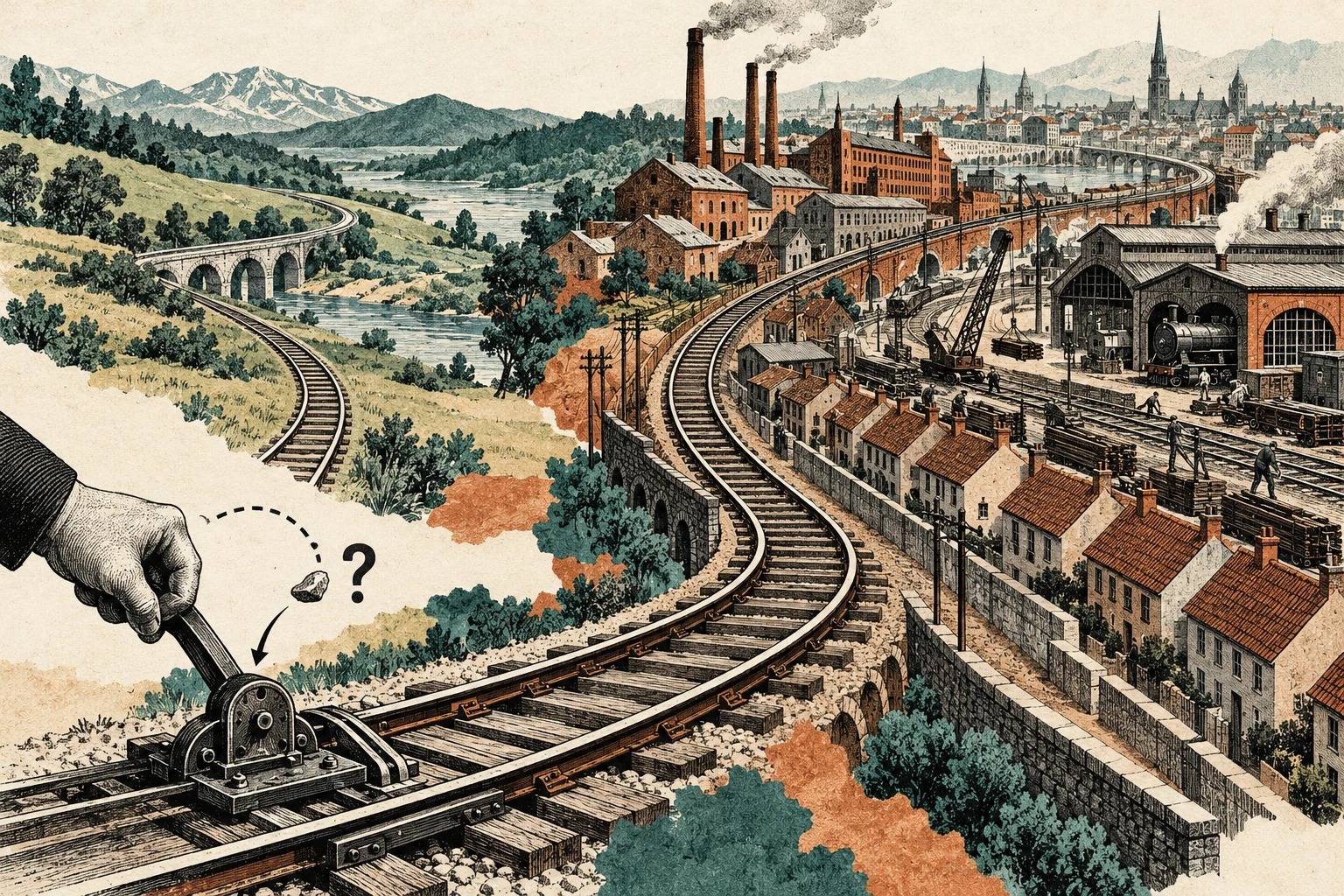
An early choice channels subsequent investment along the same route, making switching costly over time even when another option would be attractive.
AI-assisted illustration · conceptual metaphor View in visual quiz →Genesis and Global Lineage
The concept emerged in economics in the mid-1980s from two parallel breakthroughs. In his six-page paper Clio and the Economics of QWERTY (1985), the economic historian Paul A. David used the 1870s typewriter keyboard layout—designed in part to keep mechanical typebars from jamming—to show how technical interrelatedness between hardware and touch-typists’ muscle memory, economies of scale, and quasi-irreversibility of investment can lock an industry into a standard long after the original engineering constraint has disappeared. Simultaneously, W. Brian Arthur, a mathematician and operations researcher working at IIASA, Stanford, and the Santa Fe Institute, built formal models of competing technologies under increasing returns using nonlinear Polya urn processes; his canonical article appeared in the Economic Journal in 1989 and his collected papers in Increasing Returns and Path Dependence in the Economy (1994). Both challenged neoclassical economics’ reliance on diminishing returns, which guaranteed a unique, history-independent equilibrium. In the 1990s and 2000s, Douglass North in institutional economics and Paul Pierson (Politics in Time, 2004) in political science extended increasing-returns path dependence to laws, welfare states, and party systems, pairing “critical junctures” with long stretches of institutional reproduction.
Central European Lineage
Central Europe’s contribution to the literature lies not in the biography of the concept’s coiners, but in providing two of its richest empirical laboratories. The first is the post-1989 transition from state socialism: in a classic 1992 study, the sociologist David Stark demonstrated that privatization strategies in Poland, Hungary, and Czechoslovakia did not implement “designer capitalism” on a tabula rasa, but followed distinct path-dependent trajectories shaped by how enterprises, worker councils, and ministries had bargained under late socialism. The second is the natural experiment of the Partitions of Poland (1772–1918), which divided Polish lands for over a century among the Russian, Prussian, and Austro-Hungarian empires before reunification in 1918. Using spatial regression discontinuity right across the vanished imperial borders, Irena Grosfeld and Ekaterina Zhuravskaya (2015) demonstrated a crucial refinement to naive theories of historical lock-in: differences in income, industrial output, education, and corruption across the former partition borders have completely disappeared under a century of unified state policy and market integration, whereas differences in church attendance, support for democratic parties, and physical railway density remain sharply visible along the old frontier lines. Path dependence is not a blanket curse of history; it endures only where a concrete transmission mechanism—sunk physical capital that is too costly to tear up, or intergenerational family socialization—keeps reproducing the initial divergence. Related legal scholarship (cited in the English Wikipedia entry on path dependence) has similarly traced how Austrian, Prussian, and Russian administrative-law traditions continue to differentiate judicial reasoning across Polish regional administrative courts.
Documented regional lineage · Link: 1. Compiled: October 2026.
-
historical experience 97 years
Central European Source: The division of Polish lands among Russia, Prussia, and Austria (1795–1918) as a natural experiment in institutional and cultural persistence — The Partitions of Poland and their persistent institutional and cultural effects (study by Grosfeld and Zhuravskaya); Partitioned Poland: Russian, Prussian and Austrian partitions (now Poland), 1918
Global Circulation: historical persistence and path dependence — Irena Grosfeld, Ekaterina Zhuravskaya, 2015
historical experience
97 yearsThe division of Polish lands among Russia, Prussia, and Austria (1795–1918) as a natural experiment in institutional and cultural persistence — The Partitions of Poland and their persistent institutional and cultural effects (study by Grosfeld and Zhuravskaya)
1918 · Partitioned Poland: Russian, Prussian and Austrian partitions (now Poland)
historical persistence and path dependence
2015 · Irena Grosfeld, Ekaterina Zhuravskaya
- Claim & Connection
- The imperial partition borders abolished in 1918 serve in historical economics as a striking natural experiment testing which effects of past institutional regimes lock in and which fade away. Using spatial regression discontinuity across the former borders, Grosfeld and Zhuravskaya (2015) show that differences in income, industrial production, and education across the three partitions have disappeared, whereas differences in religiosity, democratic values, and railway network density persist to the present day—illustrating that path dependence operates selectively through specific transmission channels (physical infrastructure and intergenerational family socialization).
- Source Documentation
-
- scholarly study Irena Grosfeld, Ekaterina Zhuravskaya, „Cultural vs. economic legacies of empires: Evidence from the partition of Poland”, Journal of Comparative Economics, Vol. 43, No. 1, 2015, s. 55–75; abstract: spatial regression discontinuity method; convergence of economic outcomes, persistence of cultural attitudes and railway infrastructure. ideas.repec.org ↗
- scholarly study Hasło „Path dependence”, Wikipedia (en), sekcja o zastosowaniach; paragraph on the study by Stachowiak-Kudła and Kudła on how the legal traditions of the three partitions still influence the reasoning of contemporary Polish administrative courts. en.wikipedia.org ↗
- Historical Context
- The link concerns the historical case rather than the authors’ biography. Verified 2026-10: the IDEAS/RePEc page confirms the spatial regression discontinuity design, the disappearance of economic differences, and the persistence of religiosity, democratic beliefs, and railways; the abstract uses the keyword “persistence” rather than “path dependence,” so the full text remains to be checked. English Wikipedia’s “Path dependence” entry also cites a study by Stachowiak-Kudła and Kudła on partition-era legal traditions in Polish administrative courts, which was not independently verified.
Why Now
Between 2018 and 2026, path dependence returned to the center of three major policy battles. First, digital platform antitrust: regulatory actions by the European Commission, the EU Digital Markets Act (in force since 2023), and the U.S. Department of Justice’s landmark August 2024 federal court victory declaring Google an illegal monopoly in search all hinge on how default settings, data feedback loops, and switching costs create durable lock-in even at zero monetary price to consumers. Second, climate and energy infrastructure: the concept of carbon lock-in took on acute geopolitical urgency after 2022, as European states scrambling to replace Russian pipeline gas debated whether building permanent liquefied natural gas (LNG) terminals and gas-fired power plants as a “bridge fuel” would lock in fossil-fuel infrastructure and stranded assets for another forty years. Third, artificial intelligence architecture: the concentration of trillions of dollars of hardware fabrication, CUDA software libraries, and training recipes around the transformer architecture has prompted computer scientists (reviving Sara Hooker’s diagnosis of the “hardware lottery”) to ask whether the AI industry has locked itself into a narrow local optimum simply because graphics chips happened to favor matrix multiplication.
Explanatory Power
Path dependence severs the lazy inference from survival to optimality: the fact that an arrangement dominates the market does not prove that it won a fair engineering competition. Consider three examples. First, railway track gauges: nineteenth-century workshop choices remain frozen in steel because the cost of converting rolling stock and tunnels scales with the installed base. Second, legacy enterprise software: core banking systems and tax registries still run on 1960s COBOL mainframes not because COBOL is the best language, but because decades of regulatory patches layered atop the original code make a clean-slate rewrite riskier than another year of maintenance. Third, urban transport: post-war cities built around highway interchanges and low-density zoning cannot simply add a bus line and expect high ridership, because housing, retail, and tax bases have co-evolved around the car. In every case, path dependence reframes the policy question from “what is the ideal design?” to “how high is the switching barrier, and who will pay to lower it?”
Axes of Debate
Do free markets really lock into inferior standards (David and Arthur versus Liebowitz and Margolis)?
Writing from a Chicago-school property-rights perspective, Stan Liebowitz and Stephen Margolis (The Fable of the Keys, 1990) attacked Paul David’s founding case study, arguing that claims for the Dvorak keyboard’s superiority rested on flawed tests, that VHS beat Betamax because consumers valued longer recording times, and that entrepreneurs have profit incentives to coordinate transitions away from genuinely inferior standards. Strongest counterargument: Arthur’s formal theorems do not require the locked-in standard to be provably inferior at adoption; they show that under increasing returns the outcome is non-ergodic and inflexible, and in decentralized networks without a single owner, no entrepreneur can capture the externalities of financing a system-wide switch. Nature of the dispute: mixed — the historical dispute over typewriter ergonomics is empirical, while the broader clash over market efficiency is ideological.
Rigorous increasing-returns mechanism versus loose metaphor in political science
Historical institutionalists such as Kathleen Thelen and Wolfgang Streeck (2005) argue that importing the QWERTY model into politics creates a sterile dualism of rare “critical junctures” followed by mechanical stasis, missing how real institutions evolve continuously through layering, drift, and conversion. Strongest counterargument: Pierson replies that without a clear model of positive feedback and sunk-cost barriers, accounts of gradual change cannot explain why certain foundational arrangements (such as employer-based health insurance or pay-as-you-go pensions) resist frontal reform for generations. Nature of the dispute: substantive — an internal methodological debate over how to model structural inertia alongside incremental agency.
Impersonal urn dynamics versus deliberate power lock-in
Political economists such as Herman Schwartz object that Polya-urn metaphors portray institutional lock-in as the innocent byproduct of random early draws, obscuring how powerful coalitions and monopolists deliberately engineer high switching costs and supermajority rules to entrench their privilege. Strongest counterargument: Recognizing strategic design complements rather than refutes the increasing-returns model: powerful actors try to lock in many rules, and path-dependence theory explains which of those designs actually become self-reinforcing and which collapse once the founding coalition loses office. Nature of the dispute: substantive — it concerns the relative weight of decentralized coordination feedbacks versus strategic institutional design.
Underappreciated Angle
Discussions of path dependence almost always focus on the material cost of switching hardware or institutions, while overlooking how lock-in systematically destroys epistemic knowledge of alternatives. When an industry or society settles onto a single path, what disappears is not just the rival product, but the engineers who knew how to build it, the empirical data on how it performed at scale, and the vocabulary needed to evaluate it fairly. After thirty years of cumulative investment in Path A, Path A is genuinely more efficient today than an unimproved 1990 prototype of Path B—not because Path A had a higher ceiling, but because Path A received thirty years of learning-by-doing while Path B was starved of R&D. Once a field converges entirely on a single paradigm, comparing it against the road not taken becomes empirically impossible, which is why maintaining live technological alternatives is a rational investment in knowledge rather than wasteful duplication.
One-Sentence Takeaway
The fact that a technology or institution endures proves only that switching has become costlier than staying put—not that anyone ever chose it as the best possible design.
Related Concepts Network
How this concept reinforces, constrains, or complements other analytical frameworks in the corpus. View on graph →
-
Network effects reinforces
Increasing returns to adoption are the single most common mechanism locking a market into one technical standard regardless of its intrinsic superiority.
-
Complexity science complements
Arthur’s 1980s models belong directly to the Santa Fe complexity economics tradition: nonlinearity, multiple equilibria, and sensitivity to small initial fluctuations.
-
Systems thinking reinforces
Path dependence is the temporal unfolding of a reinforcing feedback loop that amplifies an early lead instead of returning the system to a single equilibrium.
-
Matthew effect reinforces
Cumulative advantage for those who already hold an early lead obeys the same Polya-urn mathematics as technological lock-in: early success breeds further success.
-
Second-order effects complements
The full costs of path dependence materialize as delayed second-order effects once complementary investments have made an early choice prohibitively expensive to reverse.
-
Antifragility in tension
Taleb praises systems that gain from shocks, whereas a path-dependent system locked into a trajectory loses its capacity to adapt because the cost of switching rises over time.
-
Moloch and coordination failure complements
Escaping an inferior locked-in standard requires coordinated simultaneous switching by many actors, each of whom has an individual incentive to wait for others to move first.
Reading Canon & Translation Bridge
Foundational texts, introductions, and critical perspectives—with availability of English and Polish editions.
-
foundational text 1985 · English
Paul A. David, Clio and the Economics of QWERTY
The six pages in the “American Economic Review” (vol. 75, no. 2, pp. 332–337) that brought path dependence into economics through the history of the QWERTY typewriter keyboard; still the sharpest short introduction to the concept.
In English: original text written in English
In Polish: Polish edition not verified
-
foundational text 1989 · English
W. Brian Arthur, Competing Technologies, Increasing Returns, and Lock-In by Historical Events
The “Economic Journal” paper (vol. 99, no. 394, pp. 116–131) setting out the formal model: under increasing returns, small random historical events select the winning technology, rendering the equilibrium unpredictable, inflexible, and potentially inefficient.
In English: original text written in English
In Polish: Polish edition not verified
-
foundational text 1994 · English
W. Brian Arthur, Increasing Returns and Path Dependence in the Economy
The University of Michigan Press collection of Arthur’s papers from 1983–1994 with a foreword by Kenneth Arrow, including the technical chapters on nonlinear Polya urn processes.
In English: original text written in English
In Polish: Polish edition not verified
-
critical perspective 1990 · English
S. J. Liebowitz, Stephen E. Margolis, The Fable of the Keys
The most famous polemic against David in the “Journal of Law and Economics” (vol. 33, no. 1, pp. 1–25): challenges the empirical claim that the Dvorak keyboard was superior and argues that QWERTY does not prove remediable market failure.
In English: original text written in English
In Polish: Polish edition not verified
-
introduction & synthesis 2000 · English
Paul Pierson, Increasing Returns, Path Dependence, and the Study of Politics
The “American Political Science Review” article (vol. 94, no. 2, pp. 251–267) that transferred Arthur’s increasing-returns mechanism to political institutions: sequence, timing, critical junctures, and institutional inertia.
In English: original text written in English
In Polish: Polish edition not verified
-
introduction & synthesis 2004 · English
Paul Pierson, Politics in Time: History, Institutions, and Social Analysis
The book-length expansion (Princeton University Press): a systematic argument that social processes must be analyzed as a moving film rather than a static snapshot.
In English: original text written in English
In Polish: Polish edition not verified
-
cross-disciplinary 1992 · English
David Stark, Path Dependence and Privatization Strategies in East Central Europe
An influential study in “East European Politics and Societies” (vol. 6, no. 1, pp. 17–54) applying path dependence to post-1989 privatization in Poland, Hungary, and Czechoslovakia, showing how each country recombined institutional legacies rather than building capitalism on a blank slate.
In English: original text written in English
In Polish: Polish edition not verified
-
cross-disciplinary 2015 · English
Irena Grosfeld, Ekaterina Zhuravskaya, Cultural vs. economic legacies of empires: Evidence from the partition of Poland
A study in the “Journal of Comparative Economics” (vol. 43, no. 1, pp. 55–75) testing which legacies of the Polish partitions survived a century and which vanished—a model of empirical discipline in measuring historical persistence.
In English: original text written in English
In Polish: Polish edition not verified