Geoeconomic fragmentation
original term: geoeconomic fragmentation (Eng.) · fragmentacja geoekonomiczna, GEF, fragmentacja gospodarki światowej
Central European lineage: 1 thread (historical experience) · 1934–1945 · jump to documentation ↓
Working Definition
Geoeconomic fragmentation (GEF) is a policy-driven reversal of global economic integration, triggered not by commercial cost calculations, but by state decisions guided by strategic and geopolitical rivalry: sanctions, tariffs, export controls, investment screening, and the splitting of payment systems and technical standards. Its defining metric is not a decline in total global trade volume, but a widening divergence between economic exchange within geopolitical blocs and exchange between them. In everyday commentary the term is often conflated with “deglobalization”; in the technical usage established by the International Monetary Fund, it denotes a deliberate, politically steered reconfiguration that operates across specific channels (trade, capital, technology, migration, and payments) and whose welfare losses can be modeled across scenarios.
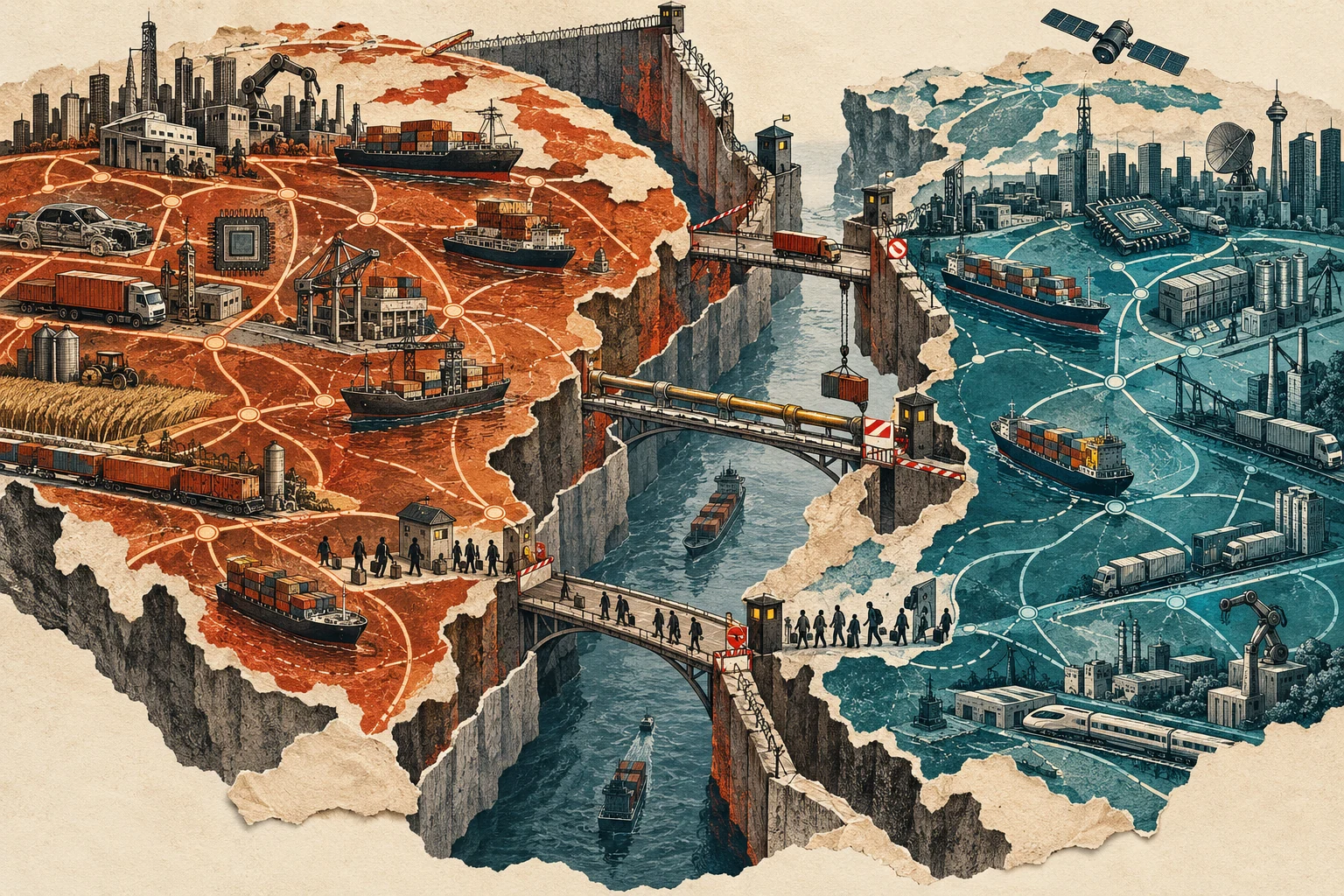
The economy splits into blocs with greater friction in the flow of goods, technology, and capital as political divides reorganize network ties.
AI-assisted illustration · conceptual metaphor View in visual quiz →Genesis and Global Lineage
The term in its current form was stabilized by a landmark IMF Staff Discussion Note in January 2023 (Aiyar, Chen, Ebeke, Ruta et al., SDN/2023/001) and brought into wider public circulation through speeches by IMF Managing Director Kristalina Georgieva and First Deputy Managing Director Gita Gopinath, who translated the fracturing of the world economy into percentages of global GDP: from 0.2% in a mild trade-realignment scenario to nearly 7% under severe fragmentation, with even steeper losses if technological decoupling is added. Its theoretical roots, however, are much older and draw on two distinct traditions. The first is the political economy of trade as an instrument of state power, laid out by Albert O. Hirschman in 1945, who demonstrated that asymmetric trade dependence grants the larger partner an “influence effect” independent of the mutual gains from trade. The second is interdependence theory in international relations: from Robert Keohane and Joseph Nye in the 1970s to Henry Farrell and Abraham Newman's 2019 article on “weaponized interdependence,” which showed how states controlling the central hubs of global financial and informational networks acquire both a “panopticon effect” (surveillance) and a “chokepoint effect” (the ability to cut off rivals). The IMF framework absorbed this diagnosis but shifted the lens from the coercing state to systemic consequences: instead of asking who can weaponize networks, it calculates how much everyone loses when networks begin to fracture. Along the way, the term has been partly co-opted by the vocabulary of industrial strategy, where “fragmentation” often serves as a euphemism for one's own subsidies and an accusation against those of others.
Central European Lineage
The theoretical literature on trade as an instrument of state coercion—on which the modern concept of geoeconomic fragmentation rests—took a classic case from Central and Southeastern Europe as its original empirical benchmark. While Albert O. Hirschman was educated in Berlin, Paris, London, and Trieste (outside the region's academic institutions), he wrote National Power and the Structure of Foreign Trade (1945) explicitly as a theoretical account of “German trading methods in recent years,” measuring great-power trade preferences toward smaller trading partners in his statistical chapters. In the historical context of the 1930s, this referred to Nazi Germany's bilateral clearing agreements with the Danubian states—Hungary, Romania, Bulgaria, and Yugoslavia—where Berlin offered above-world-market prices for agricultural products and raw materials in blocked marks, binding those smaller economies to a single buyer and turning asymmetric trade dependence into political leverage (though the specific country breakdown in Hirschman's tables remains marked for primary-text verification, as does the direct citation link to Farrell and Newman). Confirmed or not in every bibliographic link, the Danubian experience of the 1930s—alongside Central Europe's post-2022 experience when Gazprom abruptly halted gas deliveries to Poland and Bulgaria in April 2022, validating decades-long Polish investments in the Świnoujście LNG terminal and the Baltic Pipe—provides the archetype for how trade networks become instruments of coercion.
Documented regional lineage · Link: 1. Compiled: October 2026.
-
historical experience 11 years
Central European Source: Umowy clearingowe i preferencje handlowe III Rzeszy wobec Węgier, Rumunii, Bułgarii i Jugosławii (Nazi Germany's clearing agreements and trade preferences toward Hungary, Romania, Bulgaria, and Yugoslavia) — Handel bilateralny Niemiec z państwami Europy Południowo-Wschodniej w latach 30. XX w. (Germany's bilateral trade with Southeastern Europe in the 1930s); Budapest, Hungary; Bucharest, Romania; Sofia, Bulgaria; Belgrade, Yugoslavia (now Serbia), 1934
Global Circulation: trade as an instrument of state power; weaponized interdependence and geoeconomic fragmentation — Albert O. Hirschman, 1945
historical experience
11 yearsUmowy clearingowe i preferencje handlowe III Rzeszy wobec Węgier, Rumunii, Bułgarii i Jugosławii (Nazi Germany's clearing agreements and trade preferences toward Hungary, Romania, Bulgaria, and Yugoslavia) — Handel bilateralny Niemiec z państwami Europy Południowo-Wschodniej w latach 30. XX w. (Germany's bilateral trade with Southeastern Europe in the 1930s)
1934 · Budapest, Hungary; Bucharest, Romania; Sofia, Bulgaria; Belgrade, Yugoslavia (now Serbia)
trade as an instrument of state power; weaponized interdependence and geoeconomic fragmentation
1945 · Albert O. Hirschman
- Claim & Connection
- Albert O. Hirschman's book “National Power and the Structure of Foreign Trade” (1945), a foundational reference for contemporary literature on weaponized interdependence and geoeconomic fragmentation, builds its theory of trade as an instrument of state power by comparing it with “German trading methods in recent years” and statistically measuring great-power trade preferences toward smaller states. To the best of the briefing author's knowledge, this refers specifically to Germany's 1930s trade policy toward Hungary, Romania, Bulgaria, and Yugoslavia, which locked those economies into dependence on a single buyer; this specific country detail remains to be verified directly in the open source text.
- Source Documentation
-
- bibliographic record Albert O. Hirschman, National Power and the Structure of Foreign Trade, University of California Press, Berkeley 1945; wyd. rozszerzone 1980; reedycja Voices Revived 2018; publisher description: comparison of the theory with “German trading methods in recent years”; statistical section on trade preferences toward smaller trading countries. ucpress.edu ↗
- bibliographic record Rekordy Internet Archive dla wydań 1945 i 1980; Internet Archive identifiers nationalpowerstr0000hirs, nationalpowerst00hirs. archive.org ↗
- Historical Context
- Hirschman (born in Berlin, educated in Berlin, Paris, the LSE, and Trieste) does not meet the regional formation criterion; this link concerns solely the historical case from the region on which his classic text relies. The year 1934 is indicative (the start of the bilateral clearing agreements under Schacht's New Plan). A verifier should check Chapters II–III and the statistical section of the book, as well as whether Farrell and Newman (2019) cite Hirschman directly (no citation appears in the Semantic Scholar bibliography record). Check 2026-10: both URLs work; the UC Press page confirms the comparison with “German trading methods in recent years” and Chapter V on great-power trade preferences toward smaller countries; the specific detail on Hungary, Romania, Bulgaria, and Yugoslavia remains unverified in the full text.
Why Now
The concept became indispensable when three major shocks converged between 2018 and 2024. First, the US–China tariff war launched in 2018 demonstrated that the world's largest economies were willing to reverse decades of trade integration without an underlying economic crisis as a pretext. Second, the COVID-19 pandemic in 2020 exposed the degree to which the production of pharmaceuticals, personal protective equipment, and semiconductors depended on single geographic bottlenecks. Third, Russia's full-scale invasion of Ukraine in February 2022 and the sweeping Western sanctions that followed triggered a collapse in direct economic ties between Russia and the West and what European Central Bank President Christine Lagarde in April 2023 called the “weaponization of energy.” These shocks were compounded by sweeping US export controls on advanced semiconductors and chip-making equipment to China in October 2022 and the transatlantic subsidy race sparked by the US Inflation Reduction Act. In May 2024, Gita Gopinath presented the empirical figures that became canonical: following the invasion of Ukraine, trade between geopolitically distant blocs fell by roughly 12 percentage points more than trade within blocs, inter-bloc foreign direct investment dropped by about 20 percentage points more, and the number of new trade restrictions imposed globally each year had more than tripled since 2019.
Explanatory Power
Geoeconomic fragmentation allows analysts to distinguish cyclical fluctuations in trade from a structural transformation because it shifts attention from aggregate global totals to the geography of flows relative to political alliances. First, it resolves a major statistical paradox: global goods trade in 2022–2023 remained near record highs in absolute terms, yet trade flows between rival geopolitical blocs began diverging sharply from flows within friendly blocs—a tectonic shift that aggregate global trade-to-GDP ratios completely obscure. Second, it explains the rapid rise of “connector economies” such as Vietnam, Mexico, and Poland, which attract surging trade and investment precisely because geopolitical blocs need intermediary channels to bypass direct bilateral tariffs, lengthening supply chains rather than shortening them. Third, it puts a price tag on geopolitical rhetoric: IMF scenario modeling translates vague debates over “strategic autonomy” and “economic security” into a concrete welfare ledger, showing that the heaviest costs of decoupling fall on emerging and developing economies that rely on capital and technology from geopolitically rival powers.
Axes of Debate
Is geoeconomic fragmentation actually happening?
Empirical trade economists (such as Pinelopi Goldberg and Tristan Reed, 2023) point out that after 2008 globalization slowed down (“slowbalization”) rather than reversed, that most multinational firms retained their foreign suppliers after the pandemic, and that the dramatic turn occurred first in policy announcements and public sentiment rather than in aggregate physical trade flows. Strongest counterargument: IMF and ECB researchers reply that their metrics measure not the overall level of global trade, but its re-routing along geopolitical fault lines (measured, for instance, by UN General Assembly voting alignment); the surge in trade passing through third-country “connector” hubs is proof that commerce is actively detouring around bloc boundaries, not that those boundaries are imaginary. Nature of the dispute: substantive — a methodological dispute over the appropriate metric: aggregate global trade volume versus the geopolitical geometry of bilateral flows.
The welfare cost of fragmentation versus the tail risk of dependence
Multilateral economic institutions (the IMF, the WTO, and central banks) model geoeconomic fragmentation as a pure global welfare loss and call for “pragmatic” multilateralism to preserve open trade rules. Strongest counterargument: Realist international relations scholars and theorists of weaponized interdependence reply that standard macroeconomic trade models ignore tail risk: in 2022, Europe paid a massive economic and security bill for a decade of cheap Russian pipeline gas that no standard equilibrium growth model had priced in, showing that the insurance premium of diversification can be far lower than the cost of strategic blackmail. Nature of the dispute: mixed — substantive regarding how to price geopolitical tail risk in economic models, but rhetorical where “national security” is invoked as a blank check to justify any domestic protectionist subsidy.
Selective “de-risking” versus full-scale decoupling
Since 2023, the European Commission and the US administration have insisted that they pursue only targeted “de-risking” in a “small yard with a high fence” of critical technologies, rather than wholesale economic decoupling from China. Strongest counterargument: Critics from both free-trade and hawkish camps point out that the list of “strategic” sectors expands every year—from advanced logic chips to electric vehicles, batteries, cranes, and legacy semiconductors—and that every targeted restriction provokes symmetrical retaliation from the rival bloc, setting off the same escalatory dynamic regardless of the label. Nature of the dispute: rhetorical — the difference lies primarily in pacing and diplomatic messaging rather than in the underlying structural trajectory.
Underappreciated Angle
Geoeconomic fragmentation is neither symmetrical nor a two-player game between equals. The binary model of “two rival blocs” obscures the fact that the most consequential day-to-day decisions are made by third-party actors: non-aligned “connector” states that extract geopolitical and economic rent from serving as bridges, and multinational firms that relocate only the final assembly stage to a friendly jurisdiction while leaving deep upstream dependence on Chinese raw materials and components intact. As a result, direct bilateral trade statistics between rival powers can fall even as underlying technological and material dependence grows deeper inside the supply chain. For Central Europe, this paradox is particularly acute: the very region that severed its dependence on Russian energy in a matter of months after 2022 simultaneously became one of Europe's premier destinations for Chinese greenfield investment in electric-vehicle batteries and automotive components. Geoeconomic fragmentation does not simply lock a middle region inside one bloc; it forces it to decide which asymmetric dependence it considers safe.
One-Sentence Takeaway
Geoeconomic fragmentation does not mean the world trades less; it means states begin trading with those they might one day fight as if the war had already begun.
Related Concepts Network
How this concept reinforces, constrains, or complements other analytical frameworks in the corpus. View on graph →
-
Supply chain resilience reinforces
Fragmentation turns supply-chain resilience from a prudent business slogan into a core criterion of state policy: actors who know a market may be closed for political reasons diversify even at the cost of efficiency.
-
De-risking complements
De-risking is the policy doctrine proposed by Western governments as a controlled, selective version of economic decoupling; geoeconomic fragmentation is the broader macro-process that doctrine seeks to manage.
-
Industrial policy reinforces
Subsidies for semiconductors and clean technologies are both a consequence of fragmentation and its fuel, as every subsidy package triggers a retaliatory response from rival blocs.
-
Polycrisis complements
Geoeconomic fragmentation is one of the primary transmission channels through which the pandemic, war, and technological rivalry amplify one another rather than subsiding separately.
-
Digital sovereignty complements
Conflict over cloud computing, data localization, and network standards is geoeconomic fragmentation transposed from physical goods to information infrastructure.
-
Dual-use technology reinforces
Export controls on advanced microchips and lithography machines demonstrate that the boundary between commercial trade and national security now runs through individual industrial products.
-
Path dependence constrains
Decades of investment in global supply chains create massive sunk costs that slow down economic fracturing and explain why aggregate trade data lag behind political rhetoric for years.
Reading Canon & Translation Bridge
Foundational texts, introductions, and critical perspectives—with availability of English and Polish editions.
-
foundational text 2023 · English
Shekhar Aiyar, Jiaqian Chen, Christian Ebeke, Michele Ruta i in., Geoeconomic Fragmentation and the Future of Multilateralism
The IMF Staff Discussion Note (SDN/2023/001, January 15, 2023) that popularized the term, categorized the transmission channels of fragmentation (trade, capital, technology, migration, payments), and estimated the GDP costs of various scenarios.
In English: original text written in English
In Polish: no Polish edition
-
foundational text 2019 · English
Henry Farrell, Abraham L. Newman, Weaponized Interdependence: How Global Economic Networks Shape State Coercion
The landmark article in International Security (vol. 44, no. 1) describing the “panopticon effect” and “chokepoint effect” in hub-and-spoke networks like SWIFT and the internet—the theoretical foundation for understanding why economic integration becomes a lever of state coercion.
In English: original text written in English
In Polish: Polish edition not verified
-
introduction & synthesis 2024 · English
Gita Gopinath, Geopolitics and its Impact on Global Trade and the Dollar
A lecture at the Stanford Institute for Economic Policy Research (May 7, 2024) presenting the most widely cited empirical figures on inter-bloc trade and investment flows after 2022; available on the IMF website.
In English: original text written in English
In Polish: no Polish edition
-
critical perspective 2023 · English
Pinelopi K. Goldberg, Tristan Reed, Is the Global Economy Deglobalizing? If So, Why? And What Is Next?
A paper in Brookings Papers on Economic Activity (Spring 2023) demonstrating empirically that after 2008 globalization slowed down rather than reversed, and that the sharp turn occurred first in policy and public sentiment rather than in physical trade flows.
In English: original text written in English
In Polish: no Polish edition
-
cross-disciplinary 1945 · English
Albert O. Hirschman, National Power and the Structure of Foreign Trade
The classic analysis of foreign trade as an instrument of state power, written under the impression of 1930s German trade policy; the original source of the concept of asymmetric trade dependence to which all contemporary literature returns.
In English: original text written in English
In Polish: Polish edition not verified
-
introduction & synthesis 2023 · English
Henry Farrell, Abraham L. Newman, Underground Empire: How America Weaponized the World Economy
A narrative book-length account of weaponized interdependence, tracing how the United States came to control the central nodes of global finance, data, and semiconductor supply chains.
In English: original text written in English
In Polish: Polish edition not verified
-
cross-disciplinary 1985 · English
David A. Baldwin, Economic Statecraft
A foundational political-science taxonomy of sanctions, embargoes, and aid as tools of foreign policy, making it possible to judge whether today's instruments of fragmentation are genuinely new.
In English: original text written in English
In Polish: Polish edition not verified
Primary-Source Quotes
After several decades of increasing global economic integration, the world is facing the risk of policy-driven geoeconomic fragmentation (GEF).