Systems & Complexity #059
State capacity
original term: state capacity (Eng.) · sprawność państwa, siła państwa, władza infrastrukturalna
Central European lineage: 2 threads (historical experience) · 1990–2007 · jump to documentation ↓
Working Definition
State capacity is the degree to which a state can actually implement and enforce the policies it decides upon: collect taxes, adjudicate contracts, build infrastructure, deliver public services, and maintain a monopoly on the legitimate use of violence across its territory. In technical comparative politics and economics, it is disaggregated into fiscal capacity (raising revenue), legal capacity (enforcing property rights and court judgments), administrative capacity (delivering services and regulating), and coercive capacity. Crucially, the concept must be separated from the scope of the state—the list of tasks a government claims responsibility for: a state can be simultaneously sprawling in scope and impotent in execution, or narrow in scope and highly effective. Colloquially, a “strong state” is often confused with an authoritarian police state; analytically, a strong state is one that possesses what Michael Mann called infrastructural power—the logistical capacity to penetrate civil society and get things done.
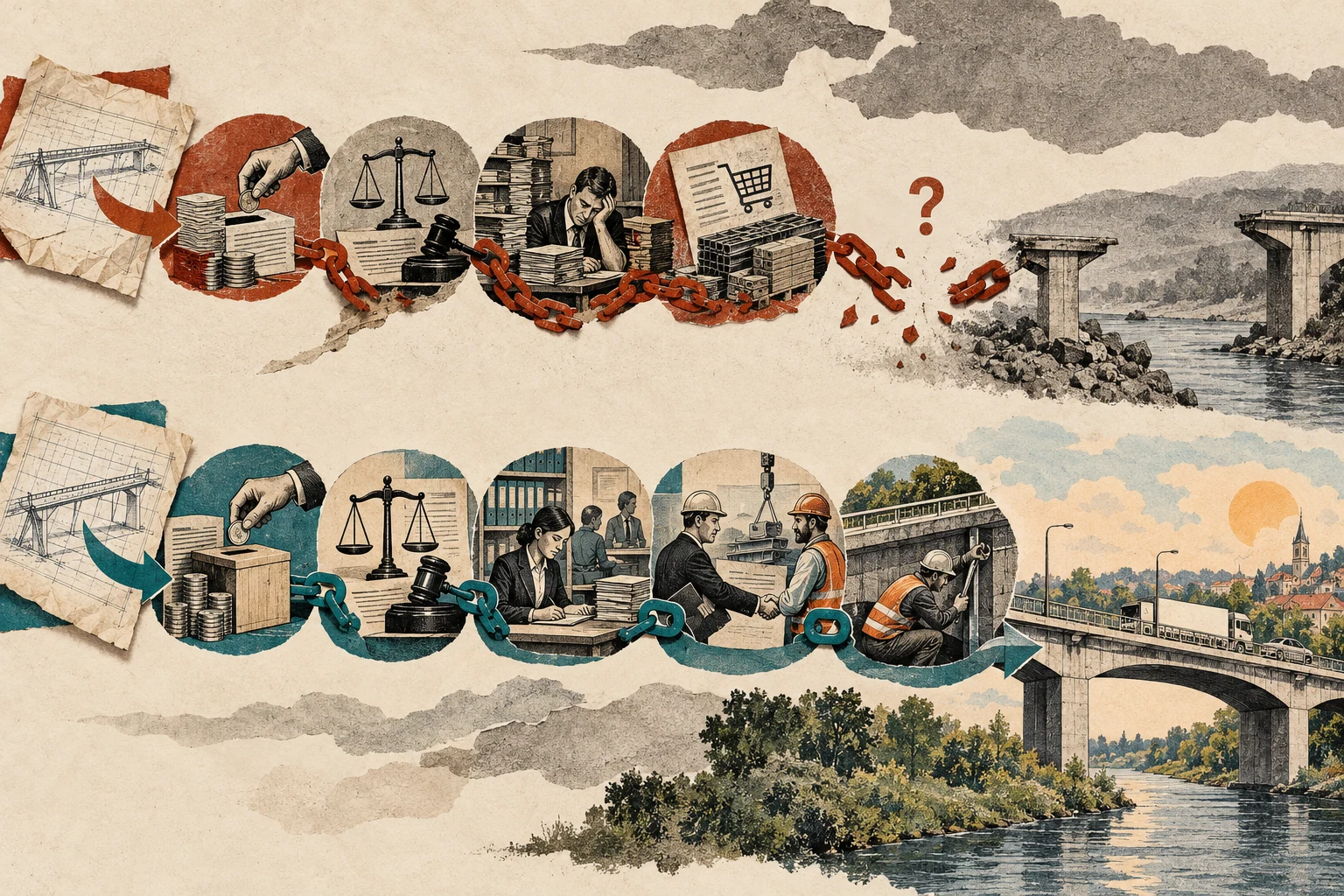
Turning a decision into reality requires a functioning chain of institutions, personnel, and resources; merely announcing a plan does not ensure execution.
AI-assisted illustration · conceptual metaphor View in visual quiz →Genesis and Global Lineage
While the concept’s roots lie in Max Weber’s definition of the modern state as a bureaucratic apparatus claiming a monopoly on legitimate physical violence, “state capacity” emerged as an explicit analytical variable in the mid-1980s. In a seminal 1984 article, the historical sociologist Michael Mann distinguished despotic power (the range of actions a ruler can take without routine negotiation with civil-society groups) from infrastructural power (the institutional capacity of a state to penetrate its territory and logistically implement decisions)—pointing out that modern liberal democracies are despotically weak yet infrastructurally stronger than any ancient empire. A year later, Bringing the State Back In (1985), edited by Evans, Rueschemeyer, and Skocpol, placed state capacities at the center of comparative political science, while Charles Tilly (Coercion, Capital, and European States, 1990) traced their origins to the fiscal and administrative demands of war (“war made the state, and the state made war”). In State-Building (2004), Francis Fukuyama separated the scope of state activities from the strength of state institutions, arguing that the 1990s Washington Consensus had confused cutting state scope with building state strength. Economists Timothy Besley and Torsten Persson (Pillars of Prosperity, 2011) subsequently formalized fiscal and legal capacity in political economy.
Central European Lineage
Central and Eastern Europe did not produce the coiners of the term, but the post-1989 collapse of state socialism provided the decisive historical laboratory that reshaped how scholars think about state capacity. First, the institutional implosion of the Russian state in the 1990s—unable to collect taxes, pay wages, or prevent private protection rackets from replacing courts—inspired Stephen Holmes’s 1997 essay What Russia Teaches Us Now, which inverted the Cold War liberal reflex: individual rights and free markets do not flourish when the state withers away, because “the largest and most reliable human rights organization is the liberal state.” Second, within core Central Europe and the Baltics, Anna Grzymała-Busse’s comparative monograph Rebuilding Leviathan (2007) examined post-communist state reconstruction across Poland, Czechia, Slovakia, Hungary, Slovenia, Estonia, Latvia, Lithuania, and Bulgaria. Challenging naive technocratic rankings, she showed that governing parties sought to build institutions they could exploit for partisan patronage—delaying civil-service laws, multiplying discretionary agencies, and skimming privatization—and that what forced governments to build independent audit offices, regulators, and civil-service rules was not civic virtue, but the fear that a credible parliamentary opposition would win the next election and turn discretionary state power against them.
Documented regional lineage · Links: 2. Compiled: October 2026.
-
historical experience 17 years
Central European Source: Building public administration, oversight institutions, and privatization in Poland, Czechia, Slovakia, Hungary, Slovenia, Bulgaria, Estonia, Latvia, and Lithuania after 1989 — Post-communist state rebuilding in Central Europe and the Baltic states; Warsaw, Poland; Prague, Czechia; Budapest, Hungary; Bratislava, Slovakia; Ljubljana, Slovenia; Tallinn, Estonia; Riga, Latvia; Vilnius, Lithuania; Sofia, Bulgaria, 1990
Global Circulation: state exploitation by governing parties and the constraining role of robust party competition — Anna Grzymała-Busse, 2007
-
historical experience 6 years
Central European Source: Weakness of the post-Soviet state in the 1990s: inability to collect taxes, enforce contracts, and protect property — Collapse of state institutions in post-1991 Russia; Moscow, Russia (then Russian SFSR / Russian Federation), 1991
Global Circulation: weak state and individual rights; liberalism as dependent on state capacity — Stephen Holmes, 1997
historical experience
6 yearsWeakness of the post-Soviet state in the 1990s: inability to collect taxes, enforce contracts, and protect property — Collapse of state institutions in post-1991 Russia
1991 · Moscow, Russia (then Russian SFSR / Russian Federation)
weak state and individual rights; liberalism as dependent on state capacity
1997 · Stephen Holmes
- Claim & Connection
- In his essay “What Russia Teaches Us Now,” Stephen Holmes used the institutional collapse of post-Soviet Russia as a foundational lesson for liberal theory: individual rights and liberties do not exist without a state capable of taxing, spending, and enforcing the law. The Russian experience of the 1990s became a key point of departure for later scholarship on state capacity as a precondition of liberal order.
- Source Documentation
-
- reception / translation Stephen Holmes, „What Russia Teaches Us Now”, The American Prospect; main text: argument on a state capable of taxing, spending, and enforcing the law; sentence on “the largest and most reliable human rights organization”. prospect.org ↗
- Historical Context
- Russia belongs to the region’s eastern neighborhood; the case is included because it illuminates the shared post-communist experience of state weakness in the 1990s. First publication in “The American Prospect” no. 33 (July–August 1997) is cited from standard bibliography; the magazine’s web archive carries a December 19, 2001 upload date, so the print date remains to be cross-checked directly.
historical experience
17 yearsBuilding public administration, oversight institutions, and privatization in Poland, Czechia, Slovakia, Hungary, Slovenia, Bulgaria, Estonia, Latvia, and Lithuania after 1989 — Post-communist state rebuilding in Central Europe and the Baltic states
1990 · Warsaw, Poland; Prague, Czechia; Budapest, Hungary; Bratislava, Slovakia; Ljubljana, Slovenia; Tallinn, Estonia; Riga, Latvia; Vilnius, Lithuania; Sofia, Bulgaria
state exploitation by governing parties and the constraining role of robust party competition
2007 · Anna Grzymała-Busse
- Claim & Connection
- Anna Grzymała-Busse’s monograph “Rebuilding Leviathan” analyzes post-communist state reconstruction across nine countries—eight of them in the core Central European and Baltic region—demonstrating that governing parties built state institutions so as to exploit them (delaying independent oversight bodies, creating discretionary administrative agencies, and extracting resources from privatization) unless checked by robust, plausible parliamentary opposition. It is one of the foundational comparative studies in the literature on state capacity in post-communist democracies.
- Source Documentation
-
- scholarly study Anna Grzymala-Busse, Rebuilding Leviathan: Party Competition and State Exploitation in Post-Communist Democracies, Cambridge University Press, Cambridge 2007 (Cambridge Studies in Comparative Politics); publisher description: country coverage and core thesis on party competition. cambridge.org ↗
- Historical Context
- Bulgaria belongs to the Balkan neighborhood, while the remaining eight countries belong to the core Central European and Baltic region. The link concerns the empirical subject matter of the study rather than the author’s biography.
Why Now
Between 2018 and 2026, state capacity moved from academic seminars to the center of Western policy debate. The COVID-19 pandemic of 2020–2022 acted as a global audit of administrative execution: outcomes in testing, digital vaccine rollouts, and business-relief disbursement tracked neither GDP per capita nor regime type, but the granular quality of civil-service logistics and public-health registries. In the United States, Tyler Cowen’s 2020 call for “State Capacity Liberalism” and the subsequent “abundance agenda”—crystallized in Ezra Klein and Derek Thompson’s 2025 book Abundance—asked why the world’s richest country takes over a decade and billions of dollars per mile to build high-speed rail, transmission lines, or housing that Spain or France builds at a fraction of the cost, diagnosing a self-inflicted “vetocracy” of procedural lawsuits. Meanwhile, Russia’s full-scale invasion of Ukraine in 2022 offered a stark battlefield demonstration of Mann’s distinction: Ukraine’s wartime resilience rested on remarkable digital and logistical infrastructural capacity, whereas Russia displayed immense despotic power paired with brittle, corrupt administrative execution.
Explanatory Power
The concept severs the conflation of policy ambition with policy delivery (a gap captured in Polish political vernacular since 2014 by państwo teoretyczne—a “theoretical state” that exists on paper but fails in practice). First, it explains why identical laws produce opposite outcomes across jurisdictions: a property tax is worth only as much as the accuracy of the land cadastre, and a targeted social transfer is worth only as much as the registries used to reach recipients. Second, it clarifies the pathology of 1990s post-Soviet privatization: following advice to “shrink the state” in countries lacking basic court enforcement and bankruptcy administration produced oligarchic asset-stripping rather than competitive markets. Third, it diagnoses contemporary policy failures in wealthy democracies as bottlenecks of execution rather than intent: when a government passes a green transition or housing package and nothing gets built on time, the binding constraint is rarely the headline budget, but the number of procurement engineers in the agency, the legacy IT system, and whether civil servants can sign a decision without fearing prosecution.
Axes of Debate
State strength versus state scope (Fukuyama’s matrix versus libertarian critics)
Libertarians and public-choice economists suspect that calls to build “state capacity” are a Trojan horse for expanding government spending; Fukuyama (2004) and abundance advocates reply that scope and strength are orthogonal axes, and that a lean regulatory state requires higher administrative competence than a sprawling patronage state. Strongest counterargument: Critics reply that administrative capacity is never a neutral tool sitting idle: once a state builds a powerful tax or regulatory apparatus, bureaucratic self-interest ensures that its scope will expand to use every power it possesses. Nature of the dispute: substantive — it concerns whether administrative capacity can be institutionally decoupled from the political drive to expand state scope.
Can state capacity be imported from abroad?
International development agencies long assumed that institutional capacity can be transferred through technical templates and foreign funding; comparative scholars (including Fukuyama, Lant Pritchett, and Grzymała-Busse) counter that imported “isomorphic mimicry” creates hollow facade institutions unless domestic coalitions have an endogenous stake in enforcing the rules. Strongest counterargument: The 2004 EU enlargement in Central Europe and the Baltics shows that strong external conditionality can accelerate administrative modernization for a time, though once accession is complete the external lever weakens and institutions can be hollowed out. Nature of the dispute: mixed — the mechanics of conditionality versus domestic coalitions are substantive, though debates over “reform colonialism” carry heavy rhetorical charge.
Infrastructural capacity as public good versus high-modernist danger (Mann and Klein versus James C. Scott)
Contemporary “state-capacity liberals” treat administrative execution as an almost unqualified good; critics in the tradition of James C. Scott (Seeing Like a State, 1998) warn that the worst twentieth-century catastrophes—forced collectivization, authoritarian urban renewal—were perpetrated by states with high infrastructural capacity to render society legible and standardized from above. Strongest counterargument: Defenders reply that Scott’s catastrophes require combining high administrative capacity with authoritarianism and a prostrate civil society; in a constitutional democracy, the far more common pathology today is procedural paralysis that prevents a city from building a subway line or wind turbine in twenty years. Nature of the dispute: substantive — it concerns where a polity sits between unchecked technocratic coercion and procedural vetocracy.
Underappreciated Angle
The least measured component of state capacity is the asymmetry of personal risk facing the individual civil servant. Governance indices count agency budgets, staffing, and statutory timelines, yet rarely ask what governs daily execution: does the official signing a decision fear the consequences of acting more than the consequences of doing nothing? In administrations that responded to past corruption scandals by layering criminal liability, anti-corruption bureaus, and audit inspections atop every procurement signature, an official who approves a rapid tender risks investigation if anything goes wrong, whereas an official who demands three external legal opinions or cancels a tender on a technicality faces zero penalty for a two-year delay. Administrative paralysis is then not a symptom of lazy bureaucrats, but a rational survival strategy under asymmetric punishment—explaining why states with large bureaucracies stall on simple infrastructure projects, and why an acute crisis that suspends normal audit procedures is often the only moment when the state suddenly “knows how to act.”
One-Sentence Takeaway
A state is defined not by the laws its parliament passes or the strategies its ministers announce, but by what actually reaches the end of the execution chain—the land registry, the tax system, and the civil servant who is not afraid to sign the permit.
Related Concepts Network
How this concept reinforces, constrains, or complements other analytical frameworks in the corpus. View on graph →
-
Legibility complements
Administrative legibility of society—cadastres, tax rolls, standardized weights—is a precondition of state capacity, yet in James C. Scott’s analysis also the engine of its worst high-modernist disasters.
-
Goodhart’s law constrains
Quantitative indicators of state capacity (tax-collection ratios, case-clearance times) cease to measure genuine institutional performance as soon as bureaucracies are rewarded on the metric alone.
-
Wicked problems in tension
State capacity measures the execution of tasks with a well-defined objective, whereas wicked problems lack a stable problem definition or an agreed stopping rule.
-
Creative destruction complements
Schumpeterian economic renewal requires a state strong enough to enforce contracts, competition law, and bankruptcy, yet insulated enough not to bail out every incumbent loser.
-
Hypernormalization in tension
A regime can maintain the theatrical appearance of omnipresent control even as its actual administrative capacity hollows out from within.
-
Antifragility complements
Genuine state capacity encompasses not merely lean efficiency in calm times, but fiscal and administrative slack that can be mobilized during a crisis.
-
Moloch and coordination failure reinforces
A state capable of credible enforcement is the classic institutional solution to multipolar coordination traps that private actors cannot escape on their own.
Reading Canon & Translation Bridge
Foundational texts, introductions, and critical perspectives—with availability of English and Polish editions.
-
foundational text 2004 · English
Francis Fukuyama, State-Building: Governance and World Order in the 21st Century
The concise book that separated the scope of state functions from the strength of state power, placing institutional capacity at the center of post-9/11 global politics.
In English: original text written in English
In Polish: Polish edition not verified
-
foundational text 1984 · English
Michael Mann, The Autonomous Power of the State: Its Origins, Mechanisms and Results
The classic article in the “European Journal of Sociology” (vol. 25, no. 2, pp. 185–213) introducing the distinction between despotic power and infrastructural power that still anchors the field.
In English: original text written in English
In Polish: Polish edition not verified
-
foundational text 1985 · English
Peter B. Evans, Dietrich Rueschemeyer, Theda Skocpol (red.), Bringing the State Back In
The landmark volume that returned the state as an autonomous actor to comparative social science and established state capacities as a core explanatory variable.
In English: original text written in English
In Polish: Polish edition not verified
-
introduction & synthesis 1990 · English
Charles Tilly, Coercion, Capital, and European States, AD 990–1990
The historical-sociological theory of how European states acquired fiscal and administrative capacity: war made the state, and the state made war.
In English: original text written in English
In Polish: Polish edition not verified
-
cross-disciplinary 2011 · English
Timothy Besley, Torsten Persson, Pillars of Prosperity: The Political Economics of Development Clusters
The formal political-economy model treating fiscal capacity (taxation) and legal capacity (contract enforcement) as complementary forward-looking investments by incumbents.
In English: original text written in English
In Polish: Polish edition not verified
-
introduction & synthesis 2007 · English
Anna Grzymała-Busse, Rebuilding Leviathan: Party Competition and State Exploitation in Post-Communist Democracies
A comparative study of nine post-communist democracies showing that governing parties build state institutions to exploit them unless constrained by a credible opposition.
In English: original text written in English
In Polish: Polish edition not verified
-
critical perspective 1998 · English
James C. Scott, Seeing Like a State: How Certain Schemes to Improve the Human Condition Have Failed
The essential warning that high administrative capacity combined with high-modernist hubris and weak civil society produces social and ecological catastrophes when local practical knowledge (mētis) is crushed.
In English: original text written in English
In Polish: Polish edition not verified
Primary-Source Quotes
The largest and most reliable human rights organization is the liberal state.