Systems & Complexity #066
Supply chain resilience
original term: supply chain resilience (Eng.) · rezyliencja łańcuchów dostaw, odporność łańcucha dostaw, just-in-case
Global-circulation concept — no documented lineage in Central Europe. jump to documentation ↓
Working Definition
Supply chain resilience is the capacity of a network of suppliers, manufacturers, logistics providers, and distributors to absorb a shock, maintain core operations during the disruption, and recover to a desired state—or reconfigure into a better one—within an acceptable time and cost. In its technical formulation, it comprises four measurable capabilities: redundancy (buffer stocks, dual sourcing, spare capacity), flexibility (the ability to switch production lines, inputs, and transport routes), visibility (knowing what is happening at second- and third-tier sub-suppliers), and velocity of response. In popular usage since 2020, the phrase has been flattened into “hold larger inventories and manufacture closer to home,” missing the core insight: resilience is a topological property of the entire production network rather than the sum of buffers held by individual firms.
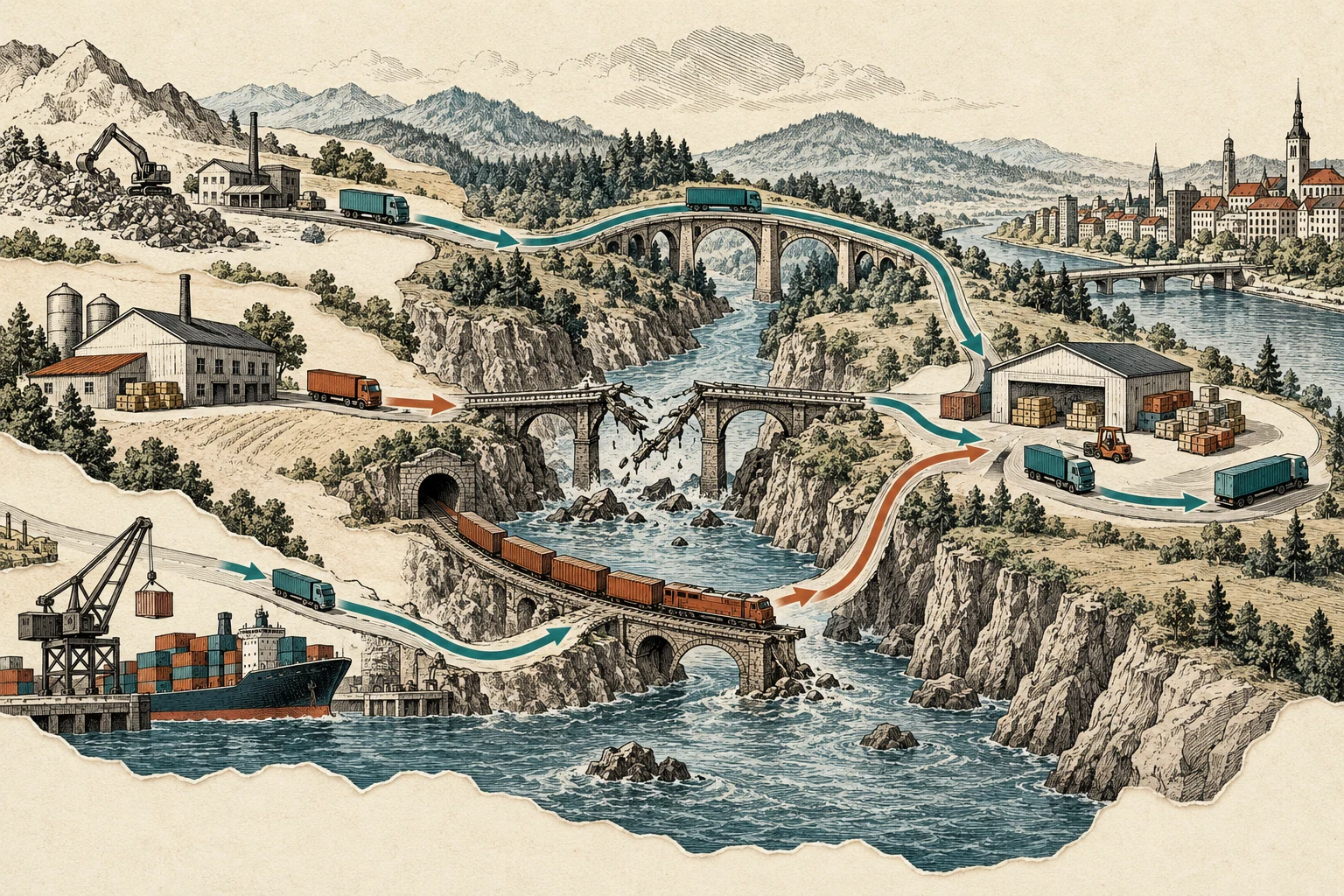
Backup routes and reserves keep deliveries moving after one path fails; resilience requires prepared alternatives, not just speed.
AI-assisted illustration · conceptual metaphor View in visual quiz →Genesis and Global Lineage
The systems concept of resilience was introduced by the ecologist C. S. Holling in 1973, who distinguished a system’s capacity to persist through shocks from engineering stability, understood as rapid return to a fixed equilibrium. The term was transplanted into logistics and operations management by the Cranfield school in the United Kingdom: in their 2004 paper Building the Resilient Supply Chain, Martin Christopher and Helen Peck diagnosed how global outsourcing and lean practices had simultaneously lengthened and thinned supply networks, arguing that firms needed to design for resilience rather than merely manage routine variance. Independently at MIT, Yossi Sheffi showed in The Resilient Enterprise (2005)—drawing on case studies after the September 11 attacks and a 2000 fire at a Philips semiconductor plant in Albuquerque—that firms able to detect and respond to disruptions faster than their rivals capture lasting market share, with the diverging fates of Nokia and Ericsson becoming the textbook illustration. For a decade and a half, the concept remained a specialized topic within operations research, overshadowed by the triumph of Toyota-style just-in-time production. After 2020 it was co-opted by industrial policy and geopolitics: in the mouths of governments and management consultancies, “resilience” became the master justification for reshoring, friendshoring, and industrial subsidies, shifting the term’s meaning from a structural property of networks to a strategic doctrine of the state.
Central European Lineage
We found no documented link between this concept and the intellectual history or historical experience of Central Europe.
We found no documented link between this concept and the intellectual history or historical experience of Central Europe (by our methodology, this means “none found,” not “none exists”; as of October 2026).
Why Now
Since 2018 the concept has moved from specialist logistics journals to the front pages through a relentless sequence of global shocks. The US–China tariff war (from 2018) turned the geography of sourcing into an explicit political variable for the first time in decades. The COVID-19 pandemic in 2020 exposed how heavily Western supplies of face masks, ventilators, and active pharmaceutical ingredients depended on a handful of Asian manufacturing hubs, and then—when consumer demand for durable goods rebounded—jammed container ports and shipping lanes, sending spot freight rates from Shanghai to Los Angeles soaring. In March 2021 the container ship Ever Given blocked the Suez Canal for six days, while a global semiconductor shortage idled automotive assembly lines across Europe (including plants in Czechia, Slovakia, and Poland) and North America throughout 2021 and 2022. Russia’s full-scale invasion of Ukraine in February 2022 severed pipeline gas flows, Black Sea grain routes, and supplies of purified neon gas used in chip lithography, and in 2024 Houthi attacks in the Red Sea once again forced container ships around the Cape of Good Hope. Institutional responses followed swiftly: President Biden’s February 2021 executive order mandated a 100-day federal supply-chain review, the European Union enacted the European Chips Act and the Critical Raw Materials Act, and the McKinsey Global Institute estimated in its 2020 report Risk, resilience, and rebalancing in global value chains that companies can expect a disruption lasting a month or longer every 3.7 years on average. The return of sweeping tariffs in US trade policy in 2025 added a final twist: “resilience” is now invoked both to defend protectionist walls and to warn against the fragility they create.
Explanatory Power
The concept makes clear why unit-cost efficiency and systemic resilience are measured in different currencies and over different time horizons: cost savings show up in every quarterly earnings report, whereas the value of resilience materializes only during a shock that may occur once a decade. Three examples illustrate its reach. First, it explains the 2021 automotive semiconductor paradox: carmakers, long the textbook champions of just-in-time discipline, canceled chip orders in spring 2020 when lockdowns hit, only to find themselves at the back of the foundry queue behind consumer electronics when vehicle demand roared back—what failed was not warehouse inventory, but network visibility and contractual option value. Second, it reveals why surface-level supplier diversification is often an illusion: five competing Tier-1 suppliers may all source a critical chemical or microcontroller from a single Tier-3 plant in one river valley, as the 2011 Thailand floods demonstrated for the world’s hard-disk-drive industry. Third, it separates genuine resilience from autarky: concentrating all production inside one country’s borders actually increases vulnerability to a domestic shock (a regional flood, power outage, or strike), whereas true resilience requires geographic dispersion and pre-qualified switching capacity across borders.
Axes of Debate
Redundancy versus efficiency (just-in-case versus just-in-time)
Management consultants and industrial-policy advocates after 2020 argue that the era of pure just-in-time is over and firms must shift to just-in-case: larger buffer stocks, dual sourcing, and slack capacity. Trade economists (notably Richard Baldwin and Rebecca Freeman) counter that holding idle inventory and duplicating factories is expensive, imposing a permanent deadweight tax on consumers every year to insure against rare events. Strongest counterargument: Standard trade-cost calculations assume that disruptions follow a stationary, independent probability distribution; if shocks are fat-tailed and globally correlated (a pandemic or geopolitical rupture hits multiple nodes simultaneously), expected-loss models severely underprice the option value of spare capacity. Nature of the dispute: substantive — it hinges on empirical parameters of the shock distribution and the social discount rate, though long-tail data remain scarce.
Network resilience versus national security
Policymakers in Washington and Brussels use the language of supply-chain resilience to justify industrial subsidies, export controls, and friendshoring. Supply-chain researchers (such as Yossi Sheffi) point out that political reshoring often reduces operational resilience by replacing a diversified global network with concentrated domestic bottlenecks while raising input costs that eat into firms’ financial buffers. Strongest counterargument: From a state’s perspective, the relevant threat is not a random natural disaster but the deliberate weaponization of choke points by a strategic rival (Russian pipeline gas in 2022, Chinese export restrictions on gallium and germanium in 2023); against an intelligent adversary, probabilistic diversification models no longer apply. Nature of the dispute: mixed — the analytical distinction between random hazard and strategic coercion is substantive, but “resilience” also serves as a convenient rhetorical fig leaf for ordinary rent-seeking protectionism.
Firm-level capability versus network-level topology
Managerial literature treats resilience as an organizational capability that an individual enterprise can build through its own procurement audits, safety stocks, and scenario planning. Complex-networks researchers reply that resilience is governed by the macroscopic topology of the entire supply web—which no single firm can see or control—and that uncoordinated buffer-building by individual firms can actively destabilize the system (the panic-ordering bullwhip of 2021). Strongest counterargument: Investment budgets and legal liability still sit with individual corporations; a network theory that offers no actionable decision rule for a procurement officer leaves practice untouched. Nature of the dispute: substantive — a genuine clash over the appropriate unit of analysis and over whether coordination requires public mandates, industry stress tests, or focal-firm standards.
Underappreciated Angle
Public debate fixates on geography (where factories sit) and physical inventory (how many weeks of parts sit in warehouses), while ignoring the financial architecture that engineered the fragility in the first place. For three decades capital markets systematically penalized working capital: inventory on a balance sheet was treated as lazy cash, and stripping out spare capacity to boost return on invested capital (ROIC) and fund share buybacks was rewarded as managerial excellence. Supply-chain resilience was not “forgotten” by negligent engineers—it was deliberately liquidated and paid out to shareholders in exchange for higher quarterly multiples. It follows that no government white paper will durably alter corporate sourcing behavior as long as equity markets price slack as waste; buffers built in the panic of a crisis are quietly pared back the moment margin pressure returns, a pattern already visible in manufacturing inventory ratios after 2023. A second blind spot concerns human capital: during the 2020–2022 crunch, the nodes that held together best were those that still retained experienced workers carrying tacit operational knowledge—truck drivers, dockworkers, veteran production schedulers—and decades of treating skilled labor as a variable cost to be automated or subcontracted away proved just as damaging to systemic resilience as factory concentration in East Asia.
One-Sentence Takeaway
Supply-chain fragility was not an engineering oversight, but the outcome of a thirty-year financial trade: firms sold off resilience, whose value shows up only in a crisis, to buy unit-cost efficiency, whose profit shows up every quarter.
Related Concepts Network
How this concept reinforces, constrains, or complements other analytical frameworks in the corpus. View on graph →
-
Antifragility in tension
Taleb distinguishes resilience (a system bounces back to its baseline state) from antifragility (a system gains from shocks); supply-chain literature usually stops at the former while occasionally claiming the latter.
-
Systems thinking reinforces
Resilience is a property of the network rather than of an isolated firm: buffer inventories at one node will not help if the bottleneck sits three tiers upstream at a sub-supplier.
-
Black Swan complements
The disruptions that justify investing in resilience are rare and hard to predict, meaning they cannot be priced through standard expected-loss actuarial calculus.
-
Path dependence constrains
Decades of unit-cost optimization built deep geographic concentration (Taiwan, China) that cannot be unwound within a single capital investment cycle.
-
Network theory reinforces
Network-science methods show that resilience depends on the topology of inter-firm links (critical nodes, single points of failure) rather than on average inventory levels.
-
Complexity science complements
Supply chains are complex adaptive systems in which locally rational responses (precautionary hoarding) generate global bullwhip oscillations.
Reading Canon & Translation Bridge
Foundational texts, introductions, and critical perspectives—with availability of English and Polish editions.
-
foundational text 2004 · English
Martin Christopher, Helen Peck, Building the Resilient Supply Chain
A paper in “The International Journal of Logistics Management” (vol. 15, no. 2, pp. 1–14) that established resilience as an explicit objective of supply-chain design in response to the vulnerabilities created by global sourcing and lean operations.
In English: original text written in English
In Polish: no Polish edition
-
foundational text 2005 · English
Yossi Sheffi, The Resilient Enterprise: Overcoming Vulnerability for Competitive Advantage
An MIT Press book using detailed case studies (notably Nokia and Ericsson after the 2000 fire at a Philips semiconductor plant) to show that resilience can be a source of competitive advantage rather than a pure cost center.
In English: original text written in English
In Polish: Polish edition not verified
-
introduction & synthesis 2015 · English
Yossi Sheffi, The Power of Resilience: How the Best Companies Manage the Unexpected
A follow-up written after the 2011 Tohoku earthquake and tsunami in Japan and the Thailand floods: focuses on deep-tier supplier risk, network visibility, and real-time response.
In English: original text written in English
In Polish: Polish edition not verified
-
critical perspective 2022 · English
Richard Baldwin, Rebecca Freeman, Risks and Global Supply Chains: What We Know and What We Need to Know
A sobering review in the “Annual Review of Economics” that cools reshoring rhetoric: maps what economics still does not know about network risk and separates direct exposure from hidden indirect exposure.
In English: original text written in English
In Polish: no Polish edition
-
cross-disciplinary 1973 · English
C. S. Holling, Resilience and Stability of Ecological Systems
The ecological source of the modern concept in the “Annual Review of Ecology and Systematics”: defines resilience as a system’s capacity to persist and absorb change across state variables, in contrast to stability as rapid return to equilibrium.
In English: original text written in English
In Polish: no Polish edition
-
cross-disciplinary 1980 · English
János Kornai, Economics of Shortage
An analysis of chronic-shortage economies (North-Holland) in which firms and households adapt to unreliable deliveries through queuing, forced substitution, and input hoarding—a historical laboratory of behaviors now labeled “just-in-case.”
In English: original text written in English
In Polish: Polish edition not verified
-
introduction & synthesis 2024 · English
Peter S. Goodman, How the World Ran Out of Everything: Inside the Global Supply Chain
A reportage by the “New York Times” economics correspondent tracing the 2020–2022 bottlenecks from factories in China to ports in California, advancing a strong thesis on how corporate consolidation and share buybacks hollowed out systemic buffers.
In English: original text written in English
In Polish: Polish edition not verified