Precautionary principle
original term: precautionary principle (Eng.) · zasada przezorności, zasada ostrożności, Vorsorgeprinzip
Global-circulation concept — no documented lineage in Central Europe. jump to documentation ↓
Working Definition
The precautionary principle is a decision rule for governing under deep uncertainty: when an action, substance, or technology poses a plausible threat of serious or irreversible harm, the lack of full scientific certainty regarding cause and effect must not be used as a reason to postpone preventive measures. In its weak version (such as Principle 15 of the 1992 Rio Declaration), the rule simply removes one convenient excuse from public debate—“it hasn't been proven beyond doubt yet, so let us wait.” In its strong version (such as the 1998 Wingspread Statement), it reverses the burden of proof: the proponent of an activity must demonstrate that it is safe before deployment, rather than the public or regulator having to prove that it is harmful after the fact. While popular commentary often reduces it to the proverb “better safe than sorry,” technically it is an institutional rule for non-ergodic situations where probability distributions are unknown and standard expected-value calculus breaks down.
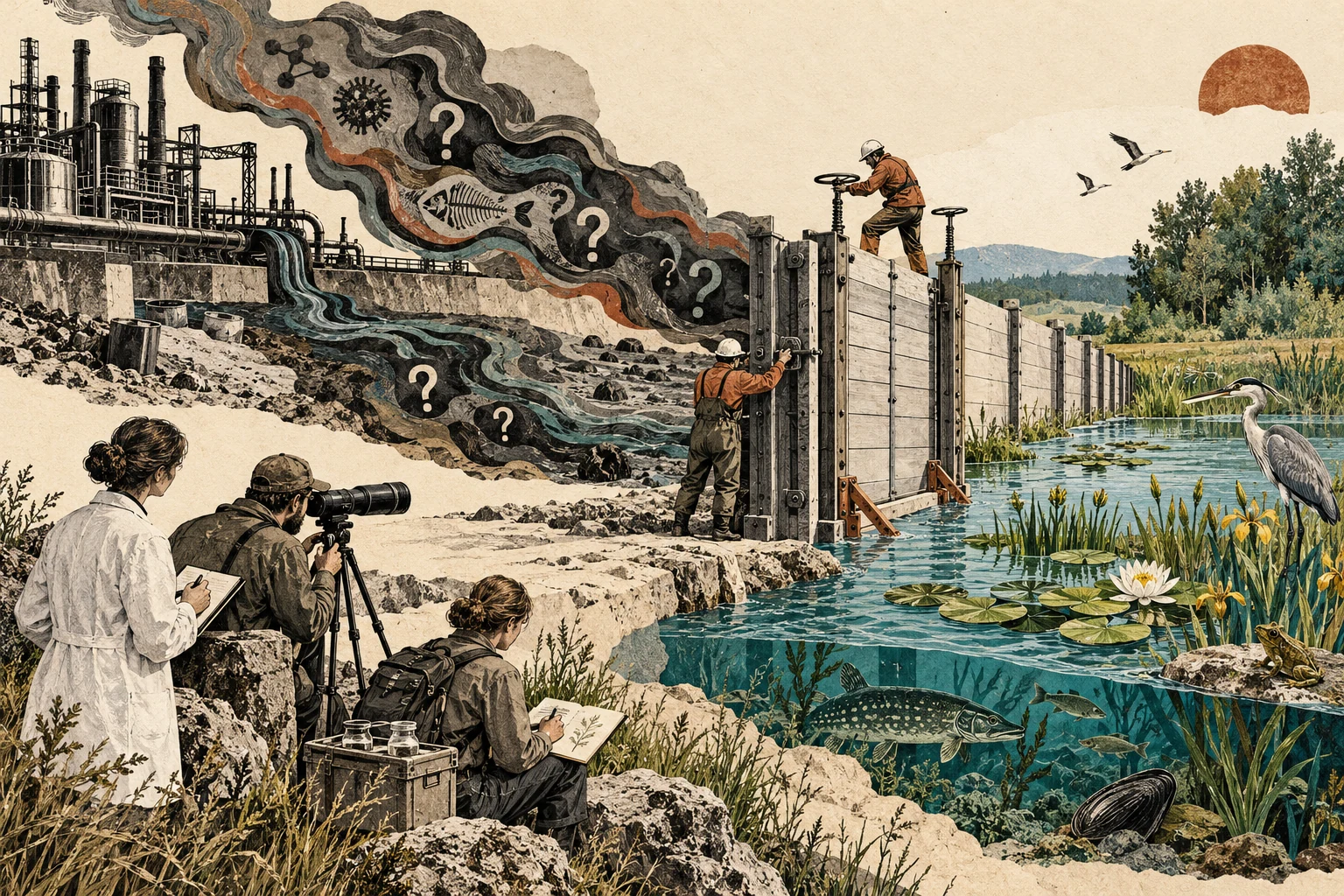
When serious, irreversible harm is plausible despite uncertainty, protective measures are taken while evidence gathering continues—requiring attention to proportionality as well.
AI-assisted illustration · conceptual metaphor View in visual quiz →Genesis and Global Lineage
The concept is a direct translation of the German Vorsorgeprinzip (“forecaring” or foresight principle), which entered West German environmental law in the 1970s alongside the “polluter pays” and prevention principles; it was used to justify curbing industrial emissions suspected of causing forest dieback (Waldsterben) and North Sea pollution before conclusive causal proof was available. Its philosophical scaffolding was provided by Hans Jonas in Das Prinzip Verantwortung (The Imperative of Responsibility, 1979): because modern technology has dramatically extended the causal and temporal reach of human action, ethics must encompass distant future consequences, and under uncertainty priority must be given to the well-grounded gloomy forecast (“the heuristics of fear”). The English term was introduced in the late 1980s by Konrad von Moltke, translating German administrative practice for British and international policy circles. Its canonical global formulation arrived in Principle 15 of the Rio Declaration on Environment and Development (1992); a stricter activist version was articulated at the Wingspread Conference in January 1998, while the European Commission's February 2000 communication turned the principle into a disciplined administrative procedure (requiring proportionality, consistency, cost-benefit examination, and periodic scientific review). Enshrined in Article 191(2) of the Treaty on the Functioning of the European Union (TFEU), the lineage runs from German administrative law through continental responsibility ethics into international and EU law, branching after 2010 into extreme-risk mathematics (Nassim Nicholas Taleb) and frontier AI governance.
Central European Lineage
We found no documented link between this concept and the intellectual history or historical experience of Central Europe.
We found no documented link between this concept and the intellectual history or historical experience of Central Europe (by our methodology, this means “none found,” not “none exists”; as of October 2026).
Why Now
Between 2018 and 2026, the precautionary principle migrated from environmental and chemical law straight to the center of global battles over frontier technology and public health. In 2023, the Future of Life Institute's open letter calling for a six-month pause on training giant language models, followed by the European Union's Artificial Intelligence Act (adopted in 2024), explicitly invoked precautionary logic: regulate systemic risks before irreversible harm is empirically demonstrated. Earlier, the COVID-19 pandemic (2020–2022) offered a double-edged lesson in real time: early, “unproven” low-cost precautions such as universal masking and ventilation proved cheap and effective against an aerosolized pathogen, whereas prolonged blanket lockdowns illustrated the severe social costs of precaution applied without proportionality or revision. Ongoing clashes over solar geoengineering, CRISPR germline editing, neonicotinoid pesticides (banned outdoors in the EU in 2018), and glyphosate have likewise become arenas where opposing camps invoke the very same principle to demand opposite policies. Finally, the widening transatlantic divide over technology regulation—where the United States generally waits for demonstrable harm while the European Union demands ex ante proof of safety—has made the precautionary principle one of the essential keys to understanding contemporary trade and regulatory friction.
Explanatory Power
The precautionary principle brings into sharp focus the crucial epistemic difference between “absence of evidence of harm” and “evidence of absence of harm,” showing how conflating the two systematically rewards actors who profit from regulatory delay. The history of asbestos, benzene, leaded gasoline, and chlorofluorocarbons (CFCs), documented in detail in the European Environment Agency's 2001 report Late Lessons from Early Warnings, reveals an identical recurring sequence: credible early scientific warnings, industry demands for “definitive” proof, decades of commercial delay, and a final bill counted in thousands of preventable deaths and irreversible contamination. Second, the principle pinpoints exactly when expected-value cost-benefit analysis is the wrong mathematical tool: when potential losses are catastrophic and irreversible (the collapse of an ecosystem, a pandemic pathogen leak, or systemic financial ruin), statistical averages become meaningless because there is no next round of the game after ruin. Third, the reversed burden of proof explains why European regulatory bodies such as the European Medicines Agency or the REACH chemical framework operate on a fundamentally different institutional logic than the traditional American approach of “prove harm in court and we will recall it”—and why regulators on each side of the Atlantic routinely view the other as irrational.
Axes of Debate
Is the precautionary principle logically coherent?
Cass Sunstein (Laws of Fear, 2005), writing from the standpoint of regulatory cost-benefit analysis and behavioral law and economics, argues that the strong version of the principle is literally paralyzing: because risks exist on all sides of any choice—both action and inaction carry hazards—a rule forbidding action whenever serious harm is possible forbids everything at once, and its political appeal stems from availability heuristics and loss aversion rather than sound reasoning. Strongest counterargument: Proponents reply that the principle does not counsel avoiding all risk, but only asymmetric, non-ergodic tail risk: irreversible, systemic harm with an unknown probability distribution. Nassim Nicholas Taleb and his co-authors (2014) demonstrate mathematically that in fat-tailed domains involving a non-zero probability of ruin, standard expected-utility theory fails, meaning Sunstein's charge of “incoherence” judges the principle by a probabilistic yardstick that the domain itself invalidates. Nature of the dispute: substantive — it turns on whether there exists a distinct class of systemic, irreversible decisions for which expected-value calculus is mathematically inappropriate, and how tightly that boundary can be drawn.
Who should bear the burden of proof?
Chemical, agricultural, and biotechnology industries, alongside pro-innovation economists, argue that reversing the burden of proof requires proving a negative (the complete absence of future harm), which is logically impossible and in practice blocks life-saving innovations (such as Golden Rice, genetically modified crops, or novel therapeutics) whose non-introduction also claims human lives. Strongest counterargument: The European Environment Agency's Late Lessons from Early Warnings studies document that under the traditional burden of proof, costly regulatory delay was the historical rule and expensive “false alarms” were the rare exception; assigning the burden of proof is not an exercise in formal logic, but a political decision about who pays the cost of scientific uncertainty while that uncertainty lasts. Nature of the dispute: mixed — beneath a methodological debate over standards of scientific proof lies a distributive conflict over how to allocate the costs of uncertainty between private innovators and the public.
Precaution toward frontier AI: pause or race?
Advocates of training pauses, compute thresholds, and strict pre-deployment licensing for frontier AI models (the AI safety community and segments of European regulation) apply a strong precautionary rule to existential and systemic risks; opponents (accelerationists, venture capital, and parts of the defense establishment) counter that slowing down carries its own existential risk—ceding technological supremacy to geopolitical rivals who do not practice precaution. Strongest counterargument: The geopolitical race argument proves only that unilateral precaution is costly and unstable, not that precaution itself is misguided; moreover, the European Commission's 2000 procedural version of the principle explicitly requires proportionality and iterative review as new evidence emerges, so the real dispute concerns the calibration of safeguards rather than the principle itself. Nature of the dispute: rhetorical — to a large degree, both camps invoke unquantified “existential risk” as a trump card to license predetermined policy conclusions without specifying falsifiable thresholds of evidence.
Underappreciated Angle
Although the precautionary principle is almost always debated as a rule about braking technological speed, at bottom it is a rule about the distribution of epistemic power. The seemingly procedural question “who must prove what, and to what standard, before a product enters the market?” determines whose scientific data count, who funds toxicology and safety testing, whether raw study data are public or proprietary, and who profits while scientific consensus is still forming. Viewed through this lens, the recurring regulatory clashes between the European Union and the United States are not psychological disagreements between “risk-averse Europeans” and “entrepreneurial Americans,” but institutional struggles over whether regulatory science should be produced by the commercial applicant or demanded ex ante by a public agency. Equally overlooked is the principle's built-in visibility bias: precaution carries its own cost of delay, yet that cost rarely enters public statistics because the victims of an unapproved drug or an unbuilt clean-energy facility have no names—and it is precisely this asymmetry of visible harm versus invisible foregone benefit that drives both the principle's enduring political appeal and its frequent regulatory abuse.
One-Sentence Takeaway
The precautionary principle does not tell us how much risk to take, but who must bear the cost of ignorance while uncertainty lasts—which is why every fight over it is ultimately a fight over power rather than probabilities.
Related Concepts Network
How this concept reinforces, constrains, or complements other analytical frameworks in the corpus. View on graph →
-
Black Swan reinforces
The precautionary principle is a decision rule designed for high-impact events whose probabilities cannot be estimated in advance and whose consequences are irreversible.
-
Antifragility complements
Taleb recasts the principle as a ruin criterion: precaution is warranted only for systemic, fat-tailed risks capable of causing total ruin, not for ordinary everyday uncertainty.
-
Decision reversibility reinforces
The Rio Declaration ties precaution to threats of “serious or irreversible damage”; irreversibility is the threshold at which the principle is triggered in the first place.
-
Chesterton’s fence complements
Both rules counsel restraint before intervening in a complex system one does not fully understand; Chesterton's fence applies to removing existing institutions, whereas the precautionary principle applies to introducing novel technologies.
-
Existential risk reinforces
Arguments for pausing or restricting frontier technologies with catastrophic potential are in essence strong-form applications of the precautionary principle.
-
Planetary boundaries reinforces
Planetary boundaries operationalize “serious or irreversible damage” at the Earth-system scale, giving the precautionary principle measurable biophysical thresholds.
-
Effective altruism in tension
Expected-value maximization assumes that probabilities can be meaningfully assigned; the precautionary principle begins precisely where that assumption breaks down.
Reading Canon & Translation Bridge
Foundational texts, introductions, and critical perspectives—with availability of English and Polish editions.
-
foundational text 1992 · English
Organizacja Narodów Zjednoczonych (UNCED), Rio Declaration on Environment and Development
Principle 15 provides the most widely cited international formulation: where there are threats of serious or irreversible damage, lack of full scientific certainty shall not be used as a reason for postponing cost-effective preventive measures.
In English: original text written in English
In Polish: Polish edition not verified
-
foundational text 1979 · German
Hans Jonas, Das Prinzip Verantwortung. Versuch einer Ethik für die technologische Zivilisation
The philosophical foundation of the principle: because modern technology has vastly extended the temporal reach of human action, ethics must encompass distant future effects, and under uncertainty the “heuristics of fear” gives priority to the gloomy forecast.
In English: English edition not verified
In Polish: Polish edition not verified
-
introduction & synthesis 2001 · English
European Environment Agency, Late Lessons from Early Warnings: The Precautionary Principle 1896–2000
A landmark collection of historical case studies (from asbestos and benzene to mad cow disease) in which early scientific warnings were ignored; the best empirical demonstration of the costs of regulatory delay, followed by a second volume in 2013.
In English: original text written in English
In Polish: Polish edition not verified
-
critical perspective 2005 · English
Cass R. Sunstein, Laws of Fear: Beyond the Precautionary Principle
The most influential critique: the strong version of the principle is paralyzing because risks lie on all sides of a decision—both action and inaction carry hazards—and its appeal is explained by cognitive biases and the psychology of fear rather than logic.
In English: original text written in English
In Polish: Polish edition not verified
-
cross-disciplinary 2014 · English
Nassim Nicholas Taleb, Rupert Read, Raphael Douady, Joseph Norman, Yaneer Bar-Yam, The Precautionary Principle (with Application to the Genetic Modification of Organisms)
A probabilistic reconstruction from extreme-risk theory: the principle is rigorously valid only for systemic, fat-tailed risks where the stakes involve non-ergodic ruin rather than bounded losses.
In English: original text written in English
In Polish: Polish edition not verified
-
cross-disciplinary 1986 · German
Ulrich Beck, Risikogesellschaft. Auf dem Weg in eine andere Moderne
The broader sociological backdrop: reflexive modernity manufactures invisible, uninsurable, cross-border risks, and the precautionary principle is politics' institutional response to that condition.
In English: English edition not verified
In Polish: Polish edition not verified
-
introduction & synthesis 2000 · English
Komisja Europejska, Communication from the Commission on the Precautionary Principle, COM(2000) 1 final
The European Union's official proceduralization of the principle, laying down six operational criteria: proportionality, non-discrimination, consistency, examination of benefits and costs, review in light of new scientific data, and assignment of the burden of proof.
In English: original text written in English
In Polish: Polish edition not verified
Primary-Source Quotes
Where there are threats of serious or irreversible damage, lack of full scientific certainty shall not be used as a reason for postponing cost-effective measures to prevent environmental degradation.