Creative destruction
original term: creative destruction (Eng.) · twórcza destrukcja, twórcze niszczenie, schöpferische Zerstörung
Central European lineage: 1 thread (author from the region) · 1911–1942 · jump to documentation ↓
Working Definition
Creative destruction is the economic process through which new products, production methods, markets, and organizational forms incessantly displace existing ones, destroying the capital value, skills, and market positions built around the old order. In the technical framework of Joseph Schumpeter and endogenous growth theory, this upheaval is not a regrettable side effect of competition, but its engine: long-run productivity grows because innovators capture temporary monopoly rents by rendering incumbents obsolete, not because identical firms shave pennies off an unchanging product. In casual corporate and political speech, the phrase has degenerated into an alibi excusing any plant closure or mass layoff as “progress”; rigorous use requires showing what new productive combination is created and whether resources reallocate toward higher-value uses.
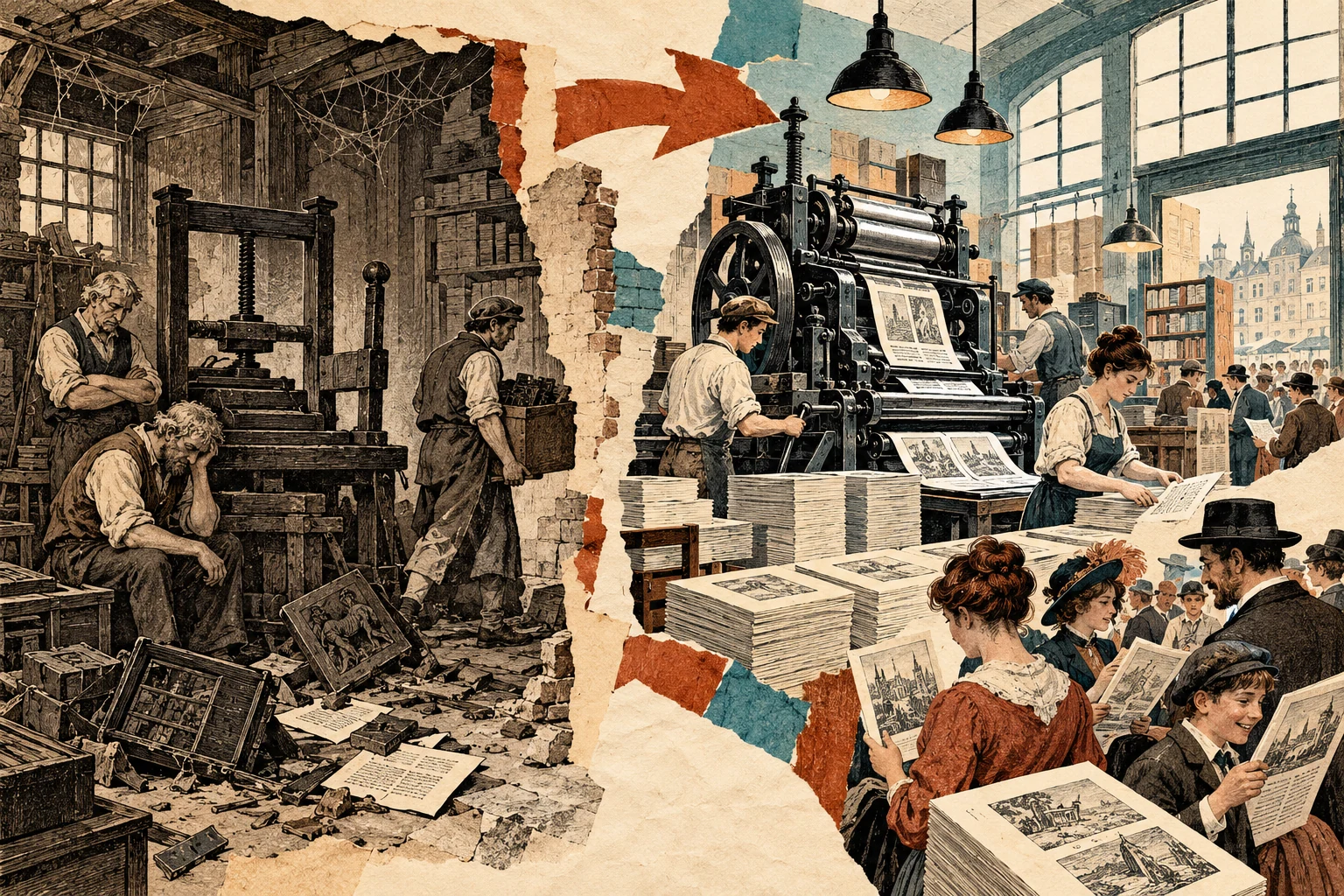
A new production method opens up possibilities while displacing older workshops and skills, distributing gains and losses unevenly.
AI-assisted illustration · conceptual metaphor View in visual quiz →Genesis and Global Lineage
Joseph A. Schumpeter immortalized the English phrase in Chapter VII of Capitalism, Socialism and Democracy (1942), describing an “industrial mutation” that “incessantly revolutionizes the economic structure from within, incessantly destroying the old one, incessantly creating a new one.” The theoretical architecture had been laid thirty years earlier in Theorie der wirtschaftlichen Entwicklung (The Theory of Economic Development, 1911), casting the credit-financed entrepreneur as the agent who breaks static Walrasian equilibrium with “new combinations,” and in Business Cycles (1939), interpreting macroeconomic waves as gales of innovation. The German compound schöpferische Zerstörung had been used earlier by Werner Sombart in Krieg und Kapitalismus (1913), drawing on Friedrich Nietzsche, while the portrait of the bourgeoisie tearing down its own productive forces comes straight from Marx and Engels’s Communist Manifesto (1848)—whose historical vision Schumpeter absorbed while inverting its verdict. The analytical lineage ran through evolutionary economics (Nelson and Winter, 1982) into formal macroeconomics when Philippe Aghion and Peter Howitt published A Model of Growth through Creative Destruction in Econometrica (1992), turning Schumpeter’s prose into a mathematical model of quality-ladder growth. In the 1990s the business-school variant (disruptive innovation, Clayton Christensen, 1997) and Silicon Valley’s “move fast and break things” stripped the concept of Schumpeter’s tragic sociological irony, turning a diagnosis of capitalist instability into a managerial battle cry.
Central European Lineage
The author of the canonical formulation was formed intellectually in the late Habsburg Empire. Born in 1883 in Triesch (now Třešť, Czechia) in Moravia, Schumpeter attended the Theresianum academy and studied law and economics at the University of Vienna, earning his doctorate in 1906 and participating in Eugen von Böhm-Bawerk’s seminar—where he debated Rudolf Hilferding, Otto Bauer, and Ludwig von Mises over the future of capitalism and socialism. In 1909 he took up his first professorship at the Franz Joseph University in Czernowitz, the multilingual capital of Austrian Bukovina (now Chernivtsi, Ukraine). During his Czernowitz years (1909–1911) he completed Theorie der wirtschaftlichen Entwicklung (1911), forging the figure of the equilibrium-shattering entrepreneur against the Austrian School’s theory of capital and time. He subsequently taught in Graz (1911–1921), served briefly as Finance Minister of the Austrian Republic in 1919, taught in Bonn (1925–1932), and emigrated to Harvard in 1932, where he wrote Capitalism, Socialism and Democracy. Eight decades later, after 1989, Central Europe became an intense empirical laboratory of industrial reallocation—though formal models of post-communist transition (such as Aghion and Olivier Blanchard’s 1994 NBER model of transition speed in Poland and Central Europe) analyzed the shift from state to private employment without adding a distinct regional revision to the concept.
Documented regional lineage · Link: 1. Compiled: October 2026.
-
author from the region 31 years
Central European Source: Joseph Alois Schumpeter, “Studia prawa i ekonomii w Wiedniu (doktorat 1906, seminarium Böhm-Bawerka), profesura w Czerniowcach (1909–1911) i Grazu; „Theorie der wirtschaftlichen Entwicklung” (1911)”; Vienna, Austria; Czernowitz (now Chernivtsi, Ukraine); Graz, Austria, 1911
Global Circulation: creative destruction (Capitalism, Socialism and Democracy, Ch. VII) — Joseph A. Schumpeter, 1942
author from the region
31 yearsJoseph Alois Schumpeter, “Studia prawa i ekonomii w Wiedniu (doktorat 1906, seminarium Böhm-Bawerka), profesura w Czerniowcach (1909–1911) i Grazu; „Theorie der wirtschaftlichen Entwicklung” (1911)”
1911 · Vienna, Austria; Czernowitz (now Chernivtsi, Ukraine); Graz, Austria
creative destruction (Capitalism, Socialism and Democracy, Ch. VII)
1942 · Joseph A. Schumpeter
- Claim & Connection
- The canonical formulation comes from an economist formed in the Habsburg monarchy: born in Triesch (Třešť) in Moravia, Schumpeter studied in Vienna under Eugen von Böhm-Bawerk (earning his doctorate in 1906) and held his first university chair in Czernowitz (1909–1911), the period during which he wrote “Theorie der wirtschaftlichen Entwicklung” (1911), introducing the figure of the equilibrium-breaking entrepreneur-innovator that thirty years later, at Harvard, received the name “creative destruction.” The German phrase itself had been used earlier by Werner Sombart (“Krieg und Kapitalismus,” 1913), who was educated in Berlin and Pisa, outside our region.
- Source Documentation
-
- primary source Joseph A. Schumpeter, Capitalism, Socialism, and Democracy, 2nd ed., Harper & Brothers, New York–London (przedmowa datowana: marzec 1942); Ch. VII “The Process of Creative Destruction,” pp. 81–86; sentence on “the essential fact about capitalism” on p. 83. archive.org ↗
- biographical record Wikipedia (en), „Joseph Schumpeter”; Early life and Career sections: Triesch, Theresianum, University of Vienna (Böhm-Bawerk, doctorate 1906), Czernowitz 1909–1911, Graz, Bonn 1925–1932, Harvard 1932–1950; Theorie der wirtschaftlichen Entwicklung 1911. en.wikipedia.org ↗
- scholarly study Wikipedia (en), „Creative destruction”; History section: Sombart, Krieg und Kapitalismus (1913); Marx, Nietzsche; Schumpeter 1942. en.wikipedia.org ↗
- Historical Context
- His birthplace in Moravia (Triesch / Třešť) is noted as biographical context, while the link rests on his academic formation in Vienna and his first professorship in Czernowitz (Austrian Bukovina, now Chernivtsi, Ukraine). The earlier genealogy of the German term in Sombart is traced by Hugo and Erik S. Reinert (2006).
Why Now
Three developments between 2018 and 2026 brought creative destruction back to center stage. First, in October 2025 the Royal Swedish Academy of Sciences awarded the Nobel Prize in Economics to Joel Mokyr alongside Philippe Aghion and Peter Howitt, citing Aghion and Howitt explicitly “for the theory of sustained growth through creative destruction” and canonizing the 1992 Schumpeterian growth paradigm. Second, generative artificial intelligence since 2022–2023 triggered the first technological shock in decades aimed squarely at white-collar, cognitive, and creative occupations (coding, translation, design, legal drafting) rather than routine factory assembly—raising the question of whether AI automation will generate enough new high-productivity tasks to offset displaced ones. Third, empirical macroeconomists (Thomas Philippon, Ufuk Akcigit, Jan De Loecker) documented a secular decline in business dynamism across the United States and Europe—slower firm entry, falling job reallocation, rising markups, and defensive “killer acquisitions” by digital giants—suggesting that the Schumpeterian engine has been sputtering in the very sectors that invoke its name most loudly.
Explanatory Power
The concept separates two fundamentally different modes of competition that static textbook microeconomics conflates. Price competition among similar firms making identical widgets squeezes profit margins by a few percentage points; competition “from the new commodity, the new technology, the new source of supply, the new type of organization” strikes not at the margins of existing firms’ profits and outputs, “but at their foundations and their very lives.” First, the decline of brick-and-mortar retail employment after 2010 was not caused by department stores failing to price-match one another, but by e-commerce logistics competing on a different cost and convenience curve. Second, the downfall of titans like Kodak or Nokia cannot be explained by executive laziness; as Christensen showed, an incumbent’s greatest strengths—existing customer relationships, high-margin legacy lines, and specialized routines—blind and handcuff it when a new paradigm starts out in a low-margin niche. Third, in macroeconomic policy, indiscriminate bailouts, ultra-cheap credit, and permanent job-preservation subsidies purchase short-term peace at the price of long-term stagnation: keeping capital and skilled labor locked inside low-productivity “zombie firms” starves entering innovators of the inputs needed for growth.
Axes of Debate
Does creation actually compensate for destruction in the places that suffer it
Labor economists and sociologists studying localized deindustrialization—most famously David Autor, David Dorn, and Gordon Hanson in their research on the “China shock” (2013–2021), alongside historians of Central Europe’s post-1989 industrial closures—demonstrate that destroyed manufacturing jobs in specific industrial towns were rarely replaced by new knowledge-economy jobs in the same regions or for the same workers: the destruction was geographically concentrated and permanent, while the creation accrued to distant metropolitan hubs. Strongest counterargument: Aghion and co-authors reply that localized scarring is an argument for Danish-style flexicurity—generous portable unemployment insurance, active retraining, and housing mobility—not for freezing the industrial structure in amber, since economies that block firm exit end up losing both productivity growth and employment over the medium run. Nature of the dispute: substantive — it concerns the spatial and generational friction of labor reallocation and the institutional preconditions required to keep creative destruction politically survivable.
Early Schumpeter versus late Schumpeter: the lone entrepreneur or the R&D conglomerate
In Theorie der wirtschaftlichen Entwicklung (1911), Schumpeter cast the outsider entrepreneur as the hero of innovation (“Schumpeter Mark I”); in Capitalism, Socialism and Democracy (1942), he argued that innovation was becoming routinized inside the giant R&D laboratories of monopolistic corporations, which needed market power to fund risky investments (“Schumpeter Mark II”). Defenders of today’s tech hyperscalers routinely invoke Mark II to argue that only trillion-dollar platforms can afford frontier AI clusters. Strongest counterargument: Aghion, Nick Bloom, Richard Blundell, Rachel Griffith, and Peter Howitt (Quarterly Journal of Economics, 2005) showed empirically that the relationship between competition and innovation follows an inverted U: while neck-and-neck firms innovate furiously to “escape competition,” an uncontestable monopolist insulated from entry slackens its innovative effort and uses its cash pile to buy up or crush nascent challengers. Nature of the dispute: substantive — a central empirical question in modern antitrust and innovation economics, resolved by measuring entry threats and patent quality across market structures.
Analytical growth mechanism versus ideological alibi
Intellectual historians (Hugo and Erik S. Reinert) and critics of neoliberalism argue that “creative destruction” has been weaponized in public discourse to aestheticize economic insecurity, treating every corporate downsizing, private-equity asset stripping, or public-sector cut as an inevitable gale of evolutionary progress without checking whether anything productive was created. Strongest counterargument: Since the 1990s, empirical productivity accounting (Foster, Haltiwanger, and Krizan) has provided a strict quantitative test: aggregate productivity growth can be decomposed into within-firm improvements and between-firm reallocation; where the reallocation component is zero or negative, destruction is merely destructive, and the Schumpeterian model says so explicitly. Nature of the dispute: mixed — rigorously testable in firm-level census microdata, heavily rhetorical in cable-news and boardroom commentary.
Underappreciated Angle
The least read half of Schumpeter’s 1942 book is its dark political prophecy: Schumpeter did not write Capitalism, Socialism and Democracy to celebrate creative destruction’s triumph, but to explain why creative destruction ultimately destroys the political and cultural institutions that allow capitalism to survive. In Chapters XI–XIV, he argued that the relentless rationalism of the capitalist market erodes the pre-capitalist protective strata (family dynasties, small proprietors, traditional crafts), turns corporate management into risk-averse salaried bureaucracy, and finances a growing class of credentialed intellectuals whose structural incentives reward moral critique of the market order. Citizens who take rising material prosperity for granted increasingly demand political protection against the gale of creative destruction—producing a gradual migration toward administrative regulation, corporatist bailouts, and state-managed capitalism. Seen through Schumpeter’s own sociological lens, the simultaneous ubiquity of “disruption” talk in twenty-first-century rhetoric and the measurable slowdown of actual firm turnover in Western economies is not a paradox: it is the exact late-stage equilibrium he predicted when both entrenched incumbents and insecure voters discover a shared interest in taming the gale.
One-Sentence Takeaway
Capitalism’s decisive competition is not over price, but over obsolescence: long-run growth happens not when existing firms make the same things slightly cheaper, but when a new combination renders the old ones beside the point.
Related Concepts Network
How this concept reinforces, constrains, or complements other analytical frameworks in the corpus. View on graph →
-
Path dependence in tension
Creative destruction assumes that superior innovations displace incumbents; path dependence shows how inferior solutions persist through switching costs and coordination lock-in.
-
Rent-seeking in tension
Incumbent firms often defend themselves against creative destruction not by innovating, but through lobbying, patent thickets, and regulatory barriers, stalling the Schumpeterian engine.
-
Network effects constrains
Where a product’s value grows with its user base, a challenger must overcome not only the incumbent’s product quality but also its network, lengthening the replacement cycle and entrenching monopolies.
-
Enshittification complements
The progressive degradation of dominant digital platforms illustrates what happens when creative destruction ceases to discipline an entrenched gatekeeper.
-
Industrial policy in tension
The debate over whether the state should shield legacy industries and jobs or accelerate the exit of old firms and entry of new ones is at bottom a dispute over how to govern the costs of creative destruction.
-
Antifragility reinforces
Taleb describes at the systems level what Schumpeter described at the market level: the whole economy gains vitality precisely because its individual firms are allowed to fail.
-
Degrowth in tension
The Schumpeterian growth model justifies the social pain of destruction by the aggregate growth it generates; degrowth questions the desirability of that aggregate goal itself.
Reading Canon & Translation Bridge
Foundational texts, introductions, and critical perspectives—with availability of English and Polish editions.
-
foundational text 1942 · English
Joseph A. Schumpeter, Capitalism, Socialism and Democracy
Chapter VII is the six-page locus classicus that coined the English phrase; best read alongside Chapters VIII and XII, where Schumpeter argues that capitalism’s very economic success erodes its own institutional foundations.
In English: original text written in English
In Polish: “Kapitalizm, socjalizm, demokracja”, Wydawnictwo Naukowe PWN 1995, trans. Michał Rusiński
-
foundational text 1911 · German
Joseph A. Schumpeter, Theorie der wirtschaftlichen Entwicklung
Schumpeter’s early theory of the entrepreneur, “new combinations,” and bank credit as the fuel of innovation; without it, Chapter VII of the 1942 book is reduced to a slogan.
In English: English edition not verified
In Polish: “Teoria rozwoju gospodarczego”, Państwowe Wydawnictwo Naukowe 1960, trans. Joanna Grzywicka
-
foundational text 1992 · English
Philippe Aghion, Peter Howitt, A Model of Growth through Creative Destruction
The landmark paper in “Econometrica” (vol. 60, no. 2, pp. 323–351) that translated Schumpeter’s prose into a formal mathematical model of endogenous growth—the foundation for the 2025 Nobel Prize in Economics.
In English: original text written in English
In Polish: no Polish edition
-
introduction & synthesis 2020 · French
Philippe Aghion, Céline Antonin, Simon Bunel, Le pouvoir de la destruction créatrice
A synthesis of thirty years of empirical research built on the Schumpeterian growth paradigm—covering competition, patents, inequality, health, and industrial policy—written for a general readership (published in English in 2021 by Harvard University Press as “The Power of Creative Destruction”).
In English: English edition not verified
In Polish: Polish edition not verified
-
introduction & synthesis 2007 · English
Thomas K. McCraw, Prophet of Innovation: Joseph Schumpeter and Creative Destruction
An intellectual biography showing how Vienna, Czernowitz, a brief stint as Austrian finance minister and private banker, and emigration to Harvard shaped Schumpeter’s vision of capitalism.
In English: original text written in English
In Polish: Polish edition not verified
-
critical perspective 2006 · English
Hugo Reinert, Erik S. Reinert, Creative Destruction in Economics: Nietzsche, Sombart, Schumpeter
A chapter in “Friedrich Nietzsche (1844–1900): Economy and Society” (Springer) tracing the German term “schöpferische Zerstörung” back through Werner Sombart to Nietzsche and Hindu cosmology, correcting the myth that Schumpeter invented the phrase ex nihilo.
In English: original text written in English
In Polish: no Polish edition
-
cross-disciplinary 1997 · English
Clayton M. Christensen, The Innovator's Dilemma: When New Technologies Cause Great Firms to Fail
The business-school translation: explains the organizational mechanism through which well-managed incumbent firms are toppled by initially inferior, cheaper “disruptive” technologies—creative destruction seen from inside the victim.
In English: original text written in English
In Polish: “Przełomowe innowacje: możliwości rozwoju czy zagrożenie dla przedsiębiorstwa”, Wydawnictwo Naukowe PWN 2010, trans. Hanna Simbierowicz
Primary-Source Quotes
This process of Creative Destruction is the essential fact about capitalism.