De-risking
original term: de-risking (Eng.) · ograniczanie ryzyka zależności, de-risking, not decoupling, odryzykowanie
Central European lineage: 2 threads (historical experience) · 1945–2023 · jump to documentation ↓
Working Definition
De-risking is a state policy of selectively reducing strategic economic dependence on a trading partner capable of using that dependence as an instrument of political coercion, while preserving the bulk of non-sensitive commercial exchange. Operationally, it proceeds in three steps: identifying critical supply-chain chokepoints (such as critical raw materials, advanced semiconductors, active pharmaceutical ingredients, and telecommunications infrastructure), diversifying suppliers or building domestic capacity at those nodes, and restricting the outbound transfer of dual-use technologies in the opposite direction. It differs from full-scale economic decoupling in both scope and diplomatic register: rather than severing trade wholesale, it prunes specific vulnerabilities. In popular shorthand it often means simply “less China in the supply chain,” but in its precise analytical sense—building on Robert Keohane and Joseph Nye's classic distinction—it is an exercise in separating mere sensitivity (short-term price fluctuations that markets can absorb) from structural vulnerability (asymmetric exposure to strategic blackmail).
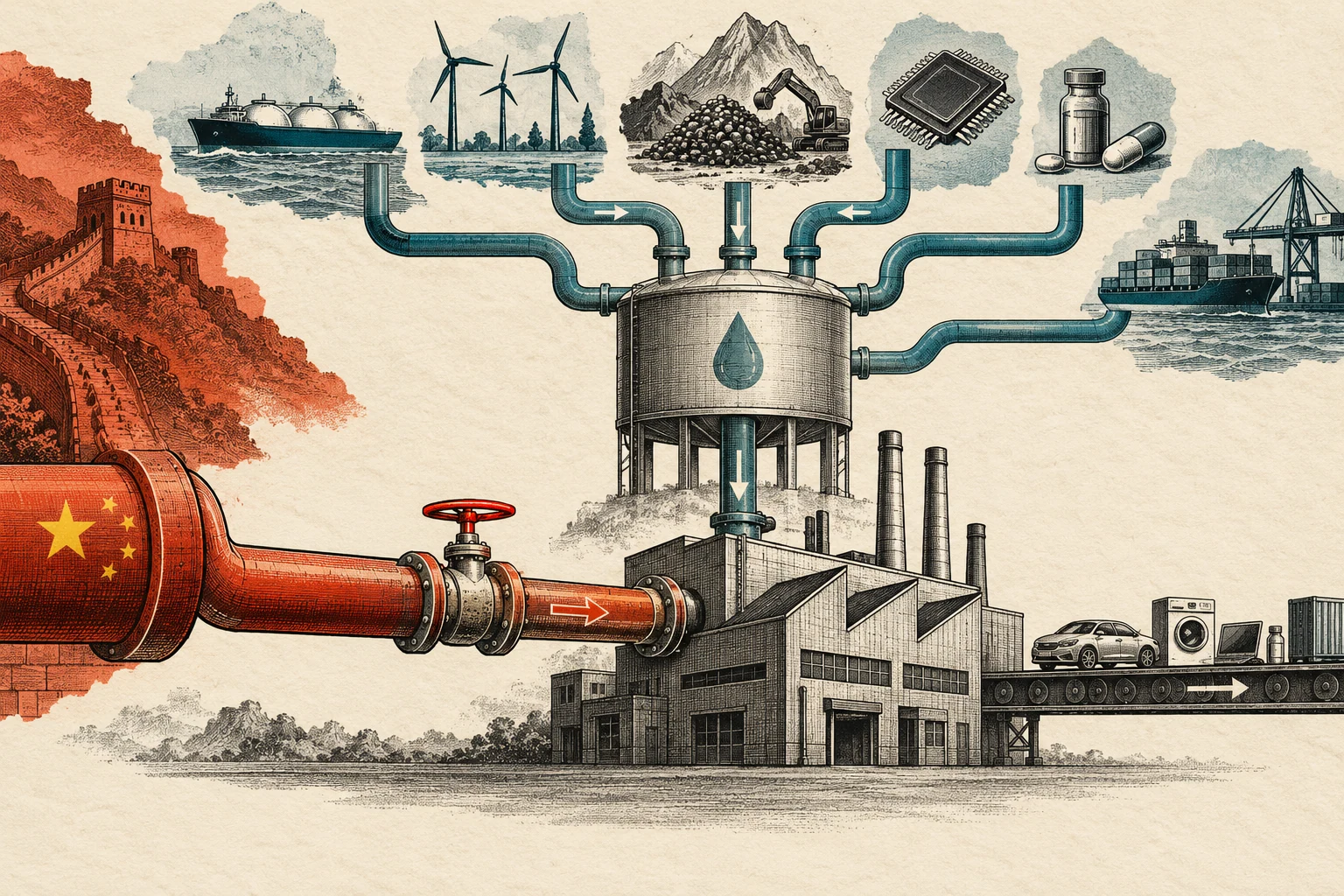
Additional suppliers and reserves reduce reliance on a single route while keeping the original link open—diversifying rather than severing ties completely.
AI-assisted illustration · conceptual metaphor View in visual quiz →Genesis and Global Lineage
The term had an earlier technical life in banking compliance, where it described financial institutions terminating correspondent relationships with clients or jurisdictions deemed to pose high money-laundering risks; it entered the vocabulary of geoeconomics in the spring of 2023. European Commission President Ursula von der Leyen coined the geopolitical usage on March 30, 2023, in a speech on EU–China relations at the Mercator Institute for China Studies and the European Policy Centre, advancing the maxim “de-risk – not de-couple” and outlining four pillars of economic security. On April 27, 2023, US National Security Advisor Jake Sullivan adopted the exact phrase in his landmark address at the Brookings Institution, explicitly crediting von der Leyen; on May 20, 2023, the G7 leaders' communiqué in Hiroshima enshrined “de-risking, not decoupling” as official Western doctrine, followed in June 2023 by the European Economic Security Strategy. The underlying intellectual lineage, however, stretches back eight decades: in 1945 Albert O. Hirschman demonstrated how asymmetric trade grants the larger power a coercive “influence effect”; in 1977 Keohane and Nye distinguished sensitivity from vulnerability in interdependent systems; and in 2019 Henry Farrell and Abraham Newman showed how global hub-and-spoke networks allow states controlling central nodes to exercise surveillance (“panopticon”) and cutoff (“chokepoint”) power over rivals (weaponized interdependence). Since 2023, the term has been partly co-opted by corporate boards as a polite euphemism for routine supply-chain relocation and dismissed by skeptics as a diplomatic fig leaf for slow-motion decoupling.
Central European Lineage
Central and Eastern Europe connects to the concept through two historical experiences: one a recently completed strategic sequence, the other the classic interwar case that inspired the theory of trade coercion. First, the Baltic states executed in practice what Brussels and Washington only later named in doctrine—after years in which Poland and the Baltic states had warned Western Europe against the strategic vulnerability of the Russian–German Nord Stream pipelines. Lithuania, Latvia, and Estonia halted imports of Russian pipeline gas in April 2022, Lithuania banned Russian liquefied natural gas in October 2023, and on February 8–9, 2025, all three countries disconnected from the Soviet-era BRELL (Belarus–Russia–Estonia–Latvia–Lithuania) synchronous electricity ring and synchronized their grids with Continental Europe. A commentary by the Warsaw-based Centre for Eastern Studies (OSW) in April 2025 explicitly analyzed this sequence as “Baltic de-risking”—a completed, textbook elimination of vulnerability to an aggressive supplier, initiated back in 2014 when Lithuania leased the Independence LNG terminal in Klaipėda. Second, the theoretical bedrock of de-risking grew out of 1930s Southeastern and Central Europe: Albert O. Hirschman's National Power and the Structure of Foreign Trade (1945) modeled asymmetric trade coercion on Nazi Germany's bilateral clearing agreements with Hungary, Romania, Bulgaria, and Yugoslavia, through which Berlin locked smaller agrarian states into dependence on a single buyer (though the exact empirical breakdown in Hirschman's tables and its citation link to Farrell and Newman remain marked for primary-text verification).
Documented regional lineage · Links: 2. Compiled: October 2026.
-
historical experience 74 years
Central European Source: Albert O. Hirschman — analiza handlu Niemiec z Europą Południowo-Wschodnią w latach 30. (Albert O. Hirschman — analysis of Germany's 1930s trade with Southeastern Europe), “National Power and the Structure of Foreign Trade”; Budapest, Hungary; Bucharest, Romania; Sofia, Bulgaria; Belgrade, Yugoslavia (now Serbia), 1945
Global Circulation: asymmetric trade dependence as an instrument of coercion (weaponized interdependence) — Henry Farrell, Abraham L. Newman, 2019
-
historical experience 1 year
Central European Source: Wstrzymanie importu rosyjskiego gazu (kwiecień 2022) i wyjście z systemu BRELL (8–9 lutego 2025) (Halting Russian gas imports in April 2022 and exiting the BRELL power grid on February 8–9, 2025) — Litwa, Łotwa i Estonia — zerwanie powiązań energetycznych z Rosją (Lithuania, Latvia, and Estonia — severing energy ties with Russia); Vilnius, Lithuania; Riga, Latvia; Tallinn, Estonia, 2022
Global Circulation: de-risking, not decoupling — Jake Sullivan, 2023
historical experience
1 yearWstrzymanie importu rosyjskiego gazu (kwiecień 2022) i wyjście z systemu BRELL (8–9 lutego 2025) (Halting Russian gas imports in April 2022 and exiting the BRELL power grid on February 8–9, 2025) — Litwa, Łotwa i Estonia — zerwanie powiązań energetycznych z Rosją (Lithuania, Latvia, and Estonia — severing energy ties with Russia)
2022 · Vilnius, Lithuania; Riga, Latvia; Tallinn, Estonia
de-risking, not decoupling
2023 · Jake Sullivan
- Claim & Connection
- The Baltic states executed in stages precisely what Washington and Brussels began calling “de-risking” in 2023: in April 2022 they halted imports of Russian pipeline gas, and on February 9, 2025 they synchronized their electricity grids with the Continental European system, exiting the Russian- and Belarusian-controlled BRELL ring. A 2025 analysis by the Centre for Eastern Studies (OSW) explicitly terms this sequence “Baltic de-risking” and describes it as a completed, textbook case of eliminating strategic dependence on a supplier capable of political coercion.
- Source Documentation
-
- scholarly study Joanna Hyndle-Hussein, „Baltic de-risking: the Baltic states sever energy ties with Russia”, Komentarze OSW, Ośrodek Studiów Wschodnich, 15 IV 2025; title; paragraphs on halting gas imports (April 2022), Lithuania's ban on Russian LNG (October 2023), and desynchronization from BRELL (February 8–9, 2025). osw.waw.pl ↗
- primary source Jake Sullivan, „Remarks on Renewing American Economic Leadership at the Brookings Institution”, 27 IV 2023; sentence: “we are for de-risking and diversifying, not decoupling”. bidenwhitehouse.archives.gov ↗
- Historical Context
- The term “de-risking” appears in the title of the OSW commentary rather than its body text; the Baltic case itself concerns Russia, whereas the canonical speeches by von der Leyen and Sullivan focused on China. The year 2022 marks the start of the final sequence (halting gas imports in April 2022), completed in February 2025. The link shows that the region supplied an early, completed model of the practice before the label became standard in Western China policy.
historical experience
74 yearsAlbert O. Hirschman — analiza handlu Niemiec z Europą Południowo-Wschodnią w latach 30. (Albert O. Hirschman — analysis of Germany's 1930s trade with Southeastern Europe), “National Power and the Structure of Foreign Trade”
1945 · Budapest, Hungary; Bucharest, Romania; Sofia, Bulgaria; Belgrade, Yugoslavia (now Serbia)
asymmetric trade dependence as an instrument of coercion (weaponized interdependence)
2019 · Henry Farrell, Abraham L. Newman
- Claim & Connection
- The theoretical foundation of de-risking—the thesis that asymmetric trade dependence grants the stronger partner coercive leverage over the weaker—was formulated by Albert O. Hirschman on the empirical material of Nazi Germany's bilateral trade with Hungary, Romania, Bulgaria, and Yugoslavia in the 1930s. Central and Southeastern Europe served as the historical case on which the concept of the “influence effect” of trade dependence was built.
- Source Documentation
-
- bibliographic record Albert O. Hirschman, National Power and the Structure of Foreign Trade, University of California Press, Berkeley–Los Angeles 1945, xiv, 170 s.; catalog record; empirical chapters to be verified directly in the text. archive.org ↗
- reception / translation Henry Farrell, Abraham L. Newman, „Weaponized Interdependence: How Global Economic Networks Shape State Coercion”, International Security, Vol. 44, No. 1, 2019, s. 42–79; article; Crossref bibliography record does not list Hirschman—direct citation link to be checked in the full text. api.crossref.org ↗
- Historical Context
- Bulgaria and Yugoslavia belong to the regional neighborhood (the Balkans), while Hungary and Romania belong to the core region. Because Hirschman was educated in Berlin, Paris, London, and Trieste, he does not meet the regional formation criterion; this link records the historical case rather than the author's biography. A verifier should check Part II of Hirschman's book and whether Farrell and Newman cite him directly.
Why Now
The doctrine emerged from a rapid succession of shocks between 2018 and 2023. The US–China tariff war from 2018 and the 2019 export blacklist against Huawei showed that technology supply chains could become weapons overnight. In 2020, the COVID-19 pandemic exposed reliance on single-country hubs for masks, chemical precursors, and chips. Beginning in February 2022, Russia weaponized natural gas deliveries to blackmail European governments, while Western allies weaponized SWIFT and central-bank reserve freezes against Moscow—both sides playing out Farrell and Newman's script. Sweeping US export controls on advanced AI chips and lithography tools to China in October 2022, followed by Beijing's export restrictions on gallium, germanium, graphite (2023), and rare-earth processing, completed the picture. The 2023 slogan “de-risking” named a middle path: ring-fencing critical bottlenecks (“a small yard with a high fence”) without blowing up bilateral trade worth hundreds of billions of euros, even as EU member states—above all Germany—clashed over how wide that yard should be.
Explanatory Power
De-risking shows that the danger of economic dependence is measured not by a country's aggregate share of foreign trade, but by the topology of supply-chain networks and the cost of switching under duress. First, while the EU imports roughly comparable total values of goods from China and the US, only in specific upstream bottlenecks—rare-earth permanent magnets, solar wafers, and antibiotic precursors—does Europe lack viable alternatives; de-risking directs policy attention to those chokepoints rather than the headline trade deficit. Second, it explains why Taiwan is a single point of failure for the world economy despite its modest share of global GDP: TSMC fabricates the vast majority of the world's most advanced logic semiconductors. Third, it reframes Europe's pre-2022 energy relationship with Russia: the decisive question was never “what percentage of gas comes from Gazprom,” but “who can cut off whom at what switching cost.” Because Lithuania asked that question in 2014 and built the Klaipėda LNG terminal, it could sever Russian gas imports in April 2022 without economic collapse.
Axes of Debate
Is de-risking just decoupling in velvet gloves?
Free-trade economists, Chinese officials, and export-oriented segments of German industry argue that the policy instruments deployed under de-risking—export controls, investment screening, and tariffs on electric vehicles—are indistinguishable from decoupling, and that the gentler terminology merely soothes markets and allies. Strongest counterargument: Defenders point out that aggregate EU and US trade volumes with China after 2023 did not collapse along 2022 Russian lines, and that the European Commission's framework narrows mandatory scrutiny to four priority technology areas (semiconductors, AI, quantum technologies, and biotechnology) rather than consumer goods as a whole. Nature of the dispute: mixed — the difference in initial sectoral scope is real, but the boundary between a “small yard” and an expanding perimeter is politically fluid.
Who pays the insurance premium: the state or private firms?
Western governments frame de-risking as a fiduciary responsibility of corporate boards to diversify overconcentrated supply chains; corporations reply that if the state redefines commercial efficiency as a security threat, the public treasury must compensate firms for the higher cost of redundant capacity. Strongest counterargument: European firms that had to write off billions in stranded Russian assets after February 2022 learned that geopolitical tail risk is a real business risk; shifting the entire cost of diversification onto taxpayers creates moral hazard and rewards companies that bet longest on authoritarian markets. Nature of the dispute: substantive — a distributive conflict over who pays the transition cost of rewiring supply chains.
Does de-risking build resilience or dismantle the network that confers leverage?
Contributors to The Uses and Abuses of Weaponized Interdependence (2021) warn that weaponizing network chokepoints accelerates the target state's drive for indigenous self-sufficiency—causing China to build parallel chip and payment ecosystems that strip Western hubs of leverage while leaving the world more fragmented. Strongest counterargument: The Baltic energy desynchronization demonstrates that when facing a revisionist power willing to use chokepoints for blackmail, exiting the shared network before a crisis erupts is the only way to neutralize coercion; the cost of alternative infrastructure is finite, whereas the cost of strategic capitulation is not. Nature of the dispute: substantive — an empirical disagreement over whether pruning interdependent networks makes the international system safer or removes economic restraints on conflict.
Underappreciated Angle
Public debate in Europe and North America treats de-risking almost exclusively as a strategy directed at China and Russia, yet the world's most potent architecture of weaponized interdependence belongs to the United States: dollar clearing, SWIFT governance, hyperscale cloud infrastructure, and foundational IP in semiconductor design. As Farrell and Newman show in Underground Empire (2023), Washington perfected turning global hubs into instruments of extraterritorial coercion long before Beijing did. Seen from Central Europe, de-risking therefore cuts in two directions: it is an urgent imperative to eliminate critical dependencies on eastern autocracies, but it also raises the question of how deeply European states can depend on single-source American digital and defense ecosystems when Washington's trade and alliance policies can swing every four years. The transatlantic tariff disputes of 2025–2026 turned that theoretical question into a practical dilemma: a concept forged to manage an adversary turns out to be an equally sharp diagnostic tool for examining one's own alliance.
One-Sentence Takeaway
De-risking does not ask how much you trade with a partner, but who holds the power to cut you off—and whether you can build an alternative before they pull the switch.
Related Concepts Network
How this concept reinforces, constrains, or complements other analytical frameworks in the corpus. View on graph →
-
Supply chain resilience complements
De-risking is the overarching state policy framework within which supply-chain resilience becomes a national security objective rather than merely a corporate risk-management concern.
-
Polycrisis reinforces
The COVID-19 pandemic, Russia's war against Ukraine, and US–China technological rivalry overlapped in time, jointly justifying the shift from cost efficiency to the security of dependencies.
-
Path dependence constrains
Decades of capital investment in Chinese manufacturing ecosystems mean that the cost of switching trajectories rises every year, dampening the practical ambitions of de-risking.
-
Digital sovereignty reinforces
Both frameworks apply national security logic to economic infrastructure; de-risking is its trade and supply-chain version, while digital sovereignty is its data and cloud version.
-
Dual-use technology complements
Export controls and outbound investment screening for dual-use technologies form one of the four pillars of the European Union's economic security and de-risking strategy.
-
Antifragility in tension
De-risking seeks to reduce exposure to identified chokepoints, whereas Taleb's antifragility asks how systems can gain from disorder and views narrow defensive hedging as fragile.
-
Non-zero-sum games in tension
Classical trade theory treated economic interdependence as a positive-sum game; de-risking starts from the premise that asymmetric nodes in that game can be turned into weapons of coercion.
Reading Canon & Translation Bridge
Foundational texts, introductions, and critical perspectives—with availability of English and Polish editions.
-
foundational text 2019 · English
Henry Farrell, Abraham L. Newman, Weaponized Interdependence: How Global Economic Networks Shape State Coercion
The foundational article in International Security (44/1, pp. 42–79) explaining why hub-and-spoke economic networks (SWIFT, the dollar clearing system, semiconductor design) give host states panoptic and chokepoint power; a Polish translation by Gracjan Cimek appeared in the anthology “Stosunki międzynarodowe” (vol. 2, 2022, pp. 693–708).
In English: original text written in English
In Polish: Polish edition not verified
-
foundational text 1945 · English
Albert O. Hirschman, National Power and the Structure of Foreign Trade
The first systematic theory of foreign trade as an instrument of state power: asymmetric dependence gives the stronger partner an “influence effect” because the weaker partner faces steep switching costs when attempting to diversify.
In English: original text written in English
In Polish: no Polish edition
-
introduction & synthesis 2023 · English
Henry Farrell, Abraham L. Newman, Underground Empire: How America Weaponized the World Economy
A narrative book-length account of weaponized interdependence, demonstrating that the first superpower to master choking off rivals through global financial and technological hubs was the United States rather than China.
In English: original text written in English
In Polish: Polish edition not verified
-
critical perspective 2021 · English
Daniel W. Drezner, Henry Farrell, Abraham L. Newman (red.), The Uses and Abuses of Weaponized Interdependence
An edited Brookings Institution volume in which scholars test the limits of the thesis: when network coercion fails, how it provokes counter-coalitions, and why overusing chokepoints erodes the very networks that confer power.
In English: original text written in English
In Polish: Polish edition not verified
-
cross-disciplinary 2022 · English
Chris Miller, Chip War: The Fight for the World's Most Critical Technology
An economic and technological history of semiconductors that maps the concrete global supply chain (Taiwan, the Netherlands, South Korea, the United States) at the very heart of contemporary de-risking and export controls.
In English: original text written in English
In Polish: “Wielka wojna o chipy. Jak USA i Chiny walczą o technologiczną dominację nad światem”, Prześwity (MT Biznes) 2023, trans. Aleksandra Samson-Banasik, Michał Głatki
-
introduction & synthesis 1977 · English
Robert O. Keohane, Joseph S. Nye, Power and Interdependence: World Politics in Transition
The classic distinction between “sensitivity” and “vulnerability” in economic interdependence, without which it is impossible to tell which dependencies require state intervention and which are benign market exchanges.
In English: original text written in English
In Polish: Polish edition not verified
Primary-Source Quotes
As President von der Leyen put it recently, we are for de-risking and diversifying, not decoupling.
This is why we need to focus on de-risk – not de-couple.