Rent-seeking
original term: rent-seeking (Eng.) · pogoń za rentą, zabieganie o rentę, zysk z pozycji
Global-circulation concept — no documented lineage in Central Europe. jump to documentation ↓
Working Definition
Rent-seeking is the expenditure of scarce resources—money, legal talent, lobbying effort, executive time—to obtain or defend an institutional privilege that transfers existing wealth without creating new economic value: a tariff, an import quota, an exclusive license, a targeted subsidy, or a regulatory barrier keeping competitors out. In technical economics, “economic rent” is any payment to a factor of production above what is needed to keep it in its current use on a competitive market; rent-seeking is the costly investment made to capture that surplus rather than expand output. Its central insight is that the resources burned up lobbying, litigating, and jockeying for the privilege are a pure deadweight loss to society, even when the campaign is profitable for the winner. In broad public usage, the term covers any extraction of “positional income” from market bottlenecks; in strict public-choice usage, it refers specifically to competing for politically or legally conferred transfers.
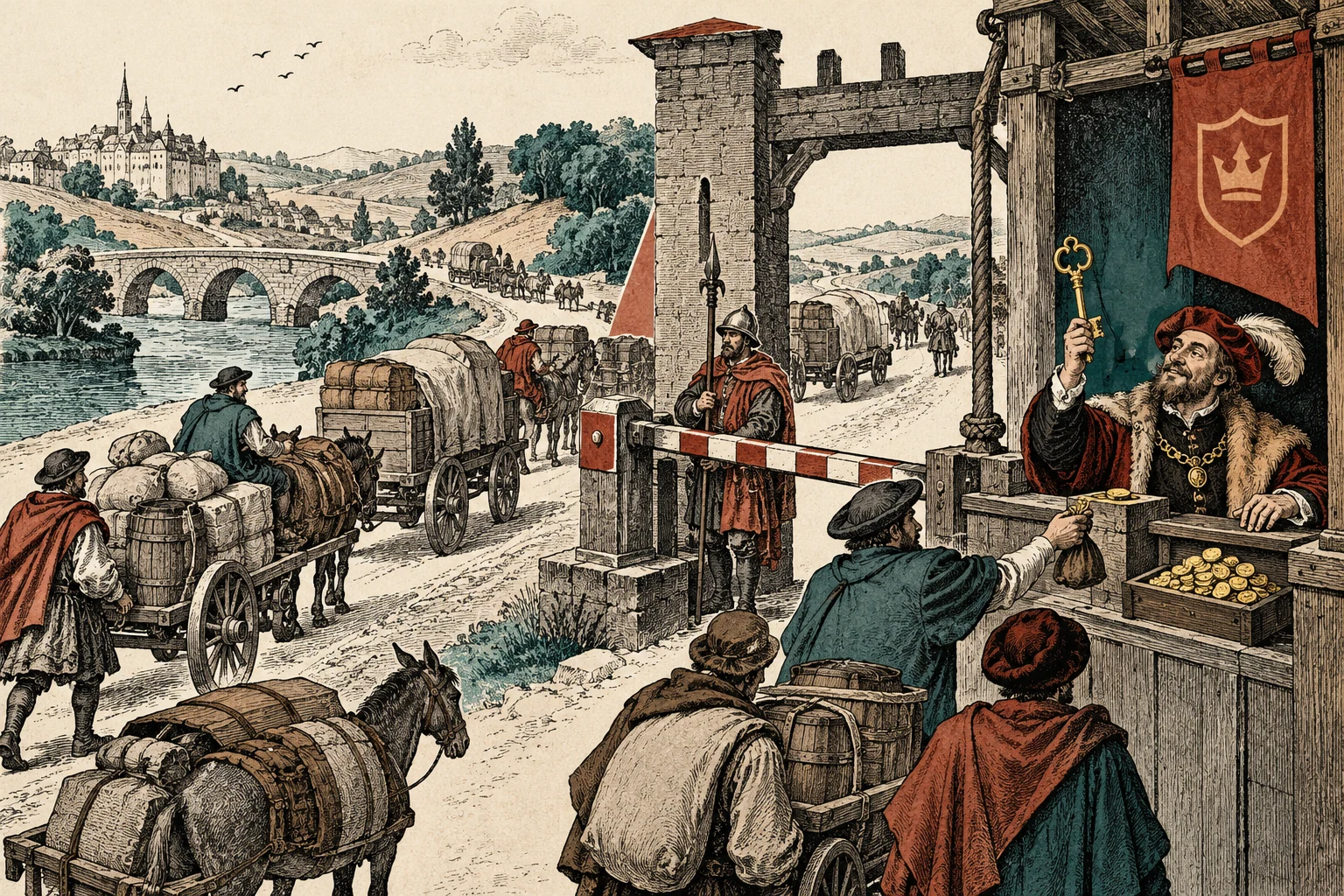
Controlling a gate makes it possible to extract payment for mere access, so profit stems from a privileged position rather than creating new value.
AI-assisted illustration · conceptual metaphor View in visual quiz →Genesis and Global Lineage
The underlying mechanism was discovered in 1967 by Gordon Tullock in a nine-page paper, The Welfare Costs of Tariffs, Monopolies, and Theft, published in the Western Economic Journal (after being rejected by leading journals). Prevailing neoclassical orthodoxy, following Arnold Harberger, measured the social cost of a monopoly or tariff solely by the small “Harberger triangle” of lost consumer transactions, treating the much larger rectangle of monopoly profit as a neutral cash transfer from buyers to the monopolist. Tullock pointed out the flaw: if the state is handing out a monopoly worth a million dollars, aspiring monopolists will rationally spend up to a million dollars in real resources—lawyers, lobbyists, campaign contributions, overbuilt capacity—competing to get it, turning the transfer rectangle itself into social waste just like the labor invested by burglars and lock-makers. Seven years later, Anne O. Krueger coined the term rent-seeking in her 1974 American Economic Review presidential address, The Political Economy of the Rent-Seeking Society, estimating that competition for import licenses in India and Turkey consumed resources equivalent to several percent of gross national product. With the 1980 volume Toward a Theory of the Rent-Seeking Society (edited by James Buchanan, Robert Tollison, and Tullock) and Mancur Olson’s The Rise and Decline of Nations (1982), the concept became a cornerstone of Virginia public-choice theory. It subsequently underwent two ideological appropriations: in the 1980s and 1990s it served as a free-market battering ram for deregulation; after the 2008 financial crisis, economists of inequality such as Joseph Stiglitz and Mariana Mazzucato flipped the lens, arguing that Wall Street, patent thickets, and tech monopolies are the premier rent-seeking machines of contemporary capitalism.
Central European Lineage
We found no documented link between this concept and the intellectual history or historical experience of Central Europe.
We found no documented link between this concept and the intellectual history or historical experience of Central Europe (by our methodology, this means “none found,” not “none exists”; as of October 2026).
Why Now
Between 2018 and 2026 rent-seeking returned to the forefront of economic debate across three distinct fronts. First, in the regulation of digital platforms: landmark antitrust rulings against Google and Apple in the United States and the European Union (including the 2024 US federal court ruling on Google’s search distribution contracts and the enforcement of the EU’s Digital Markets Act from 2023–2024) turn on whether 30 percent app-store commissions and default-placement fees represent fair compensation for innovation or toll-booth rents extracted from a digital bottleneck. Second, the return of large-scale industrial policy—the US Inflation Reduction Act and CHIPS Act (2022), alongside the European Union’s post-pandemic Recovery and Resilience Facility—unleashed hundreds of billions of dollars in discretionary grants and tax credits, creating a massive new arena of lobbying competition that public-choice critics analyze directly in Tullock’s terms. Third, in housing economics and the rise of the YIMBY (“Yes In My Backyard”) movement, restrictive municipal zoning and environmental-review vetoes are increasingly diagnosed as cartels through which incumbent homeowners capture artificial scarcity rents at the expense of younger and poorer workers—a central theme of the 2024–2026 “abundance agenda” in US and European policy debates.
Explanatory Power
The concept makes visible an economic cost that never appears as “waste” on any corporate income statement: the productive energy burned up fighting over how to slice the pie instead of baking a larger one. Three applications show its diagnostic bite. First, when an industry spends more on Washington or Brussels lobbying and patent litigation than on basic R&D, that is not a moral failing of its executives; it is a rational response to an institutional environment in which the marginal return on influencing a rule exceeds the marginal return on engineering a better product. Second, the 1993 model by Kevin Murphy, Andrei Shleifer, and Robert Vishny explains why countries with similar educational levels can diverge sharply in long-run growth: if the highest personal rewards flow to rent-seeking sectors (tax law, customs brokerage, state-enterprise patronage, financial engineering), the brightest university graduates enter those fields rather than manufacturing or science, shrinking the productive sector that rent-seekers feed upon and locking the economy into a low-growth equilibrium. Third, the concept unmasks why dominant industry incumbents often champion complex new safety, licensing, or AI-compliance regulations: because compliance has a high fixed cost, heavy regulation acts as a tax that a giant firm can easily amortize while bankrupting or deterring smaller challengers (Bootleggers and Baptists).
Axes of Debate
Does rent originate in the state or in the market
The Virginia school of public choice (Tullock, Buchanan, Tollison) and libertarian economists locate the root of rent-seeking in the state’s coercive power to grant monopolies, tariffs, and subsidies—concluding that shrinking the regulatory discretion of government is the only durable cure. Progressive economists (such as Joseph Stiglitz, Dean Baker, and Brett Christophers) counter that the largest rents of the twenty-first century—from pharmaceutical patent evergreens and land appreciation to digital platform gatekeeping and financialized share buybacks—are extracted by private corporate power and require a stronger state to curb. Strongest counterargument: Public-choice theorists reply that corporate patents, copyright terms, municipal zoning, too-big-to-fail bank charters, and non-compete clauses are themselves state-enforced legal privileges; whether the check is written by a ministry or collected via a state-backed monopoly right, the political arena remains the ultimate guarantor of the rent. Nature of the dispute: mixed — there is a substantive empirical debate over whether natural monopolies and network effects generate private rents without state help, alongside a rhetorical tug-of-war over whether to aim the “rent-seeker” label at bureaucrats or billionaires.
Is all lobbying expenditure pure social waste
In Tullock’s baseline model, resources spent on lobbying are 100 percent socially wasted, just like resources spent on burglary and iron bars. Institutional economists and pluralist political scientists object that interest-group advocacy also transmits vital technical information from the field to lawmakers and gives dispersed citizens a collective voice in policy design. Strongest counterargument: Transmitting technical information does not require an adversarial arms race of campaign donations and revolving-door hires; furthermore, Tullock’s 1980 lottery-contest model demonstrates that when many contestants bid for a single winner-take-all regulatory prize, their combined expenditures can actually exceed the value of the rent being fought over (overdissipation). Nature of the dispute: substantive — it concerns the measurable ratio between informational signaling and deadweight dissipation in real-world lobbying markets.
Precise analytical category versus all-purpose political insult
Methodological critics (including David Henderson and historians of economic thought) note that because classical Ricardo-style land rent (payment for a factor in fixed supply) involves no wasteful lobbying contest at all, calling political privilege-seeking “rent-seeking” has muddied economic vocabulary—allowing commentators on left and right alike to label any income they dislike (whether union wages, farm subsidies, or software margins) as “rent.” Strongest counterargument: Regardless of semantic drift around the noun “rent,” Tullock and Krueger’s operational test for rent-seeking remains crisp: does the activity expend scarce resources to alter the legal rules of distribution rather than to produce goods and services? That test applies symmetrically to a trade union demanding a licensing wall and an investment bank lobbying for a tax loophole. Nature of the dispute: rhetorical — both sides agree on the underlying distinction between value creation and transfer capture while contesting the polemical framing.
Underappreciated Angle
Economic estimates of rent-seeking almost always focus on the direct financial flows: how many billions of dollars were spent on lobbying firms, or how much higher consumer prices are under a tariff. The far deeper damage lies in what a rent-seeking regime does to a society’s allocation of human ambition over a generation. When young people entering university observe that the fastest, safest path to wealth and status runs through proximity to political allocation—landing a seat on a state-company board, mastering grant-application arbitrage, or brokering regulatory exemptions—rather than building a company that has to win customers in an open market, the entire cultural template of success shifts. Rent-seeking is not merely a static tax on the current year’s GDP; it is a pedagogical institution. After twenty years of pervasive rent-seeking, a country does not just have fewer engineers and founders; it has an elite class whose core professional skill is navigating patronage networks, and who therefore have a vested human-capital interest in making sure the rules are never simplified. That is why anti-rent reforms rarely succeed through moral preaching alone: they stick only when institutional changes shift the relative payoff enough that the next cohort of ambitious twenty-two-year-olds decides it is more lucrative to build something than to apply for a license.
One-Sentence Takeaway
Rent-seeking teaches us to measure the cost of a monopoly privilege not by how much the winner pockets, but by how much talent and capital everyone burned up fighting to become that winner.
Related Concepts Network
How this concept reinforces, constrains, or complements other analytical frameworks in the corpus. View on graph →
-
Incentives reinforces
Rent-seeking is the classic case in which the institutional structure of incentives directs talent and capital toward capturing existing wealth rather than creating new value.
-
Externalities complements
The social cost of lobbying for a regulatory privilege is borne by dispersed consumers and taxpayers who have no seat at the table between the interest group and the regulator.
-
Moloch and coordination failure reinforces
A rent-seeking contest is a multipolar trap: each firm must spend on lobbying lest a rival capture the privilege first, and total lobbying expenditure can easily swallow the value of the prize itself.
-
Tragedy of the commons complements
The public budget and regulatory authority function as a fiscal commons from which every organized interest coalition tries to extract more than it contributes.
-
State capacity in tension
Early public-choice theory treated the state primarily as a dispenser of rents, whereas state-capacity research shows that a professional, autonomous civil service is often a prerequisite for resisting rent-seeking capture.
-
Goodhart’s law complements
Whenever a regulator ties subsidies or licenses to an administrative proxy metric, organized applicants quickly optimize the metric rather than the public purpose.
-
Platformization reinforces
App-store commissions and mandatory pay-to-play ad placements on dominant digital platforms revive the classic question of whether a fee is payment for a service or toll-booth rent extracted from a bottleneck.
Reading Canon & Translation Bridge
Foundational texts, introductions, and critical perspectives—with availability of English and Polish editions.
-
foundational text 1967 · English
Gordon Tullock, The Welfare Costs of Tariffs, Monopolies, and Theft
The seminal paper in the “Western Economic Journal” (vol. 5, pp. 224–232) showing that the social cost of a monopoly or tariff is not limited to the small Harberger deadweight-loss triangle, because the real resources spent competing to win the monopoly rectangle are also wasted.
In English: original text written in English
In Polish: Polish edition not verified
-
foundational text 1974 · English
Anne O. Krueger, The Political Economy of the Rent-Seeking Society
The “American Economic Review” article (vol. 64, no. 3, pp. 291–303) that coined the term “rent-seeking” and estimated the massive economic cost of competing for import licenses in India and Turkey.
In English: original text written in English
In Polish: Polish edition not verified
-
introduction & synthesis 1980 · English
James M. Buchanan, Robert D. Tollison, Gordon Tullock (red.), Toward a Theory of the Rent-Seeking Society
The edited volume that turned scattered articles into a flagship research program of the Virginia school of public choice; includes Tullock’s famous chapter “Efficient Rent-Seeking” on contests where losers pay too.
In English: original text written in English
In Polish: Polish edition not verified
-
cross-disciplinary 1982 · English
Mancur Olson, The Rise and Decline of Nations: Economic Growth, Stagflation, and Social Rigidities
A comparative political-science extension: over decades of uninterrupted stability, democracies accumulate “distributional coalitions” that concentrate benefits on their members and diffuse costs across society until growth calcifies.
In English: original text written in English
In Polish: Polish edition not verified
-
introduction & synthesis 1993 · English
Kevin M. Murphy, Andrei Shleifer, Robert W. Vishny, Why Is Rent-Seeking So Costly to Growth?
A concise paper in the “American Economic Review: Papers and Proceedings” (vol. 83, no. 2, pp. 409–414) explaining why rent-seeking exhibits increasing returns: the more talent flows into extraction, the lower the return to productive entrepreneurship.
In English: original text written in English
In Polish: no Polish edition
-
critical perspective 2012 · English
Joseph E. Stiglitz, The Price of Inequality: How Today's Divided Society Endangers Our Future
A progressive appropriation of the concept: identifies rent-seeking—via financial deregulation, corporate lobbying, monopoly power, and CEO pay—as the primary driver of modern US inequality, challenging the right-wing view that rents originate only in big government.
In English: original text written in English
In Polish: Polish edition not verified
-
cross-disciplinary 2012 · English
Daron Acemoglu, James A. Robinson, Why Nations Fail: The Origins of Power, Prosperity, and Poverty
Macro-historical institutionalism: “extractive institutions” as systemic, regime-level rent-seeking by ruling elites.
In English: original text written in English
In Polish: Polish edition not verified
Primary-Source Quotes
People are said to seek rents when they try to obtain benefits for themselves through the political arena.