AI Architecture #137
Dual-use technology
original term: dual-use technologies (Eng.) · podwójne zastosowanie, dual use, dual-use items
Central European lineage: 1 thread (historical experience) · 1949–1996 · jump to documentation ↓
Working Definition
Dual-use technology refers to any tangible item, software, scientific knowledge, or technical capability developed for legitimate civilian and commercial purposes that can also be applied—with little or no modification—to military weapons systems, intelligence operations, or mass harm. In its narrow legal-administrative sense, “dual-use” is a statutory customs classification: a precision milling machine, chemical precursor, or high-performance semiconductor requires an export license because its parameters appear on an export-control annex. In its broad ethical and scientific sense (dual-use research of concern), it describes a dilemma where the same experiment or computer model that advances medical treatment or cybersecurity generates actionable instructions for building a bioweapon or executing a cyberattack. Across both registers, “dual use” is never an intrinsic physical property of an object in isolation, but a relational property linking a capability to the intent and capacity of its user.
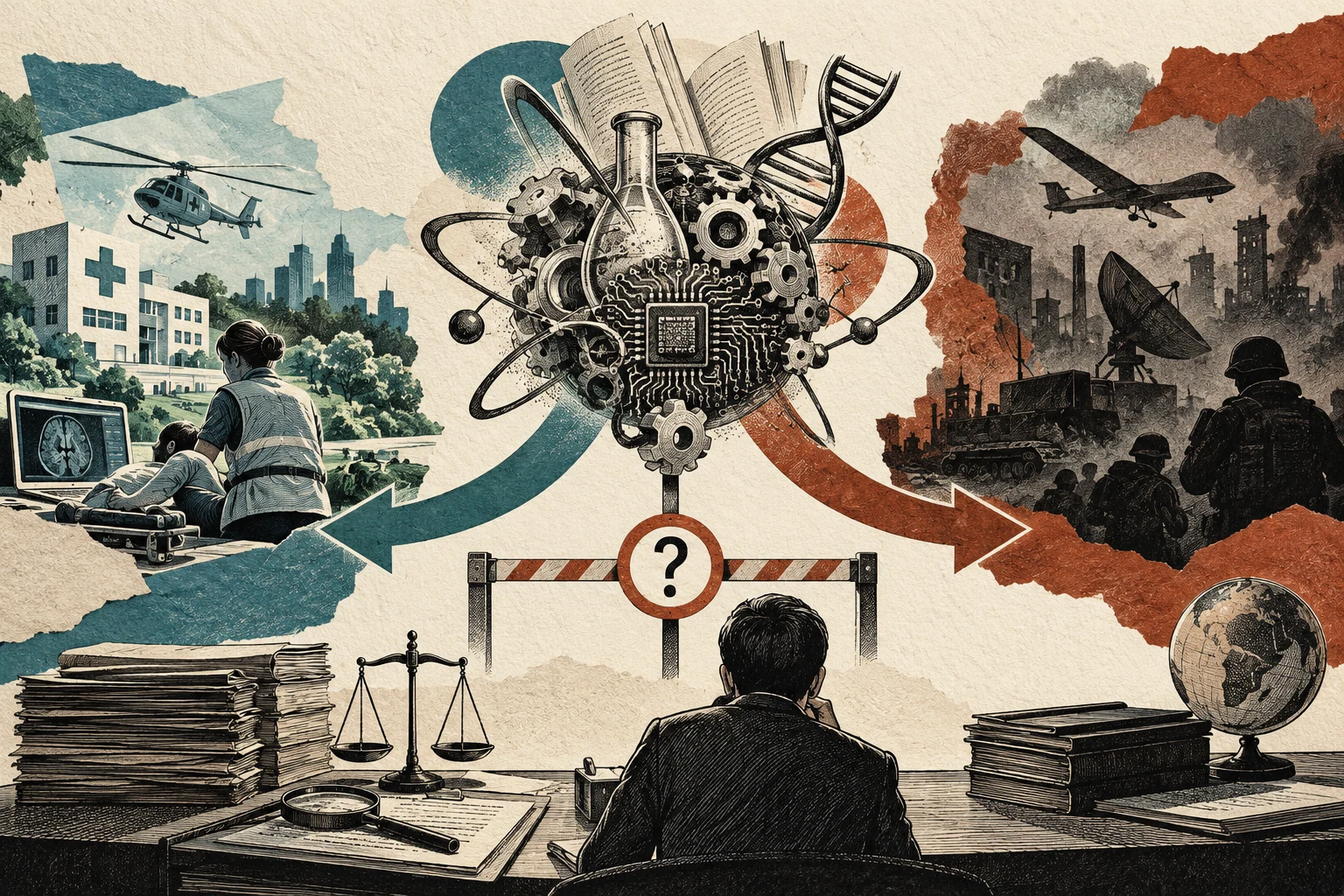
The same technical capability can serve starkly different ends, with outcomes shaped by context, access, and governance.
AI-assisted illustration · conceptual metaphor View in visual quiz →Genesis and Global Lineage
As a formal legal category, dual-use technology is a child of the Cold War. In 1949, the US and its Western allies established the Coordinating Committee for Multilateral Export Controls (COCOM), a Paris-based body maintaining secret embargo lists of industrial goods, machine tools, and computers forbidden for export to the Soviet bloc and China. For forty-five years, allies bargained (Michael Mastanduno, Economic Containment, 1992) over where to draw the line between civilian trade and items enhancing Soviet military potential. After the Soviet collapse, COCOM was dissolved on March 31, 1994 and replaced in July 1996 by the Wassenaar Arrangement on Export Controls for Conventional Arms and Dual-Use Goods and Technologies, headquartered in Vienna, canonizing the term alongside non-proliferation treaties and UN Security Council Resolution 1540 (2004). A second life began after the 2001 U.S. anthrax letters: the National Research Council’s 2004 Fink Report (Biotechnology Research in an Age of Terrorism) transplanted “dual use” to university biology labs, coining Dual Use Research of Concern (DURC). A third wave arrived in 2018 with The Malicious Use of Artificial Intelligence (Miles Brundage et al.), importing biosecurity vocabulary into deep learning—culminating in the October 2023 U.S. Executive Order defining “dual-use foundation models.” Throughout, philosophers like John Forge (2010) have warned that because almost any tool can be used for harm, “dual use” is vacuous unless anchored to specific severity thresholds.
Central European Lineage
Central and Eastern Europe did not coin the concept, but for nearly half a century the region was the primary historical target against which Western dual-use rules were defined—before undergoing an institutional reversal after 1989. From 1949 to 1994, COCOM’s control lists were designed to deny Warsaw Pact and COMECON (RWPG) economies—including Poland, Czechoslovakia, and Hungary—access to Western precision machine tools, telecommunications switches, semiconductors, and mainframes, directly shaping the trajectory of socialist-bloc computing. When COCOM members agreed on November 16, 1993 that “COCOM’s East–West focus was no longer the appropriate basis for export controls” and terminated the body in March 1994, the former embargo targets were invited inside: in September 1995, Poland, Czechia, Slovakia, and Hungary joined the negotiations, becoming founding Participating States of the 33-member Wassenaar Arrangement in July 1996, with its permanent secretariat in Vienna. Three decades later, Central Europe became a focal point of the European debate over dual-use cyber-surveillance exports: following 2021–2022 revelations that Hungarian and Polish governments had deployed NSO Group’s Pegasus spyware against opposition politicians, prosecutors, and journalists, the European Parliament’s PEGA Committee investigation (2023) turned the region’s experience into the primary test case for enforcing human-rights conditionality under the EU’s recast Dual-Use Regulation (2021/821).
Documented regional lineage · Link: 1. Compiled: October 2026.
-
historical experience 47 years
Central European Source: Utworzenie Komitetu Koordynacyjnego Wielostronnej Kontroli Eksportu (COCOM) wymierzonego w Europę Wschodnią, ZSRR i ChRL — Blok wschodni jako adresat kontroli eksportu COCOM; Eastern Europe (Soviet bloc, now Poland, Czechia, Slovakia, Hungary and others), 1949
Global Circulation: dual-use goods and technologies in the Wassenaar Arrangement export-control regime — Porozumienie Wassenaar (33 państwa założycielskie), 1996
historical experience
47 yearsUtworzenie Komitetu Koordynacyjnego Wielostronnej Kontroli Eksportu (COCOM) wymierzonego w Europę Wschodnią, ZSRR i ChRL — Blok wschodni jako adresat kontroli eksportu COCOM
1949 · Eastern Europe (Soviet bloc, now Poland, Czechia, Slovakia, Hungary and others)
dual-use goods and technologies in the Wassenaar Arrangement export-control regime
1996 · Porozumienie Wassenaar (33 państwa założycielskie)
- Claim & Connection
- The modern institutional concept of dual-use goods and technologies grew directly out of more than forty years of Cold War multilateral export controls whose primary target was the Soviet bloc: the Coordinating Committee for Multilateral Export Controls (COCOM) was established in 1949 to restrict the transfer of civilian technologies with military potential to Eastern Europe, the USSR, and China. When COCOM was dissolved on March 31, 1994 because its “East–West focus was no longer the appropriate basis for export controls,” Czechia, Hungary, Poland, and Slovakia were admitted to the successor negotiations in September 1995 and became founding Participating States of the 1996 Wassenaar Arrangement (headquartered in Vienna)—completing a historical reversal from the primary targets of dual-use export control to co-authors of the global regime.
- Source Documentation
-
- scholarly study Congressional Research Service, „Military Technology and Conventional Weapons Export Controls: The Wassenaar Arrangement”, raport RS20517, 29 IX 2006; paragraphs on COCOM (founded 1949; targets: Eastern Europe, Soviet Union, China; terminated March 31, 1994) and the definition of dual-use. everycrsreport.com ↗
- primary source The Wassenaar Arrangement, „About us” (sekcja o genezie); chronology: November 16, 1993 decision; March 31, 1994 termination of COCOM; September 11–12, 1995 admission of Russia, Czechia, Hungary, Poland, and Slovakia; July 11–12, 1996 founding by 33 states with Secretariat in Vienna. wassenaar.org ↗
- Historical Context
- This link records a foundational historical experience of the region rather than intellectual authorship: for forty-five years, Central and Eastern European economies were the defining object against which Western dual-use control lists were calibrated, before becoming founding members of the successor Wassenaar regime in 1995–1996.
Why Now
Three developments between 2018 and 2026 returned dual-use technology to the front pages of global politics. First, generative AI and computational biology blurred the boundary between software and weapons proliferation: following the 2018 Malicious Use of AI report and OpenAI’s staged release of GPT-2 in 2019, whether open-weight foundation models or protein-design algorithms lower the barrier for synthesizing pathogens or automating cyberattacks became a central preoccupation of AI governance, codified in “dual-use foundation models.” Second, hardware export controls returned as the master weapon of great-power rivalry: beginning in October 2022 (and tightened through 2023–2025), the U.S. Bureau of Industry and Security imposed sweeping controls on exporting advanced AI accelerator chips (Nvidia’s A100/H100 series) and extreme ultraviolet (EUV) lithography equipment to China—reviving Cold War COCOM choke points, now calibrated in FLOPS and interconnect bandwidth. Third, the EU’s recast Dual-Use Regulation (2021/821) expanded export controls to cyber-surveillance items capable of covertly intercepting mobile communications, thrusting dual-use licensing into European rule-of-law battles after the Pegasus and Predator scandals.
Explanatory Power
The concept shows that “technological safety” is never a self-contained property of a machine, and that governance must choose whether to regulate physical choke points, intangible information, or end users. First, the 2011–2012 controversy over gain-of-function experiments by Ron Fouchier and Yoshihiro Kawaoka—who modified H5N1 avian influenza to transmit through the air between mammals—exposed the limits of controlling dual-use knowledge: when the U.S. National Science Advisory Board for Biosecurity recommended publishing the papers with methods redacted, researchers realized no international mechanism existed for sharing redacted details only with “legitimate” labs worldwide. Second, post-2022 semiconductor export controls show why regulators gravitate toward hardware even when the risk is software: once neural weights are trained, copying a 100-gigabyte file across borders is nearly impossible to police, whereas EUV lithography machines and high-bandwidth memory fabs are concentrated in fewer than five companies globally. Third, the debate over releasing “open-weight” frontier AI models reveals that in digital technology, scientific publication and global export are the same act: uploading weights to the internet exports the capability into every jurisdiction and removes any ability to revoke the license later.
Axes of Debate
Does “potential for misuse” define anything if everything can be misused?
Philosophers and research ethicists (John Forge, Seumas Miller, Michael Selgelid) argue that defining dual use broadly as “any research or technology usable for both good and harm” is analytically useless: because chemistry, metallurgy, and computing can all be turned to harm, an unqualified “potential misuse” standard justifies bureaucratic surveillance over all science. Strongest counterargument: Biosecurity and AI safety policymakers reply that waiting for a fixed list of military items leaves regulators one war behind; the solution is defining operational capability thresholds (such as the Fink Report’s seven virology outcomes or CBRN uplift benchmarks in frontier AI) that trigger mandatory review before an experiment or model release. Nature of the dispute: substantive — both camps agree an unbounded definition is unworkable and debate how to formulate falsifiable risk triggers for general-purpose technologies.
Controlling physical hardware versus controlling intangible knowledge and code
Export-control lawyers and customs agencies tie dual-use restrictions to tangible goods and compute clusters inspectable at ports. Biosecurity and AI researchers counter that in synthetic biology (DNA sequences sent as text files) and machine learning (trained weights sent over fiber-optic cables), the proliferation vector is intangible information, rendering border customs lists obsolete. Strongest counterargument: Historical attempts to subject intangible publication and source code to arms-export licensing—most famously the 1990s U.S. prosecution of Philip Zimmermann’s PGP encryption under ITAR munitions controls, which collapsed when cryptographers printed the code in physical books protected by the First Amendment—have either failed technically or threatened open academic science. Nature of the dispute: mixed — grounded in the material difference between atoms and bits, while pitting national-security secrecy against open-science norms.
National security protection versus industrial protectionism and human-rights evasion
Trade economists and segments of the European semiconductor industry argue that unilateral export controls (such as extraterritorial U.S. rules on AI chips) function as geo-economic industrial policy crippling competitors under the banner of security—echoing Mastanduno’s findings on Cold War COCOM lists. Simultaneously, Amnesty International and the European Parliament’s PEGA Committee charge that national authorities rubber-stamp spyware exports whenever domestic defense contractors profit. Strongest counterargument: Strategists respond that when commercial AI, autonomous drones, and cyber-weapons run on the same silicon as consumer cloud services, the boundary between economic competitiveness and military power has vanished; refusing to control foundational compute choke points subsidizes the military modernization of strategic rivals. Nature of the dispute: mixed — the fusion of civilian and military supply chains is an objective reality, while “national security” is also invoked rhetorically to shield protectionism or dubious spyware exports.
Underappreciated Angle
The least appreciated flaw of dual-use regimes is their built-in temporal lag. Statutory control lists (Wassenaar annexes or EU Dual-Use lists) require years of diplomatic consensus, codifying the technologies of the previous decade while leaving emerging capabilities untouched. During the five-to-ten-year window when CRISPR, commercial spyware, or frontier language models first become viable, state bureaucracies lack the legal definitions and expertise to evaluate them—leaving governance to journal editors, cloud providers, and corporate launch committees. Central Europe’s trajectory adds an ironic lesson about the mutability of dual-use categories: an apparatus built in 1949 to keep high technology out of Warsaw, Prague, and Budapest saw those capitals become co-authors of the Wassenaar rulebook by 1996—and a quarter-century later saw the European Parliament invoke EU dual-use rules to investigate how member-state governments used imported spyware against their own citizens. Every dual-use list is written as if the world were neatly divided into trusted insiders and dangerous outsiders, only for history to prove the line moves faster than the law.
One-Sentence Takeaway
Dual-use status resides not in the object or code itself, but in who holds it and under what institutional constraints—which is why every dual-use control list is a political map of whom we trust today, drawn in the technical vocabulary of what we feared yesterday.
Related Concepts Network
How this concept reinforces, constrains, or complements other analytical frameworks in the corpus. View on graph →
-
State capacity reinforces
Dual-use export control regimes are only as effective as the customs, intelligence, and licensing bureaucracy capable of distinguishing a uranium-enrichment centrifuge or an AI training cluster from ordinary industrial equipment.
-
Digital sovereignty complements
Export controls on advanced semiconductors, lithography equipment, and model weights have become the primary instrument through which states assert sovereignty over computational supply chains.
-
Red teaming complements
Adversarial red teaming inside frontier AI laboratories is an attempt to measure a model’s dual-use misuse potential (in biosecurity or cyber-offense) prior to weight release rather than after a catastrophe.
-
Existential risk reinforces
Catastrophic risk arguments in synthetic biology and artificial intelligence rest on the structural premise that the exact same scientific capabilities that cure diseases or optimize logistics can be repurposed for mass harm.
-
Moloch and coordination failure in tension
Unilateral restraint in dual-use research or export sales penalizes the actor who holds back unless all competitors coordinate—a coordination pact that commercial and geopolitical rivalry constantly erodes.
-
Scaling laws constrains
Because model capabilities scale predictably with compute, export controls on high-end GPUs serve as a physical choke point for dual-use AI—but only until algorithmic efficiency gains lower the compute threshold.
Reading Canon & Translation Bridge
Foundational texts, introductions, and critical perspectives—with availability of English and Polish editions.
-
cross-disciplinary 1992 · English
Michael Mastanduno, Economic Containment: CoCom and the Politics of East-West Trade
The definitive political-science history of COCOM, demonstrating that dual-use control lists were never neutral technical taxonomies, but the outcome of constant bargaining between U.S. national-security hawks and Western European commercial exporters.
In English: original text written in English
In Polish: Polish edition not verified
-
foundational text 2004 · English
National Research Council (Committee on Research Standards and Practices to Prevent the Destructive Application of Biotechnology), Biotechnology Research in an Age of Terrorism
Known as the “Fink Report”: transplanted the dual-use concept from customs export lists into academic research ethics, defining seven classes of “experiments of concern” and laying the foundation for Dual Use Research of Concern (DURC) oversight.
In English: original text written in English
In Polish: no Polish edition
-
critical perspective 2010 · English
John Forge, A Note on the Definition of “Dual Use”
A sharp philosophical critique in “Science and Engineering Ethics” (vol. 16, no. 1, pp. 111–118) proving that defining dual use by mere “potential for misuse” is vacuous because almost any artifact can be misused, and arguing that the definition must incorporate concrete threat scenarios and actor capabilities.
In English: original text written in English
In Polish: no Polish edition
-
introduction & synthesis 2014 · English
Johannes Rath, Monique Ischi, Dana Perkins, Evolution of Different Dual-use Concepts in International and National Law and Its Implications on Research Ethics and Governance
A comprehensive review in “Science and Engineering Ethics” (vol. 20, no. 3, pp. 769–790) disentangling four competing dual-use dichotomies: civilian/military, peaceful/non-peaceful, legitimate/illegitimate, and benevolent/malevolent.
In English: original text written in English
In Polish: no Polish edition
-
introduction & synthesis 2012 · English
Jonathan B. Tucker (red.), Innovation, Dual Use, and Security: Managing the Risks of Emerging Biological and Chemical Technologies
Provides a structured decision framework for assessing the dual-use risk of emerging technologies, tested across fourteen historical case studies from synthetic genomics to aerosol vaccines.
In English: original text written in English
In Polish: no Polish edition
-
introduction & synthesis 2012 · English
Wendee Holtcamp, One Study, Two Paths: The Challenge of Dual-Use Research
A vivid journalistic account in “Environmental Health Perspectives” (vol. 120, no. 6, pp. a238–a242) of the 2011–2012 controversy over publishing gain-of-function experiments that made H5N1 avian influenza airborne between ferrets.
In English: original text written in English
In Polish: no Polish edition
-
cross-disciplinary 2018 · English
Miles Brundage, Shahar Avin, Jack Clark, Helen Toner, Peter Eckersley i in., The Malicious Use of Artificial Intelligence: Forecasting, Prevention, and Mitigation
The landmark 26-author report (arXiv:1802.07228) that formally imported the dual-use dilemma into modern machine learning across digital, physical, and political security domains, reshaping publication norms in AI labs.
In English: original text written in English
In Polish: no Polish edition
Primary-Source Quotes
COCOM's East-West focus was no longer the appropriate basis for export controls.