Enshittification
original term: enshittification (Eng.) · degeneracja platform, platform decay
Global-circulation concept — no documented lineage in Central Europe. jump to documentation ↓
Working Definition
Enshittification (also rendered in academic and policy contexts as platform decay) is the predictable three-stage lifecycle of a two-sided digital platform: first, it is good to its end users, operating at a loss or subsidy to lock them in through network effects; second, once users are trapped, it degrades their experience to subsidize and attract business customers (merchants, advertisers, publishers, creators); third, once those business customers are equally locked in, it degrades conditions for both sides simultaneously to claw back all remaining surplus value for shareholders and executives. Its operational mechanism is what Cory Doctorow calls twiddling: the platform's unilateral ability to continually adjust backend ranking, pricing, and visibility knobs, paired with high switching and collective-action costs that prevent victims from leaving. While everyday internet slang quickly broadened the word to mean “everything is getting worse,” in its strict analytical sense it denotes a specific structural sequence driven by the simultaneous erosion of four external constraints—competition, regulation, technical self-help (interoperability), and tech-worker bargaining power—rather than executive incompetence or bad design taste.
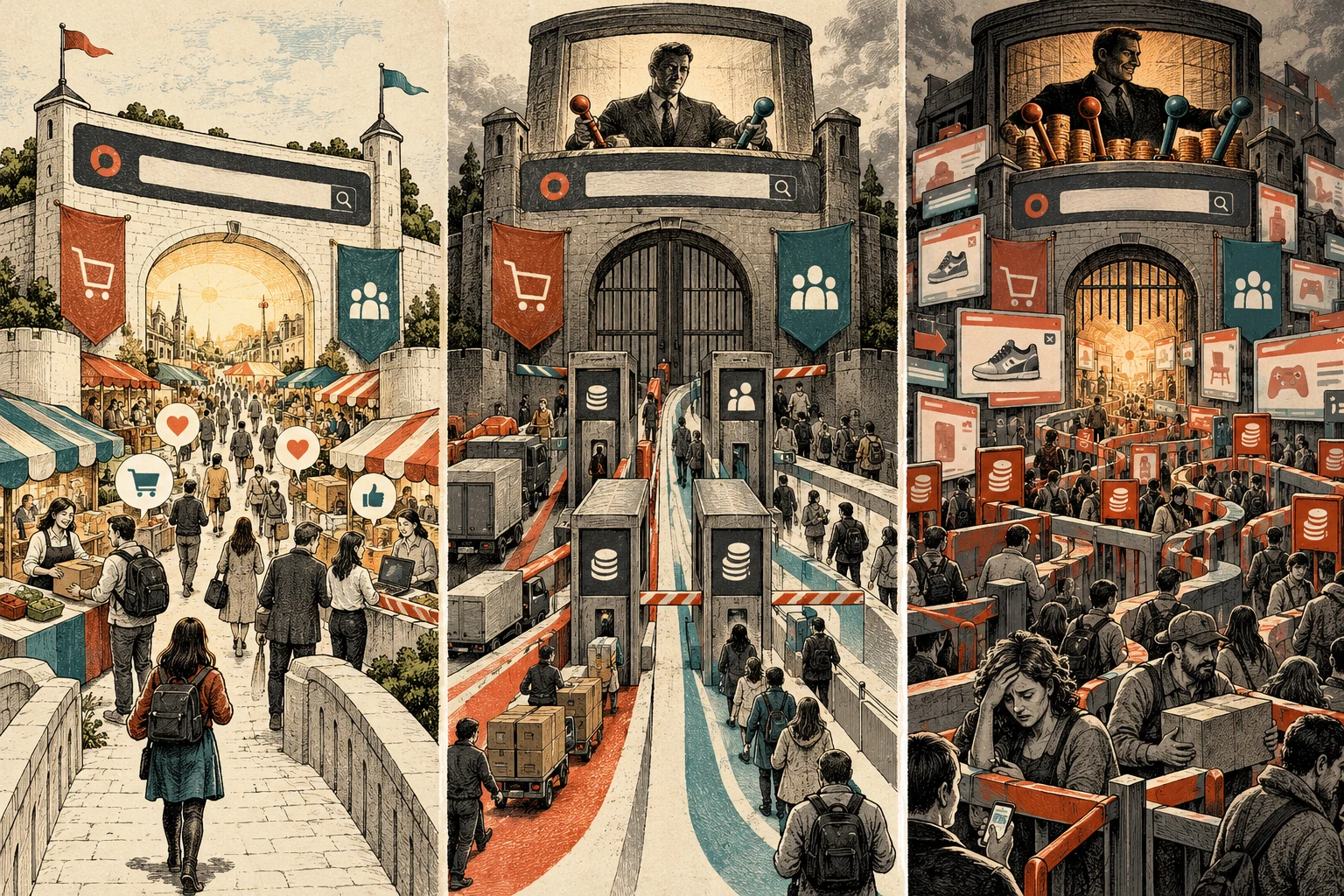
The same platform gradually worsens terms for both users and sellers, exploiting their lock-in and dependence on market access.
AI-assisted illustration · conceptual metaphor View in visual quiz →Genesis and Global Lineage
The term was coined by Canadian-British science-fiction author, journalist, and Electronic Frontier Foundation (EFF) activist Cory Doctorow. After first using the word publicly in November 2022 (notably in a November 28 blog post analyzing Amazon), he published the canonical three-stage formulation on January 21, 2023, in his Pluralistic newsletter essay “Tiktok's enshittification,” reprinted shortly afterward in Wired. Conceptually, the framework synthesizes three distinct intellectual traditions: the American Neo-Brandeisian antitrust revival (spearheaded by Lina Khan's landmark 2017 Yale Law Journal article on Amazon's antitrust paradox), the digital civil-liberties movement against Digital Rights Management (DRM) and proprietary lock-in, and the microeconomics of two-sided markets pioneered by Jean-Charles Rochet and Jean Tirole (2003), which Doctorow recasts from an efficiency model into a theory of sequential predation. In 2022, Doctorow and legal scholar Rebecca Giblin had already mapped how monopsony “chokepoints” extract value from creative workers in Chokepoint Capitalism; the 2023 coinages condensed that diagnosis into a single visceral noun. Doctorow's January 2024 Marshall McLuhan Lecture in Berlin added the historical theory of the “four brakes” whose removal unleashed the cycle, and his 2025 book Enshittification turned the diagnosis into a legislative and technical reform program. Chosen as the 2023 Word of the Year by the American Dialect Society and the 2024 Word of the Year by Australia's Macquarie Dictionary, the term has also suffered the classic fate of viral concepts: casual overuse as a generic complaint about declining service quality everywhere, stripping away its specific focus on two-sided platform lock-in.
Central European Lineage
We found no documented link between this concept and the intellectual history or historical experience of Central Europe.
We found no documented link between this concept and the intellectual history or historical experience of Central Europe (by our methodology, this means “none found,” not “none exists”; as of October 2026).
Why Now
The concept struck an immediate nerve between 2022 and 2026 because multiple dominant platforms visibly entered the terminal stage of the cycle at the very same moment. Late 2022 saw Elon Musk's acquisition of Twitter and the abrupt degradation of verification, API access, and feed quality in pursuit of subscription and ad revenue; in mid-2023, Reddit imposed prohibitive pricing on its third-party API, killing independent client apps and sparking a massive moderator blackout, while the game-engine company Unity announced (and after a developer revolt partially walked back) retroactive per-install runtime fees. Simultaneously, empirical computer-science studies documented the measurable decline of Google Search results under the weight of sponsored links and SEO spam, even as the US Department of Justice won a historic federal ruling in August 2024 declaring Google an illegal search monopolist, and the Federal Trade Commission under Lina Khan sued Amazon in September 2023 for forcing third-party merchants to buy advertising to appear in search results—practices matching Doctorow's stage-three script word for word. In Europe, the entry into force of the Digital Markets Act (DMA) and Digital Services Act (DSA) in 2023–2024—alongside national antitrust enforcement against regional two-sided marketplaces (such as rulings by Poland's competition authority, UOKiK, scrutinizing self-preferencing on dominant local e-commerce platforms like Allegro)—brought platform extraction directly into regulatory law, while the post-2023 flood of generative AI content gave platforms a new cost-cutting knob that further degraded user feeds.
Explanatory Power
Enshittification allows analysts to recognize the progressive degradation of a digital service not as an accidental blunder by out-of-touch managers, but as a rational, stage-dependent structural strategy—and to predict which group will be squeezed next. First, it explains why the very same company can transition within a decade from missionary pro-user idealism (“Don't be evil,” chronologically ordered feeds of friends, ad-free search) to burying organic results beneath a screenful of paid promotions: the corporate culture did not mysteriously rot; rather, user switching costs crossed the threshold where defection became harder than enduring abuse. Second, it resolves the blind spot that paralyzed antitrust enforcement for forty years under Robert Bork's “consumer welfare” standard: nominal prices to end consumers can remain zero while social welfare plummets, because extraction occurs through degraded search relevance, hidden merchant fees passed into retail prices, and coercive ad-buy requirements. Third, it pinpoints what an effective remedy must actually target: not moral appeals to tech executives or privacy disclosures, but lowering the cost of exit by restoring adversarial interoperability—the legal right of competitors and users to build tools that federate with, scrape, or modify an incumbent platform without its permission.
Axes of Debate
A rigorous causal theory or a catchy populist epithet?
Industrial-organization economists and mainstream management scholars argue that Doctorow simply repackages well-known microeconomic concepts—two-sided market cross-subsidies, network effects, switching costs, and hold-up problems—under a scatological label, without offering a formal predictive model capable of specifying when a platform will refrain from extracting maximum short-term rent to protect its long-term franchise. Strongest counterargument: Doctorow's contribution is not a static equilibrium model, but a political-economic explanation of why the constraints that once disciplined two-sided platforms failed simultaneously: the Chicago-school dismantling of antitrust enforcement, the weaponization of Section 1201 of the US Digital Millennium Copyright Act (DMCA) and computer-crime laws to outlaw reverse-engineering and third-party clients, the capture of sector regulators, and the post-2022 mass layoffs that broke tech workers' internal veto power. Nature of the dispute: mixed — the demand for quantitative boundary conditions is substantively valid, though much of the academic dismissal reflects discomfort with a vulgarism that achieved more policy traction than decades of journal articles.
A curable monopoly distortion or a post-capitalist “technofeudal” order?
Yanis Varoufakis (Technofeudalism, 2023) and radical political economists argue that cloud platforms are no longer capitalist markets at all, but digital fiefdoms where “cloud rent” has permanently replaced capitalist profit; from this vantage point, Doctorow's program of antitrust breakups and interoperability mandates is nostalgic Brandeisian reformism trying to restore a competitive market capitalism that technology has already abolished. Strongest counterargument: Doctorow replies that treating Big Tech as an invincible new mode of production is politically paralyzing and historically false: platform lock-in rests on specific, identifiable statutory shields (such as anti-circumvention laws, software patents, and permissive merger guidelines) enacted between the 1980s and 2010s, and whatever was constructed by legislation and court rulings can be dismantled by them—as demonstrated by the EU's DMA interoperability mandates and US antitrust victories. Nature of the dispute: substantive — it concerns whether platform power stems from an irreversible technological transformation of capital or from reversible legal and institutional choices.
Are users helpless hostages or willing participants trading quality for convenience?
Market-liberal commentators and consumer-choice theorists contend that users and merchants voluntarily stay on Amazon, Instagram, or Uber because the bundled convenience still outweighs the annoyances, arguing that Doctorow's hostage narrative patronizes consumers by denying their revealed preferences. Strongest counterargument: Revealed preference is meaningful only when exit is non-catastrophic; in stage three of enshittification, leaving a dominant platform means surrendering years of accumulated social graphs, verified customer reviews, professional audiences, or purchased digital media libraries—turning “staying” into evidence of high switching costs rather than consumer satisfaction. Nature of the dispute: rhetorical — both sides observe the same user behavior, but disagree on the normative threshold at which friction turns convenience into coercion.
Underappreciated Angle
The most counterintuitive implication of Doctorow's model is that platform decay begins not with corporate failure, but with subsidized generosity—meaning that the pathology is hardest to regulate at the exact moment it is being planted. Stage one, in which a platform offers below-cost rides, ad-free feeds, or generous creator payouts, is not a golden age of benevolent engineering later betrayed by greedy MBAs; it is a predatory capital-market investment underwritten by venture investors who explicitly price in future stage-two and stage-three lock-in as their payback mechanism. This creates a structural trap for democratic regulators and competition authorities: during stage one, when blocking a merger or mandating open protocols would painlessly prevent lock-in, any intervention looks like punishing a beloved company that is giving consumers free value; by stage three, when the abuse is obvious to everyone, the platform has become critical civic or commercial infrastructure too entrenched to unwind without short-term disruption. Equally overlooked is Doctorow's “fourth brake”—the bargaining power of technical labor: throughout the 2010s, scarce software engineers frequently resisted dark patterns and user-hostile changes from inside companies out of professional pride, a constraint that the massive tech-industry layoffs of 2022–2024 systematically liquidated with scarcely any public notice.
One-Sentence Takeaway
A digital platform does not start decaying when it loses its users; it starts decaying the moment its executives are certain that neither users nor business customers can afford to leave.
Related Concepts Network
How this concept reinforces, constrains, or complements other analytical frameworks in the corpus. View on graph →
-
Platformization complements
Platformization explains how markets and public spheres come under the control of digital intermediaries; enshittification explains what the intermediary does with that control once both sides of the market are locked in.
-
Network effects reinforces
Network effects build the mutual user lock-in that serves as the structural precondition for all three stages of platform decay.
-
Adversarial interoperability constrains
The technical and legal ability to plug into an incumbent platform without its permission restores users' exit options and, in Doctorow's framework, acts as the single strongest brake on enshittification.
-
Technofeudalism in tension
Yanis Varoufakis views dominant platforms as a post-capitalist rentier order replacing markets altogether, whereas Cory Doctorow diagnoses them as classic monopolies curable with antitrust enforcement and interoperability.
-
Surveillance capitalism complements
Shoshana Zuboff analyzes behavioral data extraction as an accumulation regime; enshittification shows how the resulting lock-in is progressively monetized at the expense of both end users and business customers.
-
Dark patterns reinforces
Manipulative user interfaces are the everyday micro-instruments of “twiddling”—the knobs platforms turn to shift surplus from users and merchants to shareholders.
-
Rent-seeking reinforces
The third stage of enshittification is textbook economic rent extraction from business customers who can no longer afford to abandon the platform.
-
Attention economy complements
User attention is the initial subsidy pool that the platform accumulates in stage one and then rations back to creators and advertisers at steadily worsening terms.
Reading Canon & Translation Bridge
Foundational texts, introductions, and critical perspectives—with availability of English and Polish editions.
-
foundational text 2023 · English
Cory Doctorow, Tiktok's enshittification
The January 21, 2023 post on Doctorow's Pluralistic blog that introduced the canonical three-stage definition of platform decay; an expanded version was subsequently published in Wired.
In English: original text written in English
In Polish: no Polish edition
-
foundational text 2025 · English
Cory Doctorow, Enshittification: Why Everything Suddenly Got Worse and What to Do About It
The book-length expansion of the thesis: diagnosis, the four historical constraints on platform abuse (competition, regulation, adversarial interoperability, and tech worker bargaining power), and a policy program for reversal.
In English: original text written in English
In Polish: Polish edition not verified
-
introduction & synthesis 2022 · English
Rebecca Giblin, Cory Doctorow, Chokepoint Capitalism: How Big Tech and Big Content Captured Creative Labor Markets and How We'll Win Them Back
An earlier study of monopsony “chokepoints” in creative labor markets (Amazon, Spotify, YouTube) out of which Doctorow's analysis of stage-two and stage-three extraction from business customers directly grew.
In English: original text written in English
In Polish: Polish edition not verified
-
cross-disciplinary 2003 · English
Jean-Charles Rochet, Jean Tirole, Platform Competition in Two-Sided Markets
The formal microeconomic theory of two-sided markets that Doctorow's narrative turns on its head, showing how a platform can subsidize one side of a market in order to capture and tax the other.
In English: original text written in English
In Polish: no Polish edition
-
cross-disciplinary 2017 · English
Lina M. Khan, Amazon's Antitrust Paradox
The landmark Yale Law Journal article that laid the legal groundwork: explaining why Chicago-school consumer-welfare antitrust doctrine is blind to predatory platform lock-in so long as short-term consumer prices remain low.
In English: original text written in English
In Polish: no Polish edition
-
critical perspective 2023 · English
Yanis Varoufakis, Technofeudalism: What Killed Capitalism
A competing macro-diagnosis: cloud platforms are not malfunctioning capitalist markets, but digital fiefdoms where cloud rent has displaced capitalist profit, implying that antitrust remedies alone cannot restore competitive markets.
In English: original text written in English
In Polish: Polish edition not verified
-
introduction & synthesis 2016 · English
Nick Srnicek, Platform Capitalism
A concise political-economic typology of digital platforms and their data-extraction imperatives, useful as structural background alongside Doctorow's lifecycle model.
In English: original text written in English
In Polish: Polish edition not verified
-
cross-disciplinary 2019 · English
Shoshana Zuboff, The Age of Surveillance Capitalism: The Fight for a Human Future at the New Frontier of Power
A sweeping synthesis of behavioral data extraction; read alongside Doctorow, it describes the informational apparatus that enables platforms to fine-tune their extraction knobs in real time.
In English: original text written in English
In Polish: Polish edition not verified
Primary-Source Quotes
Here is how platforms die: first, they are good to their users; then they abuse their users to make things better for their business customers; finally, they abuse those business customers to claw back all the value for themselves. Then, they die.