Dead internet theory
original term: dead internet theory (Eng.) · teoria martwego internetu, dead internet
Global-circulation concept — no documented lineage in Central Europe. jump to documentation ↓
Working Definition
The dead internet theory is the proposition that since a specific tipping point—originally dated by its anonymous authors to around 2016–2017—the majority of traffic, content, and visible social interaction on the internet has been generated not by human beings, but by automated bots, algorithmic curation, and synthetic media, leaving real people as an isolated minority interacting largely with machines. In its original forum version, it is a full-blown conspiracy theory claiming that government agencies and giant corporations secretly replaced the organic web with an AI-driven simulation to manufacture public consensus and steer consumer behavior. In its analytical version, adopted by media scholars and cybersecurity researchers after 2022, it describes—without positing a secret central puppeteer—an emergent structural state of the digital ecosystem in which the share of automated traffic, synthetic content, and fake engagement rises steadily while the cost of distinguishing human presence from machine output becomes prohibitive. The analytical version diagnoses the contemporary web; the conspiratorial version diagnoses the alienation of its users.
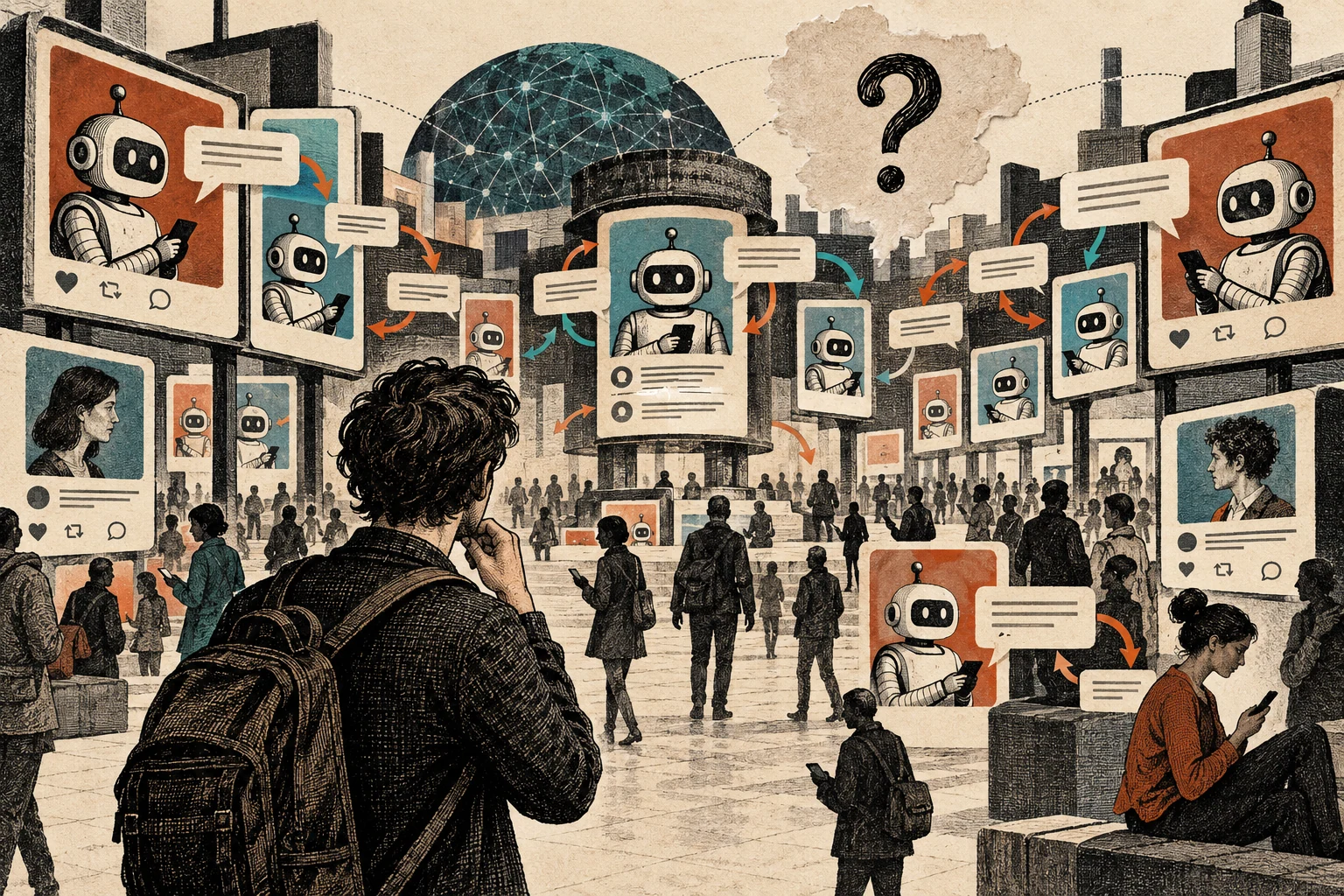
Automated profiles stage the appearance of public conversation; the image illustrates a hypothesis about the scale of online automation rather than proving humans have vanished.
AI-assisted illustration · conceptual metaphor View in visual quiz →Genesis and Global Lineage
Unlike most analytical concepts, the dead internet theory has no academic founder, only a pseudonymous forum handle. On January 5, 2021, a user named “IlluminatiPirate” published a sprawling manifesto titled Dead Internet Theory: Most of the Internet is Fake on the niche vaporwave-aesthetic forum Agora Road's Macintosh Cafe, noting that the ideas had been synthesized from earlier threads on the imageboard Wizardchan and paranormal /x/ boards on 4chan. Combining acute observations about the repetitive, hollowed-out feel of search results and social feeds with paranoid speculation that view counts were fabricated and that the US government was running a massive AI psychological operation, the post might have remained subcultural folklore had Atlantic staff writer Kaitlyn Tiffany not profiled it on August 31, 2021, establishing the framing that stuck: factually wrong as a literal plot, yet uncannily perceptive as a mood diagnosis. Crucially, the empirical building blocks existed long before the forum myth: security firm Imperva Incapsula had reported as early as 2017 that automated bots generated 51.8% of global web traffic in 2016, and Emilio Ferrara and his colleagues had mapped the rise of human-mimicking social bots in Communications of the ACM (2016). After the release of ChatGPT and image generators in late 2022, technology journalism and academic media studies (such as Yoshija Walter's 2024 commentary in AI & Society) co-opted the phrase as a descriptive shorthand for an internet flooded by synthetic slop.
Central European Lineage
We found no documented link between this concept and the intellectual history or historical experience of Central Europe.
We found no documented link between this concept and the intellectual history or historical experience of Central Europe (by our methodology, this means “none found,” not “none exists”; as of October 2026).
Why Now
Three converging developments between 2023 and 2025 turned a fringe 2021 imageboard post into what felt like a live empirical report. First, the mass deployment of large language models and diffusion image generators after November 2022 drove the marginal cost of producing plausible text and images near zero; by early 2024, Facebook feeds were famously overrun by surreal AI-generated images such as “Shrimp Jesus,” and researchers Renée DiResta and Josh Goldstein demonstrated that Meta's recommendation algorithms were actively pushing these unlabeled synthetic posts to millions of users who did not follow the pages publishing them. Second, network telemetry crossed a symbolic threshold: according to Imperva's April 2025 Bad Bot Report, automated traffic accounted for 51% of all global web traffic in 2024, with “bad bots” alone rising to 37%, driven by AI scraping and automated account abuse. Third, platforms themselves began manufacturing synthetic personas—in late 2024 Meta unveiled plans for autonomous AI-powered profiles on Facebook and Instagram with bios and profile pictures, before abruptly deleting existing official AI characters in early January 2025 amid user ridicule—even as platforms like Reddit and X locked their human archives behind expensive API paywalls because verified human text had become a scarce training commodity. Finally, a landmark Nature paper by Ilia Shumailov and colleagues (July 2024) delivered the technical punchline: AI models trained recursively on machine-generated web data suffer irreversible “model collapse,” meaning a dead internet threatens the machines themselves.
Explanatory Power
Stripped of its conspiratorial trappings, the dead internet lens reveals that online “engagement” is an industrial commodity that can be manufactured without humans—and forces analysts to ask who profits from the simulation. Consider three concrete mechanisms. First, attention-farming and account laundering: a spammer spins up automated pages posting emotionally manipulative AI images (wounded soldiers, miraculous toddlers, religious kitsch), harvests tens of thousands of automated and gullible human “Amen” comments to boost algorithmic rank, and then pivots the high-reach page to peddle financial scams, malware links, or state propaganda—a prosaic commercial pipeline that Jake Renzella and Vlada Rozova note is far more insidious than a single government conspiracy. Second, the distortion of democratic and market signals: when political journalists, campaign managers, or brand executives treat trending hashtags and reply ratios on X or TikTok as a barometer of “public opinion,” they are frequently measuring the falling rental cost of bot farms rather than human sentiment. Third, the “low-background steel” problem of human culture: just as pre-1945 shipwrecks are salvaged for steel uncontaminated by atmospheric nuclear fallout, AI labs and digital historians now treat pre-2022 web archives as a non-renewable reserve of uncontaminated human language.
Axes of Debate
Centralized conspiracy versus emergent market equilibrium
Media scholars, disinformation researchers, and technology journalists (such as Kaitlyn Tiffany, Jake Renzella, and Vlada Rozova) reject the original forum thesis of a coordinated state-corporate plot, explaining the hollowing out of the web as an unplanned tragedy of the commons produced by the aligned financial incentives of ad-tech networks, SEO spammers, creator-fund hustlers, and platforms that report monthly active users to Wall Street. Strongest counterargument: Proponents of a harder structural reading reply that the absence of a single secret cabal does not mean the absence of deliberate agency: major platforms possess the internal telemetry to know how much of their billed ad impression volume and engagement is synthetic yet face strong financial disincentives to purge it, while state intelligence services and political consultancies run documented, industrial-scale inauthentic influence operations. Nature of the dispute: mixed — the scale of commercial ad fraud and state botnets is an empirical question, whereas the original forum myth of an all-powerful “They” replacing humanity online is unfalsifiable by design.
What does “51% of internet traffic is bots” actually measure?
Empirically minded network engineers and skeptics point out that the viral headline statistics come from cybersecurity vendors selling bot-mitigation software, and that raw “bot traffic” lumps together search-engine crawlers, uptime monitors, price aggregators, and AI training scrapers—automated background processes that never pretend to be human beings conversing in a forum. Strongest counterargument: Even after subtracting benign infrastructure crawlers (“good bots”), Imperva's telemetry attributes 37% of all 2024 web traffic to malicious automation, and independent academic audits of social platforms—from Pew Research studies of tweeted links to empirical analyses of X replies and Facebook comment sections—confirm that deceptive social bots play an outsized role in amplifying polarizing content and gaming recommendation feeds. Nature of the dispute: substantive — a methodological dispute over the appropriate unit of measurement: raw HTTP packet volume versus the share of human-impersonating accounts in public social spaces.
The death of the internet versus nostalgia for the pre-platform web
Internet historians and cultural critics read the dead internet theory primarily as an expression of generational grief among veterans of 2000s forums, blogs, and imageboards mourning the loss of a quirkier, decentralized web that was killed not by AI bots, but by algorithmic consolidation into five giant apps and search-engine optimization. Strongest counterargument: Generational nostalgia does not invalidate an empirical trajectory: whatever nostalgic longing motivated the anonymous 2021 forum post, the post-2022 explosion of generative AI turned what began as a backward-looking lament for the old web into an accurate forward-looking prediction of synthetic saturation. Nature of the dispute: rhetorical — both sides agree that the texture of online life has fundamentally changed, disagreeing only on whether to call that transformation “death.”
Underappreciated Angle
The most consequential long-term effect of the “dead internet” is not the proliferation of bots themselves, but the resulting political economy of proving that you are human. When synthetic text, voice, and video become dirt cheap and ubiquitous on the open web, verified human presence turns from the default baseline of online life into a scarce luxury good—and therefore a new site of rent extraction, gating, and surveillance. We can already see the outlines of this two-tier architecture emerging: an open, unauthenticated public internet where every user must assume by default that strangers in the comment section, customer-service chat, or dating app may be language models, alongside gated private enclaves (paid subscriptions, invite-only Discord servers, cryptographic “proof-of-personhood” protocols, biometric identity wallets, and paywalled corporate APIs) where humanity is certified at the door. That shift quietly moves the central question from technology (“how many bots are out there?”) to institutional power (“who gets to issue the certificate of humanity, at what price, and at what cost to anonymity?”). For societies in Central and Eastern Europe that spent decades under state socialism learning to read between the lines of synthetic official media while retreating into trusted private circles of verified friends, this bifurcation of the public sphere into an automated facade and gated private rooms is an eerily familiar structural return.
One-Sentence Takeaway
The anonymous forum theory was wrong about the culprit but right about the trajectory: no secret cabal killed the internet, yet the attention market has learned how to run on synthetic engagement without needing human beings.
Related Concepts Network
How this concept reinforces, constrains, or complements other analytical frameworks in the corpus. View on graph →
-
AI slop reinforces
The mass, near-zero-cost production of generative AI content supplies the visible everyday material that turns the “dead internet” from a paranoid forum conspiracy into a description of ordinary user experience.
-
Enshittification complements
Platform decay explains why platform operators tolerate automated bots and synthetic engagement: quarterly ad-impression metrics matter more than whether a human sits behind the screen.
-
Model collapse complements
As the open web fills with machine-generated text and images, subsequent generations of AI models end up training on their own synthetic exhaust; the dead internet is the environmental precondition for model collapse.
-
Disinformation in tension
Traditional disinformation analysis looks for a state actor and a political message, whereas dead internet theory highlights an impersonal economy of automated reach; the two lenses capture opposite ends of the same ecosystem.
-
Attention economy reinforces
Once human attention becomes a monetizable currency, simulating attention becomes profitable—making botnets, click farms, and automated replies the logical shadow of the attention market.
-
Hyperreality complements
An internet in which algorithmic simulations of social interaction displace actual human conversation is a textbook realization of Jean Baudrillard's hyperreality.
-
Synthetic media reinforces
Synthetic text, images, voice clones, and video avatars provide the raw building blocks out of which apparent human participants on the web are fabricated.
Reading Canon & Translation Bridge
Foundational texts, introductions, and critical perspectives—with availability of English and Polish editions.
-
foundational text 2021 · English
IlluminatiPirate (pseud.), Dead Internet Theory: Most of the Internet is Fake
The January 5, 2021 post on the Agora Road's Macintosh Cafe forum that gave the theory its name and canonical outline; best read as a cultural document of online alienation rather than an empirical study.
In English: original text written in English
In Polish: no Polish edition
-
introduction & synthesis 2021 · English
Kaitlyn Tiffany, Maybe You Missed It, but the Internet ‘Died’ Five Years Ago
The feature article in The Atlantic (August 31, 2021) that brought the theory from niche imageboards into mainstream discussion and formulated its most durable assessment: factually false as a grand conspiracy, yet emotionally resonant.
In English: original text written in English
In Polish: no Polish edition
-
introduction & synthesis 2024 · English
Jake Renzella, Vlada Rozova, The ‘dead internet theory’ makes eerie claims about an AI-run web. The truth is more sinister
A concise analysis in The Conversation (May 20, 2024) that shifts the focus from “did the internet die?” to the political economy of who rents and weaponizes high-reach synthetic accounts.
In English: original text written in English
In Polish: no Polish edition
-
critical perspective 2024 · English
Yoshija Walter, Artificial influencers and the dead internet theory
A brief scholarly commentary in AI & Society (published online February 5, 2024; vol. 40, no. 1, pp. 239–240), representing one of the first academic engagements with the concept in the context of virtual influencers.
In English: original text written in English
In Polish: no Polish edition
-
cross-disciplinary 2016 · English
Emilio Ferrara, Onur Varol, Clayton Davis, Filippo Menczer, Alessandro Flammini, The Rise of Social Bots
A landmark survey in Communications of the ACM (vol. 59, no. 7, pp. 96–104) on social bots and detection methods, supplying the rigorous empirical foundation that the forum theory lacked.
In English: original text written in English
In Polish: no Polish edition
-
cross-disciplinary 2024 · English
Renée DiResta, Josh A. Goldstein, How Spammers and Scammers Leverage AI-Generated Images on Facebook for Audience Growth
An empirical study (arXiv preprint, March 19, 2024) demonstrating how Facebook's recommendation algorithm actively pushes unlabeled AI-generated images to users who do not follow the pages posting them—the definitive study of the “Shrimp Jesus” phenomenon.
In English: original text written in English
In Polish: no Polish edition
-
cross-disciplinary 2024 · English
Ilia Shumailov, Zakhar Shumaylov, Yiren Zhao, Nicolas Papernot, Ross Anderson, Yarin Gal, AI models collapse when trained on recursively generated data
A landmark paper in Nature (vol. 631, pp. 755–759) proving that machine-learning models degrade when trained recursively on synthetic output, showing why a bot-saturated web threatens AI itself.
In English: original text written in English
In Polish: no Polish edition
-
cross-disciplinary 2025 · English
Imperva (Thales), 2025 Imperva Bad Bot Report: How AI is Supercharging the Bot Threat
An industry cybersecurity report (April 15, 2025) estimating that automated traffic accounted for 51% of all web traffic in 2024; the source of the most frequently cited headline figures, best read while keeping in mind the commercial interests of anti-bot vendors.
In English: original text written in English
In Polish: no Polish edition
Primary-Source Quotes
The Internet feels empty and devoid of people. It is also devoid of content.