Dark patterns
original term: dark patterns (Eng.) · deceptive patterns, zwodnicze interfejsy, manipulacyjne wzorce projektowe
Global-circulation concept — no documented lineage in Central Europe. jump to documentation ↓
Working Definition
Dark patterns (since 2022 also widely termed deceptive patterns) are user-interface designs deliberately crafted to trick, steer, or coerce users into making choices they would not make if presented with a neutral, transparent layout: adding hidden insurance to a shopping cart, consenting to invasive behavioral tracking, or signing up for a recurring subscription that is effortless to enter and exhausting to cancel. An operational definition requires three elements: first, the designer exploits known cognitive biases (default bias, visual salience, framing, or decision fatigue); second, the resulting action benefits the platform operator or merchant at the expense of the user; third, the user typically fails to recognize that their choice was engineered. While everyday complaints often stretch the phrase to cover any clunky or annoying software, in technical human-computer interaction (HCI) and legal enforcement (Mathur et al., 2019; Gray et al., 2018) it denotes a catalog of repeatable, empirically measurable design patterns—and since 2022, a specific statutory violation in European and American digital law.
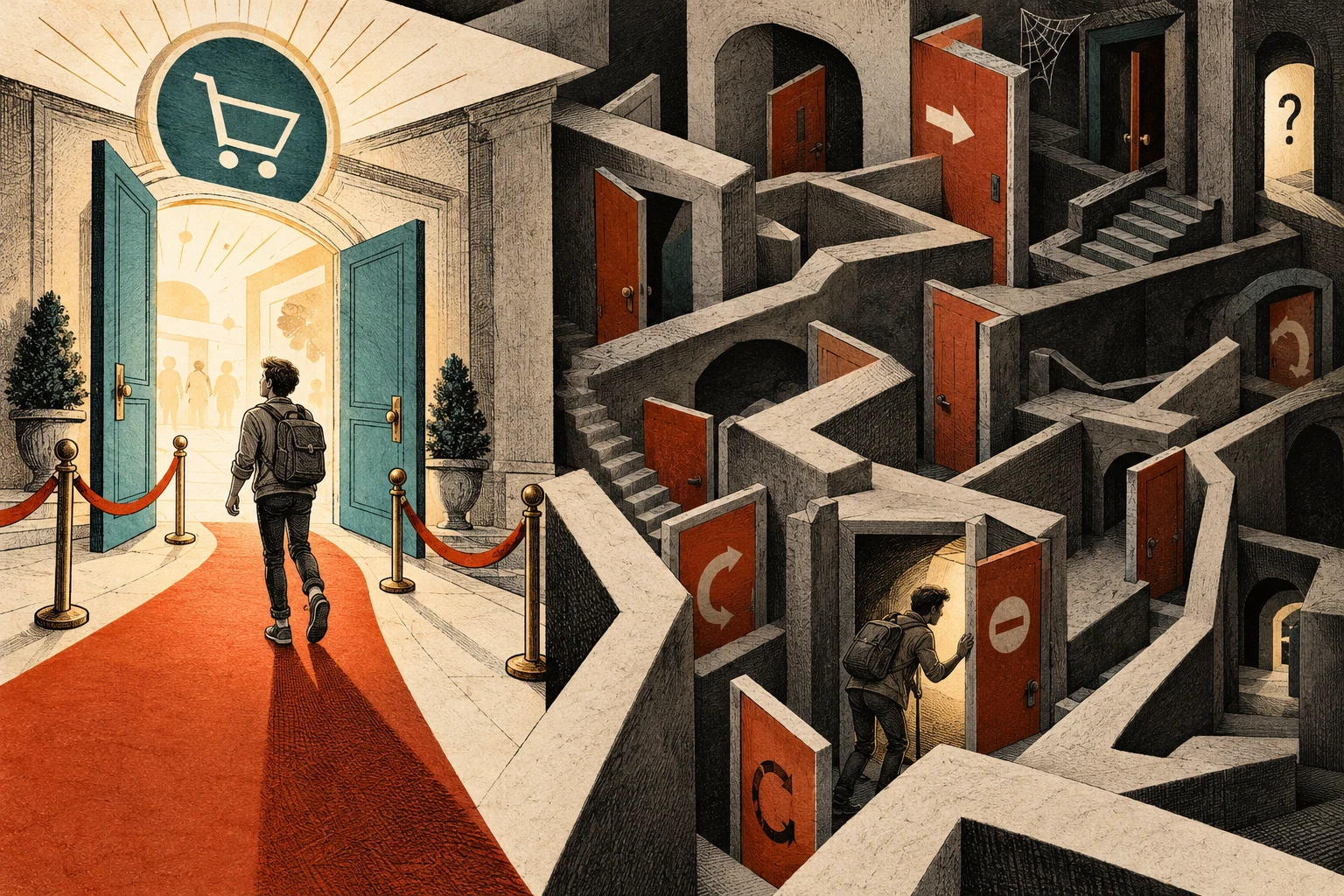
Signing up is effortless while canceling leads through a maze; the interface obstructs choices unfavorable to the provider even while leaving an exit formally available.
AI-assisted illustration · conceptual metaphor View in visual quiz →Genesis and Global Lineage
The term was coined in August 2010 by British user-experience (UX) researcher Harry Brignull, who holds a doctorate in cognitive science and launched the website darkpatterns.org as a public “hall of shame” to name and stigmatize unethical tricks within his own profession. The word pattern deliberately inverted Christopher Alexander's architectural “design patterns” (adopted by software engineering to denote reusable solutions to common problems): a dark pattern is a reusable template that solves a company's conversion-rate problem at the user's expense—such as the Roach Motel (one click to subscribe, a phone call to cancel), Confirmshaming (“No thanks, I hate saving money”), or Hidden Costs. For nearly a decade the concept circulated primarily among UX practitioners; it entered academic computer science through Colin Gray and colleagues' 2018 CHI paper and achieved hard empirical status in 2019 when Arunesh Mathur and Arvind Narayanan's team at Princeton crawled 11,000 e-commerce websites, documenting 1,818 dark-pattern deployments and a third-party industry of Shopify plugins selling fake countdown timers and scarcity alerts as turnkey software. In 2021, legal scholars Jamie Luguri and Lior Strahilevitz supplied controlled experimental proof of their causal power, while Richard Thaler introduced the parallel term sludge for administrative friction. Around 2022, Brignull renamed his project deceptive.design (deceptive patterns) on the recommendation of the World Wide Web Foundation's Tech Policy Design Lab to avoid racialized metaphors of “darkness” and emphasize legal deception, though dark patterns remains entrenched in legislation and case law.
Central European Lineage
We found no documented link between this concept and the intellectual history or historical experience of Central Europe.
We found no documented link between this concept and the intellectual history or historical experience of Central Europe (by our methodology, this means “none found,” not “none exists”; as of October 2026).
Why Now
Between 2021 and 2026, dark patterns moved from UX blogs into regulatory enforcement and litigation. In May 2021, the Vienna-based privacy non-profit noyb (founded by Max Schrems) filed over 500 GDPR complaints against deceptive cookie banners, documenting that 81% offered no “reject” button on the first layer and 73% used deceptive visual contrast. In September 2022, the US Federal Trade Commission (FTC) published Bringing Dark Patterns to Light, and in December 2022 ordered Epic Games to pay $245 million for counterintuitive button layouts that tricked Fortnite players into unwanted purchases. In early 2023, a European Commission sweep of 399 online retailers found that 37% deployed manipulative interfaces; in February 2023, the European Data Protection Board adopted guidelines on deceptive patterns in social media, while Article 25 of the EU Digital Services Act (applicable since February 2024) enacted a blanket ban on interfaces that “deceive or manipulate” users. In June 2023, the FTC sued Amazon over its “Iliad Flow”—the four-page, six-click labyrinth required to cancel Prime—followed in 2024 by the FTC's “Click-to-Cancel” rule and enforcement by national authorities (such as Poland's UOKiK penalizing fake countdown timers). Simultaneously, conversational AI assistants after 2023 opened a new frontier: persuasive chatbots deploying verbal dark patterns inside dialogue.
Explanatory Power
The concept gives analysts and regulators an instrument to distinguish bad design (incompetence) from hostile design (strategy). Without it, a cookie banner where “Accept All” is bright green and “Manage Preferences” is pale gray text looks like an aesthetic quirk; with it, one recognizes the output of A/B testing optimized to maximize consent. Three domains illustrate its reach. First, the subscription economy: measuring the click asymmetry between enrollment and cancellation (Roach Motel) turns consumer frustration into courtroom evidence (as in Amazon's internal code name “Iliad,” a nod to Homer's siege of Troy). Second, data-protection law: because the GDPR requires consent to be “freely given, specific, informed and unambiguous,” the taxonomy of interface interference provides regulators with the evidentiary bridge to prove that a user's click was legally invalid. Third, the supply chain of manipulation: Mathur and Narayanan's discovery that third-party vendors sell plug-and-play widgets generating fake scarcity alerts proves that interface deception is an industrialized B2B service rather than the work of isolated rogue designers.
Axes of Debate
Behavioral “nudge” versus “dark pattern”: where is the boundary?
Behavioral economists in the tradition of Richard Thaler and Cass Sunstein argue that “choice architecture” is inescapable—every form has a default setting and every screen has a top button—so the only meaningful distinction is whether the architect nudges people toward their own long-term welfare (“libertarian paternalism”) or toward the firm's profit (“sludge” or dark patterns). Critics from ethical UX design and consumer law reply that “the user's own interest” is hopelessly elastic in court, since every platform claims that personalized tracking and auto-renewing subscriptions are what consumers secretly want. Strongest counterargument: Jamie Luguri and Lior Strahilevitz propose a clean, empirically testable legal boundary: a benign nudge survives transparency (when you tell users that automatic pension enrollment is designed to help them save, they keep the default), whereas a dark pattern collapses when exposed (once users are clearly informed of the hidden cost or data extraction, they overwhelmingly reject it). Nature of the dispute: substantive — it concerns the operational legal test that courts and regulators need to separate legitimate persuasion from unlawful manipulation.
Enumerated blacklist of patterns versus general statutory prohibition
HCI researchers and competition agencies compile ever more detailed taxonomies (Brignull's catalog now lists 18 types; the EDPB defines 6 major categories and dozens of subtypes) because explicit blacklists give businesses clear compliance rules and make automated web-crawling audits possible. Consumer-protection lawyers warn that any fixed statutory list becomes obsolete within months, as A/B-testing algorithms automatically evolve a nineteenth pattern that skirts the literal wording of the ban. Strongest counterargument: Conversely, a broad principle-based clause (such as the DSA's prohibition on interfaces that “materially distort or impair” user autonomy) without a concrete blacklist of per se violations can prove toothless in practice, forcing under-resourced regulators to litigate complex behavioral experiments from scratch against tech giants that hold all the internal conversion telemetry. Nature of the dispute: mixed — a technical debate over legislative drafting that reflects a deeper conflict between formal legal certainty and adaptive regulatory enforcement.
Individual designer ethics versus competitive market equilibrium
Early UX reform movements placed moral responsibility on individual designers, calling for a “Hippocratic Oath” for software engineers and UX professionals to refuse orders to build manipulative flows. Economists following George Akerlof and Robert Shiller (Phishing for Phools, 2015) counter that on a competitive market where firms are judged by quarterly conversion metrics, deception is a structural equilibrium: if Airline A displays the full ticket price upfront while Airline B hides baggage and seat fees until the final checkout screen, price-comparison search engines reward Airline B, forcing Airline A to adopt the same dark pattern or go bankrupt. Strongest counterargument: While market competition alone indeed drives a race to the bottom, the rapid redesign of European cookie banners following noyb's automated complaint waves proves that combining professional naming-and-shaming taxonomies with credible regulatory penalties can shift the industry baseline faster than either designer conscience or market forces alone. Nature of the dispute: substantive — how one answers determines whether resources should go into professional ethics training or strict liability fines on corporate boards.
Underappreciated Angle
Almost all empirical research and regulatory enforcement measures the harm of dark patterns one transaction at a time: the unwanted $14.99 monthly subscription, the overpriced concert ticket, the tricked cookie consent. What goes unmeasured is the cumulative epistemic pollution of the digital commons. A user who has been burned half a dozen times by pre-checked boxes, fake countdown timers, and deceptive button colors rationally adapts by treating every digital interface as a hostile adversary—Developing defensive blindness, clicking “Accept” or “Dismiss” reflexively just to clear the screen, and assuming that all fine print is a trap. In doing so, dark patterns destroy the communicative value of legitimate warnings: medical consent forms, genuine cybersecurity alerts, banking fraud warnings, and civic notices get dismissed with the same exhausted muscle memory as a cookie banner. Just as boilerplate clickwrap terms of service hollowed out the classical legal institution of the signature—turning a solemn manifestation of assent into a meaningless twitch of the index finger—the ubiquity of dark patterns corrodes the very possibility of informed consent across digital society. Regulation that merely bans the most egregious retail tricks without restoring symmetry to everyday consent interfaces misses this systemic externality.
One-Sentence Takeaway
A user interface is never a neutral window onto a service; when signing up takes one click and canceling takes twelve, it is because an algorithm tested eleven and found that too many people still escaped.
Related Concepts Network
How this concept reinforces, constrains, or complements other analytical frameworks in the corpus. View on graph →
-
Nudge and behavioral economics in tension
A dark pattern uses the exact same choice-architecture mechanics as a behavioral nudge, but flips the normative sign to serve the interface operator against the chooser's own interest; the dispute over where one ends and the other begins is a dispute over who captures the surplus.
-
Information asymmetry reinforces
A deceptive interface deliberately widens the seller's informational advantage by burying total prices, pre-selecting costly defaults, or obstructing the exit path.
-
Attention economy complements
When human attention is the monetizable commodity, interfaces are engineered to keep users scrolling or clicking against their conscious intentions; dark patterns are the tactical instruments of that capture.
-
Surveillance capitalism reinforces
Asymmetrical cookie-consent banners and labyrinthine privacy settings are the primary choke points where interface manipulation feeds the behavioral data-extraction pipeline.
-
Enshittification complements
The proliferation of dark patterns across a mature platform is the visible surface symptom of Cory Doctorow's “twiddling”—shifting value from locked-in users to the platform operator.
-
Mechanism design constrains
Classical mechanism design assumes rational agents who know the rules of the game; dark patterns work precisely by exploiting bounded rationality and hiding the rules inside the visual hierarchy.
-
Platformization reinforces
The more everyday civic and commercial transactions are routed through a handful of dominant platform interfaces, the greater the systemic reach of even minor manipulative design tweaks.
Reading Canon & Translation Bridge
Foundational texts, introductions, and critical perspectives—with availability of English and Polish editions.
-
foundational text 2023 · English
Harry Brignull, Deceptive Patterns: Exposing the Tricks Tech Companies Use to Control You
The book-length synthesis by the UX designer who coined the term in 2010: a comprehensive taxonomy of manipulative patterns, real-world case studies, and the evolution of the movement from designer shaming to statutory bans.
In English: original text written in English
In Polish: Polish edition not verified
-
foundational text 2019 · English
Arunesh Mathur, Gunes Acar, Michael J. Friedman, Elena Lucherini, Jonathan Mayer, Marshini Chetty, Arvind Narayanan, Dark Patterns at Scale: Findings from a Crawl of 11K Shopping Websites
The first large-scale empirical measurement (CSCW 2019): an automated crawl of 11,000 shopping sites that identified 1,818 instances of dark patterns across 15 types and uncovered a third-party software ecosystem selling manipulation-as-a-service.
In English: original text written in English
In Polish: no Polish edition
-
introduction & synthesis 2018 · English
Colin M. Gray, Yubo Kou, Bryan Battles, Joseph Hoggatt, Austin Toombs, The Dark (Patterns) Side of UX Design
The landmark CHI 2018 paper that brought the concept into academic human-computer interaction (HCI) research and organized manipulative practices into five core strategies: nagging, obstruction, sneaking, interface interference, and forced action.
In English: original text written in English
In Polish: no Polish edition
-
cross-disciplinary 2021 · English
Jamie Luguri, Lior Jacob Strahilevitz, Shining a Light on Dark Patterns
A decisive experimental study by University of Chicago legal scholars (Journal of Legal Analysis): mild dark patterns more than doubled sign-ups for a dubious identity-protection program (from 11% to 26%), while aggressive patternsNearly quadrupled them (to 42%), hitting less-educated consumers hardest.
In English: original text written in English
In Polish: no Polish edition
-
cross-disciplinary 2015 · English
George A. Akerlof, Robert J. Shiller, Phishing for Phools: The Economics of Manipulation and Deception
The macroeconomic backdrop by two Nobel laureates: in competitive markets, psychological manipulation is not an aberration but an equilibrium outcome, because any firm that unilateral renounces profitable tricks loses market share to rivals that use them.
In English: original text written in English
In Polish: “Złowić frajera. Ekonomia manipulacji i oszustwa”, Polskie Towarzystwo Ekonomiczne 2017, trans. Zbigniew Matkowski
-
critical perspective 2008 · English
Richard H. Thaler, Cass R. Sunstein, Nudge: Improving Decisions About Health, Wealth, and Happiness
Essential reading from the other side of the mirror: the very same behavioral science of defaults, framing, and loss aversion that powers dark patterns is presented here as benevolent “choice architecture” (Thaler later coined the term “sludge” for its malicious twin).
In English: original text written in English
In Polish: “Impuls. Jak podejmować właściwe decyzje dotyczące zdrowia, dobrobytu i szczęścia”, Zysk i S-ka 2017, trans. Justyna Grzegorczyk
-
introduction & synthesis 2019 · English
Shoshana Zuboff, The Age of Surveillance Capitalism: The Fight for a Human Future at the New Frontier of Power
Provides the structural political economy explaining why user-hostile consent interfaces are an inescapable feature of a business model that treats human behavior as raw material.
In English: original text written in English
In Polish: “Wiek kapitalizmu inwigilacji. Walka o przyszłość ludzkości na nowej granicy władzy”, Zysk i S-ka 2020, trans. Alicja Unterschuetz
Primary-Source Quotes
Dark patterns are strikingly effective in getting consumers to do what they would not do when confronted with more neutral user interfaces.