Platformization
original term: platformization (Eng.) · platformisation, kapitalizm platform
Global-circulation concept — no documented lineage in Central Europe. jump to documentation ↓
Working Definition
Platformization (spelled platformisation in British and European scholarship) is the process by which a digital intermediary connecting two or more distinct groups of users ceases to be merely one commercial service among others and becomes unavoidable infrastructure—the mandatory gatekeeper for reaching customers, finding work, addressing an audience, or accessing sectoral data. Analytically, the concept captures three simultaneous transformations: a technical shift (application programming interfaces, software development kits, and data standards force external actors to make their products “platform-ready”), an economic shift (fragmented bilateral exchanges are reorganized into centralized multi-sided markets governed by network effects and transaction tolls), and a governance shift (the platform's private terms of service, ranking algorithms, and de-platforming rules function as the de facto law of an entire sector). While everyday commentary uses “platform” as a loose synonym for any giant tech firm, in rigorous usage platformization denotes a portable organizational template that reshapes agriculture, logistics, universities, or public administration just as thoroughly as social media.
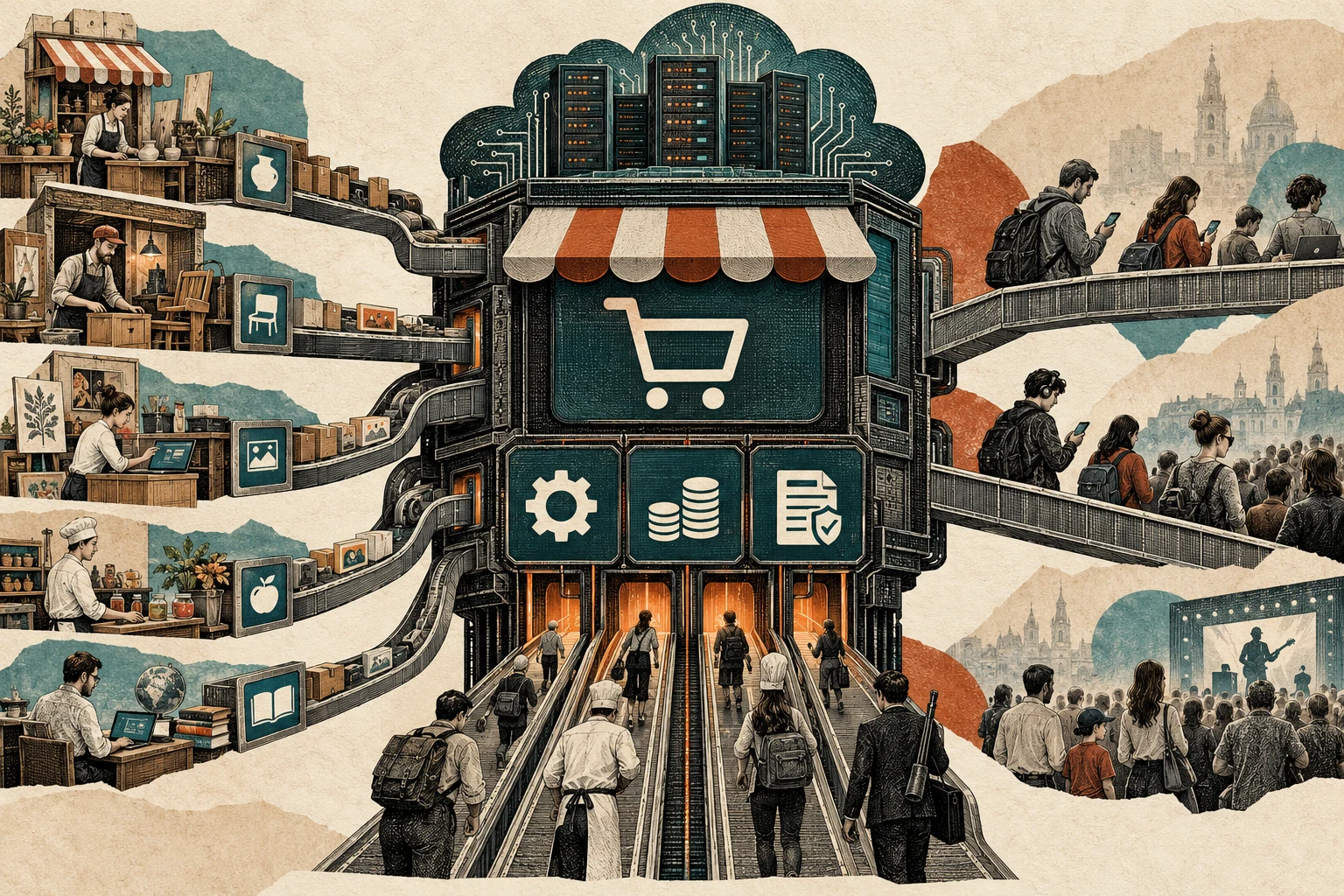
More and more independent activities must pass through a shared platform, giving the intermediary power over access rules, visibility, and terms of exchange.
AI-assisted illustration · conceptual metaphor View in visual quiz →Genesis and Global Lineage
Before scholars could analyze platformization as a process, they first had to deconstruct the word platform: in a landmark 2010 article, Tarleton Gillespie showed how firms like YouTube deployed the metaphor of a flat, open “platform” to pitch themselves to creators as empowering stages, to advertisers as curated venues, and to legislators as neutral conduits exempt from publisher liability. The process noun platformization then emerged between 2015 and 2019. First, in software studies, Anne Helmond (2015) coined “the platformization of the web” to describe a dual technical movement: how social networks like Facebook decentralized their infrastructure across the web via APIs and login widgets while recentralizing data collection by forcing third-party websites to make their data “platform-ready.” Second, in political economy, Nick Srnicek's Platform Capitalism (2016) situated the rise of the platform firm within the history of capitalist crises—showing how the 1970s manufacturing downturn, the 1990s dot-com boom, and post-2008 low interest rates drove venture capital into a corporate form designed to monopolize data extraction by positioning itself between users. In 2018–2019, the “Amsterdam school” (José van Dijck, Thomas Poell, David Nieborg, and Martijn de Waal) synthesized these strands with infrastructure studies (Jean-Christophe Plantin et al., 2018), coining the formula that platforms are becoming infrastructures, while infrastructures are being rebuilt as platforms.
Central European Lineage
We found no documented link between this concept and the intellectual history or historical experience of Central Europe.
We found no documented link between this concept and the intellectual history or historical experience of Central Europe (by our methodology, this means “none found,” not “none exists”; as of October 2026).
Why Now
Between 2018 and 2026, platformization graduated from media-studies seminars into the core framework of competition law. The 2018 Cambridge Analytica scandal exposed the political consequences of Helmond's API-driven platformization, showing how Facebook's social graph plugins allowed third-party developers to harvest population-scale psychological profiles. Two years later, the COVID-19 pandemic (2020–2021) compressed a decade of institutional platformization into weeks: public schools, universities, healthcare consultations, and restaurants migrated wholesale onto private cloud and marketplace infrastructures (Zoom, Microsoft Teams, Google Classroom, Amazon, Uber Eats)—turning private corporations into essential public utilities without a public mandate. The European Union responded by translating the academic concept into statutory law: the Digital Markets Act (DMA, 2022) codified the status of “gatekeepers” controlling “core platform services,” while the Digital Services Act (DSA) imposed due-process obligations on Very Large Online Platforms. Between 2023 and 2026, the same infrastructural play has unfolded in generative artificial intelligence, as foundation-model laboratories (OpenAI, Anthropic, Google, Meta) and cloud hyperscalers race to turn their APIs and model hubs into the mandatory platform layer for all downstream software.
Explanatory Power
Platformization reveals the common structural grammar uniting conflicts that otherwise look like isolated industry disputes. First, it reframes the legal war between Epic Games and Apple/Google (2020–2025) over the 30% app-store commission: what looks like a commercial fee dispute is a constitutional conflict over whether a company that has platformized mobile computing may levy a private tariff on digital commerce and dictate which payment rails developers use. Second, it explains the crisis of professional journalism and cultural production: newspapers and musicians had their distribution channels platformized by search engines, social feeds, and streaming aggregators that unbundled articles and songs from their institutional sources and forced publishers to reformat their work to appease opaque ranking algorithms. Third, it shows why a farmer locked into John Deere's tractor telemetry, a courier working via a delivery app, a merchant selling on a dominant national e-commerce marketplace (such as Poland's Allegro, backed by the dense network of InPost parcel lockers), and a YouTuber chasing algorithmic reach all occupy the same structural position: they bear the capital and risk of production while operating on an infrastructure whose owner can unilaterally rewrite the rules of visibility, pricing, and market access overnight.
Axes of Debate
A new stage of capitalism versus a post-capitalist “technofeudal” order
Nick Srnicek and the Amsterdam school analyze platforms as a distinctly capitalist innovation—firms that compete fiercely for market share, reinvest billions in fixed capital (data centers, subsea cables, custom silicon), and remain subject to shareholder valuation and market cyclicality. By contrast, Yanis Varoufakis (Technofeudalism, 2023) and Jodi Dean argue that because dominant platforms extract rent for access to a digital marketplace rather than producing commodities within one, they have abolished the capitalist market and replaced it with “cloud fiefdoms.” Strongest counterargument: Calling Amazon or Microsoft “feudal” obscures their relentless capital expenditure, their dependence on wage labor in warehouses and engineering teams, and the vulnerability of incumbent platforms to technological displacement; rent extraction is a classic feature of capitalist monopoly, not proof that capitalism has ended. Nature of the dispute: substantive — it concerns whether infrastructural rent extraction is a recurring monopoly tendency within capitalism or a fundamental transformation in the mode of production.
Efficiency-enhancing multi-sided market versus unaccountable private government
Industrial-organization economists in the tradition of Jean Tirole model platforms as welfare-enhancing two-sided market coordinators that solve complex matching problems, reduce transaction and search costs, and internalize network externalities. Critical legal and media scholars (such as Tarleton Gillespie, José van Dijck, and Rory Van Loo) counter that once a platform achieves infrastructural dominance, it becomes a private government—legislating rules, policing speech, adjudicating disputes, and taxing commerce without democratic representation. Strongest counterargument: Market-oriented economists reply that millions of small merchants, app developers, and creators voluntarily join platforms because bundled infrastructure (payments, logistics, fraud prevention, global reach) gives them access to customers they could never reach alone, and heavy-handed utility regulation risks freezing innovation. Nature of the dispute: mixed — measuring transaction-cost savings versus lock-in extraction is empirical, whereas framing a platform as a “neutral marketplace” versus a “private sovereign” is a clash of political philosophies.
Antitrust breakups versus public-utility regulation and public digital infrastructure
Neo-Brandeisian antitrust reformers (Lina Khan, Tim Wu) argue that the core pathology of platformization is vertical integration—when the umpire of the marketplace also fields a team on it (as when Amazon sells private-label goods against third-party merchants)—and that the remedy is structural separation and bans on self-preferencing. Infrastructure scholars reply that breaking a natural-monopoly network into smaller private platforms destroys positive network effects or quickly reconsolidates; instead, essential platforms must be regulated as common-carrier utilities or replaced at the base layer by open public protocols. Strongest counterargument: Twentieth-century telecommunications regulation demonstrates that structural separation and regulated infrastructural access are complementary: a state can prohibit a gatekeeper from competing on its own marketplace while mandating open, non-discriminatory API interconnection. Nature of the dispute: substantive — it determines whether remedies should restore competition among platforms or democratize governance of the platform infrastructure.
Underappreciated Angle
While critical scholarship overwhelmingly treats platformization as something that predatory corporations do to the state and civil society, the most consequential transformation of the 2020s is the self-platformization of the state itself. Across Europe and Asia, governments are rebuilding public administration around the exact architectural template pioneered by Silicon Valley: centralized national digital-identity wallets (such as Poland's mObywatel or Ukraine's Diia), mandatory real-time e-invoicing platforms, unified patient health portals, and municipal operating systems. In doing so, the state becomes a platform operator in its own right—formatting citizen-state relations around APIs, push notifications, and centralized data lakes. This cuts in two opposite directions. When a public school system or health service adopts a commercial cloud platform as its backbone, the state surrenders autonomy to private gatekeepers; conversely, when a democratic polity builds open Digital Public Infrastructure (DPI)—such as India's Unified Payments Interface (UPI), Brazil's Pix payment rail, or Estonia's X-Road data-exchange layer—it uses platformization to create a non-extractive public rail on which private firms compete without any corporation owning the tollbooth. The decisive political question is not how to stop platformization, but whether foundational platforms will be governed as private rent-extracting fiefdoms or accountable public commons.
One-Sentence Takeaway
A platform wins not when it builds the best product on the market, but when it stops being a product altogether and becomes the unavoidable infrastructure without which no one else's product can reach a customer.
Related Concepts Network
How this concept reinforces, constrains, or complements other analytical frameworks in the corpus. View on graph →
-
Surveillance capitalism complements
Shoshana Zuboff analyzes what platforms do with behavioral data; platformization explains how the organizational form of the platform reorganizes entire economic and civic sectors regardless of whether targeted advertising is the primary revenue stream.
-
Network effects reinforces
Direct and indirect network effects across multi-sided markets are the economic engine that turns a private intermediary into unavoidable sectoral infrastructure.
-
Enshittification complements
Cory Doctorow traces the decay lifecycle of an individual platform; platformization describes the macro-structural transformation that allows that lifecycle to repeat across news, retail, mobility, and healthcare.
-
Technofeudalism in tension
Yanis Varoufakis argues that platform rent extraction marks the death of capitalism and the birth of a neo-feudal order, whereas Nick Srnicek and the Amsterdam school maintain that platforms are a thoroughly capitalist organizational form born of crisis.
-
Algorithmic management reinforces
Algorithmic management is what platformization looks like from the standpoint of labor once a platform becomes the infrastructural gatekeeper of work.
-
Adversarial interoperability constrains
Unpermissioned interoperability attacks the closed APIs and walled gardens that serve as the technical lock-in mechanism of platformization.
-
Rent-seeking complements
Charging a 15–30% toll on every transaction crossing a digital marketplace is classic economic rent extraction, enforced through software architecture rather than land tenure.
Reading Canon & Translation Bridge
Foundational texts, introductions, and critical perspectives—with availability of English and Polish editions.
-
foundational text 2016 · English
Nick Srnicek, Platform Capitalism
The concise, influential monograph (Polity Press, Theory Redux series) that derives the rise of platforms from the long post-1970s profitability crisis of manufacturing and post-2008 monetary policy, classifying platforms into advertising, cloud, industrial, product, and lean types.
In English: original text written in English
In Polish: Polish edition not verified
-
foundational text 2019 · English
Thomas Poell, David Nieborg, José van Dijck, Platformisation
The canonical synthesis in Internet Policy Review (vol. 8, no. 4) organizing the concept across three institutional dimensions—data infrastructures, multi-sided markets, and governance frameworks—and tracing how cultural practices reorganize around them.
In English: original text written in English
In Polish: no Polish edition
-
foundational text 2015 · English
Anne Helmond, The Platformization of the Web: Making Web Data Platform Ready
The foundational software-studies article in Social Media + Society that gave the term its precise technical meaning: platforms extend their reach across the open web via APIs and social plugins while formatting external web data to fit their own databases.
In English: original text written in English
In Polish: no Polish edition
-
introduction & synthesis 2018 · English
José van Dijck, Thomas Poell, Martijn de Waal, The Platform Society: Public Values in a Connective World
A systematic sector-by-sector analysis (news media, urban transport, healthcare, and education) examining what happens to public values when civic institutions come to depend on a handful of private platform ecosystems.
In English: original text written in English
In Polish: Polish edition not verified
-
critical perspective 2010 · English
Tarleton Gillespie, The politics of ‘platforms’
The classic dissection of the word “platform” itself as a strategic discursive move allowing tech companies to present themselves as flat, neutral stages for user expression while evading the legal obligations of publishers and employers.
In English: original text written in English
In Polish: no Polish edition
-
cross-disciplinary 2019 · English
Shoshana Zuboff, The Age of Surveillance Capitalism: The Fight for a Human Future at the New Frontier of Power
Complements Srnicek's structural political economy from the standpoint of organizational sociology, showing how behavioral data extraction operates as the core accumulation imperative of consumer platforms.
In English: original text written in English
In Polish: Polish edition not verified
-
cross-disciplinary 2020 · Polish
Jan J. Zygmuntowski, Kapitalizm sieci
A Polish political-economic study (Network Capitalism) connecting platform monopolies to the governance of data commons and cooperative alternatives—a key regional reference point in Central European debates over digital industrial policy.
In English: English edition not verified
In Polish: original text written in Polish
Primary-Source Quotes
Platformisation is defined as the penetration of infrastructures, economic processes and governmental frameworks of digital platforms in different economic sectors and spheres of life, as well as the reorganisation of cultural practices and imaginations around these platforms.