Attention economy
original term: attention economy (Eng.) · gospodarka uwagi, Ökonomie der Aufmerksamkeit
Global-circulation concept — no documented lineage in Central Europe. jump to documentation ↓
Working Definition
The attention economy is a framework that treats human attention as a scarce resource for which information, media content, and digital services compete in much the same way that physical goods compete for money. In its technical sense, originating with Herbert Simon, it describes a fundamental allocation problem: in an information-rich world, the binding constraint is no longer the supply of data or channel bandwidth, but the cognitive capacity of human recipients to process what arrives. In everyday usage, solidified since the mid-2010s, the term refers to the dominant business model of ad-supported digital platforms: consumer services are offered free of monetary charge because the true product being harvested and resold to advertisers is the user's time and gaze. Analytically, keeping these two meanings distinct is essential: the first identifies an inescapable cognitive bottleneck of human beings, while the second describes a commercial market engineered to exploit that bottleneck.
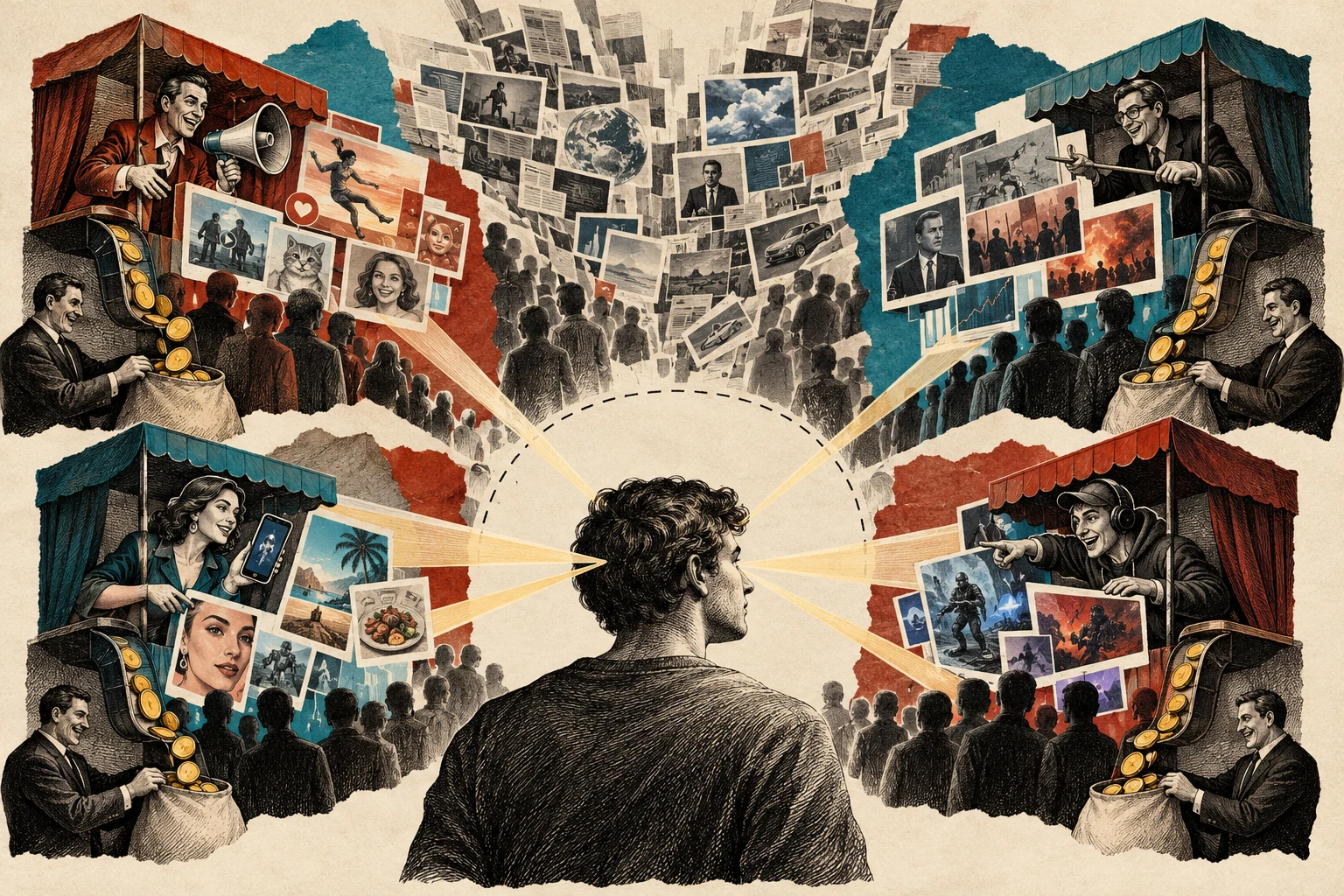
Media outlets compete for limited user attention and convert it into revenue; more available content does not create more time to take it in.
AI-assisted illustration · conceptual metaphor View in visual quiz →Genesis and Global Lineage
The foundational formulation was delivered by political scientist and economist Herbert A. Simon in a 1971 Johns Hopkins lecture on computers and the public interest: because information consumes the attention of its recipients, “a wealth of information creates a poverty of attention,” meaning that information systems in organizations should be designed to filter and conserve human attention rather than generate ever more reports. Simon was thinking about executive decision-making and institutional design, not advertising. A second step came in 1997 when physicist and writer Michael Goldhaber argued in First Monday and Wired that in cyberspace, attention would displace material production as the primary currency and source of wealth. Independently in the German-speaking world, economist and architectural theorist Georg Franck published Ökonomie der Aufmerksamkeit (The Economy of Attention, 1998), constructing a full theory of “mental capitalism” in which receiving others' attention functions as income, prestige acts as accumulated capital, and media outlets operate as attention banks—even in science, where citations serve as a parallel currency. Thomas Davenport and John Beck (2001) translated these insights into corporate management strategy, before legal scholar Tim Wu, in The Attention Merchants (2016), gave the concept its sweeping historical arc: the industrial harvesting of human attention began with Benjamin Day's 1830s New York penny press (selling newspapers below cost to resell readers' eyeballs to advertisers), expanded through commercial radio and television, and reached algorithmic perfection on mobile social platforms. Since Wu's book, the term has been largely absorbed by the “digital wellbeing” movement, where it often functions simply as an indictment of smartphone apps.
Central European Lineage
We found no documented link between this concept and the intellectual history or historical experience of Central Europe.
We found no documented link between this concept and the intellectual history or historical experience of Central Europe (by our methodology, this means “none found,” not “none exists”; as of October 2026).
Why Now
Between 2018 and 2026, the attention economy ceased to be merely a cultural critique and became the target of major legislation, antitrust enforcement, and mass tort litigation. In 2018, the Cambridge Analytica scandal demonstrated that commercial architectures built to capture and profile user attention double effortlessly as engines of political micro-targeting. In 2021, whistleblower Frances Haugen released internal Facebook research showing that the company was fully aware of how its engagement-maximizing ranking algorithms amplified civic polarization and harmed adolescent mental health. In response, the European Union's Digital Services Act (DSA, fully applicable since 2024) imposed binding obligations on Very Large Online Platforms to assess and mitigate systemic risks stemming from the design of their algorithmic recommendation feeds. In the United States, dozens of state attorneys general and hundreds of school districts filed lawsuits from 2023 onward against Meta and TikTok over addictive interface design (infinite scroll, autoplay, intermittent variable rewards), and in 2024 the US Surgeon General called for tobacco-style warning labels on social media platforms. Simultaneously, the explosion of generative AI since late 2022 drove the marginal cost of producing text, images, and video toward zero—making Herbert Simon's 1971 axiom more literal than ever: the supply of synthetic information is now effectively infinite, while the twenty-four-hour human day remains fixed.
Explanatory Power
The concept of the attention economy reveals the common structural denominator behind phenomena that otherwise appear unrelated. First, it explains why “free” digital services are often the most expensive in terms of social and cognitive cost: because the user pays no monetary price, there is no price signal to prompt rationing, while the platform optimizes the single variable it actually monetizes—time on device and ad impressions. Second, it accounts for the structural bias of online public spheres: when the reward function is rapid attention capture, content that triggers high-arousal emotions—moral outrage, novelty, fear, and tribal conflict—systematically outcompetes nuance regardless of factual accuracy. Third, it explains why public institutions, investigative newsrooms, and universities struggle against social platforms not because their content is inferior, but because they operate under incompatible constraints: an educational or civic institution cannot optimize solely for immediate dopamine capture without destroying its own mission. Finally, Simon's original formulation highlights where real power lies in an information glut: when attention is the scarce bottleneck, value is created not by producing more signals, but by filtering them—making recommendation algorithms, search rankings, and AI interfaces the decisive gatekeepers of social reality.
Axes of Debate
The market metaphor versus the ecology metaphor
Media theorists and philosophers such as Yves Citton (The Ecology of Attention, 2014/2017) argue that speaking of attention as a “currency” or “scarce resource” unwittingly naturalizes the very commodification it seeks to critique: if attention is framed as capital, trading and extracting it appears inevitable. They propose instead an ecology of attention, treating joint human focus as a fragile shared environment that can be polluted or cultivated. Strongest counterargument: Defenders of the economic framework reply that the market metaphor has unmatched descriptive precision because digital platforms literally price and trade human attention in real-time programmatic advertising auctions measured in milliseconds; ecology is a normative aspiration, whereas the attention market is an accounting reality. Nature of the dispute: mixed — a disagreement over conceptual metaphors that masks a substantive policy dispute over whether the problem requires regulating ad-tech markets or cultivating new cultural habits of focus.
Addictive behavioral design versus individual agency and media panic
Former platform designers and digital-wellbeing advocates (such as Tristan Harris and the Center for Humane Technology) argue that features like infinite scroll, push notifications, and algorithmic feeds are deliberately engineered on the model of Las Vegas slot machines to hijack subcortical reward pathways, making appeals to individual willpower inadequate. Strongest counterargument: Empirical psychologists skeptical of the “smartphone addiction” diagnosis (such as Andrew Przybylski and Amy Orben) point out that longitudinal studies often show small or noisy correlations between raw screen time and adolescent depression, warning that every new medium—from eighteenth-century novels to comic books and television—has triggered a moral panic that medicalizes ordinary habits and strips users of agency. Nature of the dispute: substantive — an empirically testable dispute over causal effect sizes and mechanisms, though independent verification remains hampered by platforms' refusal to share granular internal telemetry with outside researchers.
Radical digital rupture versus the long history of commercial media
Contemporary critics of Silicon Valley often portray the attention economy as an unprecedented twenty-first-century rupture created by smartphones and social networks. Strongest counterargument: Historians of media following Tim Wu demonstrate that the core two-sided business model—subsidizing content to harvest audience attention and resell it to advertisers—was invented in the 1830s penny press and perfected by twentieth-century broadcast networks; what is genuinely new today is not the commercial principle, but continuous mobile access, individualized behavioral feedback loops, and automated A/B testing. Nature of the dispute: substantive — how one answers determines whether effective regulation should target specific interface features of social apps or the underlying economic model of behavioral advertising itself.
Underappreciated Angle
Herbert Simon's 1971 lecture was not a jeremiad about advertising, but a constructive treatise on organizational architecture, and its central design rule has been almost completely forgotten in popular debate: in an information-rich world, a machine or organizational unit is valuable only if it absorbs more information than it emits—that is, if it acts as an attention-conserving filter rather than a loudspeaker. In Simon's example, the US State Department failed to process foreign intelligence not because it lacked cables from embassies, but because printing presses and photocopiers allowed every desk to multiply documents without expanding the cognitive bandwidth of decision-makers at the top. Today, that exact pathology defines two arenas rarely analyzed together: modern public and corporate bureaucracies drowning in automated compliance reporting, and the rise of large language models, which for the first time lower the cost of summarizing and filtering information just as radically as the internet lowered the cost of publishing it. The crucial question Simon posed half a century ago—who designs the filter, and whose priorities are baked into what it discards—is now the central political question of artificial intelligence: whoever controls the summarizing agent controls what enters human consciousness.
One-Sentence Takeaway
In an world of infinite information, value belongs to the filter—and if you do not pay for the filter, someone else is paying it to steer where you look.
Related Concepts Network
How this concept reinforces, constrains, or complements other analytical frameworks in the corpus. View on graph →
-
Surveillance capitalism reinforces
Shoshana Zuboff analyzes what platforms do with the behavioral data harvested while capturing user attention; the attention economy explains why capturing that gaze is profitable in the first place.
-
Enshittification complements
Platform decay is the late stage of a cycle in which user attention accumulated through a subsidized service is progressively monetized at the expense of both users and business customers.
-
Doomscrolling reinforces
Compulsively scrolling through bad news is an individual behavioral pattern engineered by a market in which every additional second of screen time commands a price.
-
Nudge and behavioral economics complements
Choice-architecture techniques supply the micro-tools with which attention merchants lower the friction of staying on a platform and raise the cognitive cost of leaving.
-
Platformization complements
The digital platform is the organizational form in which the attention market operates at industrial scale: a two-sided market matching human eyeballs with advertisers.
-
Technofeudalism in tension
If dominant platforms extract rent for market access rather than merely selling attention on a competitive market, the metaphor of an “attention market” obscures the shift from merchant to feudal lord.
-
Information theory constrains
Claude Shannon's mathematical theory of information measures channel capacity rather than human comprehension; Herbert Simon inverted that perspective by showing that the true bottleneck is the recipient's scarce capacity to process signals.
Reading Canon & Translation Bridge
Foundational texts, introductions, and critical perspectives—with availability of English and Polish editions.
-
foundational text 1971 · English
Herbert A. Simon, Designing Organizations for an Information-Rich World
A lecture in the Johns Hopkins series (in Martin Greenberger, ed., Computers, Communications, and the Public Interest) containing the foundational dictum that a wealth of information creates a poverty of attention; a concise text that remains the essential starting point.
In English: original text written in English
In Polish: Polish edition not verified
-
foundational text 1997 · English
Michael H. Goldhaber, The Attention Economy and the Net
An essay in First Monday (vol. 2, no. 4) that turned Simon's organizational insight into a manifesto for the internet age: attention as the new primary currency and form of property on the web, complete with the utopian overtones of the 1990s.
In English: original text written in English
In Polish: Polish edition not verified
-
foundational text 1998 · German
Georg Franck, Ökonomie der Aufmerksamkeit. Ein Entwurf
The most systematic theoretical treatment: other people's attention as income, prestige as capital, and mass media as attention banks, written from the perspective of an economist and urban theorist rather than a pundit.
In English: English edition not verified
In Polish: Polish edition not verified
-
introduction & synthesis 2001 · English
Thomas H. Davenport, John C. Beck, The Attention Economy: Understanding the New Currency of Business
The managerial version: defining attention as focused mental engagement and offering a playbook for allocating it inside corporations, illustrating how quickly the concept traveled from critique to business-school textbook.
In English: original text written in English
In Polish: Polish edition not verified
-
introduction & synthesis 2016 · English
Tim Wu, The Attention Merchants: The Epic Scramble to Get Inside Our Heads
A sweeping history of the attention industry from the 1830s New York penny press to Facebook; Wu demonstrates a recurring historical cycle in which every new medium for harvesting human attention eventually provokes an audience revolt.
In English: original text written in English
In Polish: Polish edition not verified
-
critical perspective 2014 · French
Yves Citton, Pour une écologie de l'attention
Replaces the market metaphor with an ecological one (English translation: The Ecology of Attention, 2017): human attention is not a discrete commodity to be allocated, but a shared environment we inhabit together and can collectively degrade.
In English: English edition not verified
In Polish: Polish edition not verified
-
cross-disciplinary 2013 · English
Jonathan Crary, 24/7: Late Capitalism and the Ends of Sleep
An art historian examines human sleep as the final biological frontier not yet colonized by nonstop attention markets; a dense essay that extends the problem from economics into aesthetics and bodily politics.
In English: original text written in English
In Polish: “24/7. Późny kapitalizm i celowość snu”, Karakter 2015, trans. Dariusz Żukowski
Primary-Source Quotes
What information consumes is rather obvious: it consumes the attention of its recipients. Hence a wealth of information creates a poverty of attention.