Technofeudalism
original term: technofeudalism (Eng.) · technofeudalizm, techno-féodalisme, neofeudalizm cyfrowy
Central European lineage: 1 thread (counterpoint) · 2022–2023 · jump to documentation ↓
Working Definition
Technofeudalism is the thesis that an economy dominated by hyperscale digital platforms has ceased to operate according to the classical capitalist logic of competitive markets and profit from commodity production, and now operates according to a neo-feudal logic of digital fiefdoms and rent extraction: the owner of essential digital infrastructure (a cloud network, an app store, an e-commerce marketplace, or an algorithmic feed) replaces the market itself with a privately owned territory and levies a toll on everyone who must cross it. In Yanis Varoufakis's formulation, cloud capital creates two new subordinate classes alongside traditional wage workers: cloud serfs (billions of users who perform unpaid labor by uploading photos, reviews, and behavioral traces that train platform algorithms) and cloud vassals (capitalist manufacturers, merchants, and app developers who pay a 15–40% tribute to Amazon, Apple, or Google just to reach customers). In a weaker, analytically more cautious version, the term simply highlights that infrastructural rent has displaced industrial profit as the primary source of valuation at the commanding heights of the economy.
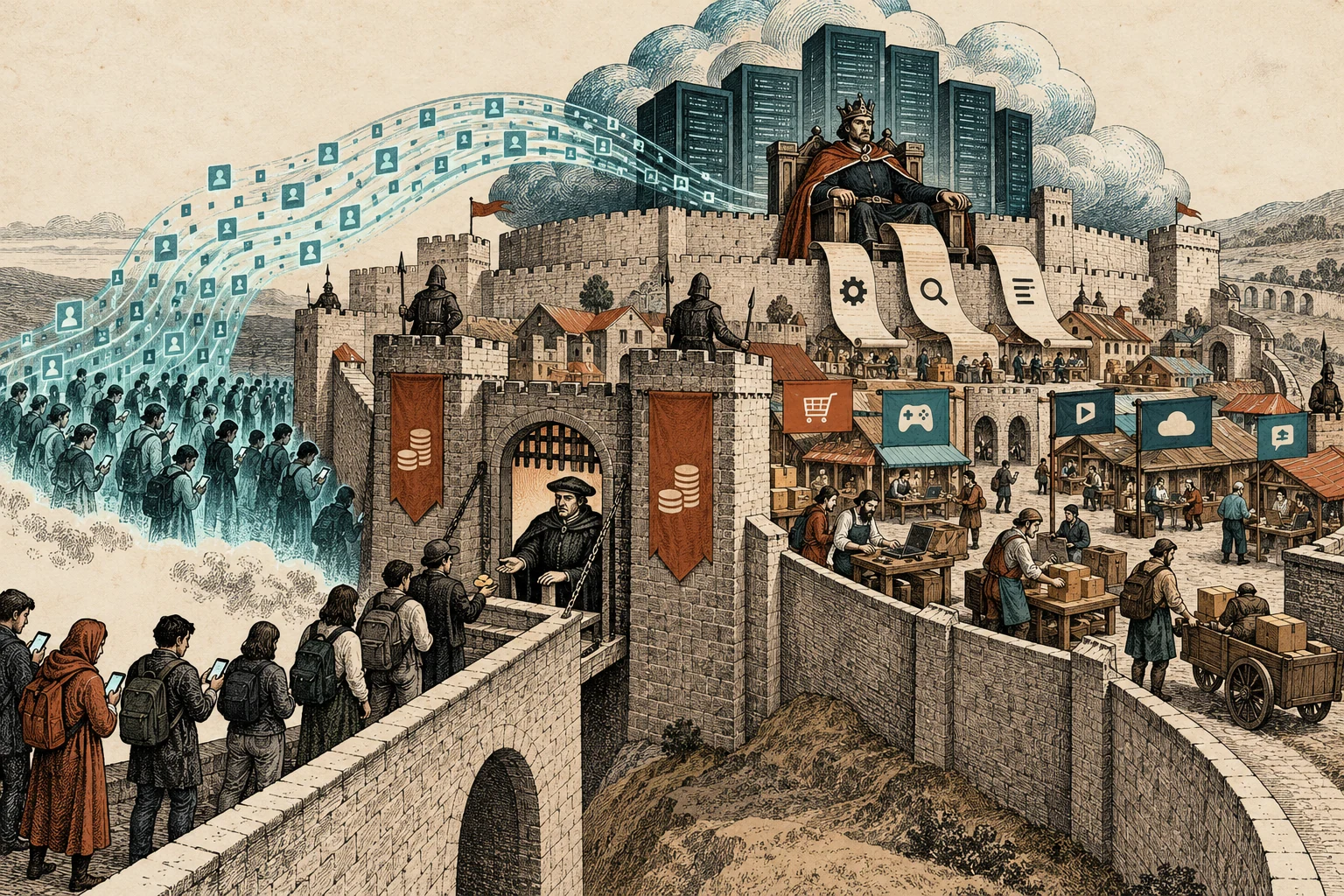
A private owner of digital infrastructure extracts fees from dependent participants; the feudal setting depicts a contested economic analogy rather than a literal return to the Middle Ages.
AI-assisted illustration · conceptual metaphor View in visual quiz →Genesis and Global Lineage
Feudal metaphors entered critiques of the digital economy along several tracks over two decades. In A Hacker Manifesto (2004), McKenzie Wark argued that a “vectoralist class” controlling the vectors of information distribution had subordinated both workers and industrial capitalists, while cryptographer Bruce Schneier popularized “feudal security” in 2012 to describe users surrendering device control to cloud vendors. The contemporary debate crystallized between 2020 and 2023 around three texts: Jodi Dean's essay Neofeudalism: The End of Capitalism? (May 2020), French regulation-school economist Cédric Durand's book Technoféodalisme (September 2020; English translation 2024), and Yanis Varoufakis's bestseller Technofeudalism: What Killed Capitalism (2023). While Durand grounded the concept in Schumpeter, Veblen, and intellectual monopolies, Varoufakis linked it to post-2008 macroeconomic history: arguing that trillions of dollars in central-bank quantitative easing injected after the Global Financial Crisis bypassed industrial investment and instead financed Big Tech's construction of cloud fiefdoms. Since 2023, the term has been adopted both by left-wing critics of Silicon Valley and by European industrial-sovereignty advocates warning that Europe risks becoming a “cloud vassal” of American and Chinese tech lords.
Central European Lineage
The most rigorous theoretical critique delimiting the concept of technofeudalism came from a writer formed intellectually in Eastern and Central Europe. Evgeny Morozov—born in 1984 in the Belarusian potash-mining town of Salihorsk, educated at the American University in Bulgaria in Blagoevgrad, and professionally formed in Prague as Director of New Media at Transitions Online (the Czech non-profit journalism organization founded in 1999 to cover post-communist Central and Eastern Europe)—published his landmark essay Critique of Techno-Feudal Reason in New Left Review in early 2022, responding directly to Durand, Dean, and Varoufakis's early lectures. Drawing on the classic Marxist historiography of the transition from feudalism to capitalism (Maurice Dobb, Paul Sweezy, and Robert Brenner), Morozov argued that the Western left's fondness for “feudal-speak” is a testament to intellectual weakness: by labeling Google or Amazon “feudal,” critics implicitly paint nineteenth- and twentieth-century industrial capitalism as a lost golden age of fair competition, while mistaking normal capitalist mechanisms—intellectual-property rents, vertical integration, and dispossession—for the death of capitalism. Morozov's skepticism toward sweeping regime-change labels resonates strongly in a post-socialist region that watched state monopolies turn into private oligarchies in the 1990s—and where the historical memory of actual East-Elbian serfdom (pańszczyzna) makes scholars cautious about equating an iPhone user uploading a selfie with a peasant bound to the soil by physical coercion.
Documented regional lineage · Link: 1. Compiled: October 2026.
-
counterpoint 1 year
Central European Source: Evgeny Morozov, “Studia w American University in Bulgaria; praca jako dyrektor ds. nowych mediów w czeskiej organizacji Transitions Online; następnie „Critique of Techno-Feudal Reason” (Studies at the American University in Bulgaria; work as Director of New Media at the Czech NGO Transitions Online; subsequently “Critique of Techno-Feudal Reason”)”; Blagoevgrad, Bulgaria; Czech Republic (now Czechia), 2022
Global Circulation: technofeudalism — Yanis Varoufakis, 2023
counterpoint
1 yearEvgeny Morozov, “Studia w American University in Bulgaria; praca jako dyrektor ds. nowych mediów w czeskiej organizacji Transitions Online; następnie „Critique of Techno-Feudal Reason” (Studies at the American University in Bulgaria; work as Director of New Media at the Czech NGO Transitions Online; subsequently “Critique of Techno-Feudal Reason”)”
2022 · Blagoevgrad, Bulgaria; Czech Republic (now Czechia)
technofeudalism
2023 · Yanis Varoufakis
- Claim & Connection
- Evgeny Morozov—born in 1984 in Salihorsk, Belarus, educated at the American University in Bulgaria, and professionally formed as Director of New Media at the Prague-based media organization Transitions Online—published the most influential theoretical rebuttal of the technofeudalism thesis in his essay “Critique of Techno-Feudal Reason” (New Left Review 133/134, 2022). Morozov argues that the left's embrace of “feudal-speak” is a symptom of intellectual weakness that substitutes moralizing medieval metaphors for a rigorous analysis of digital capitalism, and shows that Yanis Varoufakis's version largely repackages his earlier macroeconomic arguments about post-2008 quantitative easing. This link represents a critical counterpoint from the region that delimits the concept rather than its origin.
- Source Documentation
-
- primary source Evgeny Morozov, „Critique of Techno-Feudal Reason”, New Left Review 133/134, styczeń–kwiecień 2022; Part I: “feudal-speak” as a testament to intellectual weakness; section dissecting Varoufakis and quantitative easing. newleftreview.org ↗
- biographical record Wikipedia (en), „Evgeny Morozov”; sections Early life and Career: born 1984 in Salihorsk, Belarus; BA at American University in Bulgaria; Director of New Media at Transitions Online. en.wikipedia.org ↗
- scholarly study Wikipedia (en), „Transitions Online”; paragraph 1: organization founded in April 1999 as a Czech non-profit association based in Prague. en.wikipedia.org ↗
- Historical Context
- Belarus (birthplace) and Czechia (early professional formation at Transitions Online in Prague) belong to the core region, while Bulgaria (undergraduate education) belongs to the Balkan neighborhood. Note that Morozov's 2022 essay precedes Varoufakis's 2023 book because it engaged directly with Varoufakis's 2021–2022 lectures and essays introducing the term.
Why Now
Three developments between 2020 and 2026 gave the feudal metaphor immediate traction. First, legal battles over platform commissions—Epic Games v. Apple (2020–2024) and the EU Digital Markets Act from 2024—put a hard percentage on “cloud rent”: the 30% toll levied by Apple and Google on digital transactions inside their mobile ecosystems, where the platform acts simultaneously as landlord, tax collector, and court. Second, the COVID-19 pandemic and the post-2022 generative AI boom exposed the infrastructural choke hold of the three cloud hyperscalers (AWS, Microsoft Azure, Google Cloud): even frontier AI startups (OpenAI, Anthropic) pay billions in cloud-compute rent to the tech giants that are simultaneously their equity investors and rivals. Third, the fusion of infrastructural ownership with personal political power—from Elon Musk's 2022 acquisition of Twitter/X and control over Starlink in wartime Ukraine to tech billionaires at the center of US executive power in 2025—made the figure of the “digital lord” feel like a literal description of sovereignty.
Explanatory Power
Technofeudalism shifts attention from market share within a sector to ownership of the marketplace itself. First, when a consumer searches for “running shoes” on Amazon, they are no longer inside a classical market where buyers and sellers meet on neutral ground; they are inside a privately owned algorithmic enclosure that shows each user a personalized storefront and forces manufacturers to bid for sponsored placement just to be seen—converting industrial profit into platform rent. Second, it explains the coexistence of soaring corporate valuations with sluggish physical investment: a firm taxing access to an intangible digital bottleneck has less incentive to build factories than to deepen lock-in. Third, it captures the predicament of app developers, merchants, and publishers (“vassals”): unlike a classic supplier selling wholesale to a retailer, a third-party seller on Amazon or an app studio on iOS bears 100% of capital risk and labor liability while remaining subject to sudden expulsion if the algorithm changes or the landlord launches a competing house-brand product.
Axes of Debate
Has technofeudalism actually replaced capitalism, or is this just monopoly capitalism?
Yanis Varoufakis, Cédric Durand, and Jodi Dean argue that when rent extraction displaces profit and algorithmic fiefdoms displace decentralized markets as the engine of accumulation, retaining the word “capitalism” obscures a systemic rupture. Evgeny Morozov, Nick Srnicek, and mainstream political economists counter that rent-seeking and intellectual-property tolls have been integral to capitalism since Ricardo and Marx, and that Big Tech firms remain capitalist corporations subject to fierce rivalry (as in the AI race), massive fixed-capital depreciation in data centers, and shareholder discipline. Strongest counterargument: A medieval lord never had to reinvest tens of billions of dollars every quarter in rapidly depreciating silicon chips out of fear that a rival fiefdom would lure away his serfs with a better short-video algorithm or language model; the compulsion to innovate and accumulate fixed capital proves that capitalist competition remains in force. Nature of the dispute: mixed — beneath a semantic dispute over historical periodization lies a substantive disagreement over whether inter-platform competition still disciplines tech giants.
Analytical political economy versus misleading medieval metaphor
Economic historians and medievalists (following Marc Bloch's Feudal Society) note that historical feudalism was a decentralized system of personal oaths, military service, and mutual obligations under parcellized sovereignty—the opposite of hyper-centralized global corporations governed by California contract law. Cédric Durand defends the term as a precise category describing intellectual monopoly, switching-cost lock-in, and macroeconomic predation. Strongest counterargument: Even if the analogy to tenth-century vassalage is loose, the metaphor captures an experiential truth that neoclassical economics' vocabulary of “two-sided market externalities” conceals: the asymmetrical dependence of small businesses and citizens on the arbitrary rulebook of a private sovereign. Nature of the dispute: rhetorical in popular punditry, but substantive in Durand's and Morozov's technical debates over economic rent and productive investment.
What drove the shift: central-bank monetary policy or digital network architecture?
Varoufakis places primary causal weight on post-2008 monetary policy: over a decade of near-zero interest rates and quantitative easing flooded markets with cheap liquidity that Big Tech captured to build cloud infrastructure. Platform scholars such as Nick Srnicek and Shoshana Zuboff locate the cause in the intrinsic properties of digital data, zero marginal reproduction costs, and two-sided network effects, which drive winner-take-all concentration under any monetary regime. Strongest counterargument: China's digital giants (Alibaba, Tencent, ByteDance) built equally entrenched “cloud fiefdoms” and super-apps under a completely different monetary and financial system than Western quantitative easing—suggesting that digital network topology and state industrial policy matter more than central-bank bond buying alone. Nature of the dispute: substantive — it determines whether the remedy lies in reforming central banking and corporate finance or in mandating open protocols and interoperability.
Underappreciated Angle
While technofeudalism was coined to diagnose Silicon Valley and Shenzhen, its most revealing insight concerns the quiet transformation of the modern state from sovereign regulator into paying cloud vassal. A digital fiefdom endures because the territorial state first privatized telecommunications infrastructure and then made its daily operations—tax administration, schools, hospital records, defense logistics, and law enforcement—dependent on renting server capacity and software licenses from the three hyperscalers it claims to regulate. For Central and Eastern Europe, this paradox carries a sharp historical echo: during the post-1989 transition, states privatized banking and telecommunications infrastructures to foreign strategic investors, only to discover how difficult it is to exercise regulatory power over an infrastructure you no longer own. Viewed from this angle, the decisive question is who holds the position of suzerain: in China, the Communist Party demonstrated after 2020 that platform lords remain subordinate to the state; in the United States, the boundary between executive power and cloud owners has blurred; and in the European Union, the regulator writes ambitious rulebooks while paying monthly cloud rent to the regulated.
One-Sentence Takeaway
Debating whether dominant platforms are “capitalist” or “feudal” tells us less about the middle Ages than about our present predicament: we have allowed private corporations to stop competing in the market and start owning the territory where the market meets.
Related Concepts Network
How this concept reinforces, constrains, or complements other analytical frameworks in the corpus. View on graph →
-
Surveillance capitalism in tension
Shoshana Zuboff analyzes behavioral data extraction as a rogue mutation within capitalism, whereas Yanis Varoufakis contends that the same infrastructural extraction has killed capitalism and replaced it with a rentier order; the dispute concerns the diagnosis of the macro-system rather than the description of platform practices.
-
Rent-seeking reinforces
Extracting a toll for access to a digital marketplace (“cloud rent”) is the core economic mechanism of technofeudalism; classical rent theory allows economists to model the phenomenon without relying on medieval metaphors.
-
Platformization complements
Platformization describes the institutional process by which digital intermediaries capture sector after sector; technofeudalism proposes a macro-historical name for the socio-economic regime that results.
-
Enshittification reinforces
Cory Doctorow's stage-three platform decay—squeezing locked-in users and business customers simultaneously—is the everyday micro-practice of cloud rent extraction viewed from the product side.
-
Network effects complements
Network effects explain why digital fiefdoms hold their subjects without physical walls: the cost of leaving rises with every additional buyer and seller who remains inside the platform.
-
Adversarial interoperability constrains
Unpermissioned interoperability offers a concrete technical and legal weapon to break open digital fiefdoms—supplying the practical policy remedy that fatalistic technofeudal diagnoses often lack.
-
Late capitalism in tension
Both concepts diagnose the contemporary political economy, but “late capitalism” insists on the unbroken continuity of capitalist accumulation laws, whereas technofeudalism proclaims a structural rupture.
Reading Canon & Translation Bridge
Foundational texts, introductions, and critical perspectives—with availability of English and Polish editions.
-
foundational text 2023 · English
Yanis Varoufakis, Technofeudalism: What Killed Capitalism
The book that brought the term into global public circulation: cloudalists, cloud capital, cloud serfs, and cloud vassals, framed as a personal letter to the author's Marxist metallurgist father.
In English: original text written in English
In Polish: “Technofeudalizm. Co zabiło kapitalizm?”, Wydawnictwo Glowbook 2024, trans. Paweł Szadkowski
-
foundational text 2020 · French
Cédric Durand, Technoféodalisme. Critique de l'économie numérique
An earlier, more systematic treatise in French regulation-school political economy (English translation: How Silicon Valley Unleashed Technofeudalism, 2024), analyzing intellectual monopoly, algorithmic predation, and macroeconomic stagnation.
In English: English edition not verified
In Polish: Polish edition not verified
-
critical perspective 2022 · English
Evgeny Morozov, Critique of Techno-Feudal Reason
The most searching theoretical critique (New Left Review 133/134): revisits the classic Marxist transition debates (Dobb, Sweezy, Brenner) to show that contemporary platform giants remain thoroughly capitalist firms driven by competitive accumulation and intellectual-property law.
In English: original text written in English
In Polish: Polish edition not verified
-
introduction & synthesis 2020 · English
Jodi Dean, Neofeudalism: The End of Capitalism?
A widely read essay in the Los Angeles Review of Books (May 12, 2020) that crystallized the broader American debate over neofeudalism: parcelized sovereignty, platform lords, extreme hinterland inequality, and catastrophic anxiety.
In English: original text written in English
In Polish: Polish edition not verified
-
cross-disciplinary 2019 · English
Shoshana Zuboff, The Age of Surveillance Capitalism: The Fight for a Human Future at the New Frontier of Power
The major competing diagnosis of the exact same digital giants that retains the noun “capitalism”—reading Zuboff alongside Varoufakis clarifies what is analytically at stake in choosing between the two labels.
In English: original text written in English
In Polish: “Wiek kapitalizmu inwigilacji. Walka o przyszłość ludzkości na nowej granicy władzy”, Zysk i S-ka 2020, trans. Alicja Unterschuetz
-
cross-disciplinary 1939 · French
Marc Bloch, La société féodale
The classic Annales-school historical study of medieval European feudalism; indispensable for testing how much of the platform–fiefdom analogy is structural analysis and how much is rhetorical flourish.
In English: English edition not verified
In Polish: “Społeczeństwo feudalne”, Państwowy Instytut Wydawniczy 1981, trans. Eligia Bąkowska
Primary-Source Quotes
the popularity of feudal-speak is a testament to intellectual weakness, rather than media savviness
Capitalism is turning itself into neofeudalism.