Adversarial interoperability
original term: adversarial interoperability (Eng.) · interoperacyjność bez zgody, competitive compatibility, comcom
Global-circulation concept — no documented lineage in Central Europe. jump to documentation ↓
Working Definition
Adversarial interoperability (also termed competitive compatibility or comcom) is the practice of creating a new product or service that plugs into, reads the file formats of, or interfaces with an existing dominant system against the wishes and without the permission of that system's owner: reverse-engineering a proprietary protocol, building an alternative third-party client, refilling a chipped printer cartridge, or stripping ads and trackers from a webpage. Introduced by Cory Doctorow in 2019, the concept contrasts this practice with indifferent interoperability (where a manufacturer does not care who makes accessories, like a standard wall socket) and cooperative interoperability (where firms voluntarily agree on a shared standard or open API). While casual shorthand sometimes equates it with “consumer-friendly hacking,” analytically it describes a legal-technical regime in which clean-room reverse engineering, bots, scrapers, and format converters are protected from intellectual-property and computer-crime liability, allowing insurgents to overcome network effects by piggybacking on an incumbent's installed base.
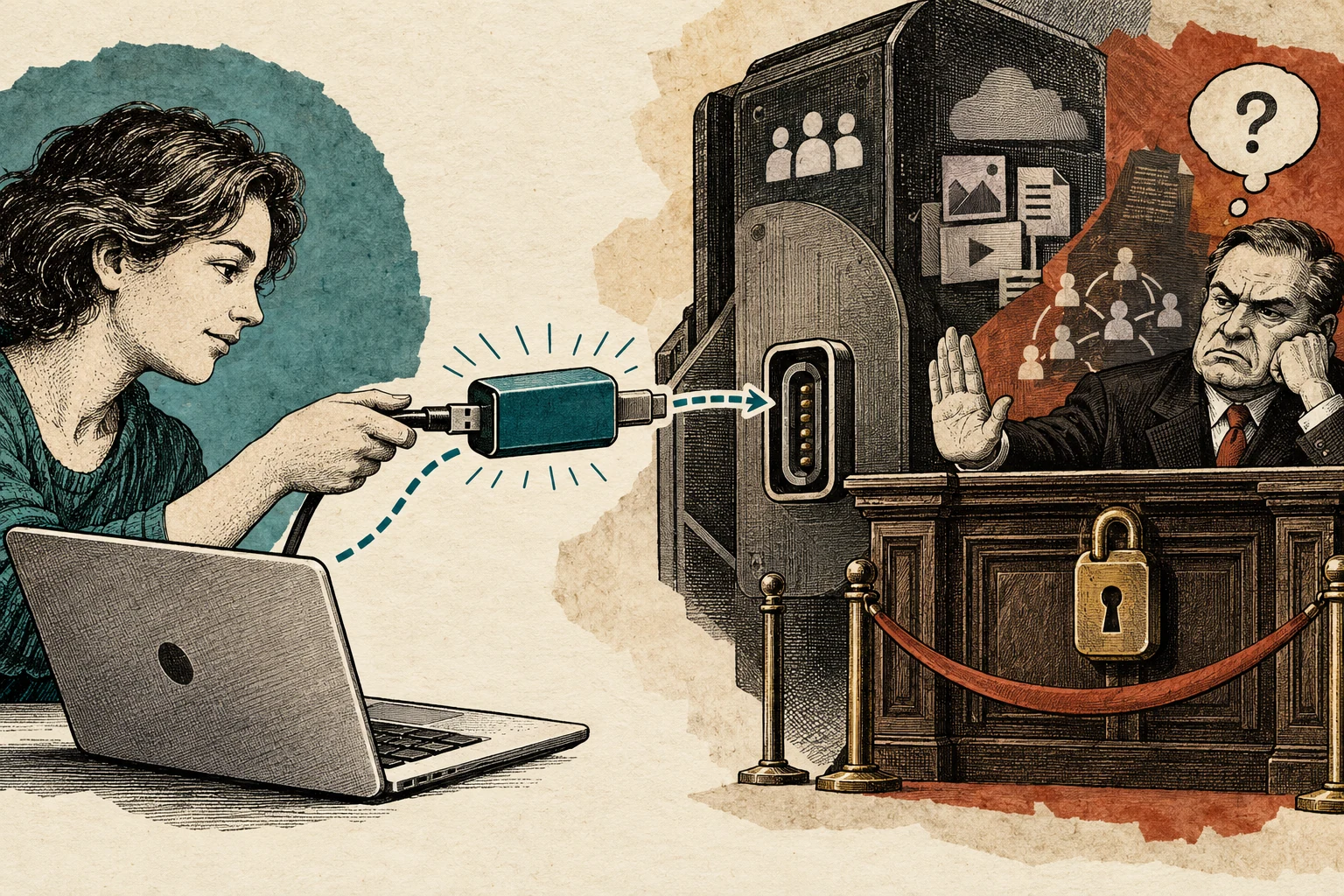
An independent adapter enables interoperation without the closed-system owner's approval, centering user agency and compatibility.
AI-assisted illustration · conceptual metaphor View in visual quiz →Genesis and Global Lineage
The phrase was coined by Cory Doctorow in a series of essays on the Electronic Frontier Foundation (EFF) Deeplinks blog between June and October 2019—calling it “an elegant weapon for a more civilized age”—and expanded into a policy program in Chokepoint Capitalism (with Rebecca Giblin, 2022) and The Internet Con (2023). Doctorow's core historical argument is that today's tech monopolies were themselves built through adversarial interoperability before kicking away the ladder: in the 1980s, Phoenix Technologies and Compaq used clean-room reverse engineering to clone the IBM PC BIOS; Andrew Tridgell's Samba reverse-engineered Microsoft's SMB protocol so Linux servers could join Windows workgroups; Apple built iWork to read and write Microsoft .doc files without Redmond's blessing; and Facebook scaled early on by providing tools that scraped users' messages and friend lists out of MySpace. Intellectually, the concept synthesizes the cyberlaw tradition of Lawrence Lessig (Code, 1999), Pamela Samuelson and Suzanne Scotchmer (The Law and Economics of Reverse Engineering, 2002), and Jonathan Zittrain (The Future of the Internet, 2008). Doctorow argues that this generative dynamic was strangled after 1998 by a legal thicket—Section 1201 of the US Digital Millennium Copyright Act (DMCA) banning DRM circumvention, the Computer Fraud and Abuse Act (CFAA) treating terms-of-service violations as felony hacking, software patents, and clickwrap licenses—which turned unauthorized compatibility into a crime. Since 2020, Doctorow has also used the synonym competitive compatibility (comcom) so policymakers do not mistake pro-consumer competition for cyberwarfare.
Central European Lineage
We found no documented link between this concept and the intellectual history or historical experience of Central Europe.
We found no documented link between this concept and the intellectual history or historical experience of Central Europe (by our methodology, this means “none found,” not “none exists”; as of October 2026).
Why Now
Between 2019 and 2026, the question of who may legally plug into a dominant platform moved to the center of technology regulation. In 2019, the expert report Competition Policy for the Digital Era (by Jacques Crémer, Yves-Alexandre de Montjoye, and Heike Schweitzer) placed interoperability on the European Commission's agenda, leading to the EU Digital Markets Act (DMA, enforced from 2024), which requires designated “gatekeepers” to open messaging services (such as WhatsApp) and mobile operating systems (such as iOS) to third-party app stores and payment systems. Doctorow entered this debate with a warning: top-down mandates alone let incumbents game standards committees, whereas legalizing bottom-up adversarial interoperability lets nimble competitors route around foot-dragging gatekeepers. Simultaneously, high-profile flashpoints dramatized the struggle: the “Right to Repair” movement battling John Deere over encrypted tractor diagnostics and Apple over parts pairing; Twitter/X and Reddit shutting down free API access in 2023 to kill third-party clients like Apollo; Apple blocking Beeper Mini in December 2023 after it reverse-engineered iMessage for Android users; and the rise of federated social networks (Mastodon/ActivityPub, Bluesky/AT Protocol) designed to prevent any company from locking in the social graph.
Explanatory Power
Adversarial interoperability explains why network effects alone do not make digital monopolies immortal—and why legal shields, rather than superior engineering, keep users trapped. First, it exposes the “ladder-kicking” pattern of Silicon Valley history: nearly every dominant platform used unpermissioned scraping, protocol emulation, or format conversion when it was a challenger, then lobbied for strict anti-circumvention and anti-scraping laws once it became the incumbent. Second, it shows that switching costs are a policy choice rather than a law of physics: leaving Facebook or WhatsApp feels impossible today because leaving means losing contact with friends who stay behind; if an independent client were legally permitted to read and write messages into Facebook's network without Meta's consent, a user could leave the company without leaving the community. Third, it illuminates the hidden danger of complex compliance mandates: when governments impose duties that only a trillion-dollar incumbent can automate, and allow that incumbent to invoke “security compliance” to block third-party clients, regulation inadvertently cements the monopoly's moat.
Axes of Debate
Top-down regulatory mandates (DMA) versus a bottom-up right to technical self-help
European competition scholars and regulators (such as the architects of the Digital Markets Act) favor cooperative, regulated interoperability: the state designates gatekeepers, specifies formal API standards, and oversees compliance. Doctorow and the EFF argue that statutory mandates are necessary but insufficient: because tech giants can spend years stalling standards bodies and sabotaging official APIs with fees and restrictions, the law must also create a safe harbor for adversarial interoperability—stripping platforms of the right to sue competitors who reverse-engineer their way in when the official door is jammed. Strongest counterargument: Critics of unilateral self-help reply that adversarial cat-and-mouse warfare (where a startup reverse-engineers a protocol on Monday, the giant breaks it on Wednesday, and the startup pushes a workaround on Friday) creates a brittle experience that ordinary consumers will never trust; durable competition requires legally enforced interconnection rules backed by state fines, as in telecommunications. Nature of the dispute: substantive — a disagreement over regulatory institutional design and whether state-supervised APIs or permissionless technical insurgency better disciplines monopolies.
Privacy and cybersecurity: genuine risk or monopolist alibi?
Platform incumbents (Apple, Meta) and many cybersecurity engineers warn that allowing unvetted third-party clients, scrapers, and side-loaded app stores to bypass platform controls undermines end-to-end encryption, malware screening, and user privacy—pointing out that technically, an adversarial tool scraping your friends' posts for a rival app looks identical to Cambridge Analytica. Strongest counterargument: Proponents of adversarial interoperability reply that incumbents invoke “privacy and security” hypocritically—blocking a user's ad blocker or repair shop while selling behavioral tracking access to data brokers; more fundamentally, the law can distinguish between a tool acting as a fiduciary agent at the explicit direction of an individual user and bulk commercial surveillance scraping strangers' data without consent. Nature of the dispute: mixed — the engineering tension between open access and centralized security is real, but dominant firms routinely weaponize security rhetoric to protect 30% app-store rents.
Restoring competitive markets versus building a non-market digital commons
Doctorow frames adversarial interoperability primarily in the Neo-Brandeisian language of dynamic market competition, small-business entrepreneurship, and consumer choice. Advocates of the free-software movement and the non-commercial Fediverse counter that letting venture-backed startups piggyback on incumbent networks reproduces the same extractive attention economy under new management; the real goal should be open public protocols governed as a non-capitalist commons. Strongest counterargument: Open federated protocols like ActivityPub are essential, but while 98% of the public remains inside proprietary walled gardens, waiting for users to migrate en masse to non-commercial servers is a recipe for marginality; adversarial bridges that let users leave the walled garden while keeping their existing social connections are the only practical way to populate the commons. Nature of the dispute: substantive — it concerns the ultimate political-economic horizon of digital reform: competitive capitalism versus a public/cooperative digital commons.
Underappreciated Angle
Although adversarial interoperability is usually discussed as a concept in software engineering or antitrust law, at its deepest level it is a struggle over where the boundary of private property ends. In twentieth-century manufacturing, the doctrine of exhaustion (or the first-sale doctrine) drew a bright legal line at the point of purchase: once you bought a car, a tractor, or a toaster, the manufacturer's property right in that object was exhausted, and any independent mechanic or parts maker had the right to open the hood, study how the bolts fitted together, and manufacture a compatible spare part without asking permission. By embedding encrypted microchips and copyrighted firmware into physical goods—from printer cartridges and insulin pumps to John Deere tractors and iPhone screens—and wrapping every digital service in a restrictive license rather than a sale, corporations shifted the legal boundary from the physical object to the interface. Once the interface is protected by anti-circumvention felonies, ownership dissolves into revocable tenancy. Crucially, after 2023 this legal battle flipped polarity in generative AI: the very tech giants that spent two decades using the CFAA and terms of service to outlaw small developers from scraping their walled gardens invoked a sweeping right to unpermissioned scraping when devouring the open web to train their proprietary foundation models—while locking those models behind strict terms that forbid anyone else from distilling or interoperating with them. Asking “who has the right to adversarial interoperability?” exposes this double standard immediately.
One-Sentence Takeaway
Digital monopolies endure not because no engineer can figure out how to plug into their networks, but because thirty years of IP and computer-crime law made plugging in without the monopolist's permission illegal.
Related Concepts Network
How this concept reinforces, constrains, or complements other analytical frameworks in the corpus. View on graph →
-
Enshittification reinforces
Cory Doctorow identifies the legal suppression of adversarial interoperability as the key structural condition that allows dominant platforms to degrade their services without losing locked-in users.
-
Network effects constrains
Plugging into an incumbent platform without its permission allows a new entrant to tap into the incumbent's existing network of users—neutralizing the entry barrier that network effects otherwise erect.
-
Platformization in tension
Platformization rests on asymmetric control over APIs and walled gardens; adversarial interoperability strips the platform owner of the power to decide who may connect and on what terms.
-
Surveillance capitalism complements
Unpermissioned client tools—such as browser ad blockers, tracker-stripping extensions, and alternative front-ends—serve as everyday technical self-defense against behavioral data extraction.
-
Digital sovereignty complements
Protecting the legal right to reverse-engineer and plug into proprietary foreign systems is a bottom-up instrument through which users and domestic firms can reduce lock-in to extraterritorial tech giants.
-
Tragedy of the commons in tension
Open interfaces create a shared technical commons; the recurring dispute is whether unpermissioned access leads to generative innovation or to spam, scraping abuse, and privacy breaches.
Reading Canon & Translation Bridge
Foundational texts, introductions, and critical perspectives—with availability of English and Polish editions.
-
foundational text 2019 · English
Cory Doctorow, Adversarial Interoperability
The landmark essay on the Electronic Frontier Foundation's Deeplinks blog (October 2, 2019) that defined the term and assembled its canonical historical cases: IBM PC BIOS clones, Samba, third-party printer ink, and ad blockers.
In English: original text written in English
In Polish: no Polish edition
-
foundational text 2023 · English
Cory Doctorow, The Internet Con: How to Seize the Means of Computation
The book-length expansion of the interoperability program (Verso Books), combining an economic critique of platform lock-in with a detailed map of the IP and cybersecurity laws that criminalize technical self-help.
In English: original text written in English
In Polish: Polish edition not verified
-
introduction & synthesis 2022 · English
Rebecca Giblin, Cory Doctorow, Chokepoint Capitalism: How Big Tech and Big Content Captured Creative Labor Markets and How We'll Win Them Back
Demonstrates how proprietary “chokepoints” in publishing, music streaming, and audiobooks capture creators' income, proposing mandatory and adversarial interoperability as key tools to break monopsony power.
In English: original text written in English
In Polish: Polish edition not verified
-
cross-disciplinary 2002 · English
Pamela Samuelson, Suzanne Scotchmer, The Law and Economics of Reverse Engineering
The classic Yale Law Journal (vol. 111) treatise on the economics of reverse engineering, providing the rigorous legal-economic foundation behind Doctorow's activist manifesto.
In English: original text written in English
In Polish: no Polish edition
-
cross-disciplinary 2008 · English
Jonathan Zittrain, The Future of the Internet—And How to Stop It
Introduces the foundational concept of “generativity”: general-purpose computers and open networks allow strangers to build on existing systems without asking permission, whereas “tethered appliances” (like the iPhone) lock that capacity down.
In English: original text written in English
In Polish: Polish edition not verified
-
critical perspective 2019 · English
Jacques Crémer, Yves-Alexandre de Montjoye, Heike Schweitzer, Competition Policy for the Digital Era
The influential expert report for the European Commission that laid the groundwork for the Digital Markets Act—treating interoperability as a top-down regulatory mandate supervised by authorities rather than a unilateral right to adversarial hacking.
In English: original text written in English
In Polish: no Polish edition
-
cross-disciplinary 1999 · English
Lawrence Lessig, Code and Other Laws of Cyberspace
Establishes the famous maxim “code is law”: technical architecture regulates human behavior just as effectively as statutes, meaning that battles over APIs and DRM are constitutional battles over who writes the rules.
In English: original text written in English
In Polish: Polish edition not verified
Primary-Source Quotes
For a really competitive, innovative, dynamic marketplace, you need adversarial interoperability.
Any kind of interoperability mandate has the risk of becoming the ceiling on innovation, not the floor.