Horizon & Ecology #170
Doughnut economics
original term: doughnut economics (Eng.) · obwarzanek Raworth, bezpieczna i sprawiedliwa przestrzeń dla ludzkości
Global-circulation concept — no documented lineage in Central Europe. jump to documentation ↓
Working Definition
Doughnut economics is a framework for evaluating economic performance against two simultaneous boundary conditions: no one should fall into the hole below a social foundation of basic human needs (food, health, education, income, political voice, gender equality, housing, and energy), and humanity’s aggregate pressure must not overshoot an ecological ceiling defined by the nine planetary boundaries. The ring-shaped space between those two concentric boundaries—an “environmentally safe and socially just space”—replaces GDP growth as the overarching goal of economic policy. In its technical form, it is a dashboard of biophysical and social indicators with explicit thresholds; in everyday public communication, it is a visual metaphor for an economy that leaves no one in deprivation without overloading the planet. Keeping the two distinct matters: the empirical dashboard can be quantified and tested, whereas the visual metaphor often circulates as a benign civic slogan.
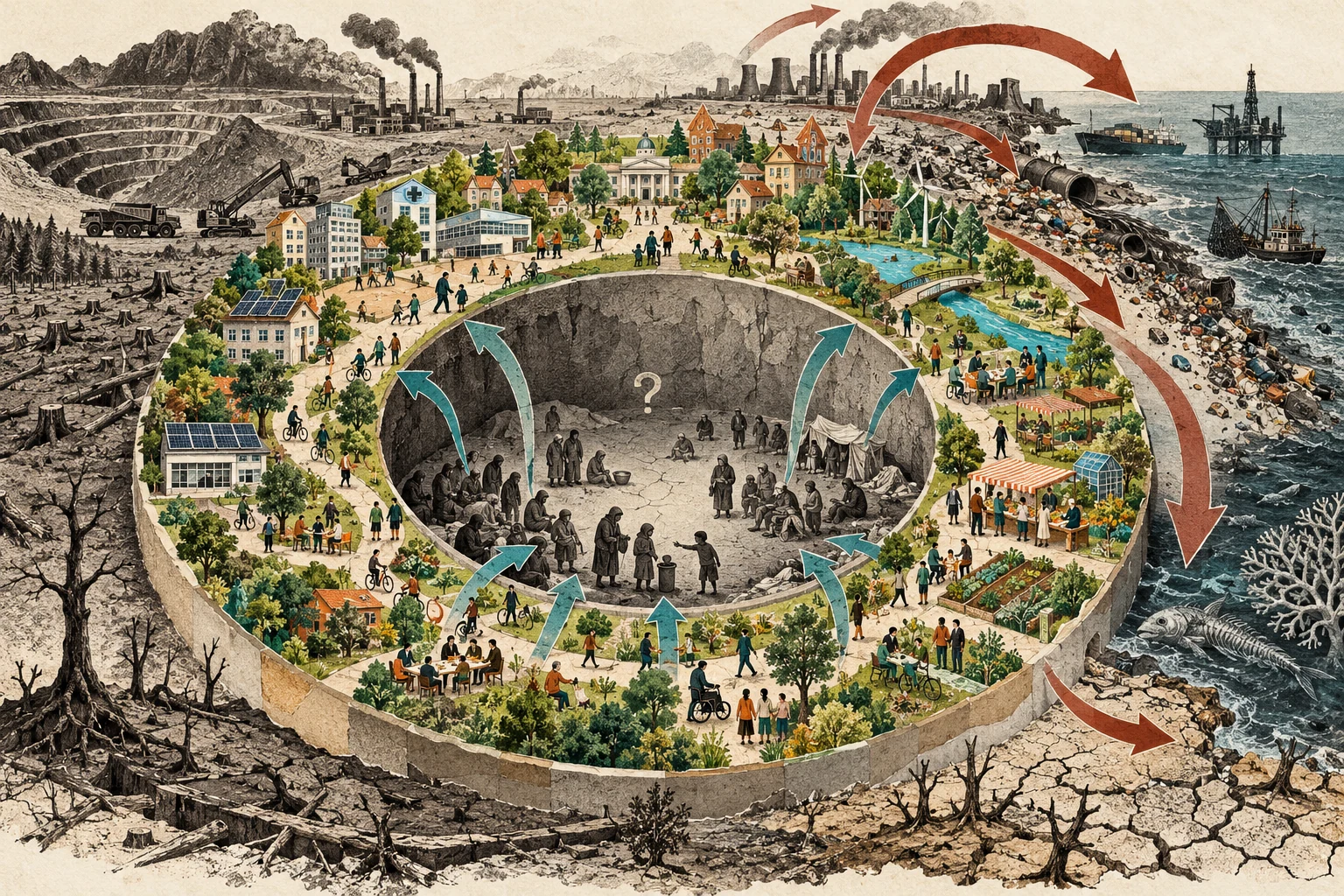
The safe and just space for humanity lies between social shortfall and ecological overshoot, requiring both boundaries to be respected at once.
AI-assisted illustration · conceptual metaphor View in visual quiz →Genesis and Global Lineage
The diagram was drawn by Kate Raworth, an Oxford-trained economist who co-authored the UN Development Programme’s Human Development Report from 1997 to 2001 and served as a senior researcher at Oxfam from 2002 to 2013. The Doughnut first appeared in a February 2012 Oxfam Discussion Paper, A Safe and Just Space for Humanity, written ahead of the UN Rio+20 Earth Summit: Raworth took the outer ring directly from the nine planetary boundaries published by Johan Rockström and colleagues in Nature in September 2009, and added an inner ring of eleven social priorities distilled from government submissions to Rio+20. Her 2017 bestseller Doughnut Economics: Seven Ways to Think Like a 21st-Century Economist updated the inner foundation to twelve dimensions aligned with the 2015 UN Sustainable Development Goals and embedded the diagram in a broader critique of neoclassical textbooks—replacing Paul Samuelson’s circular-flow diagram with an embedded-economy model, challenging mechanical equilibrium with systems feedback loops, and advocating “growth agnosticism.” Intellectually, the framework synthesizes ecological economics (Nicholas Georgescu-Roegen, Herman Daly), the capabilities approach of Amartya Sen and Martha Nussbaum, Donella Meadows’s systems thinking, and Elinor Ostrom’s work on the commons. Since 2019, through the Doughnut Economics Action Lab (DEAL), the concept has been widely adopted by municipal governments and corporate sustainability teams—though Raworth herself has repeatedly warned against its capture as a shallow greenwashing badge.
Central European Lineage
We found no documented link between this concept and the intellectual history or historical experience of Central Europe.
We found no documented link between this concept and the intellectual history or historical experience of Central Europe (by our methodology, this means “none found,” not “none exists”; as of October 2026).
Why Now
Three developments between 2018 and 2026 turned a two-dimensional diagram into an operational policy tool. First, empirical quantification: in February 2018, Daniel O’Neill and colleagues published “A Good Life for All within Planetary Boundaries” in Nature Sustainability, calculating social floors and consumption-based biophysical footprints for roughly 150 countries and demonstrating that not a single country currently inhabits the Doughnut—wealthy nations achieve high social scores only by massively overshooting the ecological ceiling, while low-overshoot nations fall short on basic human needs. Second, municipal adoption: in April 2020, at the height of the COVID-19 lockdown, the city of Amsterdam partnered with Raworth’s Doughnut Economics Action Lab to adopt a “City Portrait” as its official post-pandemic recovery strategy, inspiring similar experiments in Brussels, Copenhagen, Glasgow, and dozens of local governments worldwide. Third, global institutional uptake: in 2021 Raworth joined the World Health Organization’s Council on the Economics of Health for All (chaired by Mariana Mazzucato), and her book was translated into more than twenty languages (in Poland, tellingly rendered as Ekonomia obwarzanka after Kraków’s traditional braided ring-bread). Meanwhile, successive planetary-boundaries assessments showing six and then seven transgressed thresholds have turned the Doughnut’s outer ring from a future warning into an immediate constraint.
Explanatory Power
The Doughnut brings into view a structural coupling that neither GDP figures nor standalone environmental scorecards capture: social deprivation and ecological overshoot are two ends of a single system of provisioning and distribution. First, when national Doughnuts are calculated on a consumption-footprint basis rather than a territorial-production basis, they expose how wealthy service economies appear to “green” their domestic territory while outsourcing carbon emissions, land conversion, and material extraction through imports. Second, in urban planning, a “City Portrait” forces housing and environment departments to answer one integrated question instead of two siloed ones: how do we build enough affordable homes to lift residents above the social floor while staying inside the municipal carbon and materials budget? Third, in debates over “green growth,” the diagram shifts the burden of proof: anyone claiming that further GDP growth is necessary in a rich economy must specify which shortfall inside the ring that growth will actually cure, rather than treating rising aggregate output as self-validating.
Axes of Debate
Growth agnosticism versus explicit degrowth
Degrowth scholars (such as Jason Hickel and Giorgos Kallis) argue from ecological economics that Raworth’s “growth agnosticism” is an evasive compromise: since O’Neill et al.’s empirical mapping shows that every high-income country overshoots multiple planetary boundaries by a wide margin, the honest policy conclusion is that wealthy economies must undergo a planned reduction in material throughput rather than remain “agnostic” about GDP. Strongest counterargument: Raworth replies that framing the overarching goal in terms of a single flow metric—whether GDP up or GDP down—repeats the mistake of twentieth-century economics; the policy target should be defined in terms of human and ecological states (living inside the ring), and leading with “degrowth” alienates both developing nations that still need output growth and mainstream policymakers who can be won over to biophysical caps. Nature of the dispute: substantive — it concerns whether, given empirical limits on decoupling, neutrality toward GDP is a coherent institutional stance or merely a softer communication strategy.
A compass without an engine
Mainstream economists and scholars of global inequality—most sharply Branko Milanović in his 2018 critique “Kate Raworth’s Economics of Miracles”—argue that while the Doughnut is an attractive normative target, it lacks a political economy of transition: Raworth does not calculate how much global output would have to expand to bring the world’s poor up to a decent living standard without draconian confiscation in rich democracies, assuming away deep class and geopolitical conflicts. Strongest counterargument: Defenders of the framework reply that the Doughnut is explicitly designed as a goal function rather than a macroeconomic growth model, and that criticizing a target dashboard for not being an econometric transition model would invalidate everything from the Paris Agreement temperature target to the Sustainable Development Goals; subsequent work by O’Neill, Andrew Fanning, and Jason Hickel has supplied the missing quantitative scenarios. Nature of the dispute: mixed — Milanović’s arithmetic challenge about global income distribution is substantive, whereas dismissing the framework as an “economics of miracles” is a rhetorical swipe at a trade book rather than its underlying empirical literature.
Production-based versus consumption-based accounting
Environmental statisticians and municipal planners debate how to Downscale planetary boundaries to a single country or city: territorial accounting credits a city for closing local factories, whereas consumption-based footprint accounting charges residents for the embodied emissions and land use of imported electronics, food, and clothing. Strongest counterargument: While consumption-based accounting is ethically indispensable for preventing carbon leakage, it relies on multi-regional input-output (MRIO) models with wide statistical uncertainties and long time lags, making it difficult for a city council to use as a binding annual accountability metric. Nature of the dispute: substantive — a technical and institutional problem of measurement boundaries and political jurisdiction.
Underappreciated Angle
The least scrutinized half of the Doughnut is its inner ring, yet that is where its quietest political power lies. The outer ring comes from Earth system science and rests on contested but explicit biophysical processes; the inner ring comes from diplomatic communiqués—in 2012 from government submissions to Rio+20, and in 2017 from the UN Sustainable Development Goals. That means the lower boundary of the model is not a scientific discovery, but a snapshot of intergovernmental political compromise from a specific year. Whoever controls the definition and thresholds of the social foundation—whether it includes digital connectivity, public mobility, leisure time, or living space per person—controls how wide the “safe and just space” appears to be and how much biophysical budget is claimed as non-negotiable need. In municipal practice this becomes immediately visible: when cities from Amsterdam to Melbourne draw their own Doughnuts, they rarely alter the nine planetary boundaries, but they extensively renegotiate what counts as the local social minimum. A diagram that looks at first glance like an objective technocratic compass is, on its inner edge, a map of political bargaining.
One-Sentence Takeaway
The Doughnut does not tell an economy how fast to grow, but where it must fit—which is why its most consequential, and least visible, political decision is who gets to draw the inner ring of human need.
Related Concepts Network
How this concept reinforces, constrains, or complements other analytical frameworks in the corpus. View on graph →
-
Planetary boundaries reinforces
The outer ring of the Doughnut is taken directly from the nine planetary boundaries defined by Rockström and colleagues in 2009; without them, the model has no ecological ceiling.
-
Degrowth in tension
Raworth professes “growth agnosticism,” whereas degrowth demands a planned material contraction of wealthy economies; the dispute turns on whether agnosticism is a strategic dodge.
-
Anthropocene complements
The Doughnut attempts to translate the geological diagnosis of the Anthropocene into an operational compass for economic policy.
-
Externalities constrains
The model rejects treating ecological damage as mere “external” costs to be priced at the margin, framing them instead as breaches of hard biophysical limits.
-
Systems thinking reinforces
One of Raworth's seven ways of thinking replaces mechanical market equilibrium with the dynamics of coupled feedback loops.
-
Just transition complements
The inner ring specifies the social foundation below which an ecological transition ceases to be socially just.
-
ESG in tension
The Doughnut is increasingly adapted as a corporate sustainability reporting template, even though its author warns against reducing it to a greenwashing brand.
Reading Canon & Translation Bridge
Foundational texts, introductions, and critical perspectives—with availability of English and Polish editions.
-
foundational text 2017 · English
Kate Raworth, Doughnut Economics: Seven Ways to Think Like a 21st-Century Economist
The foundational book-length exposition of the visual model and its seven intellectual shifts, from changing the goal (from GDP to the Doughnut) to becoming agnostic about growth.
In English: original text written in English
In Polish: “Ekonomia obwarzanka. Siedem sposobów myślenia o ekonomii XXI wieku”, Wydawnictwo Krytyki Politycznej 2021, trans. Aleksandra Paszkowska
-
foundational text 2012 · English
Kate Raworth, A Safe and Just Space for Humanity: Can We Live Within the Doughnut?
The February 2012 Oxfam Discussion Paper in which the Doughnut first appeared: eleven dimensions of the social foundation derived from government submissions ahead of Rio+20 paired with the nine planetary boundaries.
In English: original text written in English
In Polish: Polish edition not verified
-
introduction & synthesis 2009 · English
Johan Rockström, Will Steffen, Kevin Noone i in., A Safe Operating Space for Humanity
The “Nature” article (vol. 461, pp. 472–475, September 23, 2009) from which Raworth borrowed the outer ring; essential for seeing how deeply the Doughnut relies on Earth system science.
In English: original text written in English
In Polish: no Polish edition
-
cross-disciplinary 2018 · English
Daniel W. O'Neill, Andrew L. Fanning, William F. Lamb, Julia K. Steinberger, A Good Life for All within Planetary Boundaries
The first systematic empirical quantification of the Doughnut across roughly 150 nations (“Nature Sustainability”, vol. 1, pp. 88–95): shows that no country currently meets its citizens' basic needs within biophysical boundaries.
In English: original text written in English
In Polish: no Polish edition
-
critical perspective 2018 · English
Branko Milanović, Kate Raworth's Economics of Miracles
A blog post on “globalinequality” (June 6, 2018): the sharpest critique from the economics of inequality, calculating that bringing everyone in the world up to the median income of wealthy nations would require tripling global GDP.
In English: original text written in English
In Polish: no Polish edition
-
introduction & synthesis 2009 · English
Tim Jackson, Prosperity without Growth: Economics for a Finite Planet
The closest companion volume from the same decade: explains why “green growth” fails to solve the problem of absolute decoupling of GDP from resource use.
In English: original text written in English
In Polish: “Dobrobyt bez wzrostu. Ekonomia dla planety o ograniczonych możliwościach”, Wydawnictwo Naukowe Uniwersytetu Mikołaja Kopernika 2015, trans. Marcin Polakowski
-
cross-disciplinary 1971 · English
Nicholas Georgescu-Roegen, The Entropy Law and the Economic Process
The thermodynamic demonstration of why the economy cannot be a closed circular flow between firms and households; mentor to Herman Daly and fountainhead of modern ecological economics.
In English: original text written in English
In Polish: no Polish edition
-
cross-disciplinary 1944 · English
Karl Polanyi, The Great Transformation: The Political and Economic Origins of Our Time
The classic statement of the thesis that the economy is “embedded” in society, which Raworth extends into her diagram of the economy embedded in society and the living world.
In English: original text written in English
In Polish: “Wielka transformacja. Polityczne i ekonomiczne źródła naszych czasów”, Wydawnictwo Naukowe PWN 2010, trans. Maria Zawadzka-Strączek
Primary-Source Quotes
Between the two boundaries lies an area – shaped like a doughnut – which represents an environmentally safe and socially just space for humanity to thrive in.
The world Kate has in mind is a world essentially devoid of major social contradictions.