Horizon & Ecology #171
Fermi paradox
original term: Fermi paradox (Eng.) · Wielka Cisza, Silentium Universi, Wielki Filtr
Central European lineage: 1 thread (documented influence) · 1964–2009 · jump to documentation ↓
Working Definition
The Fermi paradox is the clash between two plausible premises: the sheer scale and multibillion-year age of our Galaxy make the emergence of other technological civilizations seem likely, and the time required to traverse or signal across the Milky Way is brief compared to stellar lifetimes—yet we observe no trace of anyone else. Operationally, it is not the casual question “do aliens exist?”, but a diagnostic stress-test for our assumptions: every proposed resolution must identify which premise fails or which step between prebiotic chemistry and galaxy-spanning technology is overwhelmingly improbable. In popular usage, the paradox names our amazement at cosmic silence; in technical usage, it is a probabilistic accounting framework in which the absence of evidence serves as a hard datum rather than a mere lack of data.
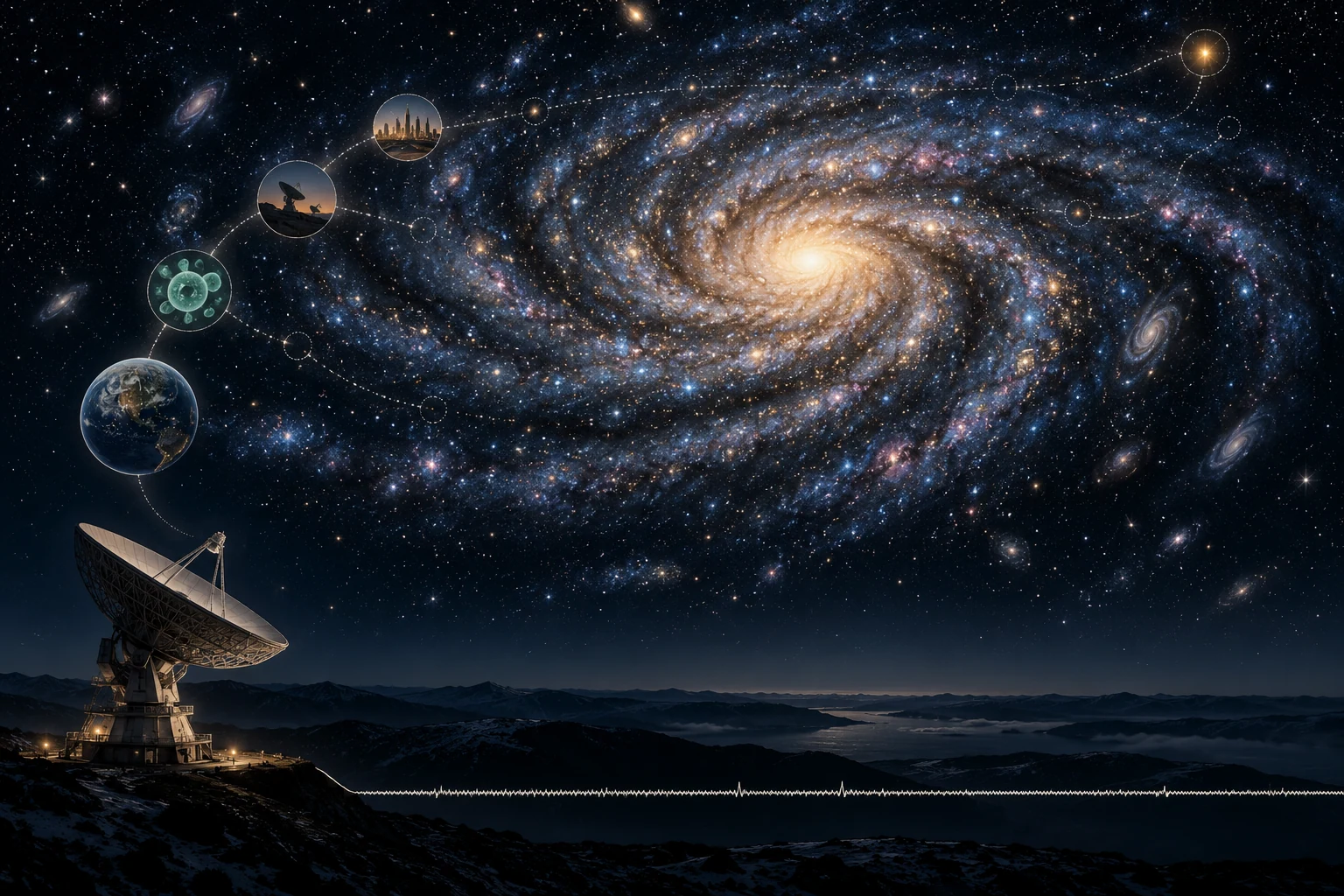
A vast number of cosmic possibilities is juxtaposed with listening posts that detect no confirmed signal. The image poses the puzzle without deciding why other civilizations remain undetected.
AI-assisted illustration · conceptual metaphor View in visual quiz →Genesis and Global Lineage
The name harks back to a summer 1950 lunchtime conversation at Los Alamos National Laboratory in which Enrico Fermi reportedly asked, “Where is everybody?”—an anecdote reconstructed from participants’ recollections (Edward Teller, Emil Konopinski, Herbert York) by Eric Jones only in 1985, though Konstantin Tsiolkovsky had sketched a similar puzzle in the 1930s. The formal argument as debated today was constructed in 1975 by astrophysicist Michael H. Hart and radicalized in 1980 by Frank Tipler, who calculated that a civilization launching self-replicating von Neumann probes would fill the Galaxy in a few million years, concluding from their absence that we are alone. In a 1983 review, David Brin dubbed the puzzle the “Great Silence” and cataloged dozens of hypotheses, including deadly probes. In a 1996–1998 essay, economist Robin Hanson introduced the framework of the Great Filter: since we see no crowded galaxy, at least one step along the evolutionary path from dead matter to interstellar expansion must be fantastically improbable, and the existential question for humanity is whether that bottleneck lies behind us or ahead of us. Nick Bostrom (2008) drew the corollary that discovering fossilized complex life on Mars would be terrible news for humanity’s survival prospects. Historian of science Robert Gray (2015) later showed that Fermi had only been asking about the engineering feasibility of interstellar travel, and that the “Fermi paradox” is really Hart’s argument cloaked in Fermi’s prestige. Meanwhile, Liu Cixin’s 2008 science-fiction novel The Dark Forest (Hei’an senlin) popularized a game-theoretic resolution in which every civilization hides because broadcasting one’s coordinates in a universe of finite resources and mutual suspicion invites pre-emptive annihilation.
Central European Lineage
A documented thread in contemporary astrobiology runs through Stanisław Lem, who analyzed the silence of the cosmos as a systematic theoretical problem a full decade before Hart’s 1975 paper. Educated in interwar Lwów (now Lviv, Ukraine) and postwar Kraków, Lem wrote Summa technologiae (published in Kraków by Wydawnictwo Literackie in 1964) partly in response to the Soviet astrophysicist Iosif Shklovsky’s 1962 monograph Universe, Life, Intelligence. Dedicating Chapter 3 (“Space Civilizations”) to what he called the “absence of cosmic miracles” or Silentium Universi, Lem questioned whether advanced intelligence must inevitably pursue brute-force energetic expansion or remain legible to human radio telescopes, returning to the epistemology of contact in his novels His Master’s Voice (Głos Pana, 1968) and Fiasco (Fiasko, 1986). This Kraków lineage directly shaped modern astrobiological theory: Milan M. Ćirković, author of the Oxford monograph The Great Silence (2018), explicitly adopts Lem’s framing of the paradox as Silentium Universi in his 2009 review “Fermi’s Paradox – The Last Challenge for Copernicanism?”, citing the 1977 Belgrade translation of Summa technologiae on civilizational self-destruction and Fiasco on the hypothesis that paranoid, totalitarian civilizations lock themselves into lethal arms races.
Documented regional lineage · Link: 1. Compiled: October 2026.
-
documented influence 45 years
Central European Source: Stanisław Lem, “Summa technologiae (rozdz. III „Cywilizacje kosmiczne”); także „Głos Pana” (1968) i „Fiasko” (1986)”; Kraków, Poland, 1964
Global Circulation: the Fermi paradox framed as Silentium Universi (“the absence of cosmic miracles”) in astrobiological review literature — Milan M. Ćirković, 2009
documented influence
45 yearsStanisław Lem, “Summa technologiae (rozdz. III „Cywilizacje kosmiczne”); także „Głos Pana” (1968) i „Fiasko” (1986)”
1964 · Kraków, Poland
the Fermi paradox framed as Silentium Universi (“the absence of cosmic miracles”) in astrobiological review literature
2009 · Milan M. Ćirković
- Claim & Connection
- Lem—shaped in Lwów and Kraków and writing “Summa technologiae” under the stimulus of Iosif Shklovsky's 1962 monograph—analyzed the silence of the cosmos as a theoretical problem a full decade before Michael Hart's 1975 paper. Milan M. Ćirković, one of the leading contemporary scholars of the paradox, adopts Lem's formulation of the paradox as the “absence of cosmic miracles” and Silentium Universi in his 2009 review article, citing “Summa” on the self-annihilation hypothesis and “Fiasco” on the hypothesis of permanently totalitarian, paranoid civilizations; in 2018 he published the monograph “The Great Silence.”
- Source Documentation
-
- reception / translation Milan M. Ćirković, „Fermi’s Paradox – The Last Challenge for Copernicanism?”, Serbian Astronomical Journal, vol. 178, 2009, s. 1–20; arXiv v1 version (slightly expanded relative to the journal): Section 1 “Introduction: Where is Everybody?”, paragraph “Even more generally…” (Lem as author of “some of the deepest thoughts on this topic”, Silentium Universi; citing Lem 1977, 1984); Section 3 “What’s Past is Prologue” (civilizational self-destruction in Shklovsky and von Hoerner, “comments in Lem 1977”); Section 7 “(Neo)Catastrophic Solutions”, hypothesis “Freedom is slavery” (“Fiasco”, Lem 1987); bibliography: Summa Technologiae (Nolit, Belgrade 1977), His Master’s Voice (1984), Fiasco (1987). arxiv.org ↗
- bibliographic record Biblioteka Narodowa, rekordy „Summa technologiae” Stanisława Lema; 1st ed.: Wydawnictwo Literackie, Kraków 1964; 2nd expanded ed. 1967; 4th ed. 1984. data.bn.org.pl ↗
- biographical record Wikipedia (en), „Stanisław Lem”; medical studies in Lwów from 1940, continued at Jagiellonian University in Kraków after 1945. en.wikipedia.org ↗
- scholarly study Wikipedia (en), „Summa Technologiae”; Chapter 3 “Space Civilizations”; influence of Shklovsky's monograph “Universe, Life, Intelligence” (1962). en.wikipedia.org ↗
- Historical Context
- Ćirković cites the Serbian translation of “Summa” (1977), based on a later Polish edition; the first Polish edition appeared in 1964. The link documents Lem's reception in contemporary astrobiological literature rather than a direct influence on Hart or Hanson. Ćirković himself works in Belgrade (in the neighboring region); we do not count him as a separate regional link.
Why Now
Three shifts since 2015 have pulled the Fermi paradox out of radio astronomy and into wider intellectual debate. First, observational astronomy sharpened both horns of the dilemma: the Kepler and TESS space telescopes confirmed that rocky habitable-zone exoplanets are the rule across the Milky Way, while Breakthrough Listen (since 2016) and the James Webb Space Telescope (since 2022) have deepened the silence despite far higher sensitivity. Second, a 2018 paper by Anders Sandberg, Eric Drexler, and Toby Ord (Dissolving the Fermi Paradox) showed that the apparent “paradox” is an artifact of plugging arbitrary point estimates into the Drake equation; using realistic probability distributions yields a substantial prior probability of Earth being alone in the observable Universe, shifting the debate onto Bayesian decision theory. Third, in existential-risk and AI governance debates, the Great Filter has become standard shorthand for asking whether civilizations survive transformative technologies, while Liu Cixin’s “dark forest”—amplified by Netflix’s 2024 3 Body Problem—has entered geopolitical and cybersecurity vocabulary as a metaphor for zero-trust environments.
Explanatory Power
The paradox’s analytical value lies in converting a speculative question about the cosmos into a disciplined audit of hidden assumptions. First, Hanson’s Great Filter forces us to distinguish where along the causal chain the bottleneck sits—abiogenesis, the transition from prokaryotes to eukaryotes, brains capable of toolmaking, or surviving high-energy technology—and reveals why an empirical discovery in one domain (say, finding independent microbial life under the ice of Enceladus) immediately updates our estimate of existential risk in another. Second, Hart’s colonization timeline exposes the unexamined imperial assumption baked into early SETI: as Lem and later Ćirković point out, expecting alien civilizations to build Dyson spheres or beacon transmitters projects twentieth-century industrial expansionism onto all possible minds. Third, anthropic observation-selection effects (Brandon Carter, Bostrom) explain why the fact that life arose early in Earth’s history does not prove abiogenesis is easy: observers necessarily find themselves on one of the rare planets where the lottery succeeded before the local star burned out. Beyond astrobiology, the Fermi paradox provides a general template for reasoning from absent evidence—“if process X operated as assumed, signature Y would be ubiquitous; we do not see Y”—applicable across evolutionary biology, financial markets, and security analysis.
Axes of Debate
Is there a paradox at all?
Decision theorists Anders Sandberg, Eric Drexler, and Toby Ord (2018) and historian of science Robert H. Gray (2015) argue that the paradox is a mathematical and historical illusion: replacing point guesses in the Drake equation with realistic uncertainty ranges yields a wide probability distribution in which an empty sky requires no special explanation, while the label itself misattributes Hart’s 1975 non-existence proof to Fermi. Strongest counterargument: Spreading uncertainty across ten orders of magnitude does not make the underlying physical question go away; Ćirković replies that “dissolving” the paradox on paper is an evasion of the Copernican principle, without which astrobiology loses its sharpest heuristic for generating testable hypotheses. Nature of the dispute: substantive — it concerns how to model deep parameter uncertainty and what evidential weight a null observation carries.
Does the Great Filter lie behind us or ahead of us?
Existential-risk researchers (Hanson, Bostrom, Ord) treat cosmic silence as a sobering upper bound on civilizational survival rates; proponents of the “Rare Earth” hypothesis (paleontologist Peter Ward and astronomer Donald Brownlee, 2000) place the bottleneck in planetary geology and evolutionary biochemistry (plate tectonics, a large moon, the eukaryotic endosymbiosis), making the silence reassuring rather than alarming. Strongest counterargument: A filter need not be a single universal hurdle; Ćirković criticizes the Rare Earth camp for linear thinking about self-organizing biological systems, and replies to the x-risk camp that a sample size of one (humanity) cannot statistically distinguish an early biological filter from a late technological one. Nature of the dispute: mixed — built around a hard empirical core in palaeobiology and planetology, but frequently mobilized for rhetorical alarm or complacency.
Strategic hiding versus anthropomorphic projection
Game-theoretically minded readers of Liu Cixin treat silence as a Nash equilibrium: in a cosmos with long communication delays and rapid “technological explosions,” any broadcast invites a pre-emptive strike. Conversely, Lem and philosophers of science argue that the silence is an artifact of our own cognitive limits: we look for radio beacons and megastructures because that is what mid-twentieth-century humans imagined doing. Strongest counterargument: The “dark forest” equilibrium is brittle because it requires 100% compliance across millions of years and potentially thousands of independent cultures—a single loud or naive civilization would break the silence—whereas the “we simply cannot recognize them” thesis risks becoming unfalsifiable. Nature of the dispute: mixed — largely rhetorical when used as a geopolitical metaphor, but substantive regarding whether any sociological hypothesis can satisfy the exclusivity requirement across all possible civilizations.
Underappreciated Angle
What makes the Fermi paradox unique in the history of science is that it uses an astronomical null result—a silent sky—as empirical evidence about humanity’s own political and technological future. Yet as Stanisław Lem noticed in 1964, every step of that inference smuggles in a parochial definition of civilizational “success.” For Hart and Tipler, a civilization that does not colonize every star system in reach or remodel galaxies into visible megastructures is by definition extinct; for Lem, a mature intelligence might turn inward toward homeostatic equilibrium or forms of inquiry that leave no waste heat for our telescopes to catch. Seen in this light, the Great Filter is as much a mirror as a telescope: whether the silence of the Universe terrifies us depends on whether we can imagine a form of intelligence that does not equate survival with infinite expansion.
One-Sentence Takeaway
The Fermi paradox does not prove that we are alone in the Universe; it proves that at least one of our default assumptions about life, technology, or visibility is wrong—and makes the silent sky the cheapest laboratory we have for figuring out which one.
Related Concepts Network
How this concept reinforces, constrains, or complements other analytical frameworks in the corpus. View on graph →
-
Existential risk reinforces
If the Great Filter lies ahead of us, the silence of the cosmos is indirect evidence that technological civilizations rarely survive their own maturity.
-
Longtermism complements
Bostrom and Hanson use the paradox to argue that the expected value of humanity's future depends on where the Great Filter is located, not just on our local policy choices.
-
Survivorship bias complements
Observation selection effects mean that the apparent ease of our own evolution tells us nothing about how frequently intelligent life arises elsewhere.
-
Probabilistic thinking constrains
Sandberg, Drexler, and Ord demonstrate that the paradox dissolves when parameter uncertainties in the Drake equation are modeled as probability distributions rather than point estimates.
-
Moloch and coordination failure complements
The “dark forest” hypothesis is a coordination trap on a galactic scale: every civilization stays silent because none can afford to trust the others.
-
Artificial general intelligence (AGI) in tension
Scenarios of machine expansion sharpen the paradox (self-replicating von Neumann probes should already be everywhere) while simultaneously supplying a prime candidate for the Great Filter.
-
Anthropocene complements
The hypothesis that technological civilizations self-destruct turns our planetary ecological crisis into a local instance of a potential cosmic regularity.
Reading Canon & Translation Bridge
Foundational texts, introductions, and critical perspectives—with availability of English and Polish editions.
-
foundational text 1975 · English
Michael H. Hart, An Explanation for the Absence of Extraterrestrials on Earth
The article in the “Quarterly Journal of the Royal Astronomical Society” (vol. 16, pp. 128–135) that turned Fermi's lunchtime question into a formal argument: since colonizing the Galaxy would take only a few million years and no one is here, no one is out there.
In English: original text written in English
In Polish: Polish edition not verified
-
foundational text 1998 · English
Robin Hanson, The Great Filter – Are We Almost Past It?
The online essay (first version 1996) that coined the term “Great Filter” and drew the counterintuitive conclusion that the easier it was for life to reach our current stage, the bleaker our future prospects are.
In English: original text written in English
In Polish: no Polish edition
-
introduction & synthesis 2015 · English
Stephen Webb, If the Universe Is Teeming with Aliens… Where Is Everybody? Seventy-Five Solutions to the Fermi Paradox and the Problem of Extraterrestrial Life
Second edition (Springer, Science and Fiction series; the 2002 first edition covered 50 solutions) cataloging proposed resolutions of the paradox and noting which ones are empirically testable.
In English: original text written in English
In Polish: no Polish edition
-
introduction & synthesis 2018 · English
Milan M. Ćirković, The Great Silence: Science and Philosophy of Fermi’s Paradox
An Oxford University Press monograph organizing solutions by their methodological assumptions and arguing that the paradox represents the ultimate test of Copernicanism.
In English: original text written in English
In Polish: Polish edition not verified
-
critical perspective 2018 · English
Anders Sandberg, Eric Drexler, Toby Ord, Dissolving the Fermi Paradox
A paper (arXiv:1806.02404) showing that once parameter uncertainties in the Drake equation are properly represented as probability distributions, the probability of being alone in the observable Universe is substantial, requiring no exotic explanations.
In English: original text written in English
In Polish: no Polish edition
-
critical perspective 2015 · English
Robert H. Gray, The Fermi Paradox Is Neither Fermi’s Nor a Paradox
An article in “Astrobiology” (vol. 15, no. 3, pp. 195–199) demonstrating that Fermi was asking about the feasibility of interstellar travel, whereas the argument against the existence of extraterrestrials comes from Hart.
In English: original text written in English
In Polish: no Polish edition
-
cross-disciplinary 1964 · Polish
Stanisław Lem, Summa technologiae
Chapter 3 (“Space Civilizations”) is a critical dissection of early SETI assumptions: Lem asks whether advanced technology must be externally visible at all and whether cosmic silence reflects our own parochial projections.
In English: “Summa Technologiae”, University of Minnesota Press 2013, trans. Joanna Zylinska
In Polish: original text written in Polish
-
cross-disciplinary 2008 · Chinese
Liu Cixin, 黑暗森林 (Hei’an senlin)
The second volume of the "Remembrance of Earth's Past“ trilogy (published in English as ”The Dark Forest"), source of today's most popular game-theoretic answer to the paradox: civilizations hide because revealing one's location in a cosmos of finite resources and chains of suspicion is suicidal.
In English: English edition not verified
In Polish: “Ciemny las”, Dom Wydawniczy Rebis 2017, trans. Andrzej Jankowski
Primary-Source Quotes
The easier it was for life to evolve to our stage, the bleaker our future chances probably are.
In the words of the great writer and philosopher Stanislaw Lem, who authored some of the deepest thoughts on this topic, Fermi’s paradox is equivalent to the ”absence of cosmic miracles” or the Silentium Universi.