Systems & Complexity #057
Externalities
original term: externalities (Eng.) · efekty uboczne, koszty zewnętrzne, external costs
Central European lineage: 1 thread (anticipation) · 1949–1960 · jump to documentation ↓
Working Definition
An externality is a cost or benefit generated by an economic activity that falls on third parties who did not choose to incur it and is not transmitted through market prices. A coal-fired factory pays for its fuel and labor, but does not pay for the asthma of neighboring residents (a negative externality); an orchardist’s honeybees pollinate a neighbor’s crop without compensation, or a vaccinated citizen reduces transmission risk for commuters on the same train (positive externalities). Operationally, analyzing a problem through externalities means auditing a balance sheet for real physical or social effects that carry a price of zero for the decision-maker. Whereas in everyday speech the term is used loosely as a synonym for “unintended side effects,” in technical welfare economics it denotes a precise divergence between marginal private cost and marginal social cost—implying that an unadjusted market will systematically overproduce goods with negative externalities and underproduce goods with positive ones.
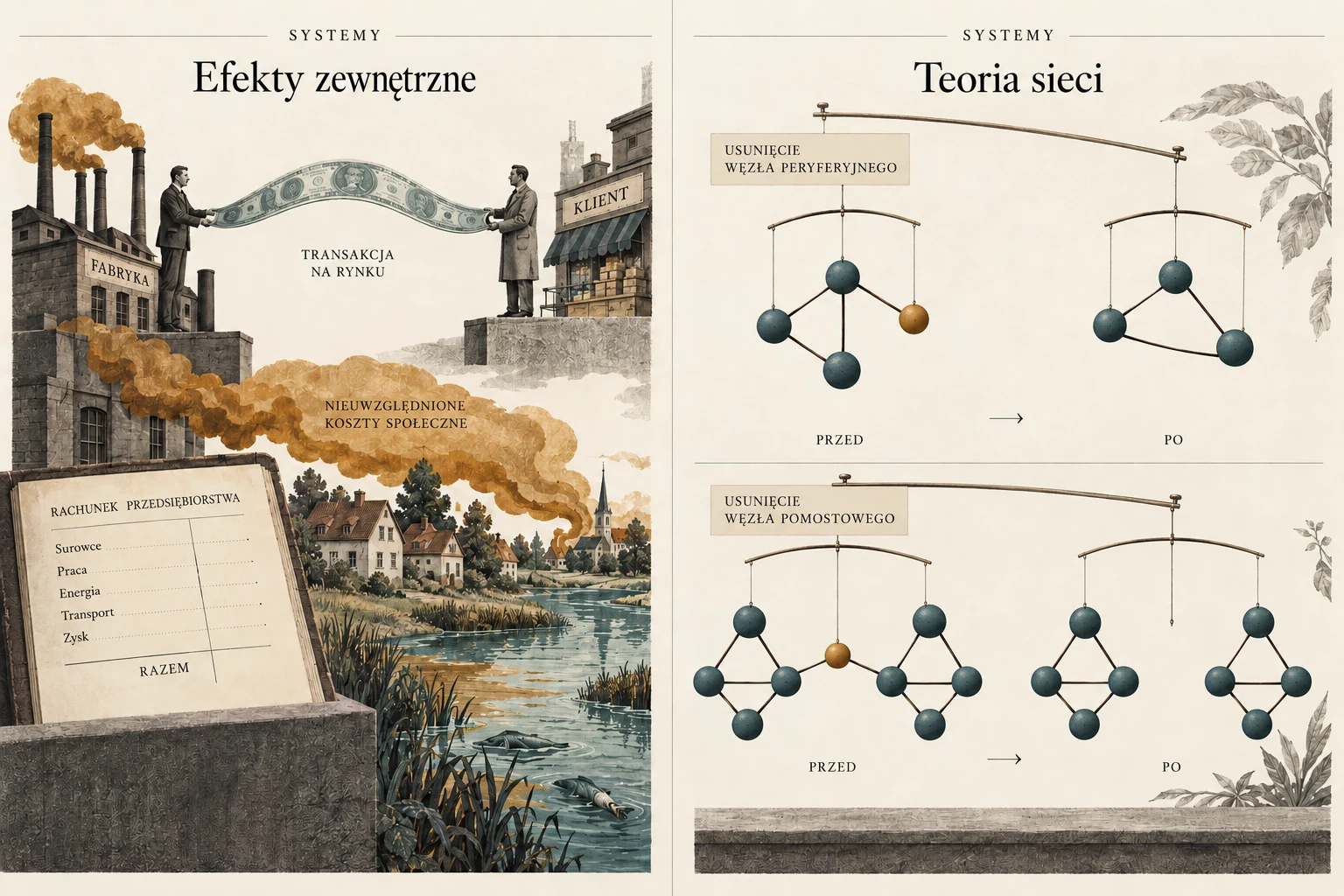
Money circulates between the transacting parties while pollution burdens the surrounding environment outside their ledger.
AI-assisted illustration · conceptual metaphor View in visual quiz →Genesis and Global Lineage
Alfred Marshall introduced the concept of external economies in Principles of Economics (1890) to describe how individual firms benefit from the geographic concentration and shared know-how of a growing industry. His Cambridge successor Arthur Cecil Pigou shifted the focus in The Economics of Welfare (1920) to the divergence between private and social net product—using smoke pouring from factory chimneys as his central example—and proposed that the state close the gap via a corrective tax or subsidy (Pigouvian taxation). For forty years Pigou’s welfare-economics framework reigned unchallenged. In October 1960, Ronald H. Coase overturned that consensus from within in The Problem of Social Cost: harm, Coase argued, is structurally reciprocal (the confectioner’s machinery disturbs the neighboring doctor only because the doctor set up an examination room next door), and if transaction costs were zero and property rights clearly assigned, the parties would bargain to an efficient outcome regardless of who held the initial legal entitlement. The real obstacle is therefore not the absence of a state tax, but positive transaction costs and ill-defined property rights. From the 1970s onward, Pigou and Coase gave birth to the two dominant policy instruments of modern environmental governance: carbon taxes and excise duties (from Pigou) and cap-and-trade markets for sulfur dioxide and greenhouse gases (from Coase and John Dales).
Central European Lineage
Born in Lemberg (Lwów, then in Austro-Hungarian Galicia, now Lviv, Ukraine) and intellectually formed at the University of Vienna—where he earned his doctorate in 1906, attended Eugen von Böhm-Bawerk’s famous seminar, and served as chief economist at the Vienna Chamber of Commerce until 1934—Ludwig von Mises devoted a remarkable section of Human Action (1949, Chapter XXIII, §6) to “The Limits of Property Rights and the Problems of External Costs and External Economies.” Eleven years before Coase’s 1960 paper, Mises argued that what welfare economists call “external costs” are not a flaw inherent in private ownership, but the direct result of legal loopholes left in the enforcement of property rights and tort liability: for decades nineteenth-century legislatures and courts deliberately exempted railways and factories from civil liability for smoke, noise, and stray sparks in order to subsidize industrialization. Where land is unowned, users strip timber and deplete game without regard for future yields; where inventions lack patent protection, innovators bear all research costs while competitors capture the external economies gratis. Mises and Coase share no documented citation link—Coase’s 1960 paper engages Pigou directly without mentioning Mises—and their conclusions diverge in an important respect: whereas Mises saw closing property-right loopholes as a sufficient remedy, Coase demonstrated that when transaction costs are high (as with millions of dispersed citizens breathing urban air), assigning private titles alone cannot solve the problem.
Documented regional lineage · Link: 1. Compiled: October 2026.
-
anticipation 11 years
Central European Source: Ludwig von Mises, “Human Action, Ch. XXIII, §6 “The Limits of Property Rights and the Problems of External Costs and External Economies””; Vienna, Austria, 1949
Global Circulation: externalities as a problem of property rights and transaction costs (The Problem of Social Cost) — Ronald Coase, 1960
anticipation
11 yearsLudwig von Mises, “Human Action, Ch. XXIII, §6 “The Limits of Property Rights and the Problems of External Costs and External Economies””
1949 · Vienna, Austria
externalities as a problem of property rights and transaction costs (The Problem of Social Cost)
1960 · Ronald Coase
- Claim & Connection
- Mises, educated at the University of Vienna (doctorate 1906, Böhm-Bawerk’s seminar) and active in Vienna until 1934, framed external costs in “Human Action” (1949) not as an inherent failure of the market, but as the consequence of loopholes in the legal system of property rights and liability: if an owner were held strictly liable for all physical effects of using their property, costs would not be shifted onto third parties. Eleven years later Coase shifted the weight of economic analysis from Pigouvian taxes to the delineation of property rights and the costs of negotiating them. No evidence was found that Coase drew on Mises’s text; this is an earlier formulation of a kindred idea, not a documented influence.
- Source Documentation
-
- primary source Ludwig von Mises, Human Action: A Treatise on Economics, Yale University Press, New Haven 1949; wyd. online Mises Institute; Ch. XXIII “The Data of the Market,” §6. mises.org ↗
- reception / translation Ronald H. Coase, „The Problem of Social Cost”, Journal of Law and Economics, Vol. 3, October 1960, s. 1–44; entire article; cites Pigou (Economics of Welfare, 4th ed., 1932), with no reference to Mises. en.wikipedia.org ↗
- biographical record Ludwig von Mises — Wikipedia (pl); studies at the University of Vienna from 1900, doctorate Feb 20, 1906, Böhm-Bawerk’s seminar ca. 1904–1914. pl.wikipedia.org ↗
- Historical Context
- Mises was born in Lemberg/Lwów (1881, now Lviv, Ukraine), but his intellectual formation was thoroughly Viennese: gymnasium, University of Vienna, and the Vienna Chamber of Commerce (from 1909). The term “external costs” itself comes from the Marshall–Pigou tradition, which Mises invokes in order to invert its institutional diagnosis. Review 2026-10 confirmed all URLs and the text of §6 (p. 658 of the online edition), including passages on unowned land erosion, patents, and the historical exemption of factories and railways from tort liability for smoke and sparks.
Why Now
Between 2018 and 2026, pricing externalities moved from textbook diagrams to the center of geopolitical and industrial conflict. Following the 2018 reform of the European Union Emissions Trading System (EU ETS), the price of emitting a metric ton of CO2 in Europe rose from under 10 euros to peaks above 80–100 euros in 2022–2023, transforming the economics of coal-dependent utilities in countries like Poland and sparking fierce domestic debates over energy transition costs. On May 17, 2023, the EU enacted the Carbon Border Adjustment Mechanism (CBAM, entering its reporting phase in October 2023 and its financial phase in 2026)—the world’s first major trade instrument taxing the embedded carbon externalities of imported steel, cement, aluminum, and fertilizers at the border. Simultaneously, the concept expanded into two new arenas: the digital attention economy, where researchers and litigants frame adolescent mental-health harms, political polarization, and misinformation as unpriced negative externalities of advertising-driven recommendation algorithms; and generative AI infrastructure, where since 2023–2024 municipalities and grid regulators in the United States and Europe have confronted the massive electricity, water, and grid-congestion externalities generated by hyperscale AI data centers.
Explanatory Power
Thinking in externalities replaces moralizing (“is this industry evil?”) with institutional accounting (“whose ledger is missing a line item?”). Consider three illustrations. First, fossil-fuel power generation: pricing a ton of CO2 emissions at zero is not “market neutrality,” but an implicit subsidy paid in the currency of future flood damage, heat mortality, and agricultural loss. Second, algorithmic social platforms: a platform maximizes user engagement and ad impressions while the costs of sleep deprivation, fraud, and content-moderation trauma are borne by families, schools, and public health systems; recognizing this as an externality points away from futile appeals for “corporate digital ethics” toward tort liability, default-setting mandates, and Pigouvian levies. Third, positive externalities explain why basic scientific research, open-source software maintenance, and infectious-disease vaccination are chronically underfunded by private markets: because the creator of a foundational mathematical theorem or a critical open-source cryptographic library captures only a tiny fraction of the social value it generates for the world economy, pure market pricing will always supply less of it than society needs.
Axes of Debate
Pigouvian taxation versus Coasean bargaining and cap-and-trade
Welfare economists in the tradition of Pigou (and contemporary advocates of a global carbon tax such as William Nordhaus) argue that when millions of emitters harm billions of people across generations, bilateral bargaining is a fantasy because transaction costs are prohibitive, leaving state-administered price instruments as the only viable remedy. Strongest counterargument: Coasean economists and following them William Baumol (1972) reply that the state never possesses the information needed to know the true marginal social damage curve in advance; setting a hard physical cap on total emissions and letting firms trade permits (as in the EU ETS) uses market prices to discover where abatement is cheapest while guaranteeing the environmental quantity target. Nature of the dispute: substantive — an institutional-design debate over whether price instruments (taxes) or quantity instruments (tradable permits) perform better under uncertainty and high transaction costs.
A correctable market friction versus the systemic logic of capitalism (Pigou versus Kapp)
Institutional and ecological economists following K. William Kapp (The Social Costs of Private Enterprise, 1950) argue that cost-shifting is not an occasional anomaly at the margins of an otherwise efficient market, but the normal, ubiquitous way profit-maximizing firms compete—meaning that piecemeal Pigouvian taxes merely chase externalized costs from one ecological sink or jurisdiction to another. Strongest counterargument: Mainstream environmental economists reply that if “everything” is declared a systemic externality, the concept loses all operational bite; its practical value lies precisely in isolating specific, measurable unpriced flows (such as sulfur dioxide, leaded gasoline, or CO2) that have in fact been successfully curbed once priced or capped. Nature of the dispute: mixed — combining a substantive empirical question about cross-media cost shifting with a deeper ideological divide over whether market economies can be reformed from within.
Property rights (Mises, Demsetz) versus community governance (Ostrom)
Austrian and Chicago-school property-rights theorists argue that negative externalities vanish once resources are parcelled into clearly defined private property protected by strict tort liability. Strongest counterargument: Elinor Ostrom (1990) demonstrated empirically that many common-pool resources (groundwater basins, migratory fisheries, the atmosphere) cannot be physically fenced into private parcels, and that user-governed polycentric institutions often outperform both private titling and centralized state taxation. Nature of the dispute: substantive — settled empirically by the biophysical characteristics (excludability and divisibility) of the resource in question.
Underappreciated Angle
The deepest—and most uncomfortable—insight of Coase’s 1960 paper is that the concept of an “externality” is never morally or legally neutral, because economics has no purely technical criterion for deciding who owns the baseline right. Calling factory smoke a “negative externality imposed on residents” presupposes that residents hold an initial entitlement to clean air; if the law instead grants the factory an unrestricted right to emit, then forcing it to install scrubbers imposes an uncompensated cost on the factory. Pigou smuggled an intuitive moral baseline into the word “harm”; Coase exposed that baseline as a prior legal and political choice. Consequently, every technical calculation of an externality—most famously the “Social Cost of Carbon” computed by government agencies—depends on prior normative decisions that cannot be read off from market data: whose damages across the globe count, how harms across income levels are weighted, and what discount rate is applied to people born in 2100. Technical battles over “getting the prices right” are always disguised political battles over who holds the initial right not to be harmed.
One-Sentence Takeaway
Markets rarely miscalculate the items that appear on a firm’s balance sheet; they fail through what the law allows to be left off the sheet entirely, which is where battles over climate, digital platforms, and public health are actually decided.
Related Concepts Network
How this concept reinforces, constrains, or complements other analytical frameworks in the corpus. View on graph →
-
Tragedy of the commons reinforces
Overexploitation of an open-access resource is a reciprocal negative externality that each user imposes on all other users of the shared pool.
-
Moloch and coordination failure complements
Competitive races in which every participant dumps unpriced costs onto the environment are externalities locked in by multipolar competition.
-
Second-order effects complements
An externality is a specific structural class of second-order effect: a consequence borne by a third party who never consented to the transaction.
-
Incentives reinforces
Internalizing an externality—via a tax, cap-and-trade permit, or tort liability—works by altering the price incentives facing the decision-maker rather than relying on moral appeals.
-
Planetary boundaries reinforces
The breaching of planetary boundaries is the cumulative ledger of negative externalities left off the balance sheets of firms and states since industrialization.
-
Network effects complements
Network effects are positive consumption externalities: each additional user joining a telephone or software network raises its value for existing users.
-
Mechanism design constrains
Emissions trading markets and spectrum auctions show that many externalities can be priced through designed markets without a central planner knowing each firm’s abatement cost.
Reading Canon & Translation Bridge
Foundational texts, introductions, and critical perspectives—with availability of English and Polish editions.
-
foundational text 1920 · English
Arthur Cecil Pigou, The Economics of Welfare
The canonical distinction between marginal private net product and marginal social net product, and the source of the corrective “Pigouvian” tax or subsidy.
In English: original text written in English
In Polish: Polish edition not verified
-
foundational text 1960 · English
Ronald H. Coase, The Problem of Social Cost
The landmark article in the “Journal of Law and Economics” that reframed externalities from unilateral harm into a reciprocal conflict over property rights and transaction costs—the foundation of the Coase theorem.
In English: original text written in English
In Polish: Polish edition not verified
-
critical perspective 1949 · English
Ludwig von Mises, Human Action: A Treatise on Economics
Chapter XXIII, §6 treats external costs as the consequence of legislative loopholes in property and tort liability rather than market failure—an essential counterpoint to the default Pigouvian frame.
In English: original text written in English
In Polish: “Ludzkie działanie. Traktat o ekonomii”, Instytut Ludwiga von Misesa 2007, trans. Witold Falkowski
-
critical perspective 1950 · English
K. William Kapp, The Social Costs of Private Enterprise
The radical institutionalist critique from the opposite direction: unpaid social costs are not a minor market friction, but the systemic operating principle of profit-seeking enterprise.
In English: original text written in English
In Polish: Polish edition not verified
-
critical perspective 1972 · English
William J. Baumol, On Taxation and the Control of Externalities
Demonstrates that regulators rarely possess the information needed to calculate the theoretically optimal Pigouvian tax, proposing instead politically set environmental standards achieved via unit charges.
In English: original text written in English
In Polish: Polish edition not verified
-
cross-disciplinary 1968 · English
Garrett Hardin, The Tragedy of the Commons
A biologist states the same divergence between private gain and shared cost without the apparatus of welfare economics in the “Science” essay that popularized the problem across the natural sciences.
In English: original text written in English
In Polish: Polish edition not verified
-
introduction & synthesis 1990 · English
Elinor Ostrom, Governing the Commons: The Evolution of Institutions for Collective Action
Empirical studies of communities governing shared pastures, water basins, and fisheries—establishing a third institutional path between Pigouvian state taxation and Coasean privatization.
In English: original text written in English
In Polish: Polish edition not verified
Primary-Source Quotes
But this is not the outcome of alleged deficiencies inherent in the system of private ownership of the means of production. It is on the contrary a consequence of loopholes left in this system.