Horizon & Ecology #169
Planetary boundaries
original term: planetary boundaries (Eng.) · bezpieczna przestrzeń operacyjna dla ludzkości, safe operating space for humanity
Global-circulation concept — no documented lineage in Central Europe. jump to documentation ↓
Working Definition
Planetary boundaries are a set of nine Earth-system processes—climate change, biosphere integrity, biogeochemical nitrogen and phosphorus flows, land-system change, freshwater change, ocean acidification, atmospheric aerosol loading, stratospheric ozone depletion, and novel entities—for which scientists have proposed quantitative control variables and precautionary thresholds. As long as anthropogenic pressure remains below those thresholds, the planet is likely to stay within a Holocene-like state: the only environmental envelope in which human agriculture and complex civilizations have ever developed. The zone inside the thresholds is called the “safe operating space for humanity.” Crucially, in its technical definition a boundary is not a physical tipping point itself, but a normative guardrail placed upstream of the zone of rising, uncertain risk—a distinction often lost in everyday usage, which flattens the boundaries into hard physical cliffs read straight off instruments.
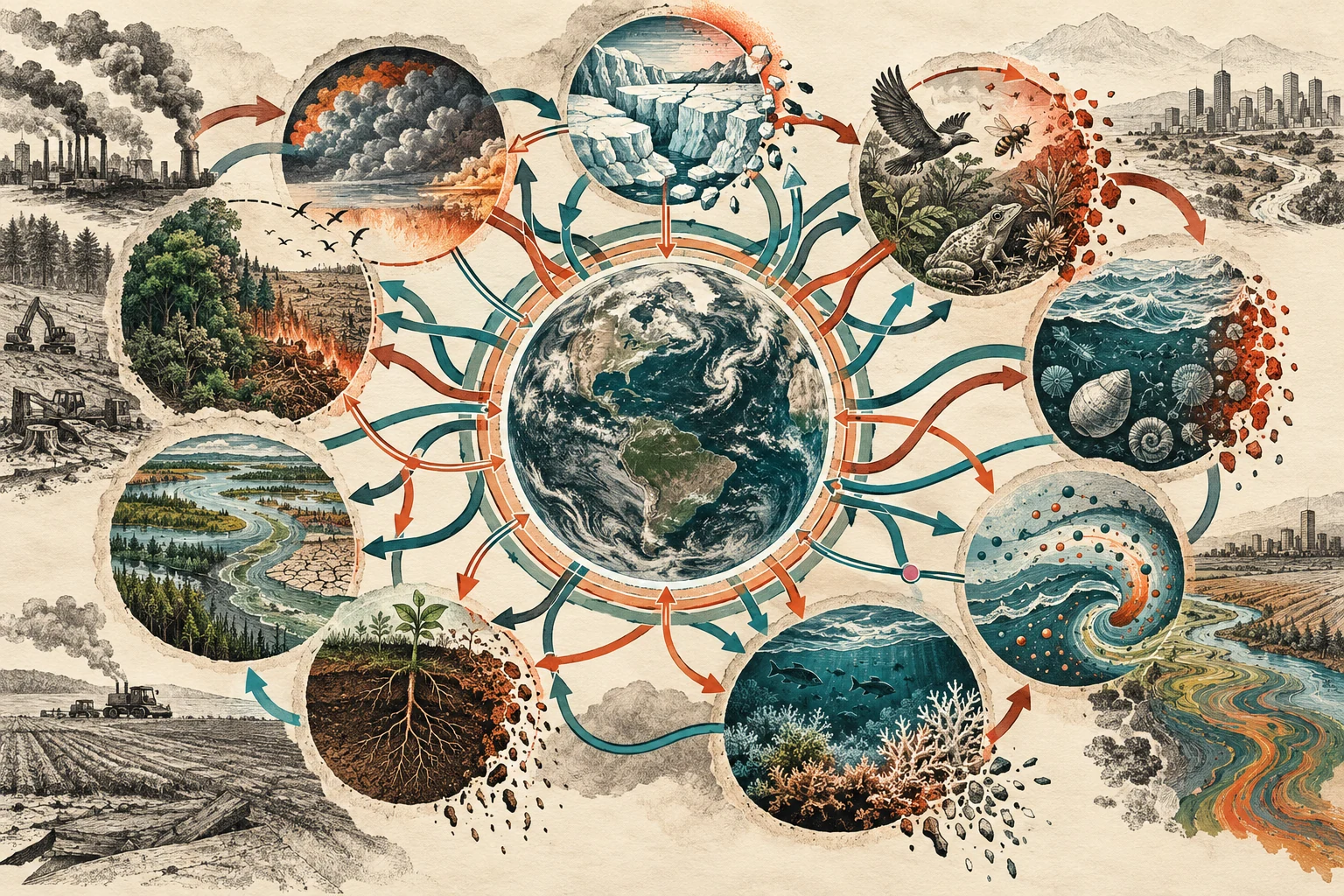
Earth's stability depends on interconnected ecological processes; the diagram shows thresholds and dependencies qualitatively without claiming a live measurement.
AI-assisted illustration · conceptual metaphor View in visual quiz →Genesis and Global Lineage
The framework was unveiled in 2009 by a group of twenty-nine Earth-system scientists led by Johan Rockström of the Stockholm Resilience Centre and Will Steffen, in two paired publications: a compact four-page feature in Nature (September 23, 2009) and a full methodological paper in Ecology and Society (November 18, 2009). Co-authors included Paul J. Crutzen (who popularized the term Anthropocene), Hans Joachim Schellnhuber of the Potsdam Institute, and tipping-points researcher Timothy Lenton. The concept synthesizes three intellectual lineages: ecological resilience and regime-shift theory (C. S. Holling, Carl Folke), Earth system science developed within the International Geosphere-Biosphere Programme (synthesized in Steffen et al.’s Global Change and the Earth System, 2004), and the older limits-to-growth debate inaugurated by the Club of Rome’s The Limits to Growth (1972). While explicitly nodding to the 1972 report, Rockström’s team departed from it in a key respect: instead of modeling non-renewable resource depletion and macroeconomic trajectories, they defined biophysical state thresholds for the Earth’s sink and life-support capacities. In a 2015 Science update, Steffen, Katherine Richardson, Rockström, and colleagues added regional sub-boundaries and elevated climate change and biosphere integrity to two “core” boundaries; in September 2023 in Science Advances, Richardson and colleagues quantified all nine boundaries for the first time and concluded that six had been transgressed. Meanwhile, the concept was rapidly adopted by European environmental policy, corporate ESG reporting, and the Science Based Targets Network, where the numbers are often treated as turn-key allocation budgets stripped of their original scientific caveats.
Central European Lineage
We found no documented link between this concept and the intellectual history or historical experience of Central Europe.
We found no documented link between this concept and the intellectual history or historical experience of Central Europe (by our methodology, this means “none found,” not “none exists”; as of October 2026).
Why Now
Three developments between 2018 and 2026 turned an academic synthesis into an operational grammar of environmental governance. First, successive scientific updates moved the diagnostic needle in one direction: three boundaries transgressed in 2009, four in 2015, six in 2023, and in 2025 the Potsdam-led Planetary Health Check announced that ocean acidification had crossed its threshold as the seventh transgressed boundary. Second, the European Union wrote the goal of “living well, within the planetary boundaries” into its binding 8th Environment Action Programme (2022), extending the European Green Deal, while initiatives such as the Science Based Targets Network began translating global biophysical thresholds into corporate and municipal targets—immediately triggering disputes over how a shrinking global budget should be divided among unequal actors. Third, the framework entered mainstream economics and urban planning through Kate Raworth’s Doughnut Economics (2017), which paired Rockström’s outer ecological ceiling with an inner floor of human rights and was adopted as a strategic compass by cities from Amsterdam to Brussels. Readers today thus encounter planetary boundaries simultaneously as a high-level policy consensus and as a site of live methodological debate within ecology.
Explanatory Power
The framework forces observers to see environmental degradation as a tightly coupled system of nine processes rather than a single carbon-emissions problem with side effects. First, it highlights biogeochemical nitrogen and phosphorus flows—transgressed further beyond their safe boundary than almost any other process, yet barely visible in public politics, even though agricultural runoff drives anoxic dead zones (such as in the Baltic Sea) and destabilizes aquatic ecosystems far beyond farming’s direct carbon footprint. Second, the boundary for land-system change explains why monoculture bioenergy plantations or uncritical afforestation schemes can improve a narrow carbon ledger while simultaneously pushing biodiversity and freshwater boundaries deeper into the red: optimizing a single metric in isolation merely shifts ecological damage across compartments. Third, the concept of a “safe operating space” inverts the default policy question from “how much pollution can we afford to abate?” to “what planetary state do we need to maintain?”, forcing explicit reflection on the Holocene as a normative baseline rather than treating incremental emission cuts as self-sufficient.
Axes of Debate
Do global thresholds make sense for spatially heterogeneous processes?
Ecologists and hydrologists—including Simon Lewis in Nature (2012) and José M. Montoya, Ian Donohue, and Stuart L. Pimm in Trends in Ecology & Evolution (2018)—argue that biodiversity loss, freshwater withdrawal, and land-use change do not possess a single global tipping point; aggregating local ecosystem collapses into one planetary number is scientifically arbitrary, and global extinction-rate metrics do not map onto any known mechanism of local ecosystem functioning. Strongest counterargument: Since their 2015 update, the framework’s authors have acknowledged spatial heterogeneity by introducing sub-global regional distributions alongside aggregate boundaries, while maintaining that cumulative biosphere degradation weakens the Earth system’s overall capacity to buffer carbon and regulate climate, making a global indicator meaningful as a measure of planetary resilience even without a single cliff edge. Nature of the dispute: substantive — it concerns whether Earth system science can define valid aggregate control variables for the biosphere, not whether human pressure on ecosystems is severe.
Pure science or politics dressed in scientific authority?
Scholars in Science and Technology Studies (STS) and environmental governance (surveyed by Frank Biermann and Rakhyun E. Kim, 2020) point out that placing a boundary at a specific distance upstream of an uncertain threshold requires a value judgment about acceptable risk; presenting the resulting numbers as purely scientific findings depoliticizes what ought to be a democratic choice and hands technocrats the power to define “safety.” Strongest counterargument: The framework’s authors state explicitly in their foundational papers that positioning a boundary involves normative risk judgments while characterizing the underlying biophysical response curves is an empirical task; they offer the boundaries as a structured starting point for political deliberation, whereas the alternative—having no quantitative guardrails at all—is an even more consequential political choice made by default. Nature of the dispute: mixed — the critique hits home against corporate and bureaucratic uses that treat the nine numbers as unquestionable natural laws, but is much weaker against the primary scientific papers themselves.
Who gets to use the remaining operating space?
Development economists and Global South scholars emphasize that a planetary cap without a principle of fair allocation freezes historical inequalities in place, since wealthy industrialized nations have already consumed the bulk of the safe space for carbon, nitrogen, and materials. This critique directly inspired Raworth’s “safe and just space” and the Earth Commission’s subsequent work on “safe and just Earth system boundaries” (Rockström et al., Nature, 2023). Strongest counterargument: Defenders of the original 2009 architecture reply that deliberately separating biophysical diagnostics from distributive justice was what allowed the framework to achieve broad scientific uptake; baking a controversial formula of global per-capita redistribution into the physical model from the start would have invited immediate political rejection. Nature of the dispute: substantive — it turns on the institutional design question of whether global biophysical limits can be usefully specified in abstraction from equity rules.
Underappreciated Angle
The least examined premise of the entire planetary-boundaries architecture is its choice of the Holocene—the last 11,700 years—as the normative gold standard. Treating the geological epoch in which agriculture and cities arose as the only proven safe envelope for humanity is a sensible precautionary heuristic, but it carries three rarely discussed implications. First, in several dimensions the Holocene baseline is already irretrievable on any policy-relevant timescale: atmospheric CO2 concentrations and global species distributions will not return to pre-industrial levels for centuries, meaning that “safety” is increasingly defined by distance from a state we can no longer inhabit. Second, the Holocene was stable only in its global mean temperature; regionally, it included severe megadroughts and hydroclimatic shifts that toppled civilizations, so keeping global averages inside the ring does not guarantee local security. Third, continuity with the past tells us what worked for a world of a few million neolithic farmers, not what biophysical configuration best supports ten billion people. At its core, the planetary-boundaries framework is therefore a profoundly conservative philosophy of nature: its deepest axiom is not any of its nine numbers, but the judgment that a known planetary state is always preferable to an unknown one.
One-Sentence Takeaway
Planetary boundaries do not measure how much abuse the Earth can take before breaking; they measure how much risk humanity is willing to tolerate before leaving behind the only geological climate in which civilization has ever existed.
Related Concepts Network
How this concept reinforces, constrains, or complements other analytical frameworks in the corpus. View on graph →
-
Anthropocene reinforces
Planetary boundaries attempt to quantify what the Anthropocene states qualitatively: humanity has become a geological force capable of pushing the Earth system out of its Holocene state.
-
Doughnut economics complements
Raworth adopted the nine planetary boundaries as the outer ring of the Doughnut and added an inner ring of social thresholds absent from Rockström's framework.
-
Climate tipping points reinforces
Nonlinear threshold transitions in the Earth system are the primary justification for setting boundaries with a safety buffer upstream of the point of collapse.
-
Tragedy of the commons complements
Each boundary describes a planetary-scale commons that lacks an overarching institution capable of enforcing limits across all users.
-
Degrowth in tension
Degrowth advocates treat transgressed boundaries as proof that decoupling economic growth from environmental pressure has failed; the framework's authors avoid that conclusion and leave economic pathways open.
-
Systems thinking reinforces
The framework assumes that the nine processes are tightly coupled, so transgressing one boundary shifts the others—a classic insight of feedback-loop systems analysis.
-
Existential risk constrains
Planetary boundaries describe the loss of Holocene-like conditions favorable to human civilization, not the biological extinction of our species; conflating the two scales distorts the stakes.
Reading Canon & Translation Bridge
Foundational texts, introductions, and critical perspectives—with availability of English and Polish editions.
-
foundational text 2009 · English
Johan Rockström, Will Steffen, Kevin Noone i in., A safe operating space for humanity
The four-page “Nature” commentary (vol. 461, pp. 472–475, September 23, 2009) that brought the term into wide circulation and announced that three boundaries had already been transgressed.
In English: original text written in English
In Polish: no Polish edition
-
foundational text 2009 · English
Johan Rockström, Will Steffen, Kevin Noone i in., Planetary Boundaries: Exploring the Safe Operating Space for Humanity
The full, open-access exposition in “Ecology and Society” (vol. 14, no. 2, art. 32), detailing the rationale for each of the nine boundaries and establishing the Holocene as the scientific reference point for a desirable planetary state.
In English: original text written in English
In Polish: no Polish edition
-
foundational text 2015 · English
Will Steffen, Katherine Richardson, Johan Rockström i in., Planetary boundaries: Guiding human development on a changing planet
The second major iteration in “Science” (vol. 347, February 13, 2015): updates control variables for most boundaries, singles out climate change and biosphere integrity as two “core” boundaries, and adds a regional level.
In English: original text written in English
In Polish: no Polish edition
-
introduction & synthesis 2023 · English
Katherine Richardson, Will Steffen, Wolfgang Lucht i in., Earth beyond six of nine planetary boundaries
The third major update in “Science Advances” (vol. 9, September 2023), the first to quantify all nine boundaries; reports that six have been transgressed and introduces human appropriation of net primary production (HANPP) for biosphere integrity.
In English: original text written in English
In Polish: no Polish edition
-
critical perspective 2018 · English
José M. Montoya, Ian Donohue, Stuart L. Pimm, Planetary Boundaries for Biodiversity: Implausible Science, Pernicious Policies
A sharp critique by ecologists in "Trends in Ecology & Evolution" (vol. 33, no. 2, pp. 71–73): argues that a single global boundary for biodiversity has no basis in known ecological mechanisms and can harm conservation policy.
In English: original text written in English
In Polish: no Polish edition
-
critical perspective 2020 · English
Frank Biermann, Rakhyun E. Kim, The Boundaries of the Planetary Boundary Framework: A Critical Appraisal of Approaches to Define a „Safe Operating Space” for Humanity
A comprehensive review in the “Annual Review of Environment and Resources” organizing critiques from Earth system science, development studies, and STS, while tracing how the framework entered policy.
In English: original text written in English
In Polish: no Polish edition
-
cross-disciplinary 2017 · English
Kate Raworth, Doughnut Economics: Seven Ways to Think Like a 21st-Century Economist
The most influential translation of planetary boundaries into economics: the ecological ceiling meets a social foundation, making the goal of economic policy to stay between the two.
In English: original text written in English
In Polish: “Ekonomia obwarzanka. Siedem sposobów myślenia o ekonomii XXI wieku”, Wydawnictwo Krytyki Politycznej 2021, trans. Aleksandra Paszkowska
-
cross-disciplinary 1972 · English
Donella H. Meadows, Dennis L. Meadows, Jørgen Randers, William W. Behrens III, The Limits to Growth
The Club of Rome report with which planetary boundaries are constantly compared; whereas Meadows modeled resource depletion and economic growth trajectories, Rockström defines state thresholds for Earth-system processes.
In English: original text written in English
In Polish: “Granice wzrostu”, Państwowe Wydawnictwo Ekonomiczne 1973, trans. Wiesława Rączkowska, Stanisław Rączkowski
Primary-Source Quotes
a scientific reference point for a desirable planetary state