Systems & Complexity #044
Systems thinking
original term: systems thinking (Eng.) · dynamika systemów, podejście systemowe
Central European lineage: 3 threads (author from the region, documented influence, parallel discovery) · 1949–2008 · jump to documentation ↓
Working Definition
Systems thinking is a mode of analysis that explains the behavior of a phenomenon through the structure of couplings among its elements rather than through the properties of isolated parts or external shocks. Operationally, it asks us to identify stocks (accumulations), flows (rates of change), reinforcing and balancing feedback loops, and time delays, and then to trace what pattern of behavior that structure generates over time. Its technical version—system dynamics—culminates in a formal computer simulation; its colloquial version, widespread in management and journalism, stops at a loop diagram and the slogan “everything is connected to everything else.” The difference is that a model can be falsified, whereas a slogan cannot.
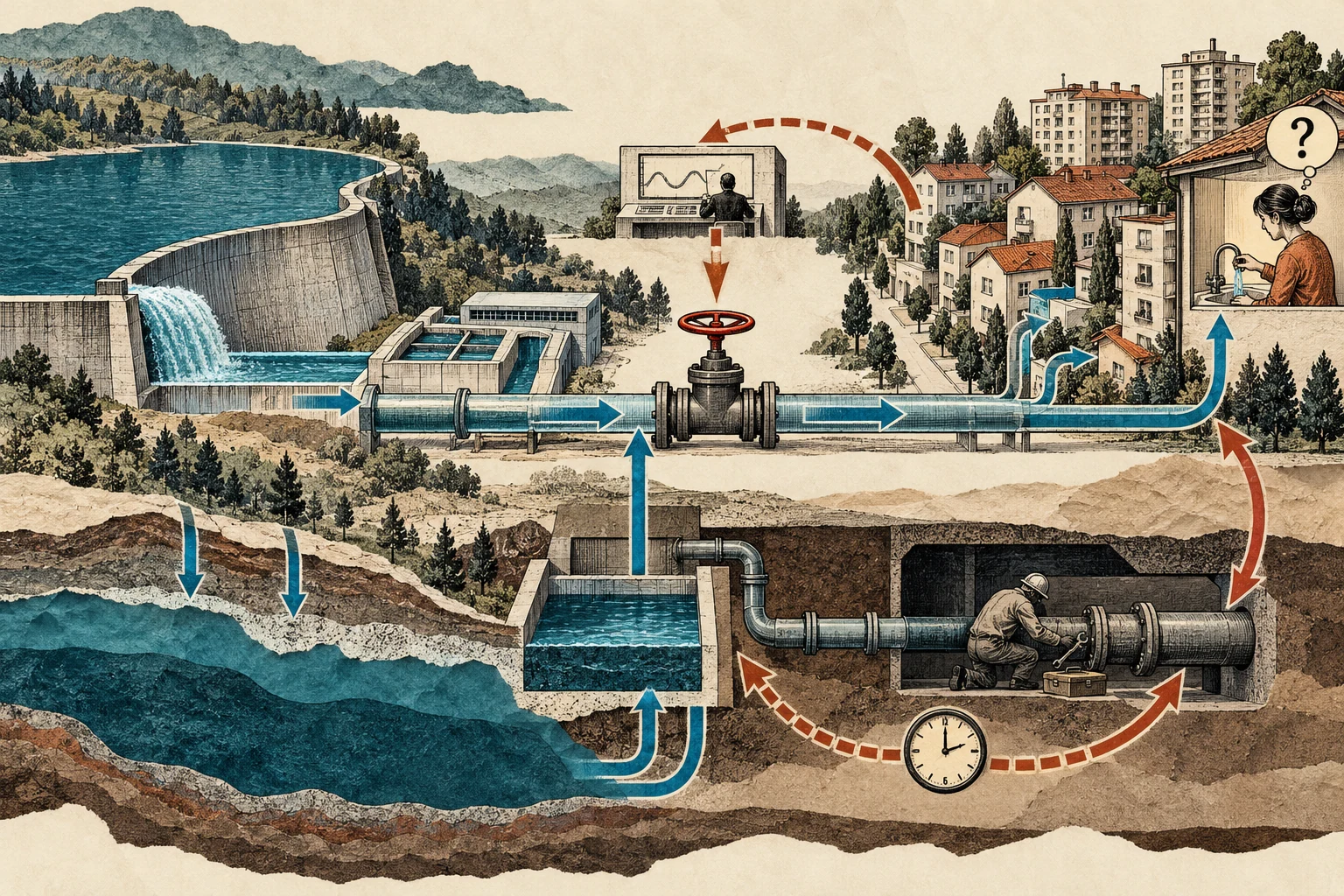
Water access depends on an entire system of resources, flows, controls, and delays, where changing one element reverberates through the rest.
AI-assisted illustration · conceptual metaphor View in visual quiz →Genesis and Global Lineage
The concept grew out of two distinct lineages that only later merged under a single banner. The first is the cybernetics of Norbert Wiener (1948) and W. Ross Ashby: the mathematics of feedback, regulation, and homeostasis. The second is the system dynamics of Jay W. Forrester, an MIT electrical engineer who in Industrial Dynamics (1961) transferred control-engineering simulation first to the corporation, then to the city (1969), and finally to the global economy and biosphere (1971). Out of Forrester’s MIT group came Donella H. Meadows, a Harvard-trained biophysicist (1968), lead author of The Limits to Growth (1972) for the Club of Rome, and later author of the classic essay on leverage points (1999) and the primer Thinking in Systems (drafted in 1993, published posthumously in 2008). Alongside this engineering lineage ran the General System Theory of the biologist Ludwig von Bertalanffy, who from the 1940s called for a unified science of open systems across biology, psychology, and the social sciences. In the 1990s Peter Senge popularized the approach in management as “the fifth discipline,” bringing both mass reach and conceptual dilution.
Central European Lineage
The primary thread leads to Vienna. Born in Atzgersdorf near Vienna, Ludwig von Bertalanffy studied at Innsbruck from 1918 and from 1924 read biology at the University of Vienna, where he earned his doctorate under Moritz Schlick in 1926, completed his habilitation in 1934, and taught until 1948; there he wrote Theoretische Biologie (1932) and his first papers on allgemeine Systemlehre, whose English version appeared in Biologia Generalis in 1949 before his 1968 synthesis General System Theory in New York (published in Polish by PWN in 1984). Did the MIT line of Forrester and Meadows draw on him? The documented link is modest but explicit: in Thinking in Systems, Meadows cites Bertalanffy’s Problems of Life (1952, p. 105) in endnote 3 to Chapter 3, alongside notes on resilience and hierarchy. A single citation documents familiarity with the text rather than methodological dependence; in her bibliography Meadows lists Forrester, Senge, Sterman, and Richardson, and from Bertalanffy’s tradition only Ervin Laszlo and Joanna Macy. A second, parallel thread comes from Poland: Oskar Lange, educated at the Jagiellonian University in Kraków and co-architect of the market socialism model, published Całość i rozwój w świetle cybernetyki in Warsaw in 1962, issued in English by Pergamon Press in 1965 as Wholes and Parts: A General Theory of System Behaviour. Written one year after Industrial Dynamics within the tradition of Wiener’s cybernetics and dialectical materialism east of the Iron Curtain, it shows no documented influence in either direction and awaits closer textual verification.
Documented regional lineage · Links: 3. Compiled: October 2026.
-
author from the region 59 years
Central European Source: Ludwig von Bertalanffy, “University of Vienna biological studies and habilitation; “General System Theory” in “Biologia Generalis” (1949)”; Vienna, Austria, 1949
Global Circulation: systems thinking — Donella H. Meadows, 2008
-
documented influence 56 years
Central European Source: Ludwig von Bertalanffy, “Problems of Life: An Evaluation of Modern Biological Thought”; Vienna, Austria (formation); book published after emigration, New York, 1952
Global Circulation: systems thinking (Thinking in Systems: A Primer) — Donella H. Meadows, 2008
-
parallel discovery 1 year — regional source later than global formulation
Central European Source: Oskar Lange, “Całość i rozwój w świetle cybernetyki”; Warsaw, Poland, 1962
Global Circulation: system dynamics (Industrial Dynamics) — Jay W. Forrester, 1961
author from the region
59 yearsLudwig von Bertalanffy, “University of Vienna biological studies and habilitation; “General System Theory” in “Biologia Generalis” (1949)”
1949 · Vienna, Austria
systems thinking
2008 · Donella H. Meadows
- Claim & Connection
- General System Theory, from which the core vocabulary of systems thinking (open system, wholeness, hierarchy, equifinality) derives, originated in Vienna: Bertalanffy moved there in 1924 to study biology, earned his doctorate under Moritz Schlick in 1926, completed his habilitation in 1934, and taught at the University of Vienna until 1948, publishing his first programmatic papers on “allgemeine Systemlehre” in the 1940s before issuing his book-length synthesis “General System Theory” in North America in 1968.
- Source Documentation
-
- biographical record Wikipedia (de), hasło „Ludwig von Bertalanffy”; sections “Herkunft und Ausbildung” and “Wirken”: Innsbruck 1918, Vienna 1924, doctorate 1926 (Schlick), habilitation 1934, associate professor 1940; section “Veröffentlichungen”: “General System Theory,” Biologia Generalis 1/1949, pp. 114–129. de.wikipedia.org ↗
- biographical record Wikipedia (en), hasło „Ludwig von Bertalanffy”; Biography section: Atzgersdorf near Vienna, University of Vienna, departure from Vienna in 1948; “Zu einer allgemeinen Systemlehre,” Blätter für deutsche Philosophie 1945; General System Theory, Braziller 1968. en.wikipedia.org ↗
- bibliographic record Biblioteka Narodowa, rekord: Ludwig von Bertalanffy, Ogólna teoria systemów. Podstawy, rozwój, zastosowania, PWN 1984, przekł. Ewa Woydyłło-Woźniak; title, publisher, and translator fields. data.bn.org.pl ↗
- Historical Context
- Biographical evidence comes from encyclopedias; David Pouvreau’s 2009 biographical monograph was not consulted. The year 1949 refers to the article in “Biologia Generalis”; English Wikipedia dates the earlier sketch “Zu einer allgemeinen Systemlehre” to 1945. After the war Bertalanffy lost his right to teach due to his NSDAP membership (German Wikipedia); we note the fact without interpretation.
documented influence
56 yearsLudwig von Bertalanffy, “Problems of Life: An Evaluation of Modern Biological Thought”
1952 · Vienna, Austria (formation); book published after emigration, New York
systems thinking (Thinking in Systems: A Primer)
2008 · Donella H. Meadows
- Claim & Connection
- In “Thinking in Systems,” Meadows cites Bertalanffy directly: endnote 3 to Chapter 3 (“Why Systems Work So Well”) refers to “Problems of Life” (John Wiley & Sons, New York 1952), p. 105. That is the only reference to him in the book; in the “Systems Resources” bibliography Meadows lists neither him nor General System Theory, apart from books by Ervin Laszlo and Joanna Macy.
- Source Documentation
-
- reception / translation Donella H. Meadows, Thinking in Systems: A Primer, red. Diana Wright, Chelsea Green, White River Junction 2008; Notes, Chapter Three, note 3 (between note 2 — Holling 1978 — and note 4 — Swift); Bibliography of Systems Resources. archive.org ↗
- Historical Context
- The book scan was inspected in the Internet Archive (full-text file); note 3 (Bertalanffy, Problems of Life, Wiley 1952, p. 105) stands between note 2 (Holling 1978) and note 4 (Swift), while Bertalanffy does not appear in the bibliography — verified 2026-10. The exact sentence in the main text to which the note attaches was not determined; from the note sequence it belongs to the subsection on self-organization. A single endnote documents familiarity with the text, not methodological dependence.
parallel discovery
1 year — regional source later than global formulationOskar Lange, “Całość i rozwój w świetle cybernetyki”
1962 · Warsaw, Poland
system dynamics (Industrial Dynamics)
1961 · Jay W. Forrester
- Claim & Connection
- Lange, trained at the Jagiellonian University in Kraków (doctorate 1928 under Adam Krzyżanowski), published a short treatise in 1962 with PWN in Warsaw on the behavior of wholes composed of coupled elements, which Pergamon issued in English in 1965 as “Wholes and Parts: A General Theory of System Behaviour.” It appeared around the same time as Forrester’s “Industrial Dynamics” (1961) within a different tradition (Wiener’s cybernetics and dialectical materialism); no evidence of mutual influence in either direction was found.
- Source Documentation
-
- bibliographic record Biblioteka Narodowa, rekordy: Oskar Lange, Całość i rozwój w świetle cybernetyki, PWN 1962; przekłady: Pergamon/PWN 1965, Akademie-Verlag 1966–1967, Svoboda 1966, Godo Shuppan 1971; list of catalog records. data.bn.org.pl ↗
- bibliographic record Internet Archive, Oskar Lange, Wholes and Parts: A General Theory of System Behaviour, przekł. Eugeniusz Lepa, Pergamon Press, Oxford 1965, 74 s.; record metadata (subjects: Cybernetics, Dialectical materialism, System analysis). archive.org ↗
- biographical record Wikipedia (en), hasło „Oskar R. Lange”; Life section: law and economics studies in Kraków, doctorate 1928; final years: cybernetics and computers in economic planning. en.wikipedia.org ↗
- Historical Context
- The full text of the treatise was not inspected; the description relies on the title, catalog metadata, and biography. Still to be verified: whether Lange cites Bertalanffy or Forrester and whether his “general theory of system behaviour” uses feedback in a sense close to system dynamics.
Why Now
Three sequences of events between 2018 and 2026 brought Meadows’s vocabulary back to the center of public debate. The COVID-19 pandemic of 2020–2022 was a real-time lesson in delays and exponential growth: governments regulated the stock of infections using data delayed by two weeks, generating the exact oscillations triggered by delayed balancing feedback that Meadows describes in her primer. The supply-chain shocks of 2021–2022 revived the classic “bullwhip effect” that Forrester had simulated in the 1950s. Finally, climate policy—both the 2023 update of the planetary boundaries framework and successive IPCC reports—operates directly with stocks, flows, and tipping points drawn from world modeling, while the fiftieth anniversary of The Limits to Growth in 2022 prompted empirical comparisons showing the original World3 “business-as-usual” trajectory tracking observed historical data with unsettling accuracy.
Explanatory Power
Systems thinking shows that recurring behavior is a property of structure rather than intention. First, in housing policy: mortgage subsidies boost demand against an inelastic supply of apartments, so the stock “price” rises and a program enacted to improve affordability feeds the very loop it was meant to counteract. Second, in corporate management: a firm cuts training budgets after a weak quarter; a year later quality drops, and two years later earnings fall, yet no one connects effect to cause because the delay exceeds the board’s attention horizon. Third, in ecology: predator and prey populations oscillate not because anyone is mismanaging the forest, but because two coupled loops with delays must oscillate. In all three cases, asking “who is to blame?” is far less useful than asking “what structure produces this behavior?”, while Meadows’s hierarchy of leverage points explains why tweaking numbers (tax rates, subsidies) is the weakest intervention and changing the system’s goal or paradigm is the strongest.
Axes of Debate
Modeling the whole versus humility before complexity
Critics from complexity science and Austrian economics (Nassim Nicholas Taleb, and earlier Friedrich Hayek) argue that large-scale system models—especially world models—pretend to possess knowledge of parameters no one can actually measure, thereby legitimizing technocratic central steering. Strongest counterargument: In “Dancing with Systems” and her essay on leverage points, Meadows herself rejects control in favor of learning: a model is a tool for discovering which interventions fail, not for predicting exact numbers—and the baseline World3 scenario held up better than most mainstream economic forecasts from 1972. Nature of the dispute: substantive — it concerns how much of a system’s structure we must know for an explicit model to outperform having no model at all.
System dynamics versus General System Theory
Engineers in Forrester’s lineage often treat Bertalanffy’s General System Theory as philosophy without operational tools, whereas biologists and philosophers in Bertalanffy’s lineage view system dynamics as a technique without theory that reduces living systems to tanks and valves. Strongest counterargument: Proponents of synthesis point out that the core concepts of both schools (open systems, equifinality, homeostasis, feedback) are mutually translatable, and that the divide reflects institutional history and disciplinary style more than substance. Nature of the dispute: mixed — some differences are substantive (numerical simulation versus general laws), while others stem from rivalry over naming and genealogy.
Analytical tool versus technocratic ideology
Sociologists of science (Robert Lilienfeld, 1978) and critical management scholars charge the systems movement with promising a neutral science of everything while supplying a managerial idiom in which experts dismiss political conflicts over values as mere “disturbances.” Strongest counterargument: Meadows’s list of leverage points culminates in changing paradigms and transcending paradigms altogether, explicitly acknowledging that disputes over a system’s goals are political and stand higher than any technical parameter. Nature of the dispute: rhetorical — it concerns how institutions weaponize the vocabulary rather than the analytical content of the method.
Underappreciated Angle
The least discussed chapter of Meadows’s primer is not about feedback loops, but about boundaries. Every system is carved out of a continuous world by an observer, and the choice of boundary (what is inside the model, what is relegated to “the environment,” and over what time horizon) determines the conclusion before anyone draws a single arrow. This shifts systems thinking from the epistemology of the engineer to the epistemology of the observer—close to the second-order cybernetics of Heinz von Foerster, another thinker formed in Vienna. The practical implication is uncomfortable: two internally valid models of the same phenomenon with differently drawn boundaries will yield contradictory policy recommendations, and the dispute between them cannot be settled by data alone.
One-Sentence Takeaway
Before asking who is to blame for a recurring failure, ask what structure of feedback loops and delays would generate the exact same behavior without anyone’s malice.
Related Concepts Network
How this concept reinforces, constrains, or complements other analytical frameworks in the corpus. View on graph →
-
Emergence reinforces
Properties of the whole that are absent from the parts are the very reason systems analysis must examine the structure of couplings rather than isolated elements.
-
Complexity science complements
Complexity science supplies the mathematics (networks, power laws, agent-based simulations) where systems thinking offers heuristics of stocks, flows, and feedback loops.
-
Goodhart’s law reinforces
Turning an indicator into a target triggers feedback loops that corrupt the indicator—a classic system trap described by Meadows as “seeking the wrong goal.”
-
The map is not the territory constrains
A causal loop diagram and a computer simulation are models; Meadows repeatedly reminds us that everything we know about the world is a model, never the system itself.
-
Antifragility in tension
Taleb rejects the modeling of complex systems as an illusion of control, even though his own robustness to volatility is in fact a property of feedback structure.
-
Moloch and coordination failure complements
Coordination traps are systems in which locally rational decisions aggregate into an unwanted attractor; systems thinking calls this the archetypes of the “tragedy of the commons” and “escalation.”
-
Planetary boundaries reinforces
The planetary boundaries framework is a direct descendant of the World3 model and “The Limits to Growth,” applying system dynamics to the biosphere.
Reading Canon & Translation Bridge
Foundational texts, introductions, and critical perspectives—with availability of English and Polish editions.
-
foundational text 2008 · English
Donella H. Meadows, Thinking in Systems: A Primer
A posthumously published primer (drafted in 1993, edited by Diana Wright): stocks, flows, feedback loops, system traps, and leverage points explained in lucid prose without equations.
In English: original text written in English
In Polish: “Myślenie systemowe. Wprowadzenie”, Helion 2022, trans. Maksymilian Gutowski
-
foundational text 1968 · English
Ludwig von Bertalanffy, General System Theory: Foundations, Development, Applications
A collection of essays from 1945–1967: open systems, equifinality, a critique of mechanism, and the program of a science of systems cutting across disciplinary divides.
In English: original text written in English
In Polish: “Ogólna teoria systemów. Podstawy, rozwój, zastosowania”, Państwowe Wydawnictwo Naukowe 1984, trans. Ewa Woydyłło-Woźniak
-
foundational text 1961 · English
Jay W. Forrester, Industrial Dynamics
The launchpad of system dynamics: computer simulation of the firm as an arrangement of stocks, flows, and delays, from which urban and world models later grew.
In English: original text written in English
In Polish: no Polish edition
-
introduction & synthesis 1990 · English
Peter M. Senge, The Fifth Discipline: The Art and Practice of the Learning Organization
The most widely read translation of system dynamics into management: system archetypes and mental models, and the source of the popular, sometimes watered-down version of the concept.
In English: original text written in English
In Polish: “Piąta dyscyplina. Teoria i praktyka organizacji uczących się”, Dom Wydawniczy ABC 1998, trans. Helena Korolewska-Mróz
-
cross-disciplinary 1948 · English
Norbert Wiener, Cybernetics: or Control and Communication in the Animal and the Machine
The mathematical source of the concept of feedback, without which Meadows’s loop diagrams would be mere metaphor.
In English: original text written in English
In Polish: “Cybernetyka, czyli sterowanie i komunikacja w zwierzęciu i maszynie”, Państwowe Wydawnictwo Naukowe 1971, trans. Jerzy Mieścicki
-
cross-disciplinary 1962 · Polish
Oskar Lange, Całość i rozwój w świetle cybernetyki
A seventy-page attempt at a general theory of system behavior written in Warsaw by a leading economist; testimony that cybernetic thinking about wholes developed in parallel east of the Iron Curtain.
In English: “Wholes and Parts: A General Theory of System Behaviour”, Pergamon Press 1965, trans. Eugeniusz Lepa
In Polish: original text written in Polish
-
critical perspective 1978 · English
Robert Lilienfeld, The Rise of Systems Theory: An Ideological Analysis
A sociological critique of the systems movement as a technocratic ideology that promises a neutral science of everything while supplying a vocabulary of managerial power.
In English: original text written in English
In Polish: Polish edition not verified
Primary-Source Quotes
A system is an interconnected set of elements that is coherently organized in a way that achieves something.
There is yet one leverage point that is even higher than changing a paradigm.