Epistemology #027
Causal inference
original term: causal inference (Eng.) · analiza przyczynowa, model wyników potencjalnych
Central European lineage: 2 threads (author from the region, documented influence) · 1923–1990 · jump to documentation ↓
Working Definition
Causal inference is the family of mathematical formalisms and research designs that allow scientists to distinguish passive statistical association from the actual effect of an active intervention. Instead of asking how the probability distribution of outcome Y looks when we merely observe X, it asks how Y would shift if we stepped in from outside and forced X to take a specific value—or what would have happened in an individual case had a past event gone differently (counterfactuals). In everyday conversation the topic is often reduced to the paralyzing taboo “correlation does not imply causation”; in its technical sense, causal inference specifies the exact mathematical conditions under which a causal effect can be identified by combining data with explicit, falsifiable structural assumptions.
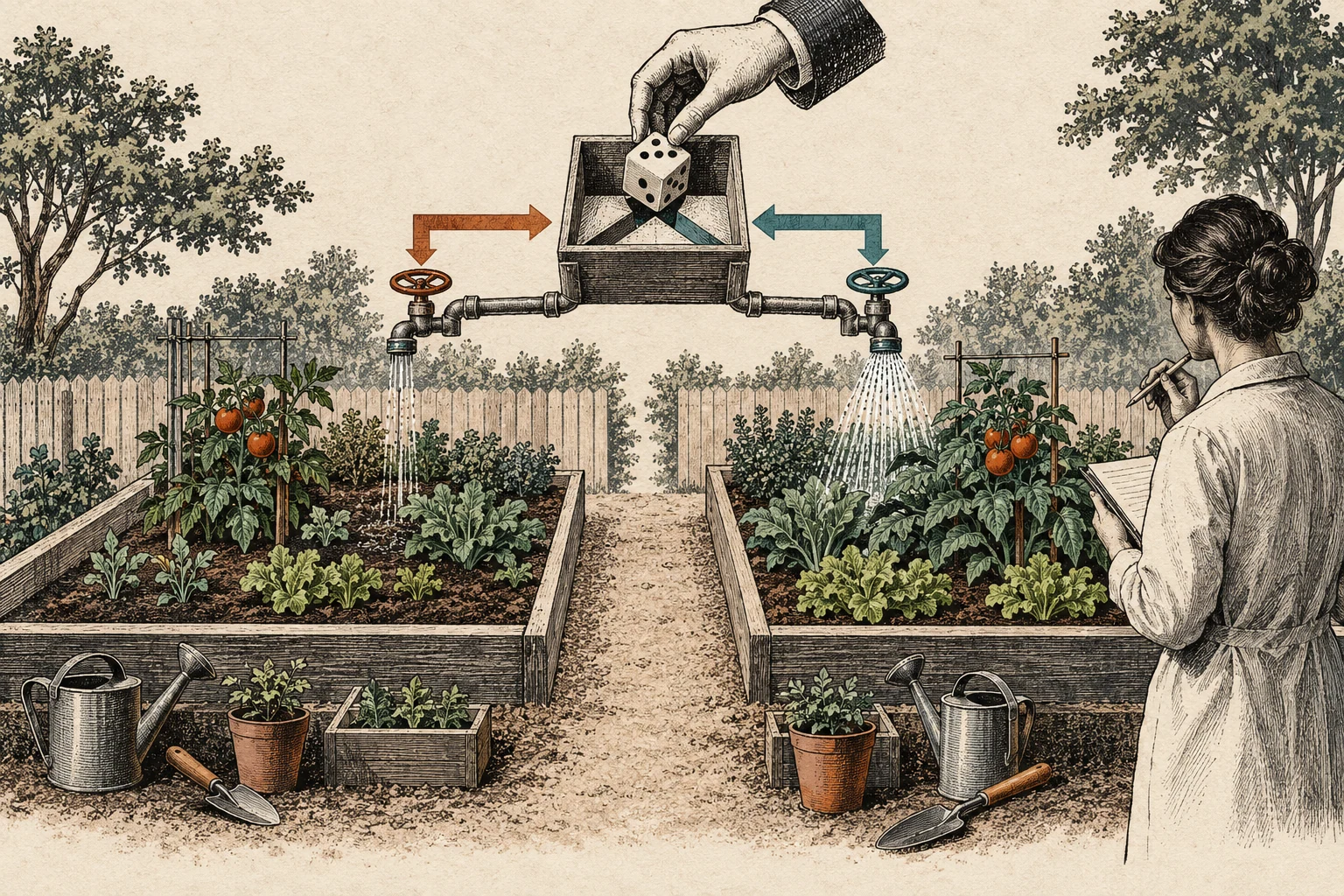
A controlled intervention helps isolate the effect of the cause under study from other differences; observing co-occurrence alone is not enough.
AI-assisted illustration · conceptual metaphor View in visual quiz →Genesis and Global Lineage
For most of the twentieth century, mainstream academic statistics—shaped by Karl Pearson, who in the 1911 edition of The Grammar of Science denounced “cause and effect” as a pre-scientific fetish and sought to replace it with contingency tables—shied away from causal vocabulary outside randomized experiments pioneered by Jerzy Neyman (1923) and Ronald A. Fisher (1925). Breaking that taboo required three independent revolutions. First, in econometrics, Trygve Haavelmo's simultaneous-equation models in the 1940s and the later “credibility revolution” of Joshua Angrist, Guido Imbens, and David Card developed quasi-experimental designs (instrumental variables, difference-in-differences, regression discontinuity) to extract causal signals from natural experiments. Second, in biostatistics and sociology, Donald B. Rubin (1974) generalized Neyman's notation into the “potential outcomes” framework (the Neyman–Rubin Causal Model), framing causation as a missing-data problem over unobservable counterfactuals. Third, in artificial intelligence, Judea Pearl in the 1990s married Bayesian networks with structural equations to create Directed Acyclic Graphs (DAGs) and the do(x) calculus. Across twentieth-century social science, these distinctions were routinely flattened into multiple regression, where researchers mistakenly believed that tossing more “control variables” into an equation automatically isolated a causal effect.
Central European Lineage
The formal mathematical foundation of the potential outcomes model was created in Polish between Bydgoszcz and Warsaw. Jerzy Spława-Neyman, trained in mathematics at Kharkov University (now Kharkiv, Ukraine) from 1912 to 1917 under probability theorist Sergei N. Bernstein, moved to newly independent Poland in 1921 to work as a statistician at the State Agricultural Research Institute (Państwowy Instytut Naukowo-Rolniczy) in Bydgoszcz. In his 1923 Polish treatise Próba uzasadnienia zastosowań rachunku prawdopodobieństwa do doświadczeń polowych (On the Application of Probability Theory to Agricultural Experiments), published in Roczniki Nauk Rolniczych and submitted toward his 1924 doctorate at the University of Warsaw, Neyman introduced a doubly indexed array of unknown “potential yields” Uij—the yield that crop variety i would produce if planted on field plot j. As Guido Imbens and Donald Rubin note, this notation was the first formal mathematical statement of potential outcomes. Neyman saw clearly that on any plot j in a single harvest, only one variety can be planted and observed, leaving alternative yields counterfactual, and derived the variance of the difference-in-means estimator under sampling without replacement. When Dorota M. Dąbrowska and Terence P. Speed translated Section 9 in Statistical Science (1990) alongside Donald B. Rubin's commentary, Rubin showed that while Neyman had transmitted the notation into English experimental theory by 1935, the 1923 Bydgoszcz paper contained the formal germ of modern counterfactual statistics half a century before Rubin extended it to observational studies in 1974.
Documented regional lineage · Links: 2. Compiled: October 2026.
-
author from the region 0 years — same text on both sides
Central European Source: Jerzy Spława-Neyman, “Próba uzasadnienia zastosowań rachunku prawdopodobieństwa do doświadczeń polowych”; Kharkov (now Kharkiv, Ukraine); Bydgoszcz and Warsaw, Poland, 1923
Global Circulation: potential outcomes model, today known as the Neyman–Rubin causal model — Jerzy Neyman, 1923
-
documented influence 67 years
Central European Source: Jerzy Spława-Neyman, “Próba uzasadnienia zastosowań rachunku prawdopodobieństwa do doświadczeń polowych (§9)”; Bydgoszcz and Warsaw, Poland, 1923
Global Circulation: Comment: Neyman (1923) and Causal Inference in Experiments and Observational Studies — Donald B. Rubin, 1990
author from the region
0 years — same text on both sidesJerzy Spława-Neyman, “Próba uzasadnienia zastosowań rachunku prawdopodobieństwa do doświadczeń polowych”
1923 · Kharkov (now Kharkiv, Ukraine); Bydgoszcz and Warsaw, Poland
potential outcomes model, today known as the Neyman–Rubin causal model
1923 · Jerzy Neyman
- Claim & Connection
- Neyman studied mathematics at Kharkov University (1912–1917), where he attended Sergei Bernstein's lectures on probability theory, and after moving to Poland in 1921 worked as a statistician at the State Agricultural Research Institute in Bydgoszcz. In his 1923 Polish paper he introduced a doubly indexed array of potential crop yields and derived the variance of the difference-in-means estimator under sampling without replacement (an urn model); Imbens and Rubin identify this notation as the first formal statement of potential outcomes. He earned his doctorate at the University of Warsaw in 1924.
- Source Documentation
-
- primary source Jerzy Splawa-Neyman, „On the Application of Probability Theory to Agricultural Experiments. Essay on Principles. Section 9”, przekład pracy z 1923 r. (Roczniki Nauk Rolniczych, t. X, Poznań 1923, s. 1–51), tł. Dorota M. Dabrowska, Terence P. Speed, Statistical Science, Vol. 5, No. 4, 1990, s. 465–472; pp. 465–470: sequence of potential yields U_ij (p. 465; eq. (13) on p. 467) and urn scheme without replacement; §9 corresponds to pp. 29–42 of the 1923 Polish original (original page numbers in square brackets). doi.org ↗
- biographical record J. J. O’Connor, E. F. Robertson, „Jerzy Neyman”, MacTutor History of Mathematics; Constance Reid, Neyman — From Life, Springer-Verlag, New York 1982; sections on studies in Kharkov, work in Bydgoszcz, and doctorate in Warsaw. mathshistory.st-andrews.ac.uk ↗
- primary source Rozporządzenie Prezydenta Rzeczypospolitej z dnia 15 lipca 1927 r. o Państwowym Instytucie Naukowym Gospodarstwa Wiejskiego, Dz.U. 1927 nr 66, poz. 586; Art. 1: “Państwowy Instytut Naukowo-Rolniczy w Bydgoszczy” among the institutions merged into PINGW; Art. 4: repeal of the decree of June 21, 1921 concerning that institute. dziennikustaw.gov.pl ↗
- biographical record Erich L. Lehmann, „Jerzy Neyman 1894–1981”, Biographical Memoirs, National Academy of Sciences, t. 63, 1994, s. 395–420; pp. 396–397: Sergei Bernstein as lecturer on probability and statistics in Kharkov. nasonline.org ↗
- scholarly study Guido W. Imbens, Donald B. Rubin, Causal Inference for Statistics, Social, and Biomedical Sciences, Cambridge University Press 2015; Ch. 2 “A Brief History of the Potential Outcomes Approach to Causal Inference,” pp. 23–30. cambridge.org ↗
- Historical Context
- Kharkov marks his university education, Bydgoszcz his agricultural experiments, and Warsaw his further work and doctoral degree. The year 1923 marks the formulation for randomized experiments; Donald B. Rubin extended the framework to observational studies in 1974. Neyman's conceptual urn model is distinct from recommending physical randomization in field layout (Fisher, 1925). Bernstein's given name is Sergei Natanovich (Lehmann 1994; Neyman's own 1967 note refers to “Serge Bernstein, my teacher in probability”).
documented influence
67 yearsJerzy Spława-Neyman, “Próba uzasadnienia zastosowań rachunku prawdopodobieństwa do doświadczeń polowych (§9)”
1923 · Bydgoszcz and Warsaw, Poland
Comment: Neyman (1923) and Causal Inference in Experiments and Observational Studies
1990 · Donald B. Rubin
- Claim & Connection
- Rubin's 1990 commentary, accompanying the English translation of Section 9, directly examines Neyman's 1923 Polish paper and its foundational significance for causal inference in both randomized experiments and observational studies. The link documents the explicit reception of the 1923 text in 1990 rather than a direct dependence of Rubin's 1974 paper on the Polish original.
- Source Documentation
-
- reception / translation Jerzy Splawa-Neyman, „On the Application of Probability Theory to Agricultural Experiments. Essay on Principles. Section 9”, tł. Dorota M. Dabrowska, Terence P. Speed, Statistical Science, Vol. 5, No. 4, 1990, s. 465–472; pp. 465–472. doi.org ↗
- reception / translation Donald B. Rubin, „Comment: Neyman (1923) and Causal Inference in Experiments and Observational Studies”, Statistical Science, Vol. 5, No. 4, 1990, s. 472–480; pp. 472–474: introduction and §2 on the earlier presence of the formalism in the statistical literature. doi.org ↗
- Historical Context
- The translation of §9 and Rubin's commentary appeared in the same issue of “Statistical Science,” 67 years after the Polish original. The delay concerns the text rather than the formalism: Rubin shows (pp. 473–474) that Neyman's 1923 notation had entered the English-language randomized-experiments literature long before 1990 (e.g., Pitman 1937, Kempthorne 1952), and Neyman himself presented it in English in 1935.
Why Now
Between 2018 and 2026, causal inference moved from a specialist methodological debate to the center of science and AI through three developments. First, Judea Pearl and Dana Mackenzie published The Book of Why (2018), popularizing the three-rung “Ladder of Causation”—Rung 1: Association (P(Y | X), passive seeing), Rung 2: Intervention (P(Y | do(X)), active doing), and Rung 3: Counterfactuals (P(Yx | x', y'), retrospective imagining)—just as “Big Data” hype claimed that raw correlations made scientific theory obsolete. Second, in October 2021, the Nobel Memorial Prize in Economic Sciences was awarded to David Card, Joshua Angrist, and Guido Imbens for analyzing causal relationships through natural experiments. Third, the rise of Large Language Models since 2022 exposed the practical boundary between Rung 1 and Rung 2: foundation models trained on next-token prediction capture high-dimensional correlational patterns, yet hallucinate causal direction, fail under distribution shifts when policies intervene in the system, and cannot separate a symptom from a cause without explicit causal scaffolding.
Explanatory Power
Causal inference explains why higher predictive accuracy can produce catastrophic policy decisions, and why blindly “controlling for everything” in a regression can manufacture a false effect (collider bias). First, in clinical AI, it resolves the hospital pneumonia paradox: models trained on health records learned that asthma lowered a pneumonia patient's risk of death and recommended sending asthmatics home. Historically, asthmatic pneumonia patients were triaged straight into intensive care, and aggressive ICU treatment lowered their mortality; using that correlation as a treatment rule confuses the effect of an intervention with baseline disease risk. Second, in labor economics, Card and Krueger's difference-in-differences comparison of fast-food restaurants across the New Jersey–Pennsylvania border isolated the causal effect of a minimum-wage hike from macroeconomic trends. Third, in digital advertising, causal models separate organic purchase intent from ad lift: users shown retargeted ads buy at high rates mainly because auctions target people already about to check out, so naive correlation wildly overstates ad effectiveness.
Axes of Debate
Structural causal graphs (Pearl) versus design-based quasi-experiments (Rubin, Angrist, Imbens)
Econometricians from the “design-based” credibility revolution (Guido Imbens, Joshua Angrist) argue that for complex social systems, researchers can rarely draw a credible complete Directed Acyclic Graph of all background variables; identification should rest on transparent, localized research designs (randomization, instrumental variables, regression discontinuities) rather than graphical algebra. Strongest counterargument: Judea Pearl and causal epidemiologists (Miguel Hernán, James Robins) reply that every quasi-experimental design relies on structural assumptions anyway (like the untestable “exclusion restriction”), and hiding those assumptions in algebraic prose rather than drawing an explicit DAG makes it easy to miss confounders or condition on a collider. Nature of the dispute: mixed — structural equation models and potential outcomes are mathematically translatable; the dispute is over which formal language makes heroic assumptions harder to smuggle past peer review.
The gold standard of Randomized Controlled Trials (RCTs) versus external validity and mechanisms
Philosopher Nancy Cartwright and economist Angus Deaton critique elevating Randomized Controlled Trials to an unquestioned “gold standard,” arguing that an RCT delivers an unbiased average treatment effect only for the specific sample and institutional environment tested, offering no automatic guarantee that the policy will work elsewhere (external validity). Strongest counterargument: Proponents of the experimental turn (Esther Duflo, Abhijit Banerjee, Michael Kremer) respond that internally valid experimental estimates, tested across multiple settings, provide a firmer foundation for cumulative knowledge than sweeping macroeconomic theories built on confounded observational regressions. Nature of the dispute: substantive — a genuine trade-off between internal validity within a sample and transportability across contexts.
“No causation without manipulation” versus immutable social attributes
Strict adherents of the Harvard potential-outcomes school (Paul Holland, Donald Rubin), following no causation without manipulation, argue that causal effects are well-defined only for variables that could in principle be assigned in an experiment—implying that speaking of the “causal effect” of race, sex, or age is mathematically ill-posed. Strongest counterargument: Sociologists (Maya Sen, Omar Wasow) show that the paradox dissolves once immutable traits are disaggregated into a “bundle of sticks” containing manipulable perceptual signals—such as randomizing racially distinctive names on identical résumés or blinding orchestra auditions behind a screen. Nature of the dispute: substantive — it forced researchers to clarify whether a study measures the effect of an institutional perception or a life-course trajectory.
Underappreciated Angle
Popular accounts celebrate causal inference as a mathematical machine for extracting certainty from messy data, yet its deepest theoretical achievement is a set of impossibility theorems—a proof of what data alone can never tell us. Judea Pearl's Ladder of Causation has the logical structure of a limitation theorem akin to Gödel's in logic: no amount of passive observational data from Rung 1, even with an infinite sample and a trillion-parameter neural network, can ever answer a Rung 2 intervention question or a Rung 3 counterfactual question unless the investigator supplies qualitative causal assumptions from outside the dataset. Equally counterintuitive is collider bias: generations of researchers were taught that “controlling for more variables” always makes a regression safer, whereas causal graph theory proves that conditioning on a common effect of two variables actively injects a phantom correlation. In an era tempted to replace scientific theory with brute-force statistical scaling, causal inference offers the hardest mathematical proof that understanding the world requires models of mechanisms, not just denser tables of co-occurrence.
One-Sentence Takeaway
Data alone can only report what happened together in the past; to know what will happen when you intervene to change the world, you must bring explicit structural assumptions that no dataset can test by itself.
Related Concepts Network
How this concept reinforces, constrains, or complements other analytical frameworks in the corpus. View on graph →
-
Applied Bayesianism complements
Bayes' rule governs how beliefs update under passive observation, whereas causal intervention calculus determines how probability distributions shift when a system is actively perturbed.
-
Survivorship bias reinforces
In the language of causal graphs, survivorship bias is a textbook instance of conditioning on a collider, which opens a spurious path of association between independent variables.
-
Falsifiability and the replication crisis reinforces
A large share of irreproducible findings in the social and biomedical sciences stems from mistaking predictive curve-fitting for the identification of a structural causal effect.
-
The map is not the territory constrains
Every causal conclusion drawn from observational data rests on a qualitative model of the world (a graph of structural assumptions) that the data alone cannot prove.
-
Goodhart’s law complements
Optimizing a proxy metric correlated with a goal fails precisely when the metric is a downstream symptom or confounded correlate rather than a causal driver of the desired outcome.
-
Scaling laws in tension
Scaling up model parameters and training corpora improves approximations of the joint observational distribution, but without structural assumptions it cannot climb to the higher rungs of the ladder of causation.
Reading Canon & Translation Bridge
Foundational texts, introductions, and critical perspectives—with availability of English and Polish editions.
-
foundational text 1974 · English
Donald B. Rubin, Estimating causal effects of treatments in randomized and nonrandomized studies
The paper that generalized Neyman's potential-outcomes notation from randomized experiments to observational studies and framed causal inference as a missing-data problem over counterfactuals.
In English: original text written in English
In Polish: no Polish edition
-
foundational text 2000 · English
Judea Pearl, Causality: Models, Reasoning, and Inference
The foundational monograph introducing structural causal models (SCMs), directed acyclic graphs (DAGs), and the do-calculus for deciding when causal effects are mathematically identifiable.
In English: original text written in English
In Polish: no Polish edition
-
introduction & synthesis 2018 · English
Judea Pearl, Dana Mackenzie, The Book of Why: The New Science of Cause and Effect
An accessible exposition of the three-rung “Ladder of Causation” (seeing, doing, imagining) and the century-long battle against a statistical orthodoxy that reduced science to correlation.
In English: original text written in English
In Polish: “Przyczyny i skutki. Rewolucyjna nauka wnioskowania przyczynowego”, Copernicus Center Press 2021, trans. Tadeusz Chawziuk
-
introduction & synthesis 2020 · English
Miguel A. Hernán, James M. Robins, Causal Inference: What If
A comprehensive epidemiology and biostatistics textbook uniting potential outcomes and causal graphs in a single framework, including time-varying treatments.
In English: original text written in English
In Polish: no Polish edition
-
cross-disciplinary 2009 · English
Joshua D. Angrist, Jörn-Steffen Pischke, Mostly Harmless Econometrics: An Empiricist's Companion
The practitioner's guide to econometrics' “credibility revolution”: instrumental variables, difference-in-differences, and regression discontinuity designs as quasi-experimental substitutes for randomization.
In English: original text written in English
In Polish: no Polish edition
-
critical perspective 2007 · English
Nancy Cartwright, Hunting Causes and Using Them: Approaches in Philosophy and Economics
A philosophical critique of methodological monism demonstrating why neither Pearl's graphs nor randomized controlled trials guarantee external validity without substantive knowledge of local mechanisms.
In English: original text written in English
In Polish: no Polish edition
-
cross-disciplinary 1748 · English
David Hume, An Enquiry Concerning Human Understanding
The classic statement of the problem of causation in Section VII, where Hume slips alongside his famous regularity definition the first explicit counterfactual definition (“if the first object had not been, the second never had existed”).
In English: original text written in English
In Polish: “Badania dotyczące rozumu ludzkiego”, Polskie Towarzystwo Filozoficzne 1928, trans. Jan Łukasiewicz, Kazimierz Twardowski
Primary-Source Quotes
These considerations imply that the slogan 'correlation does not imply causation' can be translated into a useful principle: one cannot substantiate causal claims from associations alone, even at the population level—behind every causal conclusion there must lie some causal assumption that is not testable in observational studies.