Epistemology #020
Falsifiability and the replication crisis
original term: falsifiability; replication crisis (Eng.) · falsifiability, refutability, replication crisis
Central European lineage: 3 threads (author from the region, counterpoint) · 1935–1970 · jump to documentation ↓
Working Definition
Falsifiability is the logical property of an empirical claim that allows it to be refuted by a possible observation: a hypothesis is scientific only if it forbids certain states of affairs and specifies in advance what evidence would prove it wrong. The replication crisis (where replication means repeating a study with new data and reproducibility means regenerating the result from the original data and code) is the discovery, accelerating since 2011, that a large share of published findings in psychology, preclinical medicine, and economics fail to hold up when independent researchers repeat the experiments. Both concepts converge on one operational rule: a finding nobody has tried to refute is not yet established knowledge, only a candidate for knowledge. In casual debate “falsifiability” is often wielded as a club against unwelcome theories; technically, it is a demarcation criterion that tells us whether a claim is testable, not whether it is true.
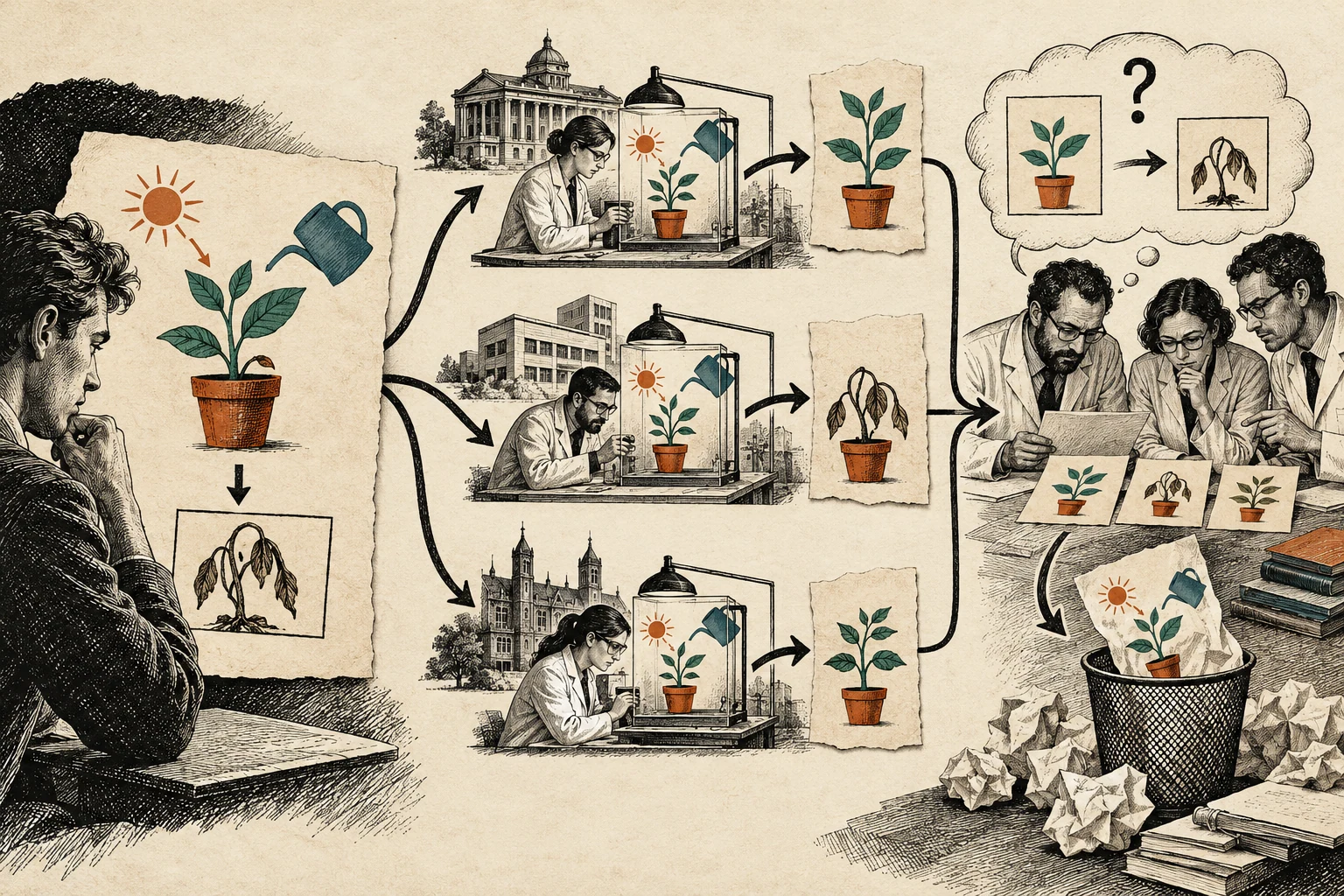
A claim is exposed to the possibility of failing a test, and independent replications check whether the result holds beyond the original study.
AI-assisted illustration · conceptual metaphor View in visual quiz →Genesis and Global Lineage
The criterion of falsifiability was formulated by Karl Popper in Logik der Forschung (1935) against the logical positivists of the Vienna Circle, who grounded scientific meaning in empirical verification. Popper inverted the problem via logical asymmetry: no number of white swans can verify “all swans are white,” whereas one black swan refutes it; science advances by bold conjectures and severe refutation attempts. Seventy years later, John P. A. Ioannidis supplied the second pillar in his 2005 PLoS Medicine paper “Why Most Published Research Findings Are False,” proving via Bayes’s theorem that when researchers test low-prior hypotheses with small samples, analytical flexibility, and publication filters rewarding p < 0.05, most published “discoveries” are false positives. Between 2011 and 2016 that warning became an empirical crisis: Joseph Simmons, Leif Nelson, and Uri Simonsohn (2011) showed how “researcher degrees of freedom” (p-hacking) turn noise into significance; the Open Science Collaboration (2015) repeated 100 psychology studies and replicated barely 36–39 percent; and a 2016 Nature survey found that over 70 percent of researchers had failed to reproduce another scientist’s experiment.
Central European Lineage
Three foundational nodes of this debate lie in Vienna, Lwów, and Debrecen. First, Karl Popper was formed entirely in interwar Vienna: born there in 1902, he studied mathematics, physics, and psychology at the University of Vienna from 1918, earned his doctorate under Karl Bühler in 1928, and wrote Logik der Forschung (Vienna: Julius Springer, 1935 imprint) in debate with the Vienna Circle of Moritz Schlick, Rudolf Carnap, and Otto Neurath. Second, in the same year — 1935 — the Polish-Jewish microbiologist Ludwik Fleck, educated at Jan Kazimierz University in Lwów (now Lviv, Ukraine), former assistant to Rudolf Weigl, and head of his own Lwów laboratory, published Entstehung und Entwicklung einer wissenschaftlichen Tatsache (Genesis and Development of a Scientific Fact), whose manuscript he had sent to Schlick in 1933. Fleck argued that a scientific fact is never a raw observation capable of refuting a theory alone, because perception is shaped by the “thought style” (Denkstil) of a “thought collective” (Denkkollektiv) — a counterpoint that reached global philosophy when Thomas Kuhn credited Fleck in the 1962 preface to The Structure of Scientific Revolutions. Third, the Hungarian philosopher Imre Lakatos — educated in Debrecen (1940–1944, PhD 1947) and Budapest, who first read Popper at the Hungarian Academy of Sciences after surviving the Recsk forced-labor camp (1950–1953) — formulated in London “sophisticated methodological falsificationism” (1970), evaluating whether a “scientific research programme” predicts novel facts or merely patches anomalies.
Documented regional lineage · Links: 3. Compiled: October 2026.
-
author from the region 0 years — same text on both sides
Central European Source: Karl Popper, “Logik der Forschung”; Vienna, Austria, 1935
Global Circulation: falsifiability as the criterion of demarcation — Karl Popper, 1935
-
counterpoint 0 years — same text on both sides
Central European Source: Ludwik Fleck, “Entstehung und Entwicklung einer wissenschaftlichen Tatsache”; Lwów (now Lviv, Ukraine), 1935
Global Circulation: falsifiability as the criterion of demarcation — Karl Popper, 1935
-
author from the region 23 years
Central European Source: Imre Lakatos, “Studies in Debrecen (1940–1944), PhD in Debrecen 1947 (doctoral studies in Budapest from 1946); work at the Mathematical Institute of the Hungarian Academy of Sciences, where he first read Popper”; Debrecen and Budapest, Hungary, 1947
Global Circulation: sophisticated methodological falsificationism and scientific research programmes — Imre Lakatos, 1970
author from the region
0 years — same text on both sidesKarl Popper, “Logik der Forschung”
1935 · Vienna, Austria
falsifiability as the criterion of demarcation
1935 · Karl Popper
- Claim & Connection
- Popper was born in Vienna, studied at the University of Vienna from 1918, earned his doctorate there in 1928 under Karl Bühler, and in Vienna — in sustained debate with the Vienna Circle — wrote “Logik der Forschung”, published by Julius Springer in Vienna with the imprint year 1935 (autumn 1934). In that book he formulated falsifiability as the criterion demarcating empirical science from non-science.
- Source Documentation
-
- biographical record Stephen Thornton, “Karl Popper”, Stanford Encyclopedia of Philosophy; §1 Life (Vienna, studies from 1918, PhD 1928); §2–3 (criterion of demarcation); Bibliography: Logik der Forschung, Wien: Julius Springer 1935. plato.stanford.edu ↗
- Historical Context
- The book appeared in late 1934 bearing the title-page date 1935; we follow the Stanford Encyclopedia of Philosophy in using 1935. Because this is the foundational global text itself, the year is identical on both sides.
counterpoint
0 years — same text on both sidesLudwik Fleck, “Entstehung und Entwicklung einer wissenschaftlichen Tatsache”
1935 · Lwów (now Lviv, Ukraine)
falsifiability as the criterion of demarcation
1935 · Karl Popper
- Claim & Connection
- Fleck, a physician and microbiologist formed in Lwów (medical degree 1922, assistant to Rudolf Weigl, head of his own bacteriological and serological laboratory from 1923), published his monograph in Basel in the exact same year as Popper’s “Logik der Forschung”, analyzing a scientific fact as the product of a thought collective and its thought style. His account challenges the assumption that an isolated observation can single-handedly refute a theory, since what counts as an observation is already shaped by a collective thought style. No evidence has been found that Fleck and Popper read each other.
- Source Documentation
-
- biographical record Wojciech Sady, “Ludwik Fleck”, Stanford Encyclopedia of Philosophy; §1 Life and Works (Lwów, MD 1922, Weigl, laboratory 1923; manuscript sent to Moritz Schlick 1933; Benno Schwabe 1935); §3–6 (thought collective and thought style); §9 (Kuhn read the book in 1949 and acknowledged it in the 1962 preface to “Structure”). plato.stanford.edu ↗
- Historical Context
- The counterpoint relation rests on the substantive tension between the two 1935 books rather than a documented personal exchange; Fleck’s documented reception ran through Thomas Kuhn (preface to “The Structure of Scientific Revolutions”, 1962).
author from the region
23 yearsImre Lakatos, “Studies in Debrecen (1940–1944), PhD in Debrecen 1947 (doctoral studies in Budapest from 1946); work at the Mathematical Institute of the Hungarian Academy of Sciences, where he first read Popper”
1947 · Debrecen and Budapest, Hungary
sophisticated methodological falsificationism and scientific research programmes
1970 · Imre Lakatos
- Claim & Connection
- Lakatos completed degrees in physics, mathematics, and philosophy in Debrecen (1944), pursued graduate work in Budapest from 1946, earned his doctorate at Debrecen in 1947, and first encountered Popper’s philosophy while working at the Mathematical Institute of the Hungarian Academy of Sciences after his release from the Recsk forced-labor camp (1950–1953). Following his emigration to Britain after the 1956 Hungarian Revolution, he formulated “sophisticated methodological falsificationism” (1970): scientists do not abandon a theory after a single refutation, but evaluate entire research programmes as progressive or degenerating.
- Source Documentation
-
- biographical record Alan Musgrave, Charles Pigden, “Imre Lakatos”, Stanford Encyclopedia of Philosophy; §1.3 (Debrecen 1940–1944, Budapest 1946, PhD 1947, Recsk, reading Popper, emigration Nov. 1956); §2.2 and §3.4 (dogmatic, naive, and sophisticated falsificationism; “Falsification and the Methodology of Scientific Research Programmes”, 1970). plato.stanford.edu ↗
- Historical Context
- Lakatos’s intellectual formation and first engagement with Popper occurred in Hungary; his canonical English-language formulation was written later at the London School of Economics.
Why Now
Between 2018 and 2026, the replication crisis evolved from scandal into scientific infrastructure. Following replication projects in psychology, cancer biology (2021), and economics, journals and funders institutionalized preregistration, open data, and Registered Reports, where peer reviewers accept or reject a study before results are known. The COVID-19 pandemic of 2020–2021 dramatized both sides at once: a flood of underpowered preprints claiming miracle cures alongside massive, preregistered platform trials (such as RECOVERY) that rapidly falsified ineffective therapies like hydroxychloroquine. Since 2022, data-fabrication scandals in behavioral research, Alzheimer’s pathology, and oncology — uncovered by independent data sleuths — have shifted debate from statistical errors to academic publishing incentives. Meanwhile, machine-learning pipelines across science since 2023 have triggered a parallel “ML reproducibility crisis,” where subtle data leakage between training and test sets produces illusory breakthroughs.
Explanatory Power
Linking Popperian falsifiability with the replication crisis separates three questions that everyday talk conflates: whether a claim is testable in principle, whether it has been severely tested, and whether that test has been independently repeated. First, it explains why a dramatic headline study with a small sample (n = 40, p = 0.04) carries far less weight than a null result from a preregistered multi-lab study: without high power and a constrained analysis plan, crossing p < 0.05 likely reflects selection noise. Second, Ioannidis’s sixth corollary explains a paradox: the “hotter” and more competitive a field is, the less likely its published findings are to be true, because competition rewards speed and striking positive claims while penalizing slow verification. Third, it clarifies what distinguishes science from its imitations in politics and business: not infallibility, but stating up front what evidence would destroy a claim and paying someone to check.
Axes of Debate
Does falsificationism describe how real science actually works?
Historians and sociologists of science following Fleck, Kuhn, and Lakatos point out that working scientists never abandon a theory after a single anomalous measurement — and rightly so, since per the Duhem–Quine thesis an experimental failure may stem from faulty instruments or auxiliary assumptions rather than a false core theory. Strongest counterargument: Popper acknowledged that no single observation compels rejection without methodological decisions, and Lakatos showed how to preserve the normative core: a research programme remains scientific as long as its adjustments predict new testable facts rather than inventing post-hoc excuses. Nature of the dispute: substantive — it concerns how to formulate demarcation when theories face experience as bundles of core laws and auxiliary hypotheses.
Systemic “crisis” vs. normal self-correcting science in action
Several methodologists and domain researchers argue that “crisis” talk is overblown and aids anti-science populists; in their view, exposing false positives through replication proves that science’s self-correction works. Strongest counterargument: Before 2011, top journals routinely refused to publish direct replications and funders refused to pay for them; a system that corrects itself only after grass-roots reformers build parallel institutions against stiff resistance was not spontaneously self-correcting. Nature of the dispute: mixed — an empirical debate over replication rates is intertwined with a strategic dispute over public trust.
Direct replication as a universal gold standard vs. contextual sensitivity in social science
Researchers studying culturally or historically embedded phenomena argue that when a study on American undergraduates in 2010 fails to replicate in Prague or Tokyo in 2024, the failure may reflect contextual variation (“hidden moderators”) rather than a false original finding. Strongest counterargument: If a claim holds only under local conditions, authors must specify those boundary conditions in advance rather than presenting a universal law and invoking “context” only after replication fails — what Popper called a conventionalist twist. Nature of the dispute: substantive — it concerns who bears the burden of specifying scope conditions and when.
Underappreciated Angle
The replication crisis is usually told as a story about statistics and incentives, rarely as a story about Ludwik Fleck’s sociology of the scientific fact. Yet Fleck in 1935 identified the mechanism behind today’s “garden of forking paths” and experimenter-expectancy effects: a shared thought style determines what counts as an observation, which anomalies are discarded as “equipment error,” and when researchers stop tweaking a protocol because the output “looks right.” Within a tight subfield, a thought collective can spend decades confirming an artifact of its own laboratory routines. Independent replication works not just because it increases sample size N, but because it changes the thought collective: a neutral team, lacking tacit investment in the original lab’s habits, runs the protocol without the micro-adjustments that kept the fragile effect alive. Consequently, while preregistration disciplines the individual researcher, only pluralism of thought styles and adversarial collaboration can test a discipline’s shared blind spots.
One-Sentence Takeaway
Science differs from ideology and folk wisdom not because its practitioners are immune to error, but because a scientific claim states in advance what evidence would prove it wrong and submits to institutions designed to go look for that evidence.
Related Concepts Network
How this concept reinforces, constrains, or complements other analytical frameworks in the corpus. View on graph →
-
Metascience reinforces
The replication crisis supplies the primary empirical material of metascience, and John Ioannidis is one of the field’s founding figures.
-
Applied Bayesianism complements
Ioannidis’s 2005 proof is a direct application of Bayes’s theorem: the probability that a statistically significant finding is true depends heavily on the prior probability of the hypothesis, not just on crossing the p < 0.05 threshold.
-
Epistemic humility reinforces
Discovering that roughly half of experimental results in leading journals fail to replicate under independent testing is the strongest institutional argument for humility toward one’s own published findings.
-
Network epistemology complements
Replication is fundamentally a network mechanism: an experimental claim becomes reliable scientific knowledge only after independent nodes in the research network verify it.
-
Matthew effect in tension
Academic reward structures that lavish grants, citations, and tenure on flashy positive findings and famous laboratories create incentives that make replication and falsification career-harming.
-
Complexity science constrains
In complex adaptive and social systems, background conditions rarely remain stationary across time and place, so a failed replication does not automatically falsify the original causal mechanism.
Reading Canon & Translation Bridge
Foundational texts, introductions, and critical perspectives—with availability of English and Polish editions.
-
foundational text 1935 · German
Karl Popper, Logik der Forschung
The foundational philosophical text: the logical asymmetry between verification and falsification, the criterion of demarcation, and the method of bold conjectures subjected to severe tests.
In English: “The Logic of Scientific Discovery”, Hutchinson 1959, trans. Karl Popper, Julius Freed, Lan Freed
In Polish: “Logika odkrycia naukowego”, Państwowe Wydawnictwo Naukowe 1977, trans. Urszula Niklas
-
foundational text 2005 · English
John P. A. Ioannidis, Why Most Published Research Findings Are False
The landmark essay in “PLoS Medicine” 2(8), e124, demonstrating from prior probabilities, statistical power, and researcher bias why most published statistically significant claims are false positives.
In English: original text written in English
In Polish: Polish edition not verified
-
critical perspective 1935 · German
Ludwik Fleck, Entstehung und Entwicklung einer wissenschaftlichen Tatsache
The scientific fact as a product of a thought collective and its thought style: shows why empirical observation is never an unmediated, theory-neutral judge.
In English: “Genesis and Development of a Scientific Fact”, University of Chicago Press 1979, trans. Fred Bradley, Thaddeus J. Trenn
In Polish: “Powstanie i rozwój faktu naukowego”, Wydawnictwo Lubelskie 1986, trans. Maria Tuszkiewicz
-
critical perspective 1970 · English
Imre Lakatos, Falsification and the Methodology of Scientific Research Programmes
Published in “Criticism and the Growth of Knowledge” (ed. Lakatos & Musgrave): explains why naive falsificationism fails to describe real science and replaces it with progressive versus degenerating research programmes.
In English: original text written in English
In Polish: “Pisma z filozofii nauk empirycznych”, Wydawnictwo Naukowe PWN 1995, trans. Wojciech Sady
-
critical perspective 1962 · English
Thomas S. Kuhn, The Structure of Scientific Revolutions
Paradigms and puzzle-solving normal science as an alternative to the Popperian logic of permanent refutation; in his preface Kuhn acknowledges his debt to Fleck’s 1935 monograph.
In English: original text written in English
In Polish: “Struktura rewolucji naukowych”, Państwowe Wydawnictwo Naukowe 1968, trans. Helena Ostromęcka
-
cross-disciplinary 2015 · English
Open Science Collaboration, Estimating the reproducibility of psychological science
One hundred replications of studies from three leading psychology journals (“Science” 349, 6251, aac4716): the empirical turning point at which the replication crisis ceased to be merely a theoretical warning.
In English: original text written in English
In Polish: no Polish edition
-
cross-disciplinary 2011 · English
Joseph P. Simmons, Leif D. Nelson, Uri Simonsohn, False-Positive Psychology: Undisclosed Flexibility in Data Collection and Analysis Allows Presenting Anything as Significant
“Psychological Science” 22(11), pp. 1359–1366: demonstrates how undisclosed “researcher degrees of freedom” push the actual false-positive rate far above the nominal 5% alpha level.
In English: original text written in English
In Polish: no Polish edition
-
introduction & synthesis 2016 · English
Monya Baker, 1,500 scientists lift the lid on reproducibility
A “Nature” survey (533, 7604, pp. 452–454) of researchers across disciplines on failed replications of others’ and their own experiments; the quickest overview of the scope of the problem.
In English: original text written in English
In Polish: no Polish edition
Primary-Source Quotes
It can be proven that most claimed research findings are false.
The hotter a scientific field (with more scientific teams involved), the less likely the research findings are to be true.