Epistemology #029
Disinformation
original term: disinformation (Eng.) · dezinformacja, dezinformatsiya, mis-/dis-/mal-information
Central European lineage: 2 threads (author from the region, historical experience) · 1964–1984 · jump to documentation ↓
Working Definition
Disinformation is false or manipulated information deliberately fabricated or disseminated to deceive an audience and inflict harm on a person, social group, institution, or state (or to secure political or financial gain). In the regulatory and research framework codified since 2017, it is defined by the intersection of falsity and intent to harm, separating it from misinformation (falsehood shared in good faith) and malinformation (genuine facts weaponized to cause harm, such as strategic leaks or doxing). In everyday speech “disinformation” is used loosely for any false claim online; technically, it is an operator-centered category requiring attribution of strategic intent or coordinated inauthentic behavior rather than merely checking whether a sentence is true. That distinction governs policy responses: correcting an honest mistake requires public communication, whereas countering a disinformation operation requires exposing the actor and disrupting its distribution infrastructure.
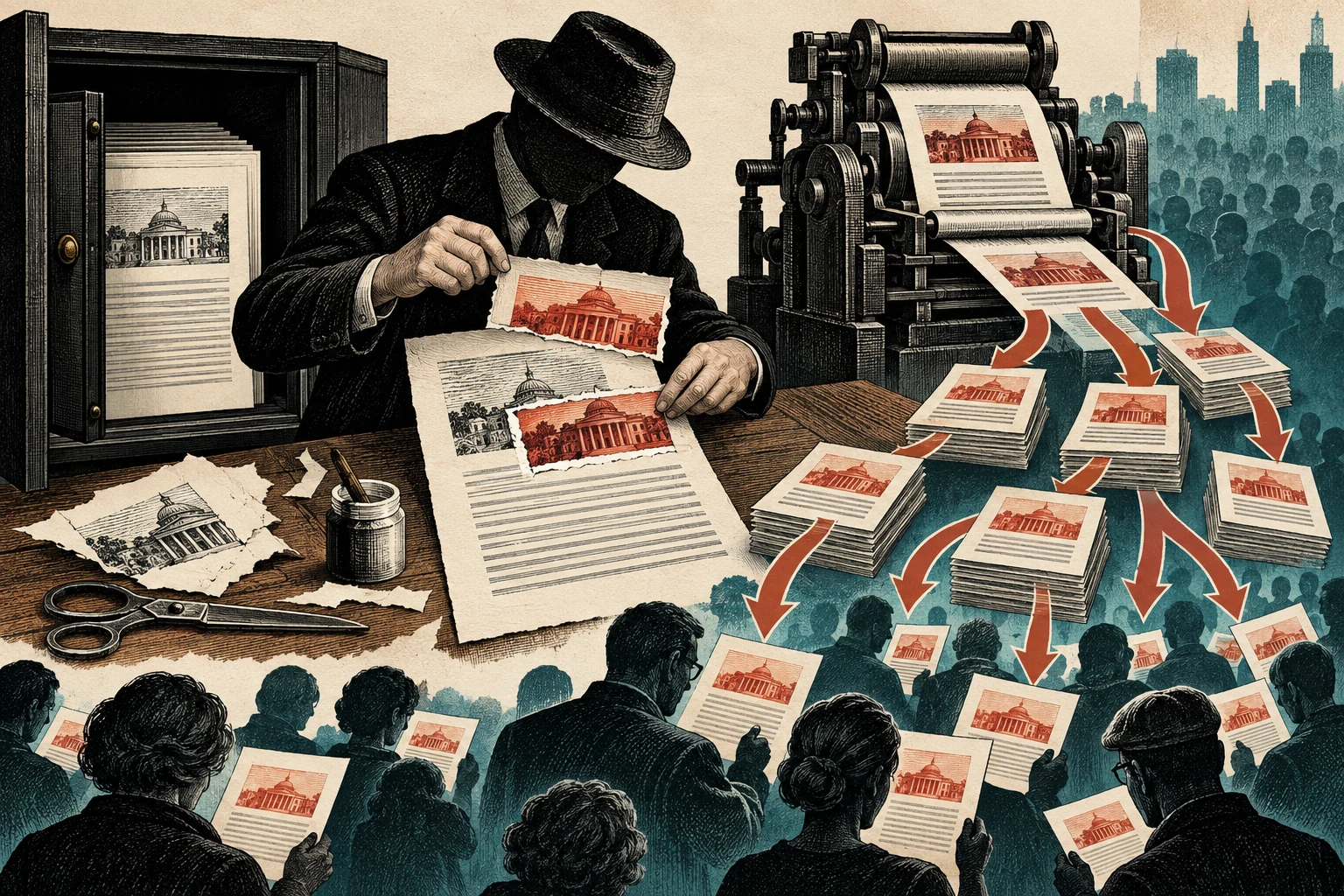
An editor knowingly alters a passage and then distributes the modified version; deliberate deception is the defining feature.
AI-assisted illustration · conceptual metaphor View in visual quiz →Genesis and Global Lineage
The concept has lived two historical lives. Its first life belongs to twentieth-century intelligence craft: the Russian term dezinformatsiya designated a branch of Soviet “active measures” (aktivnye meropriyatiya), institutionalized in specialized KGB and Warsaw Pact directorates after the Second World War and brought into Western political vocabulary in the 1970s and 1980s by Eastern-bloc intelligence defectors. In that operational tradition, disinformation was a covert campaign with a case officer, a forged document, and a target—and its highest craft consisted in planting the forgery in an independent Western newspaper so journalists would authenticate it with their own credibility. Its second life began after 2016, when the Brexit referendum and the US presidential election turned “fake news” into a global buzzword rapidly co-opted by politicians to attack critical press outlets. Seeking a more precise vocabulary, Claire Wardle and Hossein Derakhshan (in their October 2017 report for the Council of Europe) and the European Commission's High-Level Expert Group (March 2018) elevated disinformation as the anchor of a three-part taxonomy adopted by UNESCO, the EU, and major platforms. In the process, a category forged for covert intelligence operations was stretched to cover domestic partisan memes and electoral spin—turning “intent to harm” from an intelligence attribution problem into a daily moderation judgment.
Central European Lineage
One of the earliest practitioner accounts that brought the mechanics of Eastern-bloc disinformation into Western scholarship came out of Prague. Ladislav Bittman (later Lawrence Martin-Bittman) joined the Czechoslovak communist intelligence service (Státní bezpečnost, StB) in the mid-1950s, rising in 1964 to become deputy head of Department 8—the directorate for aktivní opatření (active measures and disinformation). There he organized Operation Neptune (1964), in which StB divers submerged watertight Nazi-era chests in Černé jezero (Black Lake) in the Bohemian Forest (Šumava) near the West German border and arranged for a television crew to “discover” them; the chests blended wartime records with KGB-supplied documents intended to compromise West German and Austrian politicians and force Bonn to extend the 1965 statute of limitations for Nazi war crimes. After Warsaw Pact troops crushed the Prague Spring in August 1968, Bittman defected via Vienna on September 3, 1968. In the United States, he published The Deception Game: Czechoslovak Intelligence in Soviet Political Warfare (1972) and The KGB and Soviet Disinformation (1985), and in 1986 founded the first academic Program for the Study of Disinformation at Boston University. Excerpts from The Deception Game circulated underground in Polish drugi obieg (samizdat) in 1981 as Oszukańcza gra, giving Central European dissidents an insider manual for recognizing state provocation.
Documented regional lineage · Links: 2. Compiled: October 2026.
-
historical experience 20 years
Central European Source: Podrzucenie skrzyń ze spreparowanymi „dokumentami nazistowskimi” do Czarnego Jeziora w Szumawie — Operacja Neptun (StB); Černé jezero, Šumava, Czechoslovakia (now Czechia), 1964
Global Circulation: historiography of disinformation and active measures (Shultz & Godson 1984; Rid 2020) — Richard H. Shultz, Roy Godson; Thomas Rid, 1984
-
author from the region 0 years — same text on both sides
Central European Source: Ladislav Bittman, “The Deception Game: Czechoslovak Intelligence in Soviet Political Warfare”; Prague, Czechoslovakia (now Czechia); Vienna, Austria, 1972
Global Circulation: disinformation as a deliberate, covert deception operation (insider account) — Ladislav Bittman, 1972
author from the region
0 years — same text on both sidesLadislav Bittman, “The Deception Game: Czechoslovak Intelligence in Soviet Political Warfare”
1972 · Prague, Czechoslovakia (now Czechia); Vienna, Austria
disinformation as a deliberate, covert deception operation (insider account)
1972 · Ladislav Bittman
- Claim & Connection
- Trained and employed in Czechoslovak foreign intelligence (StB) in Prague from the mid-1950s—serving in its German-Austrian section and subsequently in its active-measures (aktivní opatření) disinformation department (from 1964 as deputy chief, according to Czech biographical sources)—Bittman defected from his Vienna posting on September 3, 1968, and published in the United States the first book-length practitioner account of Eastern-bloc disinformation (1972), followed by “The KGB and Soviet Disinformation” (1985). His books are among the key channels through which the Russian term dezinformatsiya entered the English political lexicon; an underground Polish translation of excerpts from “The Deception Game” circulated in samizdat in 1981.
- Source Documentation
-
- biographical record Martin Vacek, „Ladislav Bittman stál za nejúspěšnější dezinformační akcí StB”, Ústav pro studium totalitních režimů, 18 IX 2023; paragraphs on StB training, the aktivní opatření department, Operation Neptune, the Vienna residency, and his defection on September 3, 1968. ustrcr.cz ↗
- bibliographic record Biblioteka Narodowa, rekordy: Ladislav Bittman, „The deception game: Czechoslovak intelligence in Soviet political warfare”, Syracuse University Research Corporation 1972; tenże, „Oszukańcza gra”, ED, [miejsce nieznane] 1981, 14 s., wydawnictwo nielegalne; tenże, „Mezinárodní dezinformace”, Mladá fronta 2000; MARC fields 245, 260, 500, 655. data.bn.org.pl ↗
- scholarly study Wikipedia (en), hasło „Disinformation”, sekcja o etymologii; paragraphs on the origin from Russian dezinformatsiya and the term's entry into American dictionaries in 1985, citing Bittman (1985, 1988). en.wikipedia.org ↗
- scholarly study Wikipedia (cs), hasło „Ladislav Bittman” (artykuł z adnotacją o spornej wiarygodności); career chronology: intelligence school from Sept 1, 1954; Department 4 (German-Austrian) from 1958; Berlin 1961–1963; from 1964 deputy head of Department 8 (aktivní opatření). cs.wikipedia.org ↗
- scholarly study Wikipedia (en), hasło „Ladislav Bittman”; paragraphs on Boston University (teaching from 1972, Program for the Study of Disinformation founded in 1986) and his 1972 and 1985 books. en.wikipedia.org ↗
- Historical Context
- Vienna was the site of Bittman's final posting and defection rather than his formation. The Czech Institute for the Study of Totalitarian Regimes (ÚSTR) confirms his training, service in the German-Austrian and active-measures departments, Operation Neptune, Vienna residency, and defection on Sept 3, 1968; specific dates (1954, 1964) come from the Czech Wikipedia entry and are flagged accordingly. Poland's National Library confirms the 1972, 1981 samizdat, and 2000 Czech editions. Bittman did not author today's Wardle–Derakhshan taxonomy; the link concerns the earlier operational formulation of the concept.
historical experience
20 yearsPodrzucenie skrzyń ze spreparowanymi „dokumentami nazistowskimi” do Czarnego Jeziora w Szumawie — Operacja Neptun (StB)
1964 · Černé jezero, Šumava, Czechoslovakia (now Czechia)
historiography of disinformation and active measures (Shultz & Godson 1984; Rid 2020)
1984 · Richard H. Shultz, Roy Godson; Thomas Rid
- Claim & Connection
- Operation Neptune of 1964—mounted by the active-measures department of the Czechoslovak StB with KGB participation and exposed by Bittman after his defection—serves in the scholarly literature on disinformation as the textbook case of an operation blending authentic archival records with forgeries and using independent Western press outlets as unwitting amplifiers. Its treatment in Shultz and Godson (1984) and Rid (2020) is noted for direct textual verification.
- Source Documentation
-
- scholarly study Martin Vacek, „Ladislav Bittman stál za nejúspěšnější dezinformační akcí StB”, ÚSTR, 18 IX 2023; paragraph on Operation Neptune: aims, execution, and the 1965 West German statute of limitations for Nazi war crimes. ustrcr.cz ↗
- scholarly study Wikipedia (en), hasło „Operation Neptune (espionage)”; sections on execution and sources: Bittman 1972 and 1985, Shultz and Godson “Dezinformatsia” (1984), debate over the authenticity of the submerged papers. en.wikipedia.org ↗
Why Now
Between 2018 and 2026, disinformation migrated from intelligence studies into binding European law and transatlantic conflict. Following the 2018 European Commission report, tech platforms signed the EU Code of Practice on Disinformation; strengthened in 2022, the Code was formally integrated in February 2025 into the EU Digital Services Act (DSA) as a systemic-risk mitigation standard for Very Large Online Platforms. Russia's full-scale invasion of Ukraine in February 2022 restored the word's classic operational meaning, justifying EU broadcasting bans on RT and Sputnik and exposing cross-border Doppelgänger operations that cloned European newspaper websites. Yet 2023–2025 also triggered a fierce counter-offensive in the United States: congressional investigations and lawsuits (Murthy v. Missouri, 2024) attacked academic disinformation researchers as a “censorship-industrial complex,” Stanford shuttered its Election Integrity Partnership structure, and Meta ended its third-party US fact-checking program in January 2025 in favor of Community Notes. The concept now sits at the fault line between European systemic-risk regulation and American First Amendment absolutism.
Explanatory Power
Framing disinformation around strategic intent and operational chains separates three phenomena that look identical in a social-media feed. First, an honest error in good faith (a journalist misreading a clinical preprint) calls for a transparent correction; treating it as a hostile influence operation destroys institutional trust. Second, a coordinated state or commercial campaign where the operator knows the claim is false (such as Russian narratives about “bioweapons laboratories” in Ukraine or fossil-fuel front groups manufacturing doubt about climate science) never yields to polite fact-checking, because the operator's goal is delay, polarization, and exhaustion; the effective response is infrastructural attribution—exposing the network of inauthentic accounts and cutting its distribution. Third, juxtaposing disinformation with malinformation clarifies why consequential operations like the 2016 DNC leaks used 100% authentic documents: the weapon was covert theft and strategic timing rather than textual falsity. Finally, the framework highlights status mutation along the chain: a fabrication born as deliberate disinformation in a troll factory becomes unwitting misinformation the moment an ordinary citizen shares it believing it to be true.
Axes of Debate
Intent as the defining criterion versus observable harm and behavior
European regulators, UNESCO, and Wardle's framework keep intent to deceive and harm at the center of the definition so ordinary citizens making honest mistakes are not policed alongside covert operatives. Public-health researchers and platform-safety engineers object that inner mental states are unobservable at the scale of billions of posts, arguing that enforcement should pivot to demonstrable offline harm or measurable coordinated inauthentic behavior (CIB). Strongest counterargument: Dropping intent in favor of “harmfulness” hands regulators and platforms a blank check to suppress inconvenient or heterodox truths under the banner of preventing harm; requiring evidence of coordination or fabrication constrains enforcement. Nature of the dispute: substantive — a legal and operational dilemma over what can be proven forensically without reading minds or censoring dissent.
Foreign active measures versus domestic institutional decay
Intelligence historians (Thomas Rid) trace a direct line from Cold War aktivní opatření to cyber-enabled influence operations. Political communication scholars (W. Lance Bennett, Steven Livingston, Deen Freelon, Chris Wells) counter that foreign troll farms are a convenient scapegoat: most false and disruptive narratives in Western democracies are produced domestically by elected politicians and partisan media exploiting collapsed trust in legacy institutions. Strongest counterargument: Domestic polarization supplies the dry timber, but covert operations supply the match at chosen moments; treating foreign active measures and domestic hyper-partisanship as mutually exclusive misses how modern operations piggyback on domestic fractures. Nature of the dispute: mixed — the empirical debate over relative volume is substantive, while the political temptation for elites to blame foreign actors for home-grown distrust is rhetorical.
Epistemic consumer protection versus the “censorship-industrial complex”
Civil-liberties critics and conservative movements argue that “disinformation” has become an elastic technocratic label used by officials, NGOs, and platforms to delegitimize contested political speech—on lockdowns, lab-leak hypotheses, or immigration—as a security threat. Disinformation researchers reply that this backlash is itself a political campaign to defund independent audits of platform manipulation. Strongest counterargument: Including malinformation (true information deemed harmful or out of context) inside the same regulatory family gave critics their strongest weapon: once truth is no longer a defense against being labeled “information disorder,” the boundary between counter-disinformation and speech policing becomes thin. Nature of the dispute: rhetorical — in public polemics, both camps use the word to delegitimize the other's institutional standing.
Underappreciated Angle
The most enduring lesson from Cold War practitioners like Ladislav Bittman—and the one most routinely forgotten by automated fact-checking—is that successful disinformation is rarely built out of whole-cloth lies. As Bittman explained from Prague's Department 8, an effective forgery must consist of 90% verifiable facts—real letterhead, real archival signatures, real grievances—with a 10% falsified twist inserted at the decisive joint, laundered through an independent intermediary so the target society convinces itself. Contemporary definitions that treat disinformation as “false sentences on social media” audit individual propositions while missing the laundering chain. Even more importantly, Bittman and Rid show that the primary objective of an active-measures campaign is rarely to persuade a majority of voters that proposition X is true; it is to paralyze a decision until a deadline expires, sow mutual suspicion inside a coalition, or exhaust the public into cynical passivity (hypernormalization). Measuring the impact of disinformation solely by whether citizens “believed the fake headline” measures an outcome the operator never needed to win.
One-Sentence Takeaway
Disinformation is not a stray factual error waiting for a polite correction, but a strategic operation that blends truth and forgery to manipulate a target—and any framework that forgets the operator either misses the operation or ends up policing ordinary speech.
Related Concepts Network
How this concept reinforces, constrains, or complements other analytical frameworks in the corpus. View on graph →
-
Information disorder complements
Wardle and Derakhshan's framework situates disinformation as one of three types of information disorder alongside misinformation and malinformation.
-
Post-truth in tension
Disinformation presupposes an operator who knows the truth and strategically conceals it; post-truth describes a public sphere in which factual truth has ceased to be the decisive currency.
-
Deepfake reinforces
Synthetic media lower the cost of manufacturing plausible forgeries and erode the evidentiary authority of photographic and audio records on which debunking relied.
-
Content moderation complements
Operationally distinguishing malicious intent from honest error determines whether a platform removes an account, downranks a post, or attaches a contextual label.
-
Epistemic bubbles vs. echo chambers reinforces
Closed ideological circuits lower the cost of seeding false narratives and prevent corrections from reaching audiences who have already absorbed them.
-
Hypernormalization complements
Late-stage disinformation aims not to convince citizens of a single coherent lie, but to flood the zone until no one expects public claims to correspond to reality.
-
Network epistemology constrains
Formal models of belief propagation on networks show that much of the epistemic damage attributed to malicious disinformation arises from network topology and sharing incentives rather than covert operatives.
Reading Canon & Translation Bridge
Foundational texts, introductions, and critical perspectives—with availability of English and Polish editions.
-
foundational text 2017 · English
Claire Wardle, Hossein Derakhshan, Information Disorder: Toward an Interdisciplinary Framework for Research and Policymaking
The Council of Europe report that established the contemporary policy distinction between mis-, dis-, and mal-information along the two axes of falsity and intent to harm.
In English: original text written in English
In Polish: Polish edition not verified
-
foundational text 1972 · English
Ladislav Bittman, The Deception Game: Czechoslovak Intelligence in Soviet Political Warfare
A Cold War practitioner's insider account from the Czechoslovak StB disinformation department, laying out the craft of forgeries and unwitting press placement decades before the internet; excerpts circulated in Polish underground samizdat in 1981 as “Oszukańcza gra.”
In English: original text written in English
In Polish: Polish edition not verified
-
introduction & synthesis 2020 · English
Thomas Rid, Active Measures: The Secret History of Disinformation and Political Warfare
A century-long archival history of active measures from the 1920s to modern troll farms; the best single introduction to the continuity between Cold War intelligence craft and contemporary digital operations.
In English: original text written in English
In Polish: “Wojna informacyjna”, Bellona 2022, trans. Fabian Tryl
-
critical perspective 2020 · English
Deen Freelon, Chris Wells, Disinformation as Political Communication
A review essay in “Political Communication” (37:2) taking stock of post-2016 research and highlighting how weakly documented the actual behavioral effects of disinformation campaigns remain.
In English: original text written in English
In Polish: no Polish edition
-
critical perspective 2018 · English
W. Lance Bennett, Steven Livingston, The Disinformation Order: Disruptive Communication and the Decline of Democratic Institutions
A paper in the “European Journal of Communication” (33:2) shifting explanatory weight from foreign covert operations to the domestic decay of institutional authority and mainstream gatekeeping.
In English: original text written in English
In Polish: no Polish edition
-
cross-disciplinary 2005 · English
Harry G. Frankfurt, On Bullshit
The philosophical distinction between the liar (who cares about the truth and hides it) and the bullshitter (who is indifferent to truth); exposes the blind spot of definitions built strictly around deliberate falsity.
In English: original text written in English
In Polish: “O wciskaniu kitu”, Czuły Barbarzyńca Press 2008, trans. Hanna Pustuła-Lewicka
-
introduction & synthesis 2018 · English
Cherilyn Ireton, Julie Posetti (red.), Journalism, 'Fake News' and Disinformation: Handbook for Journalism Education and Training
The UNESCO curriculum handbook that globalized Wardle's tripartite framework across journalism schools worldwide; useful as a portrait of the concept in its institutional form.
In English: original text written in English
In Polish: Polish edition not verified
Primary-Source Quotes
Dis-information. Information that is false and deliberately created to harm a person, social group, organization or country.