Epistemology #022
Legibility
original term: legibility (Eng.) · czytelność dla państwa, seeing like a state, wysoki modernizm
Central European lineage: 3 threads (documented influence) · 1944–1998 · jump to documentation ↓
Working Definition
Legibility is the property of a society, territory, or local practice that allows a distant center of power to read it at a glance: to count, name, tax, conscript, police, and plan. The concept describes not passive observation, but the active remodeling of reality so that it can be recorded: a state (or large corporation) does not merely map a forest, village, or city, but restructures it into standardized units that fit a ledger, and then governs as if the ledger were the whole reality. In James C. Scott's technical formulation, every project of making-legible is simultaneously a “thin simplification” that destroys vernacular, practical know-how (metis); in its popularized Silicon Valley version, it is often reduced to a generic “planner's failure mode,” stripping away the dimension of state coercion.
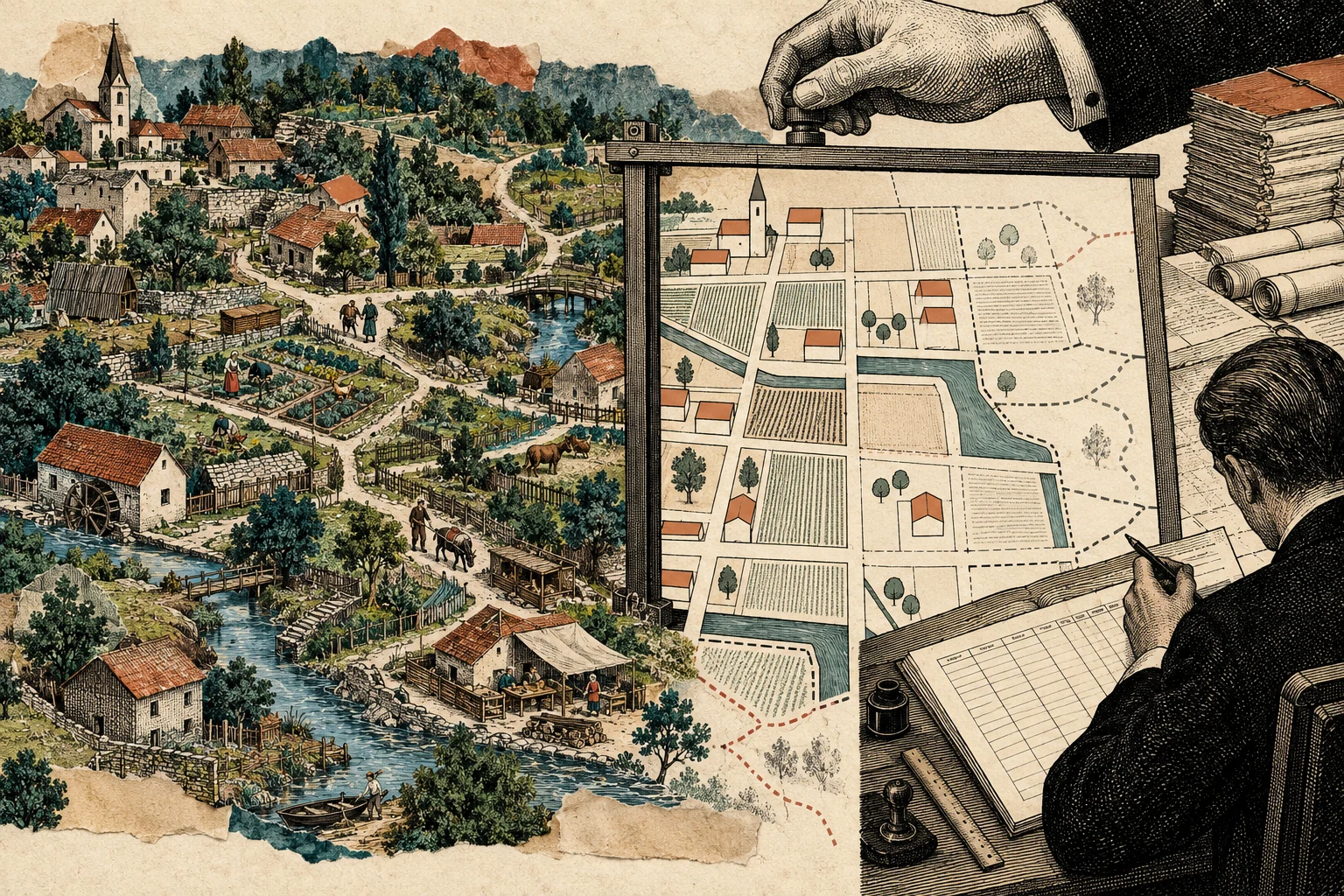
An administrative grid makes terrain easier to read and manage, but erases part of the local relationships and ways of using the place.
AI-assisted illustration · conceptual metaphor View in visual quiz →Genesis and Global Lineage
The term was introduced in this sense by the Yale political scientist and anthropologist James C. Scott in Seeing Like a State (1998), a book that grew out of his fieldwork on Southeast Asian peasantries and a deceptively simple question: why are states so relentlessly hostile to people who move around—nomads, shifting cultivators, petty traders, gypsies? Scott's answer was that mobile populations are administratively illegible. From that insight he built his four-part recipe for large-scale planning disasters: the administrative ordering of nature and society, a “high-modernist” ideology of geometric rationality, an authoritarian state willing to use coercion, and a prostrate civil society unable to resist. His case studies—eighteenth-century Prussian scientific forestry, permanent patronymic surnames, cadastral land surveys, Le Corbusier and Lúcio Costa's Brasília, Soviet forced collectivization of 1929–1933, and Julius Nyerere's ujamaa villagization in Tanzania—trace an arc from early modern cameralism through Saint-Simon to Lenin and postcolonial development agencies. After 2010, the concept was enthusiastically adopted in tech and management essays (Venkatesh Rao on Ribbonfarm, Cato Unbound), where it is frequently deployed against state regulation despite Scott's explicit insistence that large-scale corporate capitalism simplifies just as brutally.
Central European Lineage
Three documented threads in Scott's footnotes lead directly back to interwar Vienna and Budapest, where the twentieth-century debate over central planning and tacit knowledge was forged. The most prominent is Friedrich A. Hayek, educated at the University of Vienna (doctorates in 1921 and 1923) and shaped in Ludwig von Mises's Vienna seminar during the socialist calculation debate. Scott explicitly acknowledges that the epistemic case for dispersed adjustments “is most often made by proponents of laissez-faire such as Friedrich Hayek” (p. 256), pairs Hayek with the anarchist Peter Kropotkin in his conclusion (p. 344), and cites Hayek's critique of the “pretense of knowledge”—while warning in the introduction (p. 8) that his book is no apology for the free market. The second link is the Budapest-educated physician and physical chemist Michael Polanyi, whose Personal Knowledge (1958) Scott singles out in Chapter 9 as “in many ways the most searching philosophical treatment” of the practical know-how (metis) that state legibility erases (n. 22). The third is Michael's brother Karl Polanyi, a Budapest lawyer and senior editor of Der Österreichische Volkswirt in Red Vienna (1924–1933): Scott uses The Great Transformation (1944) to show that the modern market is not a “spontaneous order,” but a state-enforced project of legibility that reduces land and human labor to standardized commodities (Ch. 4, n. 106; Ch. 7, n. 112). In Central Europe, where nineteenth-century cadastral surveys arrived with partitioning empires (Prussia, Austria, Russia) and twentieth-century high modernism took the form of Soviet collectivization and socialist industrial new towns, this tension between Vienna's rival theorists was lived as material history.
Documented regional lineage · Links: 3. Compiled: October 2026.
-
documented influence 54 years
Central European Source: Karl Polanyi, “The Great Transformation”; Budapest, Austria-Hungary (now Hungary); Vienna, Austria, 1944
Global Circulation: market legibility: reducing land and labor to “factors of production” (“Seeing Like a State,” Ch. 7) — James C. Scott, 1998
-
documented influence 53 years
Central European Source: Friedrich A. Hayek, “The Use of Knowledge in Society; The Road to Serfdom; Studies in Philosophy, Economics, and Politics”; Vienna, Austria, 1945
Global Circulation: legibility and local knowledge (metis) in “Seeing Like a State” — James C. Scott, 1998
-
documented influence 40 years
Central European Source: Michael Polanyi, “Personal Knowledge: Towards a Post-Critical Philosophy”; Budapest, Austria-Hungary (now Hungary), 1958
Global Circulation: metis — practical knowledge illegible to the state (“Seeing Like a State,” Ch. 9) — James C. Scott, 1998
documented influence
53 yearsFriedrich A. Hayek, “The Use of Knowledge in Society; The Road to Serfdom; Studies in Philosophy, Economics, and Politics”
1945 · Vienna, Austria
legibility and local knowledge (metis) in “Seeing Like a State”
1998 · James C. Scott
- Claim & Connection
- Scott explicitly invokes Hayek at several points in “Seeing Like a State”: in the introduction he cautions that his critique of state planning is not a defense of unfettered market coordination “as urged by Friedrich Hayek and Milton Friedman” (p. 8); in the chapter on the planned city he acknowledges that the argument for the irreplaceability of dispersed adjustments “is most often made by proponents of laissez-faire such as Friedrich Hayek” (p. 256); in the conclusion he notes a “curiously resounding unanimity” between Hayek and Kropotkin on the impossibility of legislating for the future (p. 344); and in the notes he cites “The Road to Serfdom” and Hayek's skepticism toward the “pretense of knowledge.” Hayek was educated in Vienna (doctorates in law, 1921, and political science, 1923, at the University of Vienna) and began his work on dispersed knowledge there in Ludwig von Mises's circle.
- Source Documentation
-
- reception / translation James C. Scott, Seeing Like a State: How Certain Schemes to Improve the Human Condition Have Failed, Yale University Press, New Haven 1998; p. 8 (Introduction), p. 256 (Ch. 7), p. 344 (Conclusion); notes: p. 381 n. 51, p. 388 n. 106, p. 427 n. 34; index: “Hayek, Friedrich”. files.libcom.org ↗
- primary source F. A. Hayek, „The Use of Knowledge in Society”, American Economic Review, Vol. 35, No. 4, wrzesień 1945, s. 519–530; Part III: “knowledge of the particular circumstances of time and place”. econlib.org ↗
- biographical record Wikipedia (en), „Friedrich Hayek”; Early life / Career sections: studies at the University of Vienna (Dr. jur. 1921, Dr. rer. pol. 1923), work with Mises, Austrian Institute for Business Cycle Research. en.wikipedia.org ↗
- Historical Context
- The year 1945 in source_side refers to “The Use of Knowledge in Society” as the text closest to the concept; Scott directly cites “The Road to Serfdom” (1944) and “Studies in Philosophy, Economics, and Politics” (1967). The relationship is ambivalent: Scott adopts Hayek's epistemic premise about local knowledge while rejecting his pro-market conclusion (Ch. 7, n. 112). Page numbers follow the first Yale edition of 1998.
documented influence
40 yearsMichael Polanyi, “Personal Knowledge: Towards a Post-Critical Philosophy”
1958 · Budapest, Austria-Hungary (now Hungary)
metis — practical knowledge illegible to the state (“Seeing Like a State,” Ch. 9)
1998 · James C. Scott
- Claim & Connection
- In Chapter 9, “Thin Simplifications and Practical Knowledge: Metis,” Scott calls Michael Polanyi's “Personal Knowledge” “in many ways the most searching philosophical treatment of these issues” (n. 22). The concept of metis—practical skill that cannot be reduced to codified rules—is for Scott the exact negative of state legibility. Polanyi was educated in Budapest (medical degree 1914, doctorate in physical chemistry 1919) before emigrating to Berlin and later Manchester, where he wrote “Personal Knowledge.”
- Source Documentation
-
- reception / translation James C. Scott, Seeing Like a State, Yale University Press, New Haven 1998; Ch. 9, n. 22 (p. 426, “Notes to Pages 320–22”). files.libcom.org ↗
- bibliographic record University of Chicago Press, Michael Polanyi, Personal Knowledge: Towards a Post-Critical Philosophy (wyd. rozszerzone 2015); catalog description: first published 1958. press.uchicago.edu ↗
- biographical record Wikipedia (en), „Michael Polanyi”; Early life / Career sections: Budapest, medical diploma 1914, doctorate 1919, emigration to Berlin and later Manchester. en.wikipedia.org ↗
- Historical Context
- A single footnote, but decisive: Scott identifies Polanyi as the philosophical foundation for metis. Scott discusses the term “tacit knowledge” without attributing the coinage directly to Polanyi.
documented influence
54 yearsKarl Polanyi, “The Great Transformation”
1944 · Budapest, Austria-Hungary (now Hungary); Vienna, Austria
market legibility: reducing land and labor to “factors of production” (“Seeing Like a State,” Ch. 7)
1998 · James C. Scott
- Claim & Connection
- Scott relies twice on “The Great Transformation”: in Ch. 7, n. 112 he writes that the market imposes “its own vast simplifications” by treating land and labor as commodities, calling Karl Polanyi's book “still perhaps the best case against the pure logic of the market”; in Ch. 4, n. 106 he uses it to challenge Hayek's analogy of the market as a “spontaneous order.” Polanyi grew up and studied law in Budapest (doctorate at Kolozsvár, 1909) and worked in Vienna from 1924 to 1933 as senior editor of “Der Österreichische Volkswirt.”
- Source Documentation
-
- reception / translation James C. Scott, Seeing Like a State, Yale University Press, New Haven 1998; p. 388 n. 106 (Ch. 4); p. 412 n. 112 (Ch. 7). files.libcom.org ↗
- biographical record Wikipedia (en), „Karl Polanyi”; Early life / Career sections: Budapest, law, doctorate 1909; Vienna 1924–1933. en.wikipedia.org ↗
- bibliographic record Wikipedia (en), „The Great Transformation (book)”; first edition 1944, Farrar & Rinehart; Beacon Press edition 1957. en.wikipedia.org ↗
- Historical Context
- Scott cites the 1957 Beacon Press edition. This link extends legibility to the market rather than the state alone and acts as a counterweight to the Hayek connection.
Why Now
Between 2018 and 2026, legibility ceased to be a metaphor drawn from archival history and became the operating logic of digital governance. First, automated state scoring and welfare algorithms—China's Social Credit System pilots rolled out after 2014, the Dutch childcare benefits scandal (toeslagenaffaire) that brought down the Rutte government in January 2021, and the UK's algorithmic A-level grading fiasco of August 2020—demonstrated what happens when a bureaucracy acts on a thin statistical proxy of a citizen. Second, digital platforms constructed behavioral legibility on a scale unimaginable to any twentieth-century ministry, turning EU regulatory battles (the Digital Services Act of 2022, the AI Act of 2024) into disputes over who has the right to render whom legible. Third, the COVID-19 pandemic (2020–2022) served as a global stress test: states with clean population registries (such as Poland's PESEL or Scandinavian civic numbers) rolled out vaccines faster, yet often enforced uniform lockdown rules blind to local social conditions. Scott's death in July 2024 prompted a wave of reassessments across political science and technology studies that recognized legibility as his most enduring analytical tool.
Explanatory Power
The concept reveals that grand administrative failures rarely stem from sheer stupidity or malice; they follow structurally from how a center of power must simplify in order to see at all. Three examples illustrate its reach. First, standardized testing in education: national exams make schools legible to a ministry table, so teachers stop teaching to the concrete classroom in front of them and start teaching to the metric. Second, software engineering and legacy refactoring: a team that “cleans up” a messy legacy codebase in the name of architectural legibility often strips out undocumented workarounds encoding years of edge-case failures, producing a clean diagram that crashes in production. Third, migration policy: a state sees formal visa categories rather than kinship and informal labor networks, so tightening legible border crossings frequently drives flows into unrecorded channels where the state loses both sight and regulatory capacity. In every case, Scott's lens shifts the diagnostic question from “was the plan well-intentioned?” to “what local reality had to be blinded out for this plan to be written down?”
Axes of Debate
State versus market: who simplifies more ruthlessly
Economist Brad DeLong and libertarian contributors to the 2010 Cato Unbound symposium read Scott as an “unconscious Hayekian” who supplies devastating ammunition against state planning while shrinking from the pro-market conclusion of his own evidence. Strongest counterargument: Henry Farrell and Scott himself reply that large-scale corporate capitalism—from plantation monoculture to platform standardization—is “just as effective an agency of homogenization, uniformity, grids, and heroic simplification as the state,” and that modern markets were themselves coercively instituted by states, as Karl Polanyi demonstrated. Nature of the dispute: substantive — it concerns whether violent simplification is specific to political coercion or inherent in any organization operating at massive scale.
Thin simplification as disaster versus precondition for human welfare
Economic historians and development scholars (such as Deepak Lal and H-Net reviewers) point out that land registries, uniform weights and measures, universal vaccination rosters, and national ID numbers are also projects of state legibility—and that without them neither epidemiology nor the modern welfare state could exist. Strongest counterargument: Scott does not condemn legibility as such, but its toxic combination with high-modernist hubris, authoritarian coercion, and a silenced civil society; pointing to the benefits of clean water registries does not answer who bears the cost of simplification when local voice is excluded. Nature of the dispute: mixed — partly a substantive disagreement over historical trade-offs, partly a rhetorical caricature of what Seeing Like a State actually argues.
Metis: romantic populism or rigorous epistemology
Rational-choice theorists such as Russell Hardin argue that Soviet collectivization failed because of perverse economic incentives rather than the loss of peasant metis, charging Scott with a sentimental romanticization of folk wisdom. Strongest counterargument: Chapter 9 rests on Michael Polanyi's philosophy of science and clinical practice rather than pastoral folklore; tacit, uncodified skill is documented just as robustly in surgical theaters, aviation cockpits, and research laboratories as in peasant polyculture. Nature of the dispute: substantive — it turns on whether practical know-how is epistemically irreducible or merely awaiting formal codification.
Underappreciated Angle
The most overlooked insight in Scott's book is that legibility is ontologically irreversible. A patronymic surname imposed by a tax collector becomes, within three generations, a family's cherished identity; a cadastral survey that flattened overlapping customary land rights creates a new legal reality in which those communal rights no longer exist even in memory. Legibility is therefore not merely a distorting lens between the state and the world—it is a terraforming engine that breeds a world matching the lens. This shifts the problem from epistemology to ontology: after enough administrative cycles, there is no longer an “unspoiled” territory underneath that the map misrepresents, because the territory itself has been regrown to fit the grid. Herein lies the contemporary AI trap: the institutional datasets on which large models are trained are already the sediment of centuries of administrative simplification, and algorithmic deployment now cements those simplifications with a speed and reach no royal forestry bureau ever possessed.
One-Sentence Takeaway
A center of power cannot govern what it cannot count, so it inevitably begins remaking the living world into only those standardized units that fit its ledger.
Related Concepts Network
How this concept reinforces, constrains, or complements other analytical frameworks in the corpus. View on graph →
-
The map is not the territory reinforces
Legibility is the case in which the state does not merely confuse the map with the territory, but actively bulldozes the territory to make it match the map.
-
Goodhart’s law complements
A metric turned into a target is an administrative simplification that, once optimized, ceases to track the underlying reality—just like Scott's Prussian scientific forest.
-
Chesterton’s fence reinforces
High modernism clears away “illegible” local practices without asking why they exist; Chesterton's fence is the same epistemic caution scaled down to a single garden wall.
-
Hypernormalization complements
When the simplified official representation becomes the only language permitted in public, no one believes the legible facade, yet everyone must inhabit it.
-
Surveillance capitalism reinforces
Digital platforms have built human legibility on a scale no twentieth-century state could dream of; Scott already warned in 1998 that large-scale capitalism simplifies as brutally as bureaucracy.
-
Antifragility complements
A legible monoculture is efficient in the short run and catastrophically fragile; the messy diversity illegible to the center is the reservoir of resilience that legibility strips away.
-
Wicked problems in tension
High-modernist planning treats social life as a tame engineering puzzle; wicked-problems theory explains why Scott's grand schemes could never be “solved” once and for all.
Reading Canon & Translation Bridge
Foundational texts, introductions, and critical perspectives—with availability of English and Polish editions.
-
foundational text 1998 · English
James C. Scott, Seeing Like a State: How Certain Schemes to Improve the Human Condition Have Failed
The canonical text: from Prussian scientific forestry, permanent surnames, and cadastral maps to Brasília, Soviet collectivization, and Tanzanian ujamaa villages; Chapter 9 on metis is the key to the whole argument.
In English: original text written in English
In Polish: Polish edition not verified
-
cross-disciplinary 1945 · English
F. A. Hayek, The Use of Knowledge in Society
The economic prototype of the argument about knowledge of “the particular circumstances of time and place” that no central planner can aggregate; Scott adopts the premise and rejects the laissez-faire conclusion.
In English: original text written in English
In Polish: Polish edition not verified
-
cross-disciplinary 1958 · English
Michael Polanyi, Personal Knowledge: Towards a Post-Critical Philosophy
The philosophy of tacit knowledge that Scott identifies as the deepest treatment of metis; demanding reading, but without it legibility looks like mere administrative sociology.
In English: original text written in English
In Polish: Polish edition not verified
-
critical perspective 1944 · English
Karl Polanyi, The Great Transformation
Demonstrates that the self-regulating market was itself a project of administrative simplification imposed by the state; Scott uses this book to avoid being drafted into a defense of laissez-faire.
In English: original text written in English
In Polish: Polish edition not verified
-
critical perspective 2007 · English
Henry Farrell, DeLong, Scott and Hayek (Crooked Timber)
A concise reply to Brad DeLong's charge that Scott is a “Hayekian in denial”; Farrell argues that Scott is closer to Karl Polanyi because he studies how states forcibly construct both plans and markets.
In English: original text written in English
In Polish: no Polish edition
-
introduction & synthesis 2010 · English
James C. Scott, The Trouble with the View from Above (Cato Unbound)
An essay by the author distilling the book in a dozen pages: street names, surnames, the window tax, scientific forestry, ending with a warning that large-scale corporate capitalism simplifies just like the state.
In English: original text written in English
In Polish: no Polish edition
-
introduction & synthesis 2010 · English
Venkatesh Rao, A Big Little Idea Called Legibility (Ribbonfarm)
The essay that brought the concept into tech and management circles; its seven-step “failure mode” summary is crisp and useful, though it flattens the political coercion central to the book.
In English: original text written in English
In Polish: no Polish edition
Primary-Source Quotes
The more I examined these efforts at sedentarization, the more I came to see them as a state's attempt to make a society legible, to arrange the population in ways that simplified the classic state functions of taxation, conscription, and prevention of rebellion.
There is a curiously resounding unanimity on this point, and on no others, between such right-wing critics of the command economy as Friedrich Hayek and such left-wing critics of Communist authoritarianism as Prince Peter Kropotkin, who declared, “It is impossible to legislate for the future.”