Data brokers
original term: data brokers (Eng.) · brokerzy danych, pośrednicy danych, handel danymi osobowymi
Global-circulation concept — no documented lineage in Central Europe. jump to documentation ↓
Working Definition
A data broker is a company that collects personal information about individuals from sources other than the individuals themselves—public records, loyalty programs, mobile apps, advertising networks, and other brokers—aggregates those fragments into detailed profiles or inferences, and sells or licenses them to third parties without maintaining any direct relationship with the people profiled. Three product lines define the boundaries of the industry: marketing and audience segmentation, risk mitigation (identity verification and fraud detection), and people-search directories. In everyday speech, the term is often stretched to cover any corporation that monetizes personal data, including consumer platforms; in its precise regulatory sense, a data broker is defined by the absence of a first-party interface with the consumer, meaning there is no service relationship in which a user could meaningfully read terms or withhold consent—making structural invisibility its defining feature rather than an accidental byproduct.
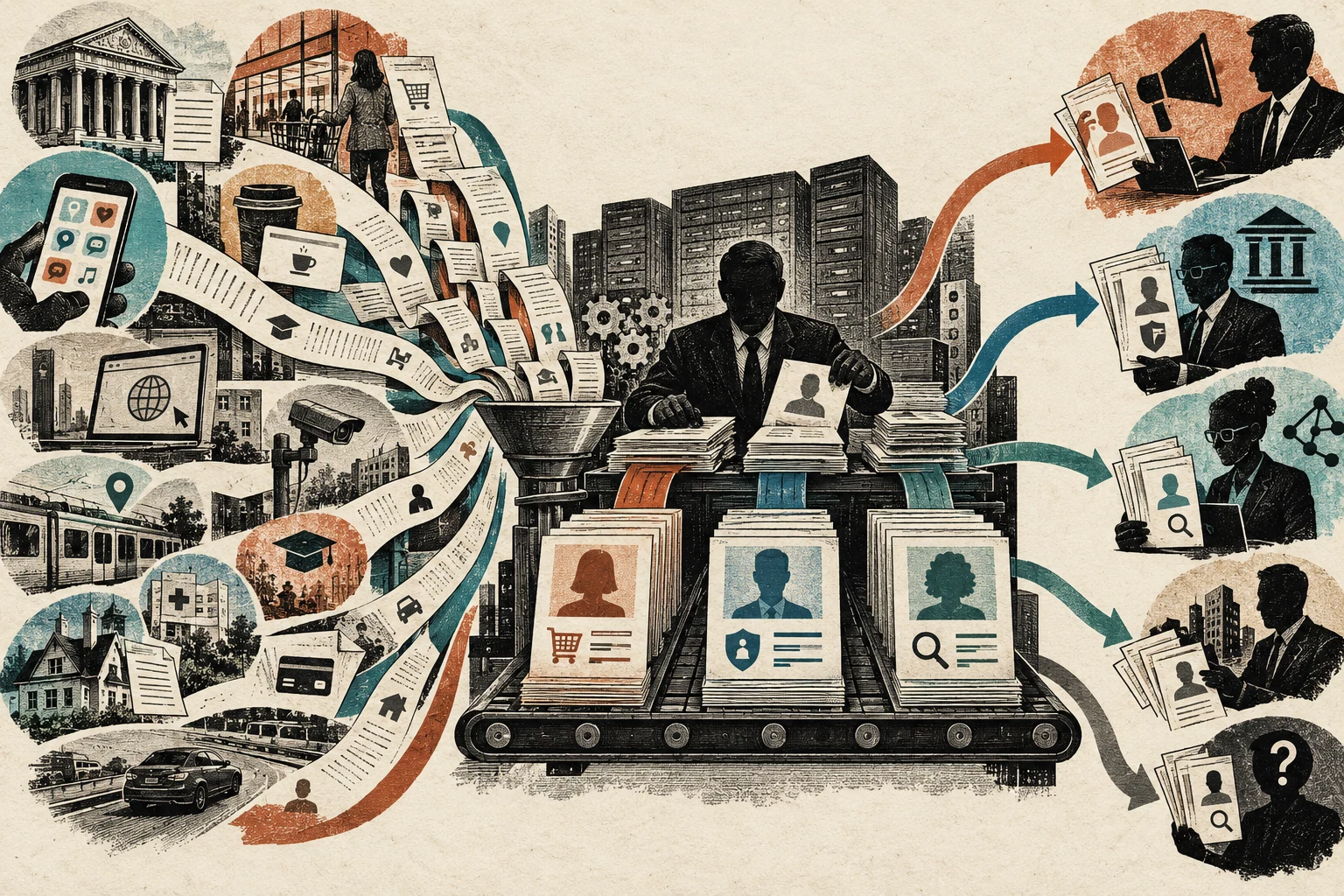
Scattered traces are stitched into profiles sold to downstream buyers, as the broker extracts commercial value from data aggregation.
AI-assisted illustration · conceptual metaphor View in visual quiz →Genesis and Global Lineage
The concept has no single founding theorist, but rather two administrative milestones. The commercial practice is decades older than the label: Acxiom was founded in 1969 to process mailing lists for direct marketing, and credit bureaus had segmented American households since the 1950s. In the 1970s and 1980s, “information broker” was a benign library-science term for a freelance research specialist who searched databases on a client’s behalf. The shift to its modern meaning was driven by regulatory investigations: beginning in 2009, the U.S. Federal Trade Commission (FTC) pressed Congress for consumer access rights; in December 2013, the Senate Commerce Committee under Jay Rockefeller published a staff report exposing industry practices; and in May 2014, the FTC released Data Brokers: A Call for Transparency and Accountability, an investigation of nine firms (Acxiom, CoreLogic, Datalogix, eBureau, ID Analytics, Intelius, PeekYou, Rapleaf, and Recorded Future) that cemented the definition used worldwide today. In Europe, the industry was confronted not through a dedicated statutory label, but through the architecture of the General Data Protection Regulation (GDPR, enacted 2016, enforced May 2018): while the GDPR never uses the phrase “data broker,” Article 14 (mandatory notice when personal data are obtained indirectly rather than from the data subject) and the strict requirement of a valid legal basis strike directly at the third-party brokerage model.
Central European Lineage
We found no documented link between this concept and the intellectual history or historical experience of Central Europe.
We found no documented link between this concept and the intellectual history or historical experience of Central Europe (by our methodology, this means “none found,” not “none exists”; as of October 2026).
Why Now
Between 2018 and 2026, data brokerage migrated from the beat of consumer privacy into the center of national security and constitutional law. The Cambridge Analytica revelations (March 2018) demonstrated how data harvested through a personality quiz taken by roughly 270,000 users could be combined with voter files and brokered records to build psychographic profiles on up to 87 million people. At the state level in the United States, Vermont enacted the first mandatory data-broker registry in 2018, followed by California in 2019 (AB 1202) and California’s landmark Delete Act (SB 362) in 2023, which mandates a single centralized portal allowing residents to demand data deletion across all registered brokers simultaneously. In parallel, investigative reporting revealed that the U.S. Department of Homeland Security, the IRS, and the FBI were purchasing commercial mobile-phone location data from brokers such as Venntel and Babel Street without judicial warrants, while in 2021 the Catholic newsletter The Pillar outed a senior church official using commercially purchased location data from the dating app Grindr. Russia’s full-scale invasion of Ukraine and escalating tensions with China added an acute geopolitical dimension: in 2024 the U.S. Congress passed the Protecting Americans’ Data from Foreign Adversaries Act, barring data brokers from selling sensitive personal data to designated foreign adversaries. In Europe, enforcement battles spearheaded by Max Schrems’s organization noyb and national data-protection authorities have targeted both traditional credit-and-marketing brokers and the real-time bidding (RTB) ad-tech ecosystem that broadcasts user profiles to hundreds of third-party bidders in milliseconds.
Explanatory Power
The concept exposes the secondary wholesale market that remains invisible when privacy is analyzed solely as a bilateral relationship between a user and an app. First, it explains why “I don’t use Facebook” offers little protection: a comprehensive dossier is assembled from payment-card transactions, property deeds, pharmacy loyalty cards, and weather-app SDKs; the FTC found in 2014 that one studied broker held3,000 data segments on nearly every U.S. consumer. Second, it illuminates the mechanism of “surveillance laundering”: a constitutional state barred from warrantless tracking simply buys the exact same tracking on the open market as a commercial subscription—exploiting a legal blind spot between criminal procedure (which binds the state) and consumer law (which assumes voluntary market transactions). Third, it shows how legally protected categories re-enter decision-making through the back door: a broker segment labeled “Expectant Parent,” “Urban Scramble,” or “Interested in Diabetes Management” is not classified by the vendor as a protected medical or racial record, yet functions identically when ingested by an insurer, landlord, or automated hiring filter.
Axes of Debate
A legitimate market to be made transparent versus an extractive model to be banned
The FTC, architects of state registry laws like California’s Delete Act, and mainstream regulatory economists treat data brokerage as a lawful industry suffering from market failure that can be corrected through transparency: public registries, audit rights, and one-click opt-out portals. Legal scholars such as Sarah Lamdan and privacy advocates counter that transparency cannot legitimize a transaction to which the profiled human was never a party, arguing for outright bans on the sale of location, health, and behavioral data and treating conglomerates like RELX and Thomson Reuters as information cartels. Strongest counterargument: Data brokers also underpin anti-fraud verification, know-your-customer (KYC) banking compliance, and public-records indexing; an uncalibrated ban on third-party data sharing would disrupt payment security and credit access, while pushing data trading into corporate subsidiaries and first-party licensing schemes. Nature of the dispute: substantive — at stake is whether notice-and-opt-out rights are operationally meaningful when consumers must police hundreds of firms they have never heard of.
Are giant platforms data brokers?
Lawmakers and journalists frequently group Google and Meta together with Acxiom and Experian because the behavioral dossiers held by big platforms dwarf those of traditional brokers. Shoshana Zuboff and advertising historians like Matthew Crain object that major platforms carefully avoid selling raw data—selling instead opaque predictions and access to user attention inside their own walled gardens—so calling them “data brokers” obscures their actual source of monopoly power. Strongest counterargument: From the standpoint of the profiled individual, the distinction between selling a raw record and selling real-time targeting access to that record is largely formal; in open real-time bidding (RTB) ad auctions, bid requests containing location and browsing context are broadcast to hundreds of external companies anyway. Nature of the dispute: mixed — the terminological dispute masks a substantive policy question over whether regulation should target the commercial transfer of data or its underlying accumulation and use.
Notice-and-consent as a redeemable tool versus a legal fiction
European digital-rights litigators (noyb, the Irish Council for Civil Liberties, and Poland’s Fundacja Panoptykon) argue that cookie banners and buried privacy policies manufacture a legal fiction of “consent,” contending that wholesale third-party data trading violates the GDPR’s core principles of purpose limitation and data minimization. Ad-tech industry groups and more cautious regulators maintain that consent frameworks can be fixed through standardized interfaces and Consent Management Platforms. Strongest counterargument: Despite slow cross-border enforcement, the GDPR’s requirement of an explicit legal basis—especially Article 14’s obligation to notify every person whose data were acquired indirectly—has proven virtually impossible for classic list brokers to satisfy lawfully when challenged in court, giving European regulators a structural lever that U.S. sectoral law still lacks. Nature of the dispute: mixed — rhetorical at the level of slogans about “user choice,” substantive at the level of burden of proof and administrative enforcement.
Underappreciated Angle
The most overlooked dimension of the data-broker industry is not the volume of data it holds, but its dismal quality. The FTC’s 2014 report devoted an entire section to pervasive inaccuracies in broker profiles: in marketing segmentation, false positives are cheap while manual verification is expensive, so erroneous inferences are rarely corrected. Public debate assumes that data brokers “know” too much about us; in practice, they frequently circulate falsehoods that the affected person cannot correct because they have no way of knowing which broker generated the score. The resulting harm is not merely the loss of secrecy, but the loss of the right to be described accurately: a rejected rental application, an inflated insurance quote, or a flagged identity check often stems from a sloppy record-linkage artifact rather than an uncomfortable truth. Here Central Europe offers an instructive structural contrast: in countries like Poland, the universal national identification number (PESEL, introduced in the late 1970s) makes deterministic record linkage across leaked or commercial databases trivial, eliminating the fuzzy name-matching errors common in the United States while making it vastly harder for a citizen to escape a linked profile once a database enters circulation. A data broker is ultimately not just a merchant of secrets, but a manufacturer of unappealable, unattributed reputation.
One-Sentence Takeaway
A data broker is not the company that knows the most about you, but the company that sells a profile of you—accurate or fabricated—to a buyer you will never meet, in a transaction to which you were never a party.
Related Concepts Network
How this concept reinforces, constrains, or complements other analytical frameworks in the corpus. View on graph →
-
Surveillance capitalism reinforces
Data brokers form the wholesale back end of surveillance capitalism: they close the loop through which behavioral traces from one service become a commodity purchasable by any outside actor.
-
Information asymmetry complements
The data broker market inverts the classic economic model: it is no longer the consumer who knows more about themselves than the seller, but the seller, insurer, or employer who buys a dossier that the data subject neither knows about nor can inspect.
-
Dark patterns reinforces
Consents extracted through manipulative dark patterns in apps and web forms supply the raw material that enters data brokerages packaged as formally “voluntary.”
-
Algorithmic bias complements
Broker segments with labels like “Urban Scramble” or “Rural and Barely Making It” smuggle ethnic and class categories into credit-scoring and ad-targeting pipelines under the guise of consumer lifestyle traits.
-
Digital sovereignty in tension
The struggle over data brokers exposes the limits of state sovereignty: citizens' personal data circulate on a global market where the government is simultaneously the regulator and one of the industry's largest paying customers.
-
Platformization constrains
Walled-garden platforms (Google, Meta, Apple) increasingly refuse to sell raw data, selling instead targeted access to profiles inside their own ecosystems—marginalizing classic third-party brokers while concentrating surveillance power.
-
Technofeudalism complements
If dominant platforms are digital fiefdoms, data brokers are the merchants and toll collectors operating in the borderlands between them; their persistence complicates claims that value extraction is fully enclosed within single cloud estates.
Reading Canon & Translation Bridge
Foundational texts, introductions, and critical perspectives—with availability of English and Polish editions.
-
foundational text 2014 · English
Federal Trade Commission, Data Brokers: A Call for Transparency and Accountability
A landmark study of nine firms (including Acxiom, Datalogix, Intelius, and PeekYou) that established the standard regulatory definition of a data broker, mapped three core product lines (marketing, risk mitigation, people search), and called for statutory transparency.
In English: original text written in English
In Polish: no Polish edition
-
foundational text 2013 · English
United States Senate, Committee on Commerce, Science, and Transportation, A Review of the Data Broker Industry: Collection, Use, and Sale of Consumer Data for Marketing Purposes
The Senate Commerce Committee staff report (the Rockefeller Report) that first publicly exposed the consumer scoring segments sold by Acxiom, Epsilon, and Experian and documented the industry's refusal to disclose its upstream data sources.
In English: original text written in English
In Polish: no Polish edition
-
introduction & synthesis 2017 · English
Wolfie Christl, Corporate Surveillance in Everyday Life. How Companies Collect, Combine, Analyze, Trade, and Use Personal Data on Billions
A Vienna Cracked Labs report offering the clearest structural map of the entire industry: from legacy brokers (Acxiom, founded in 1969) through Oracle to ad networks and credit scoring, detailing how behavioral predictions are assembled.
In English: original text written in English
In Polish: no Polish edition
-
critical perspective 2019 · English
Shoshana Zuboff, The Age of Surveillance Capitalism: The Fight for a Human Future at the New Frontier of Power
Situates data brokers within the broader logic of “behavioral surplus,” while arguing that the broker concept alone is too narrow because the most powerful platforms hoard their richest data rather than reselling it.
In English: original text written in English
In Polish: Polish edition not verified
-
critical perspective 2022 · English
Sarah Lamdan, Data Cartels: The Companies That Control and Monopolize Our Information
A law professor and librarian demonstrates how RELX (LexisNexis) and Thomson Reuters operate simultaneously as academic publishers, legal research monopolies, and commercial data brokers for police and immigration agencies, arguing they should be analyzed as information cartels.
In English: original text written in English
In Polish: Polish edition not verified
-
cross-disciplinary 2021 · English
Matthew Crain, Profit over Privacy: How Surveillance Advertising Conquered the Internet
A political-economic history of surveillance advertising since the 1990s showing that the infrastructure of commercial data trading grew out of deliberate Clinton-era regulatory choices rather than inevitable technological evolution.
In English: original text written in English
In Polish: Polish edition not verified
-
cross-disciplinary 2024 · English
Byron Tau, Means of Control: How the Hidden Alliance of Tech and Government Is Creating a New American Surveillance State
Investigative reporting by a former “Wall Street Journal” reporter detailing how U.S. federal intelligence and law-enforcement agencies purchase mobile app location data from commercial brokers to bypass Fourth Amendment warrant requirements.
In English: original text written in English
In Polish: Polish edition not verified
Primary-Source Quotes
Data brokers—companies that collect consumers’ personal information and resell or share that information with others—are important participants in this Big Data economy.